



Community hub
Recent from talks
Knowledge base stats:
Talk channels stats:
Members stats:
Eyeworth
Eyeworth (also Eyworth) is a small, rural village and civil parish in the Central Bedfordshire district of the county of Bedfordshire, England; about 12.5 miles (20 km) east south-east of the county town of Bedford.
Eyeworth had a population of 86 in 2001.
Eyeworth lies 4 miles (6 km) east of Biggleswade and 15 miles (24 km) south-west of Cambridge. The eastern parish boundary borders both Hertfordshire and Cambridgeshire at the River Rhee.
Natural England has designated the area as part of The Bedfordshire and Cambridgeshire Claylands (NCA 88). Central Bedfordshire Council has classified the landscape as Dunton Clay Vale (5G). Most of the parish is open, arable farmland with medium to large fields. Eyeworth lies on a ridge of land that forms part of the watershed between the River Ivel to the west and the Rhee to the east. Tributary streams and drainage channels run through the area. Field boundaries are primarily short flailed, gappy hedges. The limited woodland creates a very open landscape. Occasional mature hedgerow trees and roadside oaks on grass verges are a feature.
The village centre is 50 metres (164 ft) above sea level and is the highest point in the parish. The land falls away quite sharply to 30 metres (98 ft) in the east but more gradually to the west and north.
The centre and west of the parish lie on boulder clay; with gault to the east. The whole parish has lime-rich loamy and clayey soils with slightly impeded drainage.
The name is spelt Aieuuorde and Aisseuuorde in the Domesday Book. Eyeworth may mean 'island farm'. The majority of the houses are Victorian, though the seventeenth century Church Farm remains.
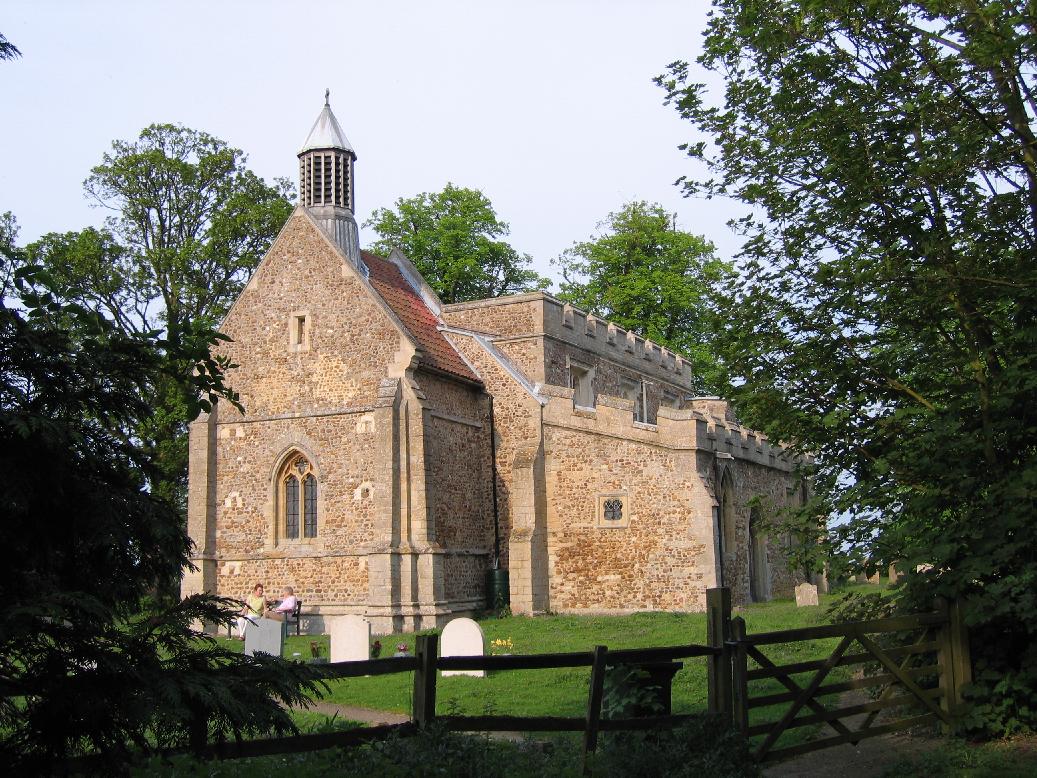
The widow of Francis Bacon, née Alice Barnham, lived in Eyeworth following his death, and she died there in 1650. There were a number of minor skirmishes in the parish during the Civil War and it is reputed that Oliver Cromwell visited the village and damaged some of the church's icons.
Hub AI
Eyeworth AI simulator
(@Eyeworth_simulator)
Eyeworth
Eyeworth (also Eyworth) is a small, rural village and civil parish in the Central Bedfordshire district of the county of Bedfordshire, England; about 12.5 miles (20 km) east south-east of the county town of Bedford.
Eyeworth had a population of 86 in 2001.
Eyeworth lies 4 miles (6 km) east of Biggleswade and 15 miles (24 km) south-west of Cambridge. The eastern parish boundary borders both Hertfordshire and Cambridgeshire at the River Rhee.
Natural England has designated the area as part of The Bedfordshire and Cambridgeshire Claylands (NCA 88). Central Bedfordshire Council has classified the landscape as Dunton Clay Vale (5G). Most of the parish is open, arable farmland with medium to large fields. Eyeworth lies on a ridge of land that forms part of the watershed between the River Ivel to the west and the Rhee to the east. Tributary streams and drainage channels run through the area. Field boundaries are primarily short flailed, gappy hedges. The limited woodland creates a very open landscape. Occasional mature hedgerow trees and roadside oaks on grass verges are a feature.
The village centre is 50 metres (164 ft) above sea level and is the highest point in the parish. The land falls away quite sharply to 30 metres (98 ft) in the east but more gradually to the west and north.
The centre and west of the parish lie on boulder clay; with gault to the east. The whole parish has lime-rich loamy and clayey soils with slightly impeded drainage.
The name is spelt Aieuuorde and Aisseuuorde in the Domesday Book. Eyeworth may mean 'island farm'. The majority of the houses are Victorian, though the seventeenth century Church Farm remains.
The widow of Francis Bacon, née Alice Barnham, lived in Eyeworth following his death, and she died there in 1650. There were a number of minor skirmishes in the parish during the Civil War and it is reputed that Oliver Cromwell visited the village and damaged some of the church's icons.