



Community hub
Recent from talks
Knowledge base stats:
Talk channels stats:
Members stats:
Fibroblast growth factor receptor 3
Fibroblast growth factor receptor 3 (FGFR-3) is a protein that in humans is encoded by the FGFR3 gene. FGFR3 has also been designated as CD333 (cluster of differentiation 333). The gene, which is located on chromosome 4, location p16.3, is expressed in tissues such as the cartilage, brain, intestine, and kidneys.
The FGFR3 gene produces various forms of the FGFR-3 protein; the location varies depending on the isoform of FGFR-3. Since the different forms are found within different tissues the protein is responsible for multiple growth factor interactions. Gain of function mutations in FGFR3 inhibits chondrocyte proliferation and underlies achondroplasia and hypochondroplasia.
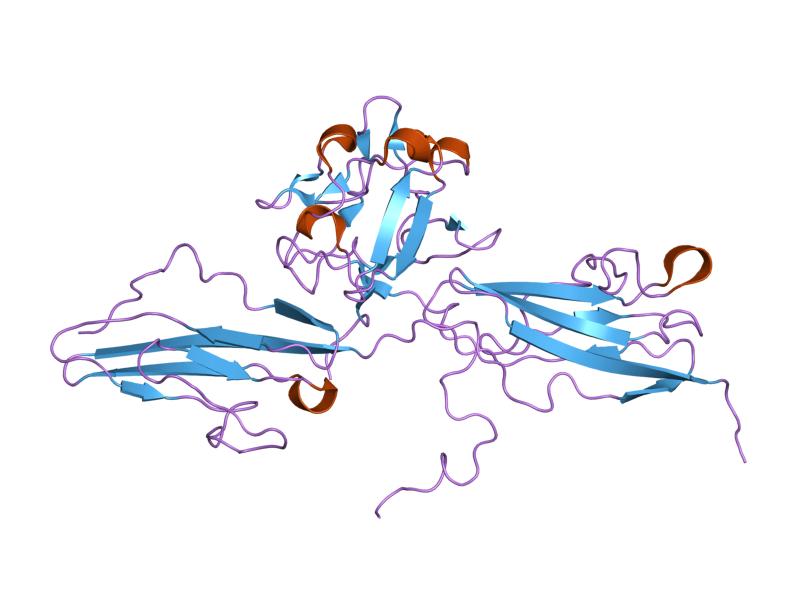
FGFR-3 is a member of the fibroblast growth factor receptor family, where amino acid sequence is highly conserved between members and throughout evolution. FGFR family members differ from one another in their ligand affinities and tissue distribution. A full-length representative protein would consist of an extracellular region, composed of three immunoglobulin-like domains, a single hydrophobic membrane-spanning segment and a cytoplasmic tyrosine kinase domain. The extracellular portion of the protein interacts with fibroblast growth factors, setting in motion a cascade of downstream signals which ultimately influence cell mitogenesis and differentiation.
This particular family member binds both acidic and basic fibroblast growth factor and plays a role in bone development and maintenance. The FGFR-3 protein plays a role in bone growth by regulating ossification. Alternative splicing occurs and additional variants have been described, including those utilizing alternate exon 8 rather than 9, but their full-length nature has not been determined.
Simplification on the mutation 46 XX 4q16.3 (female), 46XY 4q16.3 (male). Gain of function mutations in this gene can develop dysfunctional proteins "impede cartilage growth and development and affect chondrocyte proliferation and calcification" which can lead to craniosynostosis and multiple types of skeletal dysplasia (osteochondrodysplasia).
In achondroplasia, the FGFR3 gene has a missense mutation at nucleotide 1138 resulting from either a G>A or G>C. This point mutation in the FGFR3 gene causes hydrogen bonds to form between two arginine side chains leading to ligand-independent stabilization of FGFR3 dimers. Overactivity of FGFR3 inhibits chondrocyte proliferation and restricts long bone length.
FGFR3 mutations are also linked with spermatocytic tumor, which occur more frequently in older men.
Defects in the FGFR3 gene has been associated with several conditions, including craniosynostosis and seborrheic keratosis.
Hub AI
Fibroblast growth factor receptor 3 AI simulator
(@Fibroblast growth factor receptor 3_simulator)
Fibroblast growth factor receptor 3
Fibroblast growth factor receptor 3 (FGFR-3) is a protein that in humans is encoded by the FGFR3 gene. FGFR3 has also been designated as CD333 (cluster of differentiation 333). The gene, which is located on chromosome 4, location p16.3, is expressed in tissues such as the cartilage, brain, intestine, and kidneys.
The FGFR3 gene produces various forms of the FGFR-3 protein; the location varies depending on the isoform of FGFR-3. Since the different forms are found within different tissues the protein is responsible for multiple growth factor interactions. Gain of function mutations in FGFR3 inhibits chondrocyte proliferation and underlies achondroplasia and hypochondroplasia.
FGFR-3 is a member of the fibroblast growth factor receptor family, where amino acid sequence is highly conserved between members and throughout evolution. FGFR family members differ from one another in their ligand affinities and tissue distribution. A full-length representative protein would consist of an extracellular region, composed of three immunoglobulin-like domains, a single hydrophobic membrane-spanning segment and a cytoplasmic tyrosine kinase domain. The extracellular portion of the protein interacts with fibroblast growth factors, setting in motion a cascade of downstream signals which ultimately influence cell mitogenesis and differentiation.
This particular family member binds both acidic and basic fibroblast growth factor and plays a role in bone development and maintenance. The FGFR-3 protein plays a role in bone growth by regulating ossification. Alternative splicing occurs and additional variants have been described, including those utilizing alternate exon 8 rather than 9, but their full-length nature has not been determined.
Simplification on the mutation 46 XX 4q16.3 (female), 46XY 4q16.3 (male). Gain of function mutations in this gene can develop dysfunctional proteins "impede cartilage growth and development and affect chondrocyte proliferation and calcification" which can lead to craniosynostosis and multiple types of skeletal dysplasia (osteochondrodysplasia).
In achondroplasia, the FGFR3 gene has a missense mutation at nucleotide 1138 resulting from either a G>A or G>C. This point mutation in the FGFR3 gene causes hydrogen bonds to form between two arginine side chains leading to ligand-independent stabilization of FGFR3 dimers. Overactivity of FGFR3 inhibits chondrocyte proliferation and restricts long bone length.
FGFR3 mutations are also linked with spermatocytic tumor, which occur more frequently in older men.
Defects in the FGFR3 gene has been associated with several conditions, including craniosynostosis and seborrheic keratosis.