


Community hub
Recent from talks
Contribute something to knowledge base
Content stats: 0 posts, 0 articles, 1 media, 0 notes
Members stats: 0 subscribers, 0 contributors, 0 moderators, 0 supporters
Subscribers
Supporters
Contributors
Moderators
Hub AI
Craniosynostosis AI simulator
(@Craniosynostosis_simulator)
Hub AI
Craniosynostosis AI simulator
(@Craniosynostosis_simulator)
Craniosynostosis
Craniosynostosis is a condition in which one or more of the fibrous sutures in a young infant's skull prematurely fuses by turning into bone (ossification), thereby changing the growth pattern of the skull. Because the skull cannot expand perpendicular to the fused suture, it compensates by growing more in the direction parallel to the closed sutures. Sometimes the resulting growth pattern provides the necessary space for the growing brain, but results in an abnormal head shape and abnormal facial features. In cases in which the compensation does not effectively provide enough space for the growing brain, craniosynostosis results in increased intracranial pressure leading possibly to visual impairment, sleeping impairment, eating difficulties, or an impairment of mental development combined with a significant reduction in IQ.
Craniosynostosis occurs in one in 2000 births. Craniosynostosis is part of a syndrome in 15% to 40% of affected patients, but it usually occurs as an isolated condition. The term is from cranio, cranium; + syn, together; + ost, relating to bone; + osis, denoting a condition. Craniosynostosis is the opposite of metopism.
Children born with craniosynostosis have a distinct phenotype, i.e., appearance—observable traits caused by the expression of a condition's genes. The features of craniosynostosis' particular phenotype are determined by which suture is closed. The fusion of this suture causes a certain change in the shape of the skull; a deformity of the skull.
Virchow's law dictates that, when premature suture closure occurs, growth of the skull typically is restricted perpendicularly to the fused suture and enhanced in a plane parallel to it, thus trying to provide space for the fast-growing brain. Using this law, the pattern of skull deformity in craniosynostosis often may be predicted.
An illustrative example of this phenomenon is scaphocephaly, which translates from Greek as 'boat-head'; the name of the condition is suggestive of the shape of the affected skull. A synonymous term is 'dolichocephaly' (the prefix 'dolicho-' means elongated).
Premature sagittal suture closure restricts growth in a perpendicular plane, thus the head will not grow sideways and will remain narrow. This is best seen in a view standing above the child looking downward at the top of the head. Compensatory growth occurs forward at the coronal suture and backward at the lambdoid suture giving respectively a prominent forehead, called frontal bossing, and a prominent back portion of the head, called coning. This is the most common form of craniosynostosis.
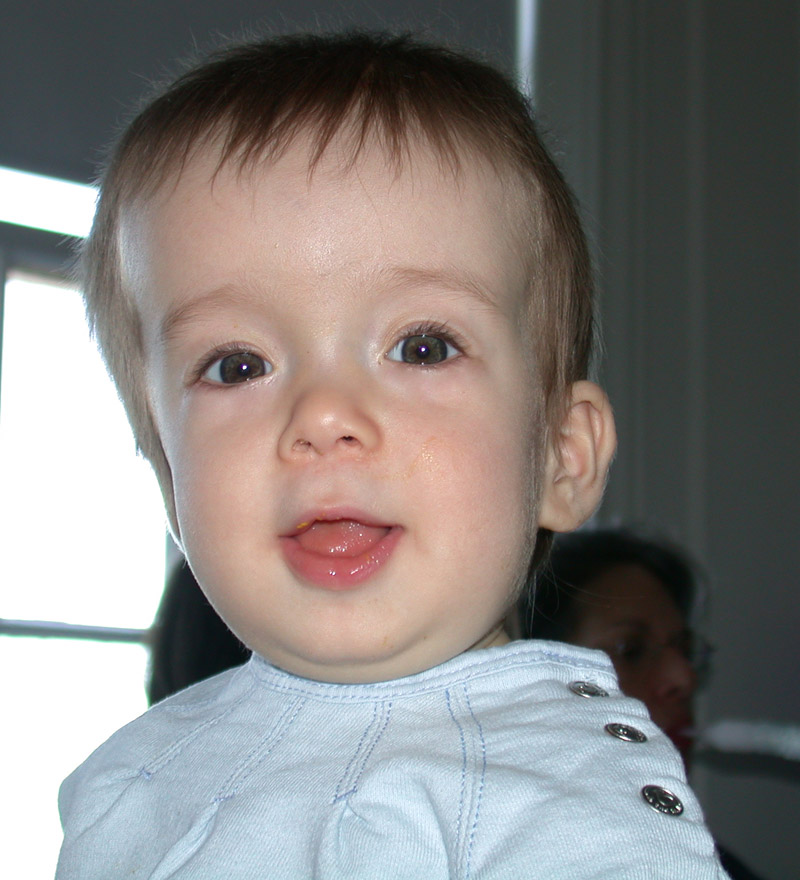
Trigonocephaly is a result from the premature closure of the metopic suture. According to Virchow's law, this fusion will result in a narrow forehead, which is even further emphasized by ridging of the suture. Compensatory growth occurs at both the coronal sutures, thereby pushing the forehead forwards. The resulting shape appears triangular from above. Like many medical terms, 'trigonocephaly' is derived from Greek, and indicates the head in question is triangular in shape. A facial feature of metopic synostosis is hypotelorism; in the frontal view, it can be seen that the width between the eyes is smaller than usual.
The Greek word πλάγιος plágios means "skew". Plagiocephaly can be subclassified as anterior plagiocephaly or posterior plagiocephaly.[citation needed]
Craniosynostosis
Craniosynostosis is a condition in which one or more of the fibrous sutures in a young infant's skull prematurely fuses by turning into bone (ossification), thereby changing the growth pattern of the skull. Because the skull cannot expand perpendicular to the fused suture, it compensates by growing more in the direction parallel to the closed sutures. Sometimes the resulting growth pattern provides the necessary space for the growing brain, but results in an abnormal head shape and abnormal facial features. In cases in which the compensation does not effectively provide enough space for the growing brain, craniosynostosis results in increased intracranial pressure leading possibly to visual impairment, sleeping impairment, eating difficulties, or an impairment of mental development combined with a significant reduction in IQ.
Craniosynostosis occurs in one in 2000 births. Craniosynostosis is part of a syndrome in 15% to 40% of affected patients, but it usually occurs as an isolated condition. The term is from cranio, cranium; + syn, together; + ost, relating to bone; + osis, denoting a condition. Craniosynostosis is the opposite of metopism.
Children born with craniosynostosis have a distinct phenotype, i.e., appearance—observable traits caused by the expression of a condition's genes. The features of craniosynostosis' particular phenotype are determined by which suture is closed. The fusion of this suture causes a certain change in the shape of the skull; a deformity of the skull.
Virchow's law dictates that, when premature suture closure occurs, growth of the skull typically is restricted perpendicularly to the fused suture and enhanced in a plane parallel to it, thus trying to provide space for the fast-growing brain. Using this law, the pattern of skull deformity in craniosynostosis often may be predicted.
An illustrative example of this phenomenon is scaphocephaly, which translates from Greek as 'boat-head'; the name of the condition is suggestive of the shape of the affected skull. A synonymous term is 'dolichocephaly' (the prefix 'dolicho-' means elongated).
Premature sagittal suture closure restricts growth in a perpendicular plane, thus the head will not grow sideways and will remain narrow. This is best seen in a view standing above the child looking downward at the top of the head. Compensatory growth occurs forward at the coronal suture and backward at the lambdoid suture giving respectively a prominent forehead, called frontal bossing, and a prominent back portion of the head, called coning. This is the most common form of craniosynostosis.
Trigonocephaly is a result from the premature closure of the metopic suture. According to Virchow's law, this fusion will result in a narrow forehead, which is even further emphasized by ridging of the suture. Compensatory growth occurs at both the coronal sutures, thereby pushing the forehead forwards. The resulting shape appears triangular from above. Like many medical terms, 'trigonocephaly' is derived from Greek, and indicates the head in question is triangular in shape. A facial feature of metopic synostosis is hypotelorism; in the frontal view, it can be seen that the width between the eyes is smaller than usual.
The Greek word πλάγιος plágios means "skew". Plagiocephaly can be subclassified as anterior plagiocephaly or posterior plagiocephaly.[citation needed]
Recent media
Recent media