



Community hub
Recent from talks
Knowledge base stats:
Talk channels stats:
Members stats:
Faber–Evans model
The Faber–Evans model for crack deflection, is a fracture mechanics-based approach to predict the increase in toughness in two-phase ceramic materials due to crack deflection. The effect is named after Katherine Faber and her mentor, Anthony G. Evans, who introduced the model in 1983. The Faber–Evans model is a principal strategy for tempering brittleness and creating effective ductility.
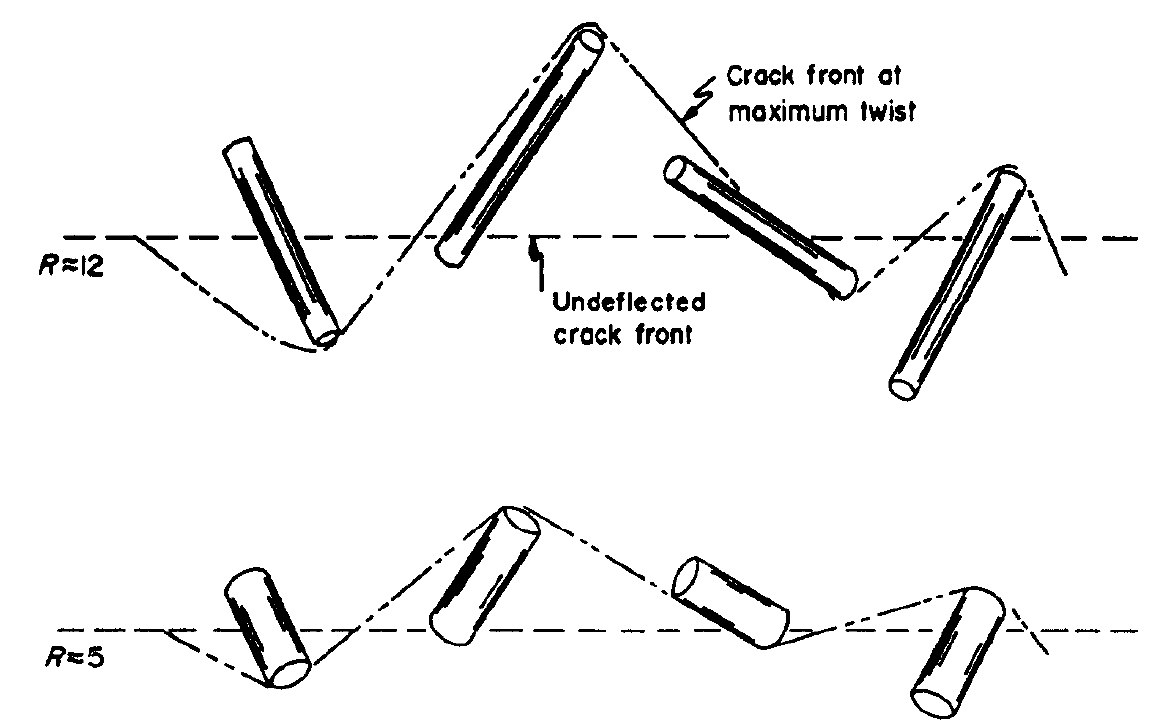
Fracture toughness is a critical property of ceramic materials, determining their ability to resist crack propagation and failure. The Faber model considers the effects of different particle morphologies, including spherical, rod-shaped, and disc-shaped particles, and their influence on the driving force at the tip of a tilted and/or twisted crack. The model first suggested that rod-shaped particles with high aspect ratios are the most effective morphology for deflecting propagating cracks and increasing fracture toughness, primarily due to the twist of the crack front between particles. The findings provide a basis for designing high-toughness two-phase ceramic materials, with a focus on optimizing particle shape and volume fraction.
Fracture mechanics is a fundamental discipline for understanding the mechanical behavior of materials, particularly in the presence of cracks. The critical parameter in fracture mechanics is the stress intensity factor (K), which is related to the strain energy release rate (G) and the fracture toughness (Gc). When the stress intensity factor reaches the material's fracture toughness, crack propagation becomes unstable, leading to failure.
In two-phase ceramic materials, the presence of a secondary phase can lead to crack deflection, a phenomenon where the crack path deviates from its original direction due to interactions with the second-phase particles. Crack deflection can lead to a reduction in the driving force at the crack tip, increasing the material's fracture toughness. The effectiveness of crack deflection in enhancing fracture toughness depends on several factors, including particle shape, size, volume fraction, and spatial distribution.
The study presents weighting functions, F(θ), for the three particle morphologies, which describe the distribution of tilt angles (θ) along the crack front:
The weighting functions are used to determine the net driving force on the tilted crack for each morphology. The relative driving force for spherical particles is given by:
where and prescribes the strain energy release rate only for that portion of the crack front which tilts. To characterize the entire crack front at initial tilt, must be qualified by the fraction of the crack length intercepted and superposed on the driving force that derives from the remaining undeflected portion of the crack. The resultant toughening increment, derived directly from the driving forces, is given by:


where represents the fracture toughness of the matrix material without the presence of any reinforcing particles, is the volume fraction of spheres, relates the rod length to its radius, , and is the ratio of the disc radius, , to its thickness, .


Hub AI
Faber–Evans model AI simulator
(@Faber–Evans model_simulator)
Faber–Evans model
The Faber–Evans model for crack deflection, is a fracture mechanics-based approach to predict the increase in toughness in two-phase ceramic materials due to crack deflection. The effect is named after Katherine Faber and her mentor, Anthony G. Evans, who introduced the model in 1983. The Faber–Evans model is a principal strategy for tempering brittleness and creating effective ductility.
Fracture toughness is a critical property of ceramic materials, determining their ability to resist crack propagation and failure. The Faber model considers the effects of different particle morphologies, including spherical, rod-shaped, and disc-shaped particles, and their influence on the driving force at the tip of a tilted and/or twisted crack. The model first suggested that rod-shaped particles with high aspect ratios are the most effective morphology for deflecting propagating cracks and increasing fracture toughness, primarily due to the twist of the crack front between particles. The findings provide a basis for designing high-toughness two-phase ceramic materials, with a focus on optimizing particle shape and volume fraction.
Fracture mechanics is a fundamental discipline for understanding the mechanical behavior of materials, particularly in the presence of cracks. The critical parameter in fracture mechanics is the stress intensity factor (K), which is related to the strain energy release rate (G) and the fracture toughness (Gc). When the stress intensity factor reaches the material's fracture toughness, crack propagation becomes unstable, leading to failure.
In two-phase ceramic materials, the presence of a secondary phase can lead to crack deflection, a phenomenon where the crack path deviates from its original direction due to interactions with the second-phase particles. Crack deflection can lead to a reduction in the driving force at the crack tip, increasing the material's fracture toughness. The effectiveness of crack deflection in enhancing fracture toughness depends on several factors, including particle shape, size, volume fraction, and spatial distribution.
The study presents weighting functions, F(θ), for the three particle morphologies, which describe the distribution of tilt angles (θ) along the crack front:
The weighting functions are used to determine the net driving force on the tilted crack for each morphology. The relative driving force for spherical particles is given by:
where and prescribes the strain energy release rate only for that portion of the crack front which tilts. To characterize the entire crack front at initial tilt, must be qualified by the fraction of the crack length intercepted and superposed on the driving force that derives from the remaining undeflected portion of the crack. The resultant toughening increment, derived directly from the driving forces, is given by:
where represents the fracture toughness of the matrix material without the presence of any reinforcing particles, is the volume fraction of spheres, relates the rod length to its radius, , and is the ratio of the disc radius, , to its thickness, .