Hubbry Logo
Face detectionFace detectionMain
Open search
Face detection
Community hub
Face detection
logo
8 pages, 0 posts
0 subscribers
Be the first to start a discussion here.
Face detection
Face detection
from Wikipedia
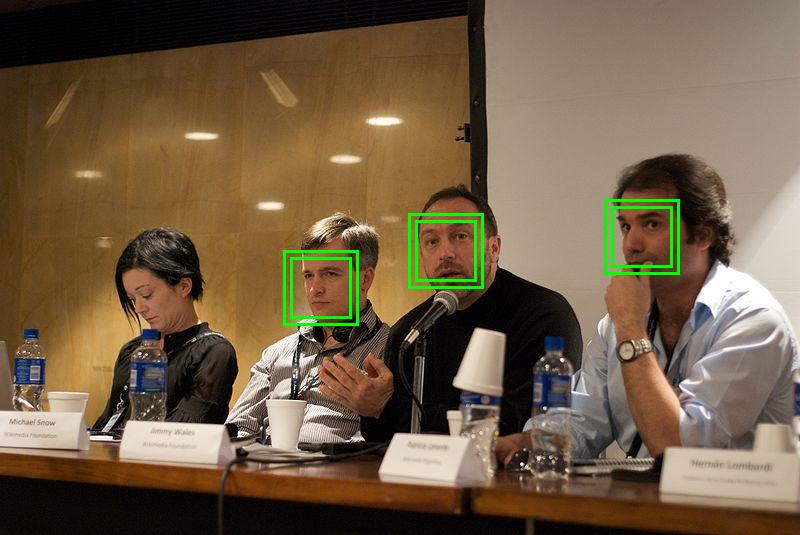
Automatic face detection with OpenCV

Face detection is a computer technology being used in a variety of applications that identifies human faces in digital images.[1] Face detection also refers to the psychological process by which humans locate and attend to faces in a visual scene.[2]

[edit]

Face detection can be regarded as a specific case of object-class detection. In object-class detection, the task is to find the locations and sizes of all objects in an image that belong to a given class. Examples include upper torsos, pedestrians, and cars. Face detection simply answers two question, 1. are there any human faces in the collected images or video? 2. where is the face located?

Face-detection algorithms focus on the detection of frontal human faces. It is analogous to image detection in which the image of a person is matched bit by bit. Image matches with the image stores in database. Any facial feature changes in the database will invalidate the matching process.[3]

A reliable face-detection approach based on the genetic algorithm and the eigen-face[4] technique:

Firstly, the possible human eye regions are detected by testing all the valley regions in the gray-level image. Then the genetic algorithm is used to generate all the possible face regions which include the eyebrows, the iris, the nostril and the mouth corners.[3]

Each possible face candidate is normalized to reduce both the lighting effect, which is caused by uneven illumination; and the shirring effect, which is due to head movement. The fitness value of each candidate is measured based on its projection on the eigen-faces. After a number of iterations, all the face candidates with a high fitness value are selected for further verification. At this stage, the face symmetry is measured and the existence of the different facial features is verified for each face candidate.[citation needed]

Applications

[edit]

Facial motion capture

[edit]

Facial recognition

[edit]

Face detection is used in biometrics, often as a part of (or together with) a facial recognition system. It is also used in video surveillance, human computer interface and image database management.

Photography

[edit]

Some recent digital cameras use face detection for autofocus.[5] Face detection is also useful for selecting regions of interest in photo slideshows that use a pan-and-scale Ken Burns effect.

Modern appliances also use smile detection to take a photograph at an appropriate time.

Marketing

[edit]

Face detection is gaining the interest of marketers. A webcam can be integrated into a television and detect any face that walks by. The system then calculates the race, gender, and age range of the face. Once the information is collected, a series of advertisements can be played that is specific toward the detected race/gender/age.

An example of such a system is OptimEyes and is integrated into the Amscreen digital signage system.[6] [7]

Emotional Inference

[edit]

Face detection can be used as part of a software implementation of emotional inference. Emotional inference can be used to help people with autism understand the feelings of people around them.[8]

AI-assisted emotion detection in faces has gained significant traction in recent years, employing various models to interpret human emotional states. OpenAI's CLIP model[9] exemplifies the use of deep learning to associate images and text, facilitating nuanced understanding of emotional content. For instance, combined with a network psychometrics approach, the model has been used to analyze political speeches based on changes in politicians' facial expressions.[10] Research generally highlights the effectiveness of these technologies, noting that AI can analyze facial expressions (with or without vocal intonations and written language) to infer emotions, although challenges remain in accurately distinguishing between closely related emotions and understanding cultural nuances.[11]

Lip Reading

[edit]

Face detection is essential for the process of language inference from visual cues. Automated lip reading has applications to help computers determine who is speaking which is needed when security is important.

See also

[edit]

References

[edit]
[edit]
Revisions and contributorsEdit on WikipediaRead on Wikipedia
from Grokipedia
Face detection is a fundamental problem in computer vision that involves developing algorithms to automatically locate and delineate human faces within static images or video frames, often as a preprocessing step for tasks such as facial recognition and expression analysis. This capability relies on distinguishing facial regions from background clutter using features like edges, textures, and geometric patterns inherent to human visages. Pioneering work in the field emphasized handcrafted features and machine learning classifiers, with the 2001 Viola-Jones algorithm marking a breakthrough by enabling real-time detection through Haar-like feature cascades, integral image computations for rapid feature evaluation, and AdaBoost for weak classifier selection, achieving practical speeds on commodity processors. This method's efficiency stemmed from sequential rejection of non-face regions, minimizing computational overhead while maintaining detection accuracy on frontal faces under controlled conditions. Contemporary approaches leverage deep convolutional neural networks (CNNs), which learn hierarchical representations directly from data, surpassing traditional methods in handling challenges like pose variations, occlusions, and illumination changes, as evidenced by high performance on benchmarks such as WIDER FACE. These neural architectures, often integrated with multi-task learning for joint detection and alignment, power applications in surveillance, biometric authentication, and augmented reality, though persistent issues include dataset biases affecting cross-demographic generalization and computational demands for deployment on edge devices.

Fundamentals

Definition and Core Concepts

Face detection is the computational task in computer vision of identifying and localizing human faces within digital images or video frames, determining their presence, positions, and approximate sizes. This process typically outputs rectangular bounding boxes around detected faces to specify regions of interest (ROIs), enabling subsequent analysis while distinguishing facial regions from complex backgrounds. Unlike broader object detection, face detection exploits inherent structural regularities of human faces, such as bilateral symmetry and key landmarks (e.g., eyes, nose, mouth), to achieve robustness across input variations. Core concepts revolve around handling intrinsic variabilities in face appearance, including scale differences due to distance from the camera, pose orientations (frontal to profile), and illumination changes that alter pixel intensities. Detection algorithms must process arbitrary scenes containing zero or multiple faces, often in real-time for applications like video surveillance, necessitating efficient verification to minimize false positives from non-facial patterns resembling faces. Fundamental principles emphasize segmentation of facial features from clutter, extraction of discriminative patterns, and validation against human-like criteria, forming a front-end step for tasks requiring facial data isolation. In practice, face detection operates on grayscale or color inputs, prioritizing causal factors like geometric constraints over superficial similarities, with performance metrics such as detection rate (true positives over total faces) and false alarm rate quantifying efficacy on benchmark datasets. Advances have shifted toward data-driven models trained on millions of annotated examples, yet core challenges persist in occluded or low-resolution scenarios, underscoring the need for invariant feature representations.

Distinction from Face Recognition

Face detection involves the algorithmic identification of regions within an image or video that contain human faces, typically outputting bounding boxes or coordinates to delineate their location and presence, irrespective of the individual's identity. This process focuses on distinguishing facial patterns from non-facial elements using features such as edge contrasts, texture, or holistic configurations like the triangular arrangement of eyes, nose, and mouth. In distinction, face recognition extends beyond mere localization by extracting and comparing unique biometric signatures—such as geometric ratios of facial landmarks or pixel intensity distributions—from the detected face to match against a gallery of known identities or perform verification. The two processes differ fundamentally in scope and complexity: detection is a localization task akin to object detection in computer vision, evaluated via metrics like precision-recall curves or intersection-over-union for bounding box accuracy, and it does not require prior knowledge of identities. Face recognition, however, constitutes a classification or one-to-many matching problem, often employing subspace methods (e.g., eigenfaces) or metric learning to achieve identity discrimination, with performance measured by false acceptance/rejection rates in controlled benchmarks like those from NIST's Face Recognition Vendor Tests. Detection serves as a prerequisite for recognition in most pipelines, as erroneous localization propagates errors to subsequent identity analysis, though standalone detection suffices for applications like crowd counting or gaze estimation without identity needs. Algorithmically, classical detection methods, such as Viola-Jones cascades relying on Haar-like features for rapid scanning, prioritize speed and robustness to pose variations but yield coarse outputs unsuitable for fine-grained identity tasks. Recognition algorithms, by contrast, demand higher invariance to illumination, occlusion, and expression, often integrating detection outputs into deeper models like convolutional neural networks trained on labeled identity datasets, highlighting the causal dependency where detection enables but does not encompass recognition. This delineation underscores detection's role as a modular, lower-level primitive in biometric systems, separable from the higher-level inference of recognition.

Historical Development

Early Research and Milestones (Pre-2000)

The initial computational efforts toward automated face detection in the 1960s and 1970s were rudimentary and often semi-automated, requiring human intervention to identify key facial landmarks such as eyes and mouth before applying simple geometric or template-based matching; these approaches, exemplified by Woodrow Bledsoe's work on feature extraction for biometric matching, laid foundational concepts but lacked full automation due to limited processing power. Fully automated detection gained traction in the late 1980s and 1990s within computer vision research, driven by advances in image processing and the need for preprocessing in face recognition systems. Early algorithms focused on single static images under controlled conditions, addressing challenges like pose variation, lighting, and clutter through handcrafted rules or statistical models. Pioneering template-matching methods, one of the earliest categories, involved correlating predefined face or feature templates with image regions; Sakai et al. (1972) introduced subtemplates for eyes, nose, and mouth to localize potential faces via a focus-of-attention mechanism, achieving initial success on grayscale photographs but struggling with scale and orientation changes. In the 1990s, knowledge-based approaches formalized human-like heuristics, such as vertical symmetry and relative feature positions; Govindaraju et al. (1990) developed a system to detect upright frontal faces in newspaper images using edge projections and geometric constraints between eyes and nose, reporting detection rates above 90% on structured text-heavy scenes. Yang and Huang (1994) extended this with a multiresolution hierarchy of rules, successfully identifying faces in 50 out of 60 complex images while noting false positives in occluded cases. Feature-invariant methods emphasized robust extraction of stable facial components like eyes or edges, independent of illumination; Yuille et al. (1988) proposed deformable templates to fit facial outlines via energy minimization, enabling detection in varied poses with reported accuracy on laboratory datasets. Sirohey (1993) combined edge maps with ellipse fitting for oval-shaped face boundaries, yielding 80% accuracy across 48 cluttered images. Leung et al. (1995) advanced probabilistic feature matching using graph models, localizing faces in 86% of 150 test images by verifying spatial relations among detected points. Appearance-based techniques, emerging mid-1990s, leveraged statistical learning from example images rather than explicit rules; Turk and Pentland (1991) applied principal component analysis (PCA) to construct an "eigenface" subspace, clustering image windows to distinguish face-like patterns from non-faces, though primarily validated for recognition, it influenced detection by rejecting outliers in low-dimensional projections. Sung and Poggio (1994) trained neural networks on 47,316 window patterns to classify face versus non-face distributions, achieving robust performance on frontal views but requiring extensive training data. Building on this, Rowley, Baluja, and Kanade (1998) proposed a neural network-based method using retinally connected networks and arbitration mechanisms for upright frontal face detection, achieving up to 91% detection rates on CMU benchmarks. These pre-2000 methods typically evaluated on small datasets like the AT&T Faces Database (around 400 images) or custom sets of 50-200 photographs, with detection rates of 70-95% under ideal conditions, highlighting limitations in real-world variability that spurred later innovations.

Classical Algorithms (2000s)

The 2000s marked a transition in face detection from earlier rule-based and statistical methods to more efficient machine learning approaches, emphasizing real-time performance on standard hardware. The seminal Viola–Jones algorithm, proposed in 2001, exemplified this shift by achieving robust detection through a combination of engineered features and boosting techniques, processing images at 15 frames per second on a 700 MHz Pentium III processor for 384×288 grayscale inputs. This framework addressed computational bottlenecks in prior methods by leveraging Haar-like rectangular features, which capture edge and line contrasts resembling facial structures, with over 180,000 possible configurations per detection window. Integral images enabled constant-time evaluation of these features by precomputing summed area tables, reducing feature computation from O(n) to O(1) per rectangle. Training involved a modified AdaBoost algorithm to select a small subset of the most discriminative features—typically 1–2 per weak classifier—from thousands, forming strong classifiers with low error rates by iteratively weighting misclassified examples. To further optimize speed, the detectors were organized into a cascade of stages, where each stage comprised increasingly complex classifiers; early stages with few features (e.g., 2–5) rejected the vast majority of non-face regions quickly, allowing only promising candidates to proceed to later, more computationally intensive stages. A typical face detector cascade consisted of 38 stages totaling around 6,000 features, yielding detection rates of up to 93.9% on benchmark datasets like the MIT+CMU test set containing 507 faces, with false positive rates tunable from 10 to 167 per image depending on configuration. Extensions and alternatives in the mid-2000s built on these principles, such as Histogram of Oriented Gradients (HOG), introduced in 2005 for pedestrian detection but adapted for faces, which encoded gradient orientations into histograms to better handle variations in illumination and local shape. However, Viola–Jones remained dominant for frontal face detection due to its efficiency and simplicity, influencing implementations in libraries like OpenCV and applications in consumer cameras. These methods generally excelled in controlled settings but struggled with profile views, occlusions, or extreme lighting, prompting later hybrid approaches combining cascades with part-based models toward the decade's end.

Deep Learning Advances (2010s-Present)

The integration of deep convolutional neural networks (CNNs) into face detection during the 2010s addressed key limitations of prior handcrafted feature methods, such as poor handling of extreme poses, partial occlusions, and scale variations, by enabling end-to-end learning of robust representations from large datasets. Early applications leveraged general-purpose CNN architectures like AlexNet (2012) for feature extraction, but specialized models emerged to optimize for facial structures. This shift was facilitated by increased computational power, GPU acceleration, and datasets like WIDER FACE (introduced in 2015), which contains over 32,000 images with 393,703 annotated faces across diverse real-world scenarios, challenging detectors on scale and occlusion. Performance metrics on benchmarks such as FDDB and WIDER FACE improved dramatically, with average precision (AP) scores rising from around 80-85% in classical methods to over 95% in deep learning variants by the late 2010s. A pivotal early model was the Multi-task Cascaded Convolutional Networks (MTCNN), proposed in 2016, which employs a three-stage cascade—proposal network (P-Net) for candidate generation, refinement network (R-Net) for filtering and regression, and output network (O-Net) for final alignment—to jointly detect faces, estimate bounding boxes, and localize five facial landmarks. Trained with online hard example mining to focus on difficult negatives, MTCNN achieved 85.08% AP on FDDB and supported real-time inference at 16 FPS on standard hardware, outperforming Viola-Jones by 10-15% on occluded faces. This cascaded approach reduced false positives through progressive refinement, influencing subsequent hybrid designs. By the late 2010s, single-stage detectors gained prominence for efficiency, exemplified by RetinaFace (2019), a dense regression model using a feature pyramid network (FPN) backbone with multi-level anchors for pixel-wise supervision on faces, landmarks, and dense maps. RetinaFace incorporates context enhancement via Feature Attention Module and achieves state-of-the-art results, such as 91.4% AP on WIDER FACE hard subset, enabling precise localization even for tiny or heavily occluded faces under 10 pixels. Adaptations of general object detectors, like SSD and YOLO variants tuned for faces (e.g., TinyFaces in 2017), further prioritized speed, attaining over 30 FPS on embedded devices while maintaining 80-90% AP on constrained datasets. Recent advancements (2020s) emphasize lightweight architectures for edge deployment, such as MobileFaceNet (2019) derivatives and transformer-based models like DETR adaptations, which leverage self-attention for global context and achieve up to 92% AP on WIDER FACE with reduced parameters (under 1M). Hybrid methods combining CNNs with vision transformers (e.g., SwinFace, 2021) have pushed boundaries on extreme conditions, with gains of 2-5% AP over RetinaFace via better scale invariance. These developments, validated on standardized benchmarks, underscore deep learning's causal reliance on data-driven hierarchies over engineered priors, though challenges persist in low-data regimes and adversarial robustness.

Algorithms and Techniques

Feature-Based and Classical Methods

Feature-based methods for face detection emphasize the extraction of invariant structural elements, such as edges, lines, or textures, that correspond to facial components like eyes, nose, and mouth, assuming these features reliably distinguish faces from background clutter. These techniques often involve detecting individual facial landmarks and verifying their geometric relationships, such as the relative positions and symmetries between eyes and nostrils. Early implementations, dating to the 1990s, relied on low-level image processing operators like Sobel edge detectors or moment invariants to identify candidate regions, followed by rule-based validation to confirm face presence. Knowledge-based approaches, a subset of feature-based methods, incorporate human-derived heuristics about facial anatomy, such as the expectation of bilateral symmetry or oval contours, to filter potential detections. For example, systems from the mid-1990s applied multi-level hierarchies: coarse segmentation via skin tone thresholding or motion cues, followed by precise feature matching using templates for eyes (dark regions with high horizontal gradients) and verification against rules like inter-eye distance approximating head width. These methods achieved moderate success in controlled settings but struggled with variations in pose, expression, or lighting due to their rigid rule sets. A landmark classical method, the Viola-Jones algorithm introduced in 2001, advanced feature-based detection through Haar-like rectangular features that capture intensity contrasts mimicking facial structures, computed efficiently via integral images for constant-time rectangle sums. It employs AdaBoost to select the most discriminative weak classifiers from thousands of possible features, forming a strong classifier, and arranges them in a cascaded structure where early stages reject non-faces quickly—often in under 10 stages for 95% accuracy on frontal faces—enabling real-time performance at 15 frames per second on 2001-era hardware. Trained on datasets like the CMU face database with 24,000 positives and negatives, it demonstrated detection rates exceeding 90% on benchmark images while minimizing false positives through bootstrapped hard negatives. Histogram of Oriented Gradients (HOG), developed in 2005 and adapted for face detection, represents images by binning edge orientations into histograms across spatial cells, yielding dense descriptors robust to minor deformations and illumination shifts by normalizing for gradient magnitude. Typically combined with linear SVM classifiers trained on aligned face patches, HOG-based detectors scan images in a sliding window manner, achieving detection accuracies around 85-95% on datasets like FDDB for near-frontal views, though computational demands limited early real-time use without optimization. These descriptors excel in capturing global shape cues, such as the rounded forehead and chin outline, outperforming simpler edge features in cluttered scenes. Classical methods like these laid foundational efficiency but exhibited limitations in generalization; for instance, Viola-Jones performs best under upright, frontal orientations with failure rates rising to over 50% for profiles exceeding 30 degrees, while HOG variants require exhaustive parameter tuning for scale invariance. Empirical evaluations on standardized benchmarks, such as the BioID database with 1,521 images, consistently showed feature-based systems yielding false positive rates of 10-20 per image in uncontrolled environments, prompting shifts toward hybrid or learning-augmented refinements before deep methods dominated.

Machine Learning and Ensemble Approaches

Machine learning approaches to face detection emerged as a paradigm shift from purely rule-based or template-matching methods, leveraging supervised learning on hand-crafted features such as Haar-like rectangles or local binary patterns to train classifiers distinguishing faces from non-faces. These methods typically involve scanning image windows at multiple scales and locations, extracting features, and applying probabilistic classifiers like support vector machines or decision trees to score regions for face presence. Ensemble techniques, particularly boosting algorithms, proved instrumental in enhancing classifier robustness by combining multiple weak learners into a strong predictor, mitigating overfitting and improving generalization on varied datasets. The Viola-Jones framework, introduced in 2001, exemplifies ensemble learning in face detection through its use of AdaBoost to select and weight thousands of Haar-like features from an initial pool exceeding 160,000 possibilities. AdaBoost operates iteratively: it trains weak classifiers (simple thresholds on individual features) on bootstrap samples, assigning higher weights to misclassified examples in subsequent rounds, and combines them via weighted voting to form a strong classifier with error rates below 0.1% in training. This boosting process prioritizes discriminative features causally linked to facial structures, such as eye regions or symmetric contrasts, enabling detection accuracies of over 95% on frontal faces while rejecting non-face regions efficiently. To achieve real-time performance, Viola-Jones organizes ensembles into a cascaded structure: successive stages of boosted classifiers reject obvious non-faces early (e.g., the first stage uses 2-3 features to discard 50% of negatives), focusing computation on promising candidates and processing images at 15 frames per second on 2001-era hardware. Empirical evaluations on datasets like CMU's face benchmark demonstrated false negative rates under 1% and false positive rates tunable to 10^{-6} per window, outperforming prior single-classifier methods by orders of magnitude in speed. Extensions, such as gentle AdaBoost variants, refined this by using exponential loss minimization for smoother convergence, reducing sensitivity to outlier labels in noisy training data. Other ensemble strategies, including bagging with random forests on histogram-of-oriented-gradients features, were explored for multi-pose detection but often lagged Viola-Jones in speed-critical applications due to higher computational demands per window. These methods collectively advanced face detection by emphasizing empirical feature discriminability over hand-engineered rules, though they remained sensitive to illumination variance and partial occlusions, paving the way for feature-invariant deep alternatives.

Deep Neural Network Models

Deep neural networks, particularly convolutional neural networks (CNNs), emerged as the dominant paradigm for face detection in the mid-2010s, leveraging end-to-end learning to extract hierarchical features that handle variations in scale, pose, occlusion, and illumination more effectively than handcrafted methods. This shift was driven by advances in general object detection frameworks, such as region proposal networks (RPNs) and single-shot detectors, adapted for facial data through specialized training on datasets like WIDER FACE, which introduced challenging in-the-wild scenarios with over 32,000 images and 393,000 annotated faces. Early CNN-based detectors often employed two-stage pipelines—proposal generation followed by classification and bounding box regression—yielding average precision (AP) improvements of 10-20% on benchmarks like FDDB compared to Viola-Jones cascades. Multi-task cascaded CNNs represent a foundational approach, exemplified by MTCNN, proposed in 2016, which integrates face detection with facial landmark localization and alignment in a three-stage cascade: a shallow proposal network (P-Net) for candidate generation, a refinement network (R-Net) for filtering via non-maximum suppression, and an output network (O-Net) for final bounding boxes and five-point landmarks. Trained jointly on CelebA and FDDB datasets using a multi-task loss combining classification, regression, and landmark errors, MTCNN achieves 85.08% accuracy on FDDB and supports real-time inference at 16 FPS on standard hardware, though it struggles with extreme poses or dense crowds due to its fixed cascade depth. Subsequent variants, such as those incorporating attention mechanisms, extended this by focusing on facial regions to boost small-face detection, with reported AP gains of 2-5% on WIDER FACE easy subset. One-stage detectors like RetinaFace, introduced in 2020, advanced efficiency and precision through a single-shot architecture with multi-level feature pyramids and context enhancement modules, enabling dense predictions across scales while regressing precise 3D-like landmarks and pose estimates. Trained on datasets including WIDER FACE and annotated for 68 landmarks, RetinaFace attains state-of-the-art results, such as 91.4% AP on WIDER FACE hard subset, outperforming MTCNN by over 10% in occluded and low-resolution scenarios via SSH (Single Stage Headless) proposals and focal loss for class imbalance. Its ResNet-50 backbone, augmented with feature pyramid networks (FPN), supports sub-millisecond inference on GPUs, making it suitable for mobile and edge deployments, though computational demands limit CPU performance without optimization. Hybrid and lightweight models, such as DSFD (Dual Shot Face Detector, 2019) and YuNet (2021), further refined CNN designs by dual-path anchors for multi-scale faces and knowledge distillation for efficiency, achieving 93.9% AP on WIDER FACE while reducing parameters by 50% relative to RetinaFace. These incorporate deformable convolutions to adapt to facial deformations, with empirical evaluations showing robustness to datasets like AFLW for pose variations up to 90 degrees yaw. Overall, DNN models prioritize generalization via large-scale pretraining on ImageNet or synthetic data, but performance disparities persist across demographics, with lower recall (e.g., 5-15% drops) for non-Caucasian faces due to dataset imbalances in sources like WIDER FACE, which overrepresent lighter-skinned samples.

Applications

Consumer and Media Applications

Face detection plays a central role in consumer photography applications by automating the identification and organization of faces within personal image libraries. In Google Photos, the "Group similar faces" feature employs machine learning algorithms to detect and cluster faces across photos, enabling users to label groups and search for specific individuals, with the option activated via app settings since at least 2019. Apple's Photos app similarly utilizes on-device deep neural networks to detect faces and upper bodies in images, supporting recognition of people and pets for streamlined library navigation and search functionality, as detailed in Apple's 2021 machine learning research. These capabilities process images locally or in the cloud to generate searchable face thumbnails, reducing manual effort in managing large collections. In smartphone cameras and companion apps, face detection enhances user experience through real-time features such as automatic focus prioritization on detected faces, smile or blink detection for hands-free capture, and selective background blurring in portrait modes. Google's ML Kit, integrated into Android development, provides APIs for detecting faces in images or live video feeds, outputting bounding boxes and facial landmarks to support these functions with input images ideally at least 480x360 pixels for accuracy. Such implementations improve photo quality in consumer devices by ensuring sharp focus on subjects while minimizing computational demands on hardware. Social media platforms leverage face detection for interactive augmented reality (AR) effects, where algorithms identify facial positions in real-time video to apply filters and overlays. Snapchat's AR lenses, a core feature since the platform's early iterations, begin with face detection to locate and track facial features in incoming frames, enabling precise alignment of virtual elements like masks or animations during live streaming or photo capture. This technology, often building on established methods like Haar cascades for initial detection, powers user-generated content and branded experiences, with Snapchat's developer tools providing face expression tracking for advanced effects such as blink or smile responses. In media production and editing, face detection streamlines workflows by indexing faces in video footage for quick retrieval and organization. Software like Corel VideoStudio Ultimate incorporates face indexing to automatically detect and tag individuals across clips, allowing editors to filter scenes by specific people without manual review. Adobe After Effects employs face tracking to detect human faces and apply targeted effects or masks, facilitating precise compositing in post-production as of version updates in 2023. These tools, often powered by convolutional neural networks, enable efficient analysis of long-form content, such as calculating on-screen presence or automating cuts in narrative videos.

Security and Surveillance Uses

Face detection serves as a foundational component in security and surveillance systems, enabling the automated identification of human faces within video feeds from closed-circuit television (CCTV) cameras, body-worn devices, and public infrastructure, which facilitates subsequent analysis such as tracking or recognition for threat assessment. In law enforcement contexts, it has been integrated into systems since the late 1990s, with early deployments including the 1998 trial in London's Newham borough for scanning crowds to detect suspects and the 1999 implementation in Minnesota for matching faces against watchlists at events like the Super Bowl. The U.S. National Institute of Justice (NIJ) has supported algorithmic development for such applications since the 1990s, emphasizing improvements in processing low-resolution or dynamic footage typical of real-world surveillance. In transportation security, the U.S. Transportation Security Administration (TSA) employs face detection as part of facial comparison technology at checkpoints to verify that the individual matches the photo on their identification document, processing travelers at over 80 U.S. airports as of 2023 with enrollment in the Credential Authentication Technology program. The Department of Homeland Security (DHS) reported in its 2024 update that face detection and capture technologies are used across components like U.S. Customs and Border Protection for biometric exit systems and traveler verification, handling millions of comparisons annually while noting operational accuracies exceeding 98% in controlled enrollment scenarios but varying in unconstrained surveillance due to factors like pose and lighting. Empirical evaluations by the National Institute of Standards and Technology (NIST) indicate that leading detection algorithms achieve false non-match rates below 0.1% on high-quality images, though performance degrades in surveillance video with motion blur or occlusions, as demonstrated in studies showing up to 20-30% accuracy drops under real-time urban conditions. Public surveillance deployments leverage face detection for real-time monitoring, such as in automated systems that alert operators to detected faces in restricted areas or crowds, with IEEE-documented implementations using classifiers like Haar cascades for initial detection in resource-constrained environments. A 2023 study on deep learning-based surveillance systems reported detection accuracies of 95-99% in controlled feeds, enabling applications like perimeter security and incident response, though real-world efficacy depends on integration with hardware capable of processing at 30 frames per second. In urban law enforcement, a cross-city analysis of 268 U.S. municipalities found that facial surveillance tools incorporating detection correlated with modest reductions in violent crime arrests, attributed to enhanced suspect identification from archival footage. These uses underscore detection's role in scaling human oversight, yet NIST evaluations highlight that algorithmic vendors often overstate surveillance robustness, with independent tests revealing demographic disparities in detection rates under varied conditions like masks or low illumination.

Commercial and Analytical Applications

Face detection technology facilitates commercial applications in retail environments by enabling real-time analysis of customer demographics, such as age and gender, to inform inventory management and personalized marketing strategies. For example, systems deployed in luxury fashion outlets identify returning high-value customers upon entry, triggering tailored in-store recommendations and promotions based on prior purchase history linked to facial profiles. Retailers like those utilizing Tencent Cloud's facial analytics process shopper data to adjust product placements, with reported improvements in conversion rates through mood-based interventions, where positive sentiment detection prompts staff assistance. In store traffic analytics, face detection tracks footfall patterns and dwell times across aisles, allowing businesses to optimize layouts for higher engagement; a 2024 implementation in mid-sized chains demonstrated up to 15% uplift in sales from reallocating high-traffic zones to impulse-buy items. Beyond demographics, integration with sentiment analysis gauges customer satisfaction via micro-expressions, enabling immediate feedback loops—such as alerting managers to frustration indicators during checkout queues—to enhance operational efficiency. Analytical applications extend to advertising, particularly out-of-home (OOH) and digital signage, where face detection measures audience exposure and engagement metrics like attention span and viewer counts. Platforms from Quividi, for instance, deploy edge AI to generate first-party data on impressions, estimating demographics for over 30 meters in public spaces and reporting dwell times with 95% accuracy in controlled tests as of 2024. This data refines ad targeting, with Novisign's facial analytics triggering content variations based on detected group compositions, yielding measurable ROI through reduced waste in media spend. In media and events, face detection supports granular audience analytics, such as tracking emotional responses to content for post-event optimization; a 2024 Fielddrive deployment at corporate gatherings analyzed real-time sentiment to adjust programming, correlating positive valence scores with 20% higher attendee retention. These tools prioritize non-intrusive metrics, aggregating anonymized aggregates to comply with data regulations while providing businesses verifiable insights into consumer behavior.

Healthcare and Specialized Uses

Face detection serves as a foundational step in healthcare applications for analyzing facial phenotypes to diagnose genetic syndromes and other conditions. Tools like Face2Gene utilize deep learning algorithms to detect and compare facial features against databases of known disorders, aiding in the identification of over 400 rare genetic conditions with a top-10 accuracy of 91%. For specific syndromes such as Cornelia de Lange, it achieves a top-one sensitivity of 88.8% in patients with classic phenotypes. In cases with evident dysmorphic features, like Angelman or Bardet-Biedl syndromes, diagnostic success rates reach 100%. These systems accelerate screening by prioritizing syndromes for genetic testing, though confirmation requires clinical and molecular validation. Beyond diagnosis, face detection enables non-invasive monitoring of vital signs and physiological states. Video-based systems detect facial regions to track subtle blood flow variations, estimating heart rate and blood pressure with high precision in controlled settings. For instance, AI models analyze facial videos to derive respiratory rates and prognoses in clinical environments, supporting remote or contactless health assessments. Pain detection leverages detected facial expressions, with deep learning frameworks classifying intensity levels in adult patients during procedures, outperforming subjective scales in objectivity. Specialized applications include intraoperative monitoring for subtle signs of consciousness or distress via involuntary micro-expressions. In patient management, face detection underpins identification systems that minimize errors in high-volume settings. Deep learning models achieve 99.7% certification accuracy for unmasked individuals across diverse hospital demographics, significantly outperforming masked scenarios at 90.8%. This reduces misidentification risks, such as wrong-site procedures, and supports secure access to records. Specialized uses extend to predictive analytics, where facial expression analysis forecasts patient decline with 99.89% accuracy using convolutional LSTM networks on video data. In cohorts like critically ill children, datasets of pain-related expressions enhance model training for tailored diagnostics. These implementations prioritize empirical validation, with performance varying by lighting, occlusion, and demographic factors.

Challenges and Limitations

Technical and Performance Issues

Face detection systems frequently encounter reduced accuracy due to illumination variations, which alter contrast and color distributions, thereby disrupting edge-based or texture-reliant feature extraction in both classical and deep learning approaches. Empirical evaluations on datasets like WIDER FACE demonstrate that average precision (AP) drops by up to 20-30% in low-light or high-dynamic-range scenarios compared to controlled lighting, as shadows obscure landmarks and overexposure saturates features. This issue persists in convolutional neural network (CNN) models, where insufficient training data diversity fails to capture causal photometric effects, leading to higher false negative rates in uncontrolled environments. Pose variations, including yaw, pitch, and roll angles beyond 30 degrees, complicate detection by misaligning facial features with pre-trained templates or regressors, often resulting in missed detections or bounding box misalignment. On benchmarks such as FDDB, non-frontal poses yield recall rates below 80% for many deep models, with performance degrading further in profile views due to partial visibility of symmetric features like eyes and nose. Advanced techniques like multi-task cascaded CNNs mitigate this through joint landmark prediction, yet they incur additional computational overhead without fully resolving extrapolation to extreme angles absent in training corpora. Occlusions from accessories, hands, or masks pose significant hurdles, as partial feature loss triggers incomplete pattern matching and increases false positives from background contaminants. Studies report detection accuracy falling to 50-70% under partial occlusion on datasets simulating real-world obstructions, with deep models relying on holistic context struggling when key regions like the mouth or cheeks are covered. Low-resolution or small-scale faces, common in surveillance footage, exacerbate this, as subsampling dilutes discriminative signals; for instance, faces under 20x20 pixels achieve AP scores 15-25% lower than larger instances on WIDER FACE's hard subset. Real-time performance remains constrained by the high computational complexity of prevailing deep architectures, which demand billions of floating-point operations (FLOPs) per inference—RetinaFace, for example, exceeds 10 GFLOPs, limiting throughput to under 30 frames per second (FPS) on standard GPUs without optimization. Lightweight alternatives like MobileFaceNets reduce parameters to under 1 million but sacrifice 5-10% accuracy on challenging benchmarks to achieve 50+ FPS on mobile hardware. Trade-offs between speed and precision are evident in embedded deployments, where quantization or pruning techniques cut latency by 40-60% yet amplify errors in edge cases like crowded scenes with overlapping detections.

Bias and Accuracy Disparities

Face detection algorithms frequently demonstrate disparities in performance across demographic groups, with higher false negative rates—indicating missed detections—observed for individuals with darker skin tones, non-Caucasian racial backgrounds, and females compared to lighter-skinned males. A 2022 empirical analysis of facial detection in automated proctoring software revealed that detection failure rates were significantly elevated for Black females (up to 12.5% higher than for white males) and intersected with sex and race, attributing this to model sensitivities to variations in skin tone and facial features underrepresented in training corpora. Similarly, evaluations of deep learning-based detectors trained on datasets like WIDER FACE have shown reduced recall rates for non-East Asian faces under varying conditions, due to dataset imbalances favoring certain ethnicities. These inaccuracies arise primarily from causal factors in dataset composition and algorithmic optimization: training data from sources like CelebA or LFWA exhibit underrepresentation of darker skin tones (e.g., fewer than 10% Type IV-VI Fitzpatrick scale faces in many benchmarks), leading models to prioritize features correlated with majority demographics, such as higher contrast in lighter skin under standard illumination. Peer-reviewed benchmarks confirm that such imbalances cause systematic drops in average precision; for example, one study reported detection accuracy falling by 15-20% for medium-to-dark skin tones in uncontrolled environments versus controlled ones optimized for Caucasian features. Gender disparities in facial analysis, with error rates for darker-skinned women exceeding 30% in legacy gender classification systems, as quantified in intersectional audits. These may stem from underrepresented features in training data. While commercial and state-of-the-art models have narrowed gaps through debiasing techniques—like adversarial training or augmented datasets—residual differentials persist, particularly in false positives for certain groups in downstream applications. The U.S. National Institute of Standards and Technology (NIST) evaluations of face recognition pipelines as of 2019 documented up to 100-fold higher false positive identification rates for Asian and African American males relative to white females across 189 algorithms. While detection-stage biases contribute, they are not the sole amplifier of these errors. High-performing algorithms, however, exhibit "undetectable" demographic differentials in controlled NIST subsets, suggesting that biases are not inherent to the technology but tied to training practices and data quality, challenging narratives of unavoidable systemic discrimination. Independent audits emphasize measuring bias per deployment, as aggregate claims from advocacy sources often overstate disparities by aggregating flawed or outdated models without disaggregating by vendor performance.

Ethical and Societal Implications

Privacy and Surveillance Concerns

Face detection technology, as a foundational component of facial recognition systems, enables the automated scanning of public and private spaces via CCTV networks, facilitating mass surveillance without individual consent and thereby eroding personal privacy. In urban environments equipped with extensive camera arrays—such as London's 627,000+ public surveillance cameras as of 2023—face detection algorithms process video feeds in real-time to locate and isolate facial features, often feeding into databases for identification or behavioral analysis. This capability has proliferated in law enforcement contexts, where agencies like the NYPD deploy it across Manhattan's camera infrastructure to monitor crowds during protests or routine patrols, raising alarms over indiscriminate tracking of innocent bystanders. Empirical evidence underscores the privacy risks, including the aggregation of biometric data into vast repositories vulnerable to breaches or abuse. The FBI's Next Generation Identification system, which incorporates face detection for matching against over 640 million photos as of 2019, exemplifies how detection scales surveillance to national levels, with limited oversight on data retention or sharing with non-federal entities. False positives compound these issues; for instance, a South Wales police trial in 2019-2020 yielded 2,451 incorrect identifications out of 2,698 alerts, with 91% false positives, potentially leading to unwarranted stops or harassment of non-suspects. Such errors disproportionately affect marginalized groups, as NIST evaluations from 2019 onward revealed higher false positive rates for certain demographics, amplifying privacy invasions through biased enforcement. Legal frameworks lag behind technological deployment, with no comprehensive U.S. federal regulation governing face detection in surveillance as of 2025, leaving gaps exploited by both public and private actors. By late 2024, fifteen states had enacted laws restricting police use, such as bans on real-time scanning in public without warrants, yet enforcement varies and commercial applications—like rental housing systems flagged by GAO for privacy risks in 2025—remain largely unchecked. Internationally, the EU's AI Act classifies real-time biometric surveillance as high-risk, mandating impact assessments, but implementation challenges persist amid national security exemptions. Advocacy groups, including the ACLU, argue that opt-out provisions like those in DHS policies for non-law enforcement uses fail to address pervasive deployment, as citizens cannot practically evade detection in public spaces. These concerns extend to potential mission creep, where initial security justifications evolve into broader societal control, as seen in experimental systems like Israel's Red Wolf, which uses face detection to enforce movement restrictions on Palestinians via automated checkpoints. A 2024 National Academies report warns that unchecked proliferation interferes with core privacy values, recommending federal moratoriums on high-risk uses until equity and civil liberties are assured through rigorous testing. While proponents cite security benefits, empirical critiques highlight that privacy safeguards, such as anonymization or deletion protocols, are inconsistently applied, underscoring the need for evidence-based regulation to mitigate causal pathways to abuse.

Controversies, Biases, and Empirical Critiques

Face detection algorithms, as a foundational component of facial analysis systems, have faced empirical scrutiny for performance disparities across demographic groups, often attributed to skewed training datasets dominated by lighter-skinned and male faces. A 2018 peer-reviewed study analyzing three commercial APIs (IBM Watson, Microsoft Azure, and Face++) reported detection and subsequent analysis errors as high as 34.7% for darker-skinned females, compared to 0.8% for lighter-skinned males, highlighting how underrepresentation in datasets like those used for training leads to lower recall rates for certain demographics. Similar patterns emerged in evaluations of open-source detectors, where algorithms trained on datasets such as WIDER FACE exhibited reduced accuracy for non-Caucasian faces under varying lighting and pose conditions due to insufficient diversity in training samples. The U.S. National Institute of Standards and Technology (NIST) in its 2019 Face Recognition Vendor Test (FRVT) Part 3 documented demographic effects in systems reliant on face detection, finding higher false positive rates in one-to-one matching for Asian (up to 100 times) and African American faces compared to Caucasian faces across 189 algorithms from 99 developers, though it noted these differentials decreased for false negatives and were not uniform across vendors. These findings underscore causal links between dataset composition and error propagation, as detection failures amplify downstream inaccuracies in recognition pipelines, prompting critiques that early claims of "bias" overlooked vendor-specific improvements and conflated correlation with inherent discrimination. Critics, including industry reports, argue that persistent emphasis on biases overlooks empirical progress; for instance, post-2019 vendor iterations and tests by firms like Clearview AI demonstrated no statistically significant racial disparities in detection-enabled matching accuracy when evaluated on NIST benchmarks, attributing residual issues to operational factors like image quality rather than algorithmic design. Security Industry Association analyses further contend that media-amplified narratives exaggerate risks, as controlled tests show modern deep learning models achieving over 99% detection accuracy across demographics when trained on balanced corpora, challenging advocacy-driven bans in jurisdictions like San Francisco (2019) that relied on pre-mitigation data. Such debates reveal tensions between empirical evidence of mitigable disparities—rooted in data imbalances—and policy responses prioritizing precautionary restrictions over ongoing technical refinements.

Recent Developments

Innovations in Algorithms and Hardware (2020-2025)

SCRFD, a single-stage face detection model released in 2021, improved efficiency by redistributing training data sampling toward hard examples and allocating computation dynamically across scales, achieving state-of-the-art performance on datasets like WIDER FACE with speeds up to 200 FPS on GPUs while maintaining high recall for small and occluded faces. This addressed limitations in prior two-stage detectors by unifying proposal generation and refinement, reducing inference time without sacrificing accuracy. The COVID-19 pandemic from 2020 prompted algorithmic adaptations for masked faces, with deep learning methods incorporating occlusion-aware feature extraction via modified CNN backbones and attention mechanisms to detect partially visible landmarks, as surveyed in analyses of post-2020 datasets showing up to 20% accuracy gains over pre-pandemic models. Techniques like synthetic mask augmentation during training enabled robustness, with hybrid models combining detection and mask classification to handle real-world variability in coverage and angles. YOLO variants advanced for specialized detection, including YOLOv7 integrations for real-time scenarios like UAV imagery, attaining 95% F1-scores at 3.7 ms inference while improving small-target localization through enhanced anchor-free heads. Enhanced YOLO architectures for tiny faces boosted average precision by 1-1.1% on benchmarks via lightweight modules and multi-scale fusion, facilitating deployment in dense crowds. Hardware innovations focused on edge acceleration, with FPGAs enabling customizable CNN pipelines for sub-millisecond latency in detection tasks, as demonstrated in real-time object detection surveys optimizing for power-constrained systems. Hybrid FPGA-GPU setups reduced energy consumption for continuous monitoring, supporting low-power face detection with latencies under 100 ms. Multitask learning on platforms like Raspberry Pi integrated detection with recognition, achieving viable real-time performance on embedded hardware via quantized models. These accelerators prioritized parallelism for convolutional layers, contrasting general-purpose CPUs by tailoring to face-specific sparsity patterns.

Integration with Emerging Technologies

Face detection algorithms have been integrated into augmented reality (AR) and virtual reality (VR) systems to enable real-time facial tracking and expression mapping, enhancing user immersion by animating virtual avatars with users' actual facial movements. For instance, Google's ARCore Augmented Faces API, updated in July 2025, provides feature points for rendering assets on detected faces without specialized hardware, supporting applications in gaming and interactive experiences. In VR contexts, such integration achieves realistic avatars by capturing subtle expressions, as demonstrated in systems using deep learning for lighting adaptation to handle variable conditions. A 2025 study further showed that facial expression control in AR/VR improves accessibility, allowing precise computer interactions via detected expressions alone. With edge computing and Internet of Things (IoT) devices, face detection facilitates low-latency, privacy-preserving processing by performing inference locally rather than in the cloud, reducing data transmission risks. ASUS IoT solutions incorporate edge AI SDKs for face detection, 1:1/1:N identification, and anti-spoofing on embedded hardware, suitable for smart cameras and access control as of 2025. Research from 2022 optimized collaborative edge-cloud frameworks for real-time face recognition, achieving inference speeds suitable for surveillance with latency under 100ms on resource-constrained devices. This integration supports IoT applications like automated attendance and emotion detection, where Raspberry Pi-based systems process facial action units in real-time for expression analysis. Face detection is increasingly combined with blockchain for decentralized identity verification, leveraging biometric data to secure transactions in cryptocurrency ecosystems and comply with KYC regulations. Systems integrate facial scans with blockchain ledgers to prevent fraud, as seen in 2025 platforms using liveness detection for live verification, achieving over 99% accuracy against deepfakes. A 2024 IEEE framework proposed multi-biometric (face, fingerprint, iris) verification on blockchain, ensuring tamper-proof storage and precise identification for distributed networks. Privacy-enhanced approaches, such as GAN-blockchain hybrids, anonymize face data while enabling verification, addressing data leakage in centralized systems. Emerging quantum computing research explores face detection enhancements through quantum algorithms, potentially offering exponential speedups over classical methods for high-dimensional pattern recognition. A 2023 Nature protocol used quantum principal component analysis and independent component analysis for ghost imaging-based face recognition, outperforming classical baselines in noisy environments. By 2024, multigate quantum convolutional neural networks demonstrated superior classification on facial datasets, leveraging quantum superposition for parallel feature extraction. However, these remain experimental, confined to simulators due to current quantum hardware limitations like qubit coherence, with practical deployment projected beyond 2030.

References

Add your contribution
Related Hubs
User Avatar
No comments yet.