
Recent from talks
Factor V
Knowledge base stats:
Talk channels stats:
Members stats:
Factor V
Coagulation factor V (Factor V), also less commonly known as proaccelerin or labile factor, is a protein involved in coagulation, encoded, in humans, by F5 gene. In contrast to most other coagulation factors, it is not enzymatically active but functions as a cofactor. Factor V deficiency leads to predisposition for hemorrhage, while some mutations (most notably factor V Leiden) predispose for thrombosis.
The gene for factor V is located on the first chromosome (1q24). It is genomically related to the family of multicopper oxidases, and is homologous to coagulation factor VIII. The gene spans 70 kb, consists of 25 exons, and the resulting protein has a relative molecular mass of approximately 330kDa.
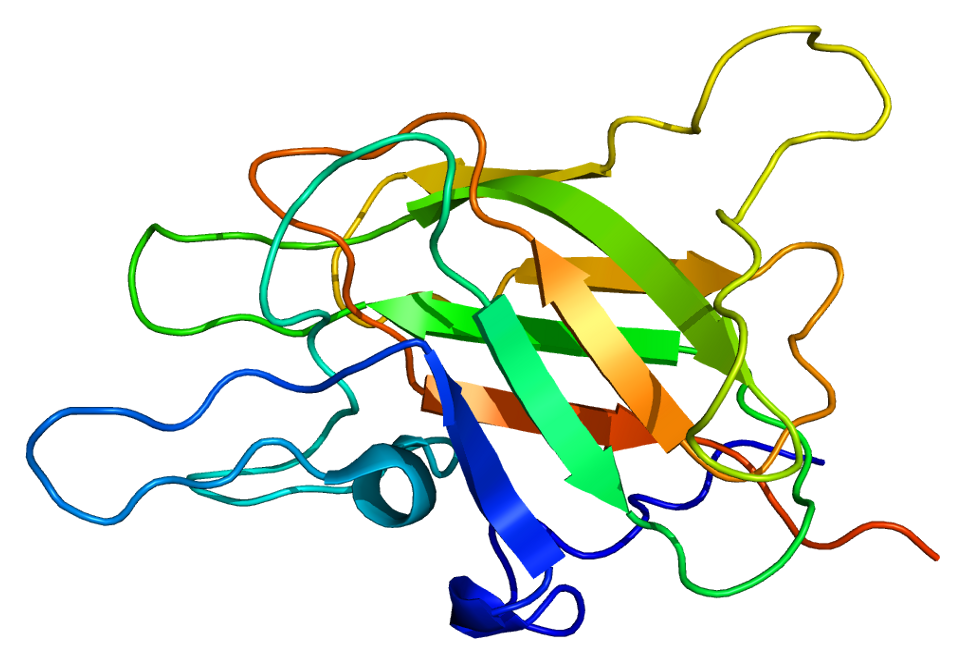
Factor V protein consists of six domains: A1-A2-B-A3-C1-C2.
The A domains are homologous to the A domains of the copper-binding protein ceruloplasmin, and form a triangular as in that protein. A copper ion is bound in the A1-A3 interface, and A3 interacts with the plasma.
The C domains belong to the phospholipid-binding discoidin domain family (unrelated to C2 domain), and the C2 domain mediates membrane binding. The B domain C-terminus acts as a cofactor for the anticoagulant protein C activation by protein S.
Activation of factor V to factor Va is done by cleavage and release of the B domain, after which the protein no longer assists in activating protein C. The protein is now divided to a heavy chain, consisting of the A1-A2 domains, and a light chain, consisting of the A3-C1-C2 domains. Both form non-covalently a complex in a calcium-dependent manner. This complex is the pro-coagulant factor Va.
Factor V is produced by megakaryocytes, which produce platelets and platelet-derived factor V, and hepatocytes, which produce plasma-derived factor V. The molecule circulates in plasma as a single-chain molecule with a plasma half-life of 12–36 hours.
Factor V is able to bind to activated platelets and is activated by thrombin. On activation, factor V is spliced in two chains (heavy and light chain with molecular masses of 110000 and 73000, respectively) which are noncovalently bound to each other by calcium. The thereby activated factor V (now called FVa) is a cofactor of the prothrombinase complex: The activated factor X (FXa) enzyme requires calcium and activated factor V (FVa) to convert prothrombin to thrombin on the cell surface membrane.
Hub AI
Factor V AI simulator
(@Factor V_simulator)
Factor V
Coagulation factor V (Factor V), also less commonly known as proaccelerin or labile factor, is a protein involved in coagulation, encoded, in humans, by F5 gene. In contrast to most other coagulation factors, it is not enzymatically active but functions as a cofactor. Factor V deficiency leads to predisposition for hemorrhage, while some mutations (most notably factor V Leiden) predispose for thrombosis.
The gene for factor V is located on the first chromosome (1q24). It is genomically related to the family of multicopper oxidases, and is homologous to coagulation factor VIII. The gene spans 70 kb, consists of 25 exons, and the resulting protein has a relative molecular mass of approximately 330kDa.
Factor V protein consists of six domains: A1-A2-B-A3-C1-C2.
The A domains are homologous to the A domains of the copper-binding protein ceruloplasmin, and form a triangular as in that protein. A copper ion is bound in the A1-A3 interface, and A3 interacts with the plasma.
The C domains belong to the phospholipid-binding discoidin domain family (unrelated to C2 domain), and the C2 domain mediates membrane binding. The B domain C-terminus acts as a cofactor for the anticoagulant protein C activation by protein S.
Activation of factor V to factor Va is done by cleavage and release of the B domain, after which the protein no longer assists in activating protein C. The protein is now divided to a heavy chain, consisting of the A1-A2 domains, and a light chain, consisting of the A3-C1-C2 domains. Both form non-covalently a complex in a calcium-dependent manner. This complex is the pro-coagulant factor Va.
Factor V is produced by megakaryocytes, which produce platelets and platelet-derived factor V, and hepatocytes, which produce plasma-derived factor V. The molecule circulates in plasma as a single-chain molecule with a plasma half-life of 12–36 hours.
Factor V is able to bind to activated platelets and is activated by thrombin. On activation, factor V is spliced in two chains (heavy and light chain with molecular masses of 110000 and 73000, respectively) which are noncovalently bound to each other by calcium. The thereby activated factor V (now called FVa) is a cofactor of the prothrombinase complex: The activated factor X (FXa) enzyme requires calcium and activated factor V (FVa) to convert prothrombin to thrombin on the cell surface membrane.
Recent media