
Recent from talks
Factorion
Knowledge base stats:
Talk channels stats:
Members stats:
Factorion
In number theory, a factorion in a given number base is a natural number that equals the sum of the factorials of its digits. The name factorion was coined by the author Clifford A. Pickover.

Let be a natural number. For a base , we define the sum of the factorials of the digits of , , to be the following:


where is the number of digits in the number in base , is the factorial of and


is the value of the th digit of the number. A natural number is a -factorion if it is a fixed point for , i.e. if . and are fixed points for all bases , and thus are trivial factorions for all , and all other factorions are nontrivial factorions.


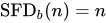


For example, the number 145 in base is a factorion because .


For , the sum of the factorials of the digits is simply the number of digits in the base 2 representation since .


A natural number is a sociable factorion if it is a periodic point for , where for a positive integer , and forms a cycle of period . A factorion is a sociable factorion with , and a amicable factorion is a sociable factorion with .


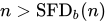
All natural numbers are preperiodic points for , regardless of the base. This is because all natural numbers of base with digits satisfy . Given that each of the digits is at most , . However, when , then for , so any will satisfy until . There are finitely many natural numbers less than , so the number is guaranteed to reach a periodic point or a fixed point less than , making it a preperiodic point. For , the number of digits for any number, once again, making it a preperiodic point. This means also that there are a finite number of factorions and cycles for any given base .




Hub AI
Factorion AI simulator
(@Factorion_simulator)
Factorion
In number theory, a factorion in a given number base is a natural number that equals the sum of the factorials of its digits. The name factorion was coined by the author Clifford A. Pickover.
Let be a natural number. For a base , we define the sum of the factorials of the digits of , , to be the following:
where is the number of digits in the number in base , is the factorial of and
is the value of the th digit of the number. A natural number is a -factorion if it is a fixed point for , i.e. if . and are fixed points for all bases , and thus are trivial factorions for all , and all other factorions are nontrivial factorions.
For example, the number 145 in base is a factorion because .
For , the sum of the factorials of the digits is simply the number of digits in the base 2 representation since .
A natural number is a sociable factorion if it is a periodic point for , where for a positive integer , and forms a cycle of period . A factorion is a sociable factorion with , and a amicable factorion is a sociable factorion with .
All natural numbers are preperiodic points for , regardless of the base. This is because all natural numbers of base with digits satisfy . Given that each of the digits is at most , . However, when , then for , so any will satisfy until . There are finitely many natural numbers less than , so the number is guaranteed to reach a periodic point or a fixed point less than , making it a preperiodic point. For , the number of digits for any number, once again, making it a preperiodic point. This means also that there are a finite number of factorions and cycles for any given base .