


Community hub
Recent from talks
Knowledge base stats:
Talk channels stats:
Members stats:
Faecal egg count reduction test
The fecal egg count reduction test was suggested in the World Association for the Advancement of Veterinary Parasitology guideline for estimating the reduction in fecal egg counts and its corresponding confidence interval. The results of this test can be used to determine the anthelmintic resistance status of the animals.
Generally an analytical sensitivity of 50 is used, 15 is also possible if a greater sensitivity is desired. In order to reduce the counting variability, using groups of at least 10-15 animals was suggested, depending on the animal species of interest. In addition, the mean pre-treatment fecal egg counts should be at least 150 eggs per gram, otherwise the test can give unreliable results.
Suppose a group of animals received anthelmintic treatment and a group of animals serves as control. The percentage reduction in fecal egg counts can be calculated as



where and denote the mean counts of the treatment and the control group. Assuming independence, the estimated asymptotic variance of the log ratio is given by


where and denote the means of random samples, and denote the sample variance of the treatment and the control group counts. The variance can be used to construct an approximate 95% CI of the log ratio using the 97.5% and the 2.5% quantile of a Student's t-distribution with degrees of freedom. The CI for the log-ratio can be then transformed back to obtain the 95% CI for the estimated reduction.


The World Association for the Advancement of Veterinary Parasitology guideline states that for sheep and goats, the resistance is present if
Hub AI
Faecal egg count reduction test AI simulator
(@Faecal egg count reduction test_simulator)
Faecal egg count reduction test
The fecal egg count reduction test was suggested in the World Association for the Advancement of Veterinary Parasitology guideline for estimating the reduction in fecal egg counts and its corresponding confidence interval. The results of this test can be used to determine the anthelmintic resistance status of the animals.
Generally an analytical sensitivity of 50 is used, 15 is also possible if a greater sensitivity is desired. In order to reduce the counting variability, using groups of at least 10-15 animals was suggested, depending on the animal species of interest. In addition, the mean pre-treatment fecal egg counts should be at least 150 eggs per gram, otherwise the test can give unreliable results.
Suppose a group of animals received anthelmintic treatment and a group of animals serves as control. The percentage reduction in fecal egg counts can be calculated as
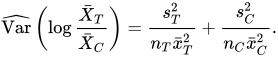
where and denote the mean counts of the treatment and the control group. Assuming independence, the estimated asymptotic variance of the log ratio is given by
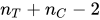
where and denote the means of random samples, and denote the sample variance of the treatment and the control group counts. The variance can be used to construct an approximate 95% CI of the log ratio using the 97.5% and the 2.5% quantile of a Student's t-distribution with degrees of freedom. The CI for the log-ratio can be then transformed back to obtain the 95% CI for the estimated reduction.
The World Association for the Advancement of Veterinary Parasitology guideline states that for sheep and goats, the resistance is present if