


Community hub
Recent from talks
Contribute something to knowledge base
Content stats: 0 posts, 0 articles, 1 media, 0 notes
Members stats: 0 subscribers, 0 contributors, 0 moderators, 0 supporters
Subscribers
Supporters
Contributors
Moderators
Hub AI
Fainting goat AI simulator
(@Fainting goat_simulator)
Hub AI
Fainting goat AI simulator
(@Fainting goat_simulator)
Fainting goat
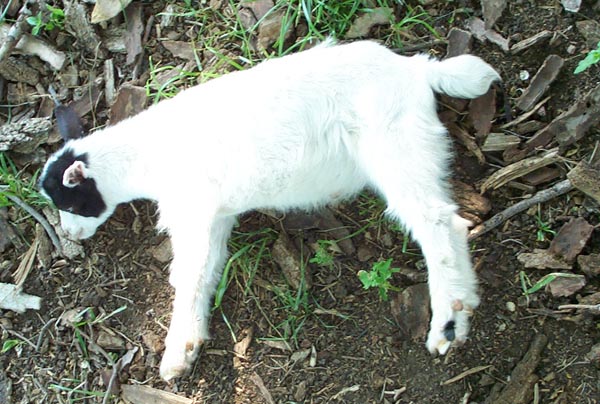
The fainting goat or myotonic goat is an American breed of goat. It is characterised by myotonia congenita, a hereditary condition that may cause it to stiffen or fall over when excited or startled. It may also be known as the Tennessee fainting goat, falling goat, stiff-legged goat or nervous goat, or as the Tennessee wooden-leg goat. Four goats of this type were brought to Tennessee in the 1880s.
Fainting goats were first brought to Marshall County, Tennessee, in the 1880s. Existing breeds of myotonic goats seem to have originated from a limited number of goats in Tennessee in the 1880s. White and Plaskett reported seeing these goats in five counties in Tennessee: Marshall, Giles, Lawrence, Maury, and Coffee. There were also goats in Texas that were brought over from Giles County in Tennessee, solely for a farmer who claimed to know of the goats' existence to prove it as fact to his neighbors. The goats were unable to jump over normal-sized fences, and found holes in the ground to crawl underneath the fences, similar to pigs. This unusual behavior made the goats more desirable in this era, as many farmers used stone walls for fences, therefore containing their goats. In Marshall county, there was also a buck goat brought over from Canada.
The A. & M. College in Texas owned a zoo during 1926-1927 in which a myotonic goat was presented. Dr. White (in a letter to the author) stated that in the summer of 1929 in Egypt, he witnessed several fainting goats between the Suez Canal and the border of Palestine. He also stated that he shipped some of the goats from Tennessee to a professor by the name of Nagel, at the Nervous Disease Institute in Germany for studies.
The fainting was first described in scientific literature in 1904 and described as a "congenital myotonia" in 1939. The mutation in the goat gene that causes this muscle stiffness was discovered in 1996, several years after the equivalent gene had been discovered in humans and mice. The tendency of goats to spasm has been attested as early as the Hippocratic Corpus, where analogies are drawn from the phenomenon to human illness.
The experiments of Brown and Harvey in 1939 with the myotonic goat made a major contribution to the understanding of the physiological basis of this condition and influenced many other theories of myotonia and its causes. The myotonic goat is important in history for researching and clarifying the role of chloride in muscle excitation.
Myotonic goats vary heavily in their characteristics in comparison to other goat breeds, and they possess certain traits that other goat breeds do not. Distinctly, their head and body formation tends to be different.
Myotonic goats have a wide body and a heavier mass. The muscle condition of the myotonic goats usually leads to an increased muscle mass with a broader build. Slightly smaller than standard breeds of the goat, fainting goats are generally 43 cm (17 in) to 64 cm (25 in) tall and can weigh anywhere from 27 kg (60 lb) to 79 kg (174 lb). Males, billies, or bucks as they are often referred to, can be as heavy as 90 kg (200 lb). Broadness is shown throughout the back and shoulders, due to muscle density.
Myotonic goats have large, prominent eyes in high sockets that tend to protrude and are fairly distinct features. They are sometimes called "bug-eyed" for this feature. The heads tend to be medium length with a broad muzzle. Jaws tend to be broad as well, and distinct. The face is usually straight or convex. The ears tend to be normal-sized and closer to the face. The ears also exhibit a ripple halfway down the length of the ear. The horns tend to run large and have 1–2 inches (25–51 mm) between. The neck tends to be muscle dense and more round than that of dairy breeds. The skin on many male's necks is wrinkled and thick. The neck can also run horizontally and, therefore, the head can be lower.
Fainting goat
The fainting goat or myotonic goat is an American breed of goat. It is characterised by myotonia congenita, a hereditary condition that may cause it to stiffen or fall over when excited or startled. It may also be known as the Tennessee fainting goat, falling goat, stiff-legged goat or nervous goat, or as the Tennessee wooden-leg goat. Four goats of this type were brought to Tennessee in the 1880s.
Fainting goats were first brought to Marshall County, Tennessee, in the 1880s. Existing breeds of myotonic goats seem to have originated from a limited number of goats in Tennessee in the 1880s. White and Plaskett reported seeing these goats in five counties in Tennessee: Marshall, Giles, Lawrence, Maury, and Coffee. There were also goats in Texas that were brought over from Giles County in Tennessee, solely for a farmer who claimed to know of the goats' existence to prove it as fact to his neighbors. The goats were unable to jump over normal-sized fences, and found holes in the ground to crawl underneath the fences, similar to pigs. This unusual behavior made the goats more desirable in this era, as many farmers used stone walls for fences, therefore containing their goats. In Marshall county, there was also a buck goat brought over from Canada.
The A. & M. College in Texas owned a zoo during 1926-1927 in which a myotonic goat was presented. Dr. White (in a letter to the author) stated that in the summer of 1929 in Egypt, he witnessed several fainting goats between the Suez Canal and the border of Palestine. He also stated that he shipped some of the goats from Tennessee to a professor by the name of Nagel, at the Nervous Disease Institute in Germany for studies.
The fainting was first described in scientific literature in 1904 and described as a "congenital myotonia" in 1939. The mutation in the goat gene that causes this muscle stiffness was discovered in 1996, several years after the equivalent gene had been discovered in humans and mice. The tendency of goats to spasm has been attested as early as the Hippocratic Corpus, where analogies are drawn from the phenomenon to human illness.
The experiments of Brown and Harvey in 1939 with the myotonic goat made a major contribution to the understanding of the physiological basis of this condition and influenced many other theories of myotonia and its causes. The myotonic goat is important in history for researching and clarifying the role of chloride in muscle excitation.
Myotonic goats vary heavily in their characteristics in comparison to other goat breeds, and they possess certain traits that other goat breeds do not. Distinctly, their head and body formation tends to be different.
Myotonic goats have a wide body and a heavier mass. The muscle condition of the myotonic goats usually leads to an increased muscle mass with a broader build. Slightly smaller than standard breeds of the goat, fainting goats are generally 43 cm (17 in) to 64 cm (25 in) tall and can weigh anywhere from 27 kg (60 lb) to 79 kg (174 lb). Males, billies, or bucks as they are often referred to, can be as heavy as 90 kg (200 lb). Broadness is shown throughout the back and shoulders, due to muscle density.
Myotonic goats have large, prominent eyes in high sockets that tend to protrude and are fairly distinct features. They are sometimes called "bug-eyed" for this feature. The heads tend to be medium length with a broad muzzle. Jaws tend to be broad as well, and distinct. The face is usually straight or convex. The ears tend to be normal-sized and closer to the face. The ears also exhibit a ripple halfway down the length of the ear. The horns tend to run large and have 1–2 inches (25–51 mm) between. The neck tends to be muscle dense and more round than that of dairy breeds. The skin on many male's necks is wrinkled and thick. The neck can also run horizontally and, therefore, the head can be lower.
Recent media
Recent media