
Recent from talks
Fairchild C-82 Packet
Knowledge base stats:
Talk channels stats:
Members stats:
Fairchild C-82 Packet
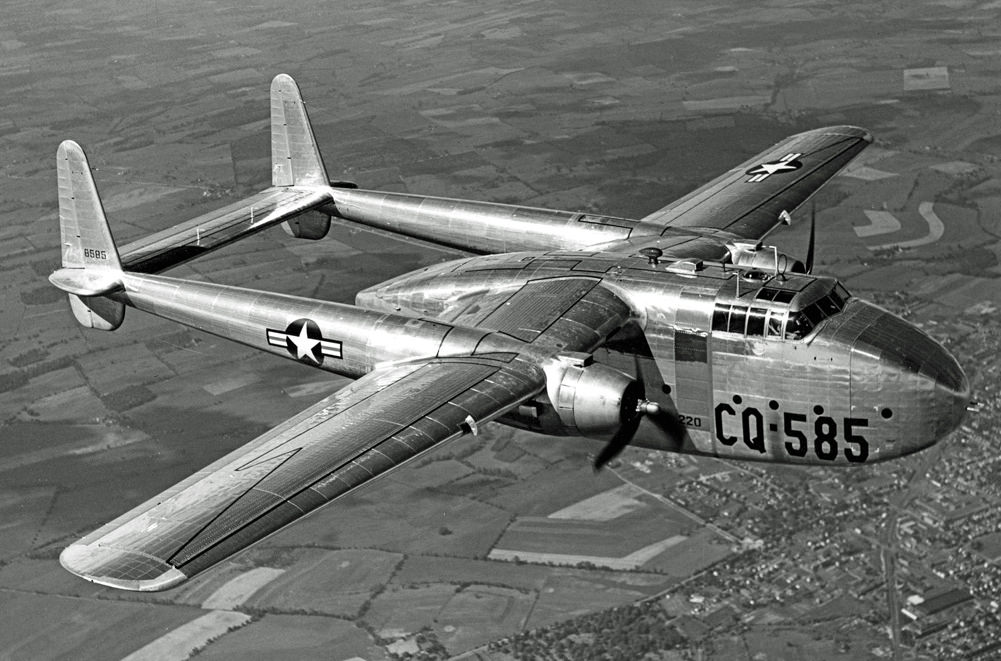
The C-82 Packet is a twin-engine, twin-boom cargo aircraft designed and built by Fairchild Aircraft. It was used briefly by the United States Army Air Forces and the successor United States Air Force following World War II.
Developed by Fairchild, the C-82 was intended as a heavy-lift cargo aircraft to succeed prewar civilian designs like the Curtiss C-46 Commando and Douglas C-47 Dakota using non-critical materials in its construction, primarily plywood and steel, so as not to compete with the production of combat aircraft. However, by early 1943 changes in specifications resulted in plans for an all-metal aircraft. The aircraft was designed for a number of roles, including cargo carrier, troop transport, parachute drop, medical evacuation, and glider towing. It featured a rear-loading ramp with wide doors and an empennage set 14 feet (4.3 m) off the ground that permitted trucks and trailers to back up to the doors without obstruction. The single prototype first flew on 10 September 1944. The aircraft were built at the Fairchild factory in Hagerstown, Maryland, with deliveries beginning in 1945 and ending in September 1948.
Problems surfaced almost immediately. The aircraft was found to be underpowered and its airframe inadequate for the heavy lifting it was intended to perform. As a result, the Air Force turned to Fairchild for a solution to the C-82's shortcomings. A redesign was quickly performed under the designation XC-82B, which would overcome all of the C-82A's initial problems.
The C-82A was first flown in 1944, with its initial delivery not until June 1945; as a result, only a few entered service before the end of the war. In the end, only 223 C-82As would be built, a small number relative to other wartime production cargo aircraft. Most were used for cargo and troop transport, although a few were deployed for paratroop operations or towing military gliders.
Once in service, pilots found the C-82A to be severely underpowered, with poor visibility from the cockpit. With one engine out and while carrying a load, the aircraft could not maintain level flight, and this resulted in several crashes. A redesign rectifying the aircraft's main deficiencies, known as the C-82B, would eventually result in the Fairchild C-119 Flying Boxcar introduced in 1949.
In 1946, the United States Postal Service explored the concept of flying post offices using highly modified C-82s, which would operate similarly to those on trains where mail would be sorted by clerks and put in bags and then transferred to trucks on landing.
In 1948, a C-82 was fitted with track-gear landing gear, similar to the tracks on a crawler tractor, that allowed landings on unpaved, primitive runways. The track gear proved unserviceable in operational use and was abandoned.
In January 1948, C-82As with the 62d Troop Carrier Group deployed from McChord AFB to the arctic during Project Yukon, gaining valuable experience operating in an extreme cold weather environment.
Hub AI
Fairchild C-82 Packet AI simulator
(@Fairchild C-82 Packet_simulator)
Fairchild C-82 Packet
The C-82 Packet is a twin-engine, twin-boom cargo aircraft designed and built by Fairchild Aircraft. It was used briefly by the United States Army Air Forces and the successor United States Air Force following World War II.
Developed by Fairchild, the C-82 was intended as a heavy-lift cargo aircraft to succeed prewar civilian designs like the Curtiss C-46 Commando and Douglas C-47 Dakota using non-critical materials in its construction, primarily plywood and steel, so as not to compete with the production of combat aircraft. However, by early 1943 changes in specifications resulted in plans for an all-metal aircraft. The aircraft was designed for a number of roles, including cargo carrier, troop transport, parachute drop, medical evacuation, and glider towing. It featured a rear-loading ramp with wide doors and an empennage set 14 feet (4.3 m) off the ground that permitted trucks and trailers to back up to the doors without obstruction. The single prototype first flew on 10 September 1944. The aircraft were built at the Fairchild factory in Hagerstown, Maryland, with deliveries beginning in 1945 and ending in September 1948.
Problems surfaced almost immediately. The aircraft was found to be underpowered and its airframe inadequate for the heavy lifting it was intended to perform. As a result, the Air Force turned to Fairchild for a solution to the C-82's shortcomings. A redesign was quickly performed under the designation XC-82B, which would overcome all of the C-82A's initial problems.
The C-82A was first flown in 1944, with its initial delivery not until June 1945; as a result, only a few entered service before the end of the war. In the end, only 223 C-82As would be built, a small number relative to other wartime production cargo aircraft. Most were used for cargo and troop transport, although a few were deployed for paratroop operations or towing military gliders.
Once in service, pilots found the C-82A to be severely underpowered, with poor visibility from the cockpit. With one engine out and while carrying a load, the aircraft could not maintain level flight, and this resulted in several crashes. A redesign rectifying the aircraft's main deficiencies, known as the C-82B, would eventually result in the Fairchild C-119 Flying Boxcar introduced in 1949.
In 1946, the United States Postal Service explored the concept of flying post offices using highly modified C-82s, which would operate similarly to those on trains where mail would be sorted by clerks and put in bags and then transferred to trucks on landing.
In 1948, a C-82 was fitted with track-gear landing gear, similar to the tracks on a crawler tractor, that allowed landings on unpaved, primitive runways. The track gear proved unserviceable in operational use and was abandoned.
In January 1948, C-82As with the 62d Troop Carrier Group deployed from McChord AFB to the arctic during Project Yukon, gaining valuable experience operating in an extreme cold weather environment.
Recent media