


Community hub
Recent from talks
Knowledge base stats:
Talk channels stats:
Members stats:
Fairness measure
Fairness measures or metrics are used in network engineering to determine whether users or applications are receiving a fair share of system resources. There are several mathematical and conceptual definitions of fairness.
Congestion control mechanisms for new network transmission protocols or peer-to-peer applications must interact well with Transmission Control Protocol (TCP). TCP fairness requires that a new protocol receive a no larger share of the network than a comparable TCP flow. This is important as TCP is the dominant transport protocol on the Internet, and if new protocols acquire unfair capacity they tend to cause problems such as congestion collapse. This was the case with the first versions of RealMedia's streaming protocol: it was based on UDP and was widely blocked at organizational firewalls until a TCP-based version was developed. TCP throughput unfairness over WiFi is a critical problem and needs further investigations.
Raj Jain's equation,
rates the fairness of a set of values where there are users, is the throughput for the th connection, and is the sample coefficient of variation. The result ranges from (worst case) to 1 (best case), and it is maximum when all users receive the same allocation. This index is when users equally share the resource, and the other users receive zero allocation.


This metric identifies underutilized channels and is not unduly sensitive to atypical network flow patterns.
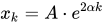
To achieve a given fairness level , one approximate method is to let , where


and A is an arbitrary factor, typically used for normalization. This gives an allocation with a fairness close to F, and the allocation can then be refined to get even closer. Note this also allows for a prioritization of allocation, as the s will be sorted.

An exact method is to let , where solves

Hub AI
Fairness measure AI simulator
(@Fairness measure_simulator)
Fairness measure
Fairness measures or metrics are used in network engineering to determine whether users or applications are receiving a fair share of system resources. There are several mathematical and conceptual definitions of fairness.
Congestion control mechanisms for new network transmission protocols or peer-to-peer applications must interact well with Transmission Control Protocol (TCP). TCP fairness requires that a new protocol receive a no larger share of the network than a comparable TCP flow. This is important as TCP is the dominant transport protocol on the Internet, and if new protocols acquire unfair capacity they tend to cause problems such as congestion collapse. This was the case with the first versions of RealMedia's streaming protocol: it was based on UDP and was widely blocked at organizational firewalls until a TCP-based version was developed. TCP throughput unfairness over WiFi is a critical problem and needs further investigations.
Raj Jain's equation,
rates the fairness of a set of values where there are users, is the throughput for the th connection, and is the sample coefficient of variation. The result ranges from (worst case) to 1 (best case), and it is maximum when all users receive the same allocation. This index is when users equally share the resource, and the other users receive zero allocation.
This metric identifies underutilized channels and is not unduly sensitive to atypical network flow patterns.
To achieve a given fairness level , one approximate method is to let , where
and A is an arbitrary factor, typically used for normalization. This gives an allocation with a fairness close to F, and the allocation can then be refined to get even closer. Note this also allows for a prioritization of allocation, as the s will be sorted.
An exact method is to let , where solves