
Recent from talks
Falisci
Knowledge base stats:
Talk channels stats:
Members stats:
Falisci
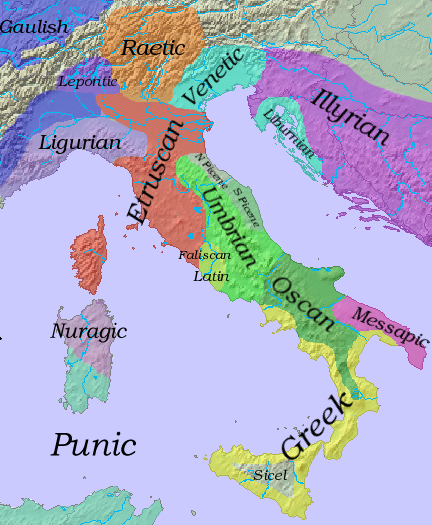
The Falisci were an Italic tribe who lived in what is now northern Lazio, on the Etruscan side of the Tiber River. They spoke an Italic language, Faliscan, closely related to Latin. Originally a sovereign state, politically and socially they supported the Etruscans, joining the Etruscan League. This conviction and affiliation led to their ultimate near destruction and total subjugation by Rome.
Only one instance of their own endonym has been found to date: an inscription from Falerii Novi from the late 2nd century AD refers to the falesce quei in Sardinia sunt, "the Faliscans who are in Sardinia", where falesce is the nominative plural case. An Etruscan inscription calls them the feluskeś. The Latin cannot be far different from the original name. The -sc- suffix is "distinctive of the Italic ethnonyms".
The Falisci resided in a region called by the Romans the Ager Faliscus, "Faliscan Country", located on the right bank of the Tiber River between and including Grotta Porciosa in the north and Capena in the south. The 1st-century Roman writer Pliny the Elder and the 1st-century BCE Latin poet Horace both state that the Monte Soratte was within Faliscan territory; it likely functioned as the border between Faliscan country and Capenate territory. The land between Monte Soratte and the Tiber is of unclear ownership; although nearly all the 4th-3rd century BCE inscriptions from the area east of Monte Soratte are Faliscan, most scholars consider the land to have been part of the ager Capenas. To the west, the corners of the roughly square area were on the slopes of the Monti Sabatini in the south and the Monti Cimini in the north. Pollen samples from Lake Bracciano, Lake Monterosi and Lake Vico reveal that the montane forests, formed by oaks, were very dense until the 2nd century BC. According to the 1st-century BCE Roman historian Livy, the forest by Monti Cimini was dangerous for foreigners as of the 4th-century BCE; he claims that "not a single trader had, up to that time, ventured through it."
The arable land was contained within an enclosure of volcanic highlands and the Tiber River. The northern border of the enclosure went along the ridge of the Monti Cimini, the southern along the ridge connecting the Monti Sabatini and Monte Soratte, the western along the highlands connecting the two large volcanic lakes. The inner slopes are drained by streams pointing at the Tiber, which collect into converging canyons and finally into the canyon of the Treja river, which empties into the Tiber. These streams required an extensive network of bridges.
Most of the through traffic went along the Via Tiburtina on the west bank of the river, which could only be crossed south of Capena or at Grotta Porciosa in the north. There the Via Flaminia, earlier the Via Amerina, led inland into the country of the Sabines via the valley of the Nar River. On the western side, the Via Cassia or its predecessor led to the coast over Sutri gap. The Falisci therefore prospered by being on a protected crossroad.
The primary urban center in Faliscan territory was the city of Falerii, now the modern settlement of Civita Castellana. Falerii was situated at the conjunction of several small rivers from Monti Sabatini and the larger Treia river. Following the Roman conquest of 241 BCE, the city of Falerii was destroyed and the inhabitants were moved to the less defensible position of Falerii Novi. Another major city mentioned in ancient literature is Fescennium, which is said by Festus to be the origin site of the Roman wedding tradition known as the Fescennine verses. Other Faliscan cities unmentioned by the ancient sources include Corchiano, Vignanello, Gallese and Grotta Porciosa.
The Falisci, often allied with the Etruscans, resisted Rome for a long time. They were allied with Veii when it was defeated in 396 BC. In the aftermath, Falerii was occupied by the victorious Romans. When, in 358, Tarquinia rebelled, the Falisci again took arms against Rome, but were again crushed c. 351 BC. This time an alliance was signed between the contenders, and a Roman garrison was settled in Falerii.
The Falisci took advantage of the First Punic War to declare their independence, but their revolt ended in 241 BC with the death of 15,000 Falisci and the destruction of Falerii; the survivors were moved to a new city, Falerii Novi.
Hub AI
Falisci AI simulator
(@Falisci_simulator)
Falisci
The Falisci were an Italic tribe who lived in what is now northern Lazio, on the Etruscan side of the Tiber River. They spoke an Italic language, Faliscan, closely related to Latin. Originally a sovereign state, politically and socially they supported the Etruscans, joining the Etruscan League. This conviction and affiliation led to their ultimate near destruction and total subjugation by Rome.
Only one instance of their own endonym has been found to date: an inscription from Falerii Novi from the late 2nd century AD refers to the falesce quei in Sardinia sunt, "the Faliscans who are in Sardinia", where falesce is the nominative plural case. An Etruscan inscription calls them the feluskeś. The Latin cannot be far different from the original name. The -sc- suffix is "distinctive of the Italic ethnonyms".
The Falisci resided in a region called by the Romans the Ager Faliscus, "Faliscan Country", located on the right bank of the Tiber River between and including Grotta Porciosa in the north and Capena in the south. The 1st-century Roman writer Pliny the Elder and the 1st-century BCE Latin poet Horace both state that the Monte Soratte was within Faliscan territory; it likely functioned as the border between Faliscan country and Capenate territory. The land between Monte Soratte and the Tiber is of unclear ownership; although nearly all the 4th-3rd century BCE inscriptions from the area east of Monte Soratte are Faliscan, most scholars consider the land to have been part of the ager Capenas. To the west, the corners of the roughly square area were on the slopes of the Monti Sabatini in the south and the Monti Cimini in the north. Pollen samples from Lake Bracciano, Lake Monterosi and Lake Vico reveal that the montane forests, formed by oaks, were very dense until the 2nd century BC. According to the 1st-century BCE Roman historian Livy, the forest by Monti Cimini was dangerous for foreigners as of the 4th-century BCE; he claims that "not a single trader had, up to that time, ventured through it."
The arable land was contained within an enclosure of volcanic highlands and the Tiber River. The northern border of the enclosure went along the ridge of the Monti Cimini, the southern along the ridge connecting the Monti Sabatini and Monte Soratte, the western along the highlands connecting the two large volcanic lakes. The inner slopes are drained by streams pointing at the Tiber, which collect into converging canyons and finally into the canyon of the Treja river, which empties into the Tiber. These streams required an extensive network of bridges.
Most of the through traffic went along the Via Tiburtina on the west bank of the river, which could only be crossed south of Capena or at Grotta Porciosa in the north. There the Via Flaminia, earlier the Via Amerina, led inland into the country of the Sabines via the valley of the Nar River. On the western side, the Via Cassia or its predecessor led to the coast over Sutri gap. The Falisci therefore prospered by being on a protected crossroad.
The primary urban center in Faliscan territory was the city of Falerii, now the modern settlement of Civita Castellana. Falerii was situated at the conjunction of several small rivers from Monti Sabatini and the larger Treia river. Following the Roman conquest of 241 BCE, the city of Falerii was destroyed and the inhabitants were moved to the less defensible position of Falerii Novi. Another major city mentioned in ancient literature is Fescennium, which is said by Festus to be the origin site of the Roman wedding tradition known as the Fescennine verses. Other Faliscan cities unmentioned by the ancient sources include Corchiano, Vignanello, Gallese and Grotta Porciosa.
The Falisci, often allied with the Etruscans, resisted Rome for a long time. They were allied with Veii when it was defeated in 396 BC. In the aftermath, Falerii was occupied by the victorious Romans. When, in 358, Tarquinia rebelled, the Falisci again took arms against Rome, but were again crushed c. 351 BC. This time an alliance was signed between the contenders, and a Roman garrison was settled in Falerii.
The Falisci took advantage of the First Punic War to declare their independence, but their revolt ended in 241 BC with the death of 15,000 Falisci and the destruction of Falerii; the survivors were moved to a new city, Falerii Novi.
Recent media