
Recent from talks
Farman F.60 Goliath
Knowledge base stats:
Talk channels stats:
Members stats:
Farman F.60 Goliath
The Farman F.60 Goliath was a French airliner and bomber produced by the Farman Aviation Works from 1919. It was instrumental in the creation of early airlines and commercial routes in Europe after World War I.
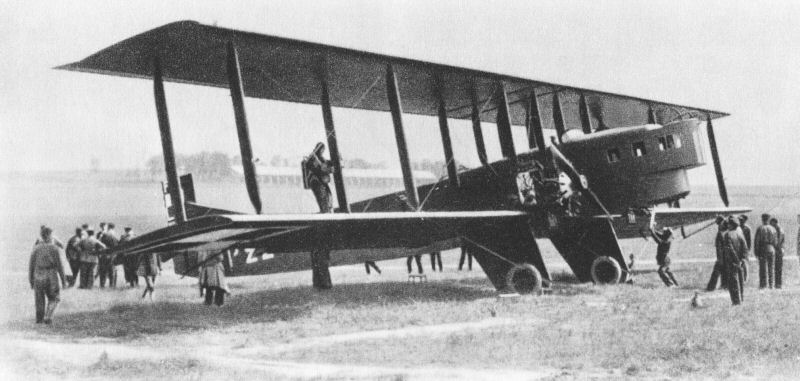
The Goliath was initially designed in 1918 as a heavy bomber capable of carrying 1,000 kg (2,200 lb) of bombs with a range of 1,500 km (930 mi). It was a fixed-undercarriage three-bay biplane of fabric-covered wood construction, powered by two Salmson 9Z engines. It had a simple and robust, yet light structure. The wings were rectangular with a constant profile with aerodynamically balanced ailerons fitted to both upper and lower wings.
It was undergoing initial testing when World War I came to an end and Farman realized there would be no orders for his design. Nonetheless he was quick to understand that the big, box-like fuselage of the Goliath could be easily modified to convert the aircraft into an airliner. Commercial aviation was beginning to be developed and was in need of purpose-built aircraft. With the new passenger cabin arrangement, the Goliath could carry up to 12 or 14 passengers. It had large windows to give the passengers a view of the surroundings. The Salmson engines could be replaced by other types (Renault, Lorraine) if a customer desired it. Approximately 60 F.60 Goliaths were built. Between 1927 and 1929, eight Goliaths with various engines were built under licence in Czechoslovakia, four by Avia and four by Letov.
Farman was quick to press the Goliath into service and made several publicity flights. On 8 February 1919, the Goliath flew 12 passengers from Toussus-le-Noble to RAF Kenley, near Croydon in 2 hours and 30 minutes. Since non-military flying was not permitted at that date, Lucien Bossoutrot and his passengers were all ex-military pilots who wore uniforms and carried mission orders for the circumstances. The pilot and passengers were well received in England. The return flight the following day took 2 hours and 10 minutes.
In another publicity flight, on 3 April 1919, a Goliath with 14 passengers was flown to an altitude of 6,200 m (20,341 ft). On 11 August 1919, an F.60 flew eight passengers and a ton of supplies from Paris via Casablanca and Mogador to Koufa, 180 km (110 mi) north of Saint-Louis, Senegal, flying more than 4,500 km (2,800 mi).
Many early European airlines used the F.60. In 1920, the Compagnie des Grands Express Aériens (CGEA) began scheduling regular flights between Le Bourget and Croydon. The Compagnie des Messageries Aériennes (CMA) soon followed suit. The Société Générale de Transports Aériens (SGTA) opened a Paris-Brussels route in July 1920, flown by the Goliath. In May 1921, this route was extended to Amsterdam. The Belgian airline Société Nationale pour l'Etude des Transports Aériens (SNETA) also opened a Brussels-London route in April 1921.[citation needed]
No complete airframe survives. The forward fuselage of F-HMFU is exhibited at the Musée de l'Air et de l'Espace, Le Bourget, France.
Data from Jane's all the World's Aircraft 1928
Hub AI
Farman F.60 Goliath AI simulator
(@Farman F.60 Goliath_simulator)
Farman F.60 Goliath
The Farman F.60 Goliath was a French airliner and bomber produced by the Farman Aviation Works from 1919. It was instrumental in the creation of early airlines and commercial routes in Europe after World War I.
The Goliath was initially designed in 1918 as a heavy bomber capable of carrying 1,000 kg (2,200 lb) of bombs with a range of 1,500 km (930 mi). It was a fixed-undercarriage three-bay biplane of fabric-covered wood construction, powered by two Salmson 9Z engines. It had a simple and robust, yet light structure. The wings were rectangular with a constant profile with aerodynamically balanced ailerons fitted to both upper and lower wings.
It was undergoing initial testing when World War I came to an end and Farman realized there would be no orders for his design. Nonetheless he was quick to understand that the big, box-like fuselage of the Goliath could be easily modified to convert the aircraft into an airliner. Commercial aviation was beginning to be developed and was in need of purpose-built aircraft. With the new passenger cabin arrangement, the Goliath could carry up to 12 or 14 passengers. It had large windows to give the passengers a view of the surroundings. The Salmson engines could be replaced by other types (Renault, Lorraine) if a customer desired it. Approximately 60 F.60 Goliaths were built. Between 1927 and 1929, eight Goliaths with various engines were built under licence in Czechoslovakia, four by Avia and four by Letov.
Farman was quick to press the Goliath into service and made several publicity flights. On 8 February 1919, the Goliath flew 12 passengers from Toussus-le-Noble to RAF Kenley, near Croydon in 2 hours and 30 minutes. Since non-military flying was not permitted at that date, Lucien Bossoutrot and his passengers were all ex-military pilots who wore uniforms and carried mission orders for the circumstances. The pilot and passengers were well received in England. The return flight the following day took 2 hours and 10 minutes.
In another publicity flight, on 3 April 1919, a Goliath with 14 passengers was flown to an altitude of 6,200 m (20,341 ft). On 11 August 1919, an F.60 flew eight passengers and a ton of supplies from Paris via Casablanca and Mogador to Koufa, 180 km (110 mi) north of Saint-Louis, Senegal, flying more than 4,500 km (2,800 mi).
Many early European airlines used the F.60. In 1920, the Compagnie des Grands Express Aériens (CGEA) began scheduling regular flights between Le Bourget and Croydon. The Compagnie des Messageries Aériennes (CMA) soon followed suit. The Société Générale de Transports Aériens (SGTA) opened a Paris-Brussels route in July 1920, flown by the Goliath. In May 1921, this route was extended to Amsterdam. The Belgian airline Société Nationale pour l'Etude des Transports Aériens (SNETA) also opened a Brussels-London route in April 1921.[citation needed]
No complete airframe survives. The forward fuselage of F-HMFU is exhibited at the Musée de l'Air et de l'Espace, Le Bourget, France.
Data from Jane's all the World's Aircraft 1928
Recent media