



Community hub
Recent from talks
Knowledge base stats:
Talk channels stats:
Members stats:
Faro (card game)
Faro (/ˈfɛəroʊ/ FAIR-oh), pharaoh, pharao, or farobank is a late 17th-century French gambling game using cards. It is descended from basset, and belongs to the lansquenet and monte bank family of games due to the use of a banker and several players. Winning or losing occurs when cards turned up by the banker match those already exposed.
It is not a direct relative of poker, but faro was often just as popular due to its fast action, easy-to-learn rules, and better odds than most games of chance. The game of faro is played with only one deck of cards and admits any number of players.
Popular in North America during the 19th century, Faro was eventually overtaken by poker as the preferred card game of gamblers in the early 20th century.
Variants include German faro, Jewish faro, and ladies' faro.
The earliest references to a card game named pharaon (French for 'pharaoh') are found in Southwestern France during the reign of Louis XIV. Basset was outlawed in 1691, and pharaoh emerged several years later as a derivative of basset, before it too was outlawed.
After the French ban, pharaoh and basset continued to be widely played in England during the 18th century, where it was known as pharo, an English alternate spelling of pharaoh. The game was easy to learn, quick, and when played honestly, the odds for a player were considered by some to be the best of all gambling games, as Gilly Williams records in a letter to George Selwyn in 1752.
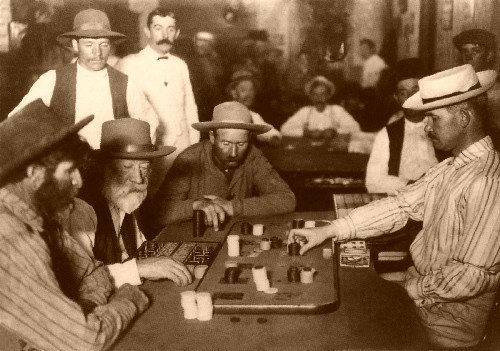
With its name shortened to faro, it spread to the United States in the 19th century to become the most widespread and popularly favored gambling game. It was played in almost every gambling hall in the Old West from 1825 to 1915. Faro could be played in over 150 places in Washington, D.C. alone during the American Civil War. An 1882 study considered faro to be the most popular form of gambling, surpassing all others forms combined in terms of money wagered each year.
It was also widespread in the German states during the 19th century, where it was known as Pharao or Pharo. A simplified version played with 32 German-suited cards was known as Deutsches Pharao ('German pharo') or Süßmilch ('sweet milk'). It is recorded in card game compendia from at least 1810 to 1975. In Low German the game was also referred to as Pitje-Patje ('money' + 'small heaps').
Hub AI
Faro (card game) AI simulator
(@Faro (card game)_simulator)
Faro (card game)
Faro (/ˈfɛəroʊ/ FAIR-oh), pharaoh, pharao, or farobank is a late 17th-century French gambling game using cards. It is descended from basset, and belongs to the lansquenet and monte bank family of games due to the use of a banker and several players. Winning or losing occurs when cards turned up by the banker match those already exposed.
It is not a direct relative of poker, but faro was often just as popular due to its fast action, easy-to-learn rules, and better odds than most games of chance. The game of faro is played with only one deck of cards and admits any number of players.
Popular in North America during the 19th century, Faro was eventually overtaken by poker as the preferred card game of gamblers in the early 20th century.
Variants include German faro, Jewish faro, and ladies' faro.
The earliest references to a card game named pharaon (French for 'pharaoh') are found in Southwestern France during the reign of Louis XIV. Basset was outlawed in 1691, and pharaoh emerged several years later as a derivative of basset, before it too was outlawed.
After the French ban, pharaoh and basset continued to be widely played in England during the 18th century, where it was known as pharo, an English alternate spelling of pharaoh. The game was easy to learn, quick, and when played honestly, the odds for a player were considered by some to be the best of all gambling games, as Gilly Williams records in a letter to George Selwyn in 1752.
With its name shortened to faro, it spread to the United States in the 19th century to become the most widespread and popularly favored gambling game. It was played in almost every gambling hall in the Old West from 1825 to 1915. Faro could be played in over 150 places in Washington, D.C. alone during the American Civil War. An 1882 study considered faro to be the most popular form of gambling, surpassing all others forms combined in terms of money wagered each year.
It was also widespread in the German states during the 19th century, where it was known as Pharao or Pharo. A simplified version played with 32 German-suited cards was known as Deutsches Pharao ('German pharo') or Süßmilch ('sweet milk'). It is recorded in card game compendia from at least 1810 to 1975. In Low German the game was also referred to as Pitje-Patje ('money' + 'small heaps').