


Community hub
Recent from talks
Contribute something to knowledge base
Content stats: 0 posts, 0 articles, 1 media, 0 notes
Members stats: 0 subscribers, 0 contributors, 0 moderators, 0 supporters
Subscribers
Supporters
Contributors
Moderators
Gladiatrix
The gladiatrix (pl.: gladiatrices) was a female gladiator of ancient Rome. Like their male counterparts, gladiatrices fought each other, or wild animals, to entertain audiences at games and festivals (ludi).
Very little is known about female gladiators. They seem to have used much the same equipment as men, but were few in number and almost certainly considered an exotic rarity by their audiences. They are mentioned in literary sources from the end of the Roman Republic and early Roman Empire, and are attested in only a few inscriptions. Female gladiators were officially banned as unseemly from 200 AD onwards, but the word gladiatrix does not appear until late antiquity.
The Romans of the Classical period had no specific word for female gladiators as a type or class. The earliest reference to a woman gladiator as gladiatrix is by a scholiast in the 4th–5th century, who mockingly wonders whether a woman undergoing training for a performance at the ludi for the Floralia, a festival known for racy performances by seminude dancers, wants to be a gladiatrix-meretrix – a gladiator who is a prostitute.
Female gladiators rarely appear in Roman histories. When they do, they are "exotic markers of truly lavish spectacle". In 66 AD, Nero had Ethiopian women, men and children fight at a munus to impress King Tiridates I of Armenia. A munus circa 89 AD, during Domitian's reign, featured battles between female gladiators, described as "Amazonian".
There is no evidence for the existence or training of female gladiators in any known gladiator school. Women were present at the schools, however, as gladiators' wives, partners or followers (ludiae), and some couples raised families. Vesley suggests that some might have trained under private tutors in Collegia Iuvenum (official "youth organisations"), where young men of over 14 years could learn "manly" skills, including the basic arts of war. He offers three inscriptions as possible evidence; one, from Reate, commemorates Valeria, who died aged seventeen years and nine months and "belonged" to her collegium; the others commemorate females attached to collegia in Numidia and Ficulea. Most modern scholarship describes these as memorials to female servants or slaves of the collegia, not female gladiators. Nevertheless, female gladiators probably followed the same training, discipline and career path as their male counterparts; though under a less strenuous training regime.
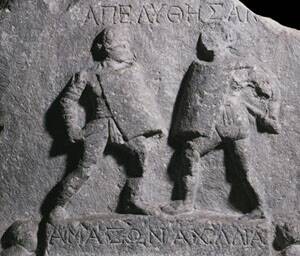
As male gladiators were usually pitted against fighters of similar skill and capacity, the same probably applied to female gladiators. A commemorative marble relief from Halicarnassus shows two near-identical gladiators facing each other. One is identified as Amazonia and the other as Achillia; their warlike "stage names" allude to the mythical tribe of warrior-women, and a feminine version of the warrior-hero Achilles. Otherwise, neither one is recognisable as male or female. Each is bareheaded, equipped with a greave, loincloth, belt, rectangular shield, dagger and manica (arm protection). Two rounded objects at their feet probably represent their discarded helmets. An inscription describes their match as missio, meaning that they were released; the relief, and its inscription, might indicate that they fought to an honourable "standing tie" as equals.
A number of specific legal and moral codes applied to gladiators. In an edict of 22 BC, all men of senatorial class down to their grandsons were prohibited from participating in the games, on penalty of infamia, which involved loss of social status and certain legal rights. In 19 AD, during the reign of Tiberius, this prohibition was extended under the Larinum Decree to include the equestrian order and all citizen women. Henceforth, all arenarii (those who appeared in the arena, in any capacity) could be declared infames. The terms of the edict indicate a class-based, rather than a gendered prohibition. Roman morality required that all gladiators be of the lowest social classes. Emperors such as Caligula, who failed to respect this distinction, earned the scorn of posterity; Cassius Dio takes pains to point out that when the much admired emperor Titus used female gladiators, they were of acceptably low class.
An inscription at Ostia Antica, marking games held there around the mid 2nd century AD, refers to a local magistrate's generous provision of "women for the sword". This is presumed to mean female gladiators, rather than victims. The inscription defines them as mulieres (women), rather than feminae (ladies), in keeping with their low social status. Juvenal describes high-status women who appear in the games as "rich women who have lost all sense of the dignities and duties of their sex." Their self-indulgence was held to have brought shame upon themselves, their gender, and Rome's social order; they, or their sponsors, undermined traditional Roman virtues and values. Women beast-hunters (bestiarii) could earn praise and a good reputation for courage and skill; Martial describes one who killed a lion - a Herculean feat, which reflected well on her editor, the emperor Titus; but Juvenal was less than impressed by Mevia, who hunted boars with a spear "like a man."
Gladiatrix
The gladiatrix (pl.: gladiatrices) was a female gladiator of ancient Rome. Like their male counterparts, gladiatrices fought each other, or wild animals, to entertain audiences at games and festivals (ludi).
Very little is known about female gladiators. They seem to have used much the same equipment as men, but were few in number and almost certainly considered an exotic rarity by their audiences. They are mentioned in literary sources from the end of the Roman Republic and early Roman Empire, and are attested in only a few inscriptions. Female gladiators were officially banned as unseemly from 200 AD onwards, but the word gladiatrix does not appear until late antiquity.
The Romans of the Classical period had no specific word for female gladiators as a type or class. The earliest reference to a woman gladiator as gladiatrix is by a scholiast in the 4th–5th century, who mockingly wonders whether a woman undergoing training for a performance at the ludi for the Floralia, a festival known for racy performances by seminude dancers, wants to be a gladiatrix-meretrix – a gladiator who is a prostitute.
Female gladiators rarely appear in Roman histories. When they do, they are "exotic markers of truly lavish spectacle". In 66 AD, Nero had Ethiopian women, men and children fight at a munus to impress King Tiridates I of Armenia. A munus circa 89 AD, during Domitian's reign, featured battles between female gladiators, described as "Amazonian".
There is no evidence for the existence or training of female gladiators in any known gladiator school. Women were present at the schools, however, as gladiators' wives, partners or followers (ludiae), and some couples raised families. Vesley suggests that some might have trained under private tutors in Collegia Iuvenum (official "youth organisations"), where young men of over 14 years could learn "manly" skills, including the basic arts of war. He offers three inscriptions as possible evidence; one, from Reate, commemorates Valeria, who died aged seventeen years and nine months and "belonged" to her collegium; the others commemorate females attached to collegia in Numidia and Ficulea. Most modern scholarship describes these as memorials to female servants or slaves of the collegia, not female gladiators. Nevertheless, female gladiators probably followed the same training, discipline and career path as their male counterparts; though under a less strenuous training regime.
As male gladiators were usually pitted against fighters of similar skill and capacity, the same probably applied to female gladiators. A commemorative marble relief from Halicarnassus shows two near-identical gladiators facing each other. One is identified as Amazonia and the other as Achillia; their warlike "stage names" allude to the mythical tribe of warrior-women, and a feminine version of the warrior-hero Achilles. Otherwise, neither one is recognisable as male or female. Each is bareheaded, equipped with a greave, loincloth, belt, rectangular shield, dagger and manica (arm protection). Two rounded objects at their feet probably represent their discarded helmets. An inscription describes their match as missio, meaning that they were released; the relief, and its inscription, might indicate that they fought to an honourable "standing tie" as equals.
A number of specific legal and moral codes applied to gladiators. In an edict of 22 BC, all men of senatorial class down to their grandsons were prohibited from participating in the games, on penalty of infamia, which involved loss of social status and certain legal rights. In 19 AD, during the reign of Tiberius, this prohibition was extended under the Larinum Decree to include the equestrian order and all citizen women. Henceforth, all arenarii (those who appeared in the arena, in any capacity) could be declared infames. The terms of the edict indicate a class-based, rather than a gendered prohibition. Roman morality required that all gladiators be of the lowest social classes. Emperors such as Caligula, who failed to respect this distinction, earned the scorn of posterity; Cassius Dio takes pains to point out that when the much admired emperor Titus used female gladiators, they were of acceptably low class.
An inscription at Ostia Antica, marking games held there around the mid 2nd century AD, refers to a local magistrate's generous provision of "women for the sword". This is presumed to mean female gladiators, rather than victims. The inscription defines them as mulieres (women), rather than feminae (ladies), in keeping with their low social status. Juvenal describes high-status women who appear in the games as "rich women who have lost all sense of the dignities and duties of their sex." Their self-indulgence was held to have brought shame upon themselves, their gender, and Rome's social order; they, or their sponsors, undermined traditional Roman virtues and values. Women beast-hunters (bestiarii) could earn praise and a good reputation for courage and skill; Martial describes one who killed a lion - a Herculean feat, which reflected well on her editor, the emperor Titus; but Juvenal was less than impressed by Mevia, who hunted boars with a spear "like a man."
Recent media
Recent media