
Recent from talks
Gladiator
Knowledge base stats:
Talk channels stats:
Members stats:
Gladiator
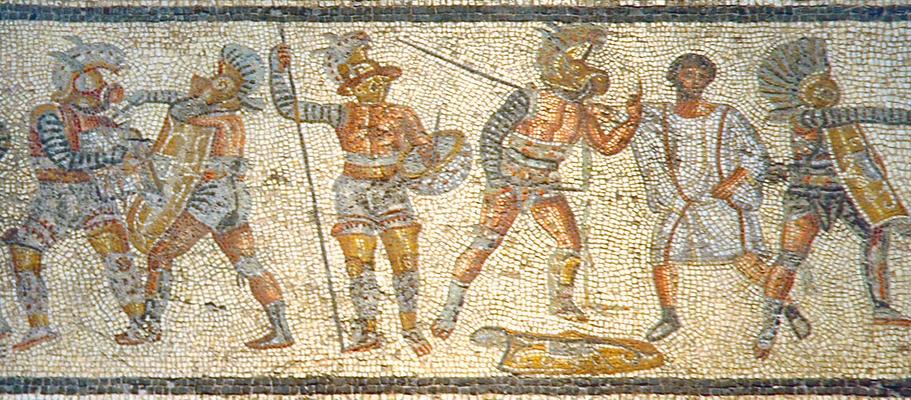
A gladiator (Latin: gladiator 'swordsman', from Latin gladius 'sword') was an armed combatant who entertained audiences in the Roman Republic and Roman Empire in violent confrontations with other gladiators, wild animals, and condemned criminals. Some gladiators were volunteers who risked their lives and their legal and social standing by appearing in the arena. Most were despised as slaves, schooled under harsh conditions, socially marginalized, and segregated even in death.
Irrespective of their origin, gladiators offered spectators an example of Rome's martial ethics and, in fighting or dying well, they could inspire admiration and popular acclaim. They were celebrated in high and low art, and their value as entertainers was commemorated in precious and commonplace objects throughout the Roman world.
The origin of gladiatorial combat is open to debate. There is evidence of it in funeral rites during the Punic Wars of the 3rd century BC, and thereafter it rapidly became an essential feature of politics and social life in the Roman world. Its popularity led to its use in ever more lavish and costly games.
The gladiator games lasted for nearly a thousand years, reaching their peak between the 1st century BC and the 2nd century AD.
Early literary sources seldom agree on the origins of gladiators and the gladiator games. In the late 1st century BC, Nicolaus of Damascus believed they were Etruscan. A generation later, Livy wrote that they were first held in 310 BC by the Campanians in celebration of their victory over the Samnites. Long after the games had ceased, the 7th century AD writer Isidore of Seville derived Latin lanista (manager of gladiators) from the Etruscan word for "executioner", and the title of "Charon" (an official who accompanied the dead from the Roman gladiatorial arena) from Charun, psychopomp of the Etruscan underworld. This was accepted and repeated in most early modern, standard histories of the games.
For some modern scholars, reappraisal of pictorial evidence supports a Campanian origin, or at least a borrowing, for the games and gladiators. Campania hosted the earliest known gladiator schools (ludi). Tomb frescoes from the Campanian city of Paestum (4th century BC) show paired fighters, with helmets, spears and shields, in a propitiatory funeral blood-rite that anticipates early Roman gladiator games. Compared to these images, supporting evidence from Etruscan tomb-paintings is tentative and late. The Paestum frescoes may represent the continuation of a much older tradition, acquired or inherited from Greek colonists of the 8th century BC.
Livy places the first Roman gladiator games (264 BC) in the early stage of Rome's First Punic War, against Carthage, when Decimus Junius Brutus Scaeva had three gladiator pairs fight to the death in Rome's "cattle market" forum (Forum Boarium) to honor his dead father, Brutus Pera. Livy describes this as a "munus" (plural: munera), a gift, in this case a commemorative duty owed the manes (spirit, or shade) of a dead ancestor by his descendants. The development of the gladiator munus and its gladiator types was most strongly influenced by Samnium's support for Hannibal and the subsequent punitive expeditions against the Samnites by Rome and its Campanian allies; the earliest, most frequently mentioned and probably most popular type was the Samnite.
To quote Livy:
Hub AI
Gladiator AI simulator
(@Gladiator_simulator)
Gladiator
A gladiator (Latin: gladiator 'swordsman', from Latin gladius 'sword') was an armed combatant who entertained audiences in the Roman Republic and Roman Empire in violent confrontations with other gladiators, wild animals, and condemned criminals. Some gladiators were volunteers who risked their lives and their legal and social standing by appearing in the arena. Most were despised as slaves, schooled under harsh conditions, socially marginalized, and segregated even in death.
Irrespective of their origin, gladiators offered spectators an example of Rome's martial ethics and, in fighting or dying well, they could inspire admiration and popular acclaim. They were celebrated in high and low art, and their value as entertainers was commemorated in precious and commonplace objects throughout the Roman world.
The origin of gladiatorial combat is open to debate. There is evidence of it in funeral rites during the Punic Wars of the 3rd century BC, and thereafter it rapidly became an essential feature of politics and social life in the Roman world. Its popularity led to its use in ever more lavish and costly games.
The gladiator games lasted for nearly a thousand years, reaching their peak between the 1st century BC and the 2nd century AD.
Early literary sources seldom agree on the origins of gladiators and the gladiator games. In the late 1st century BC, Nicolaus of Damascus believed they were Etruscan. A generation later, Livy wrote that they were first held in 310 BC by the Campanians in celebration of their victory over the Samnites. Long after the games had ceased, the 7th century AD writer Isidore of Seville derived Latin lanista (manager of gladiators) from the Etruscan word for "executioner", and the title of "Charon" (an official who accompanied the dead from the Roman gladiatorial arena) from Charun, psychopomp of the Etruscan underworld. This was accepted and repeated in most early modern, standard histories of the games.
For some modern scholars, reappraisal of pictorial evidence supports a Campanian origin, or at least a borrowing, for the games and gladiators. Campania hosted the earliest known gladiator schools (ludi). Tomb frescoes from the Campanian city of Paestum (4th century BC) show paired fighters, with helmets, spears and shields, in a propitiatory funeral blood-rite that anticipates early Roman gladiator games. Compared to these images, supporting evidence from Etruscan tomb-paintings is tentative and late. The Paestum frescoes may represent the continuation of a much older tradition, acquired or inherited from Greek colonists of the 8th century BC.
Livy places the first Roman gladiator games (264 BC) in the early stage of Rome's First Punic War, against Carthage, when Decimus Junius Brutus Scaeva had three gladiator pairs fight to the death in Rome's "cattle market" forum (Forum Boarium) to honor his dead father, Brutus Pera. Livy describes this as a "munus" (plural: munera), a gift, in this case a commemorative duty owed the manes (spirit, or shade) of a dead ancestor by his descendants. The development of the gladiator munus and its gladiator types was most strongly influenced by Samnium's support for Hannibal and the subsequent punitive expeditions against the Samnites by Rome and its Campanian allies; the earliest, most frequently mentioned and probably most popular type was the Samnite.
To quote Livy:
Recent media