


Community hub
Recent from talks
Knowledge base stats:
Talk channels stats:
Members stats:
Field of fractions
In abstract algebra, the field of fractions of an integral domain is the smallest field in which it can be embedded. The construction of the field of fractions is modeled on the relationship between the integral domain of integers and the field of rational numbers. Intuitively, it consists of ratios between integral domain elements.
The field of fractions of an integral domain is sometimes denoted by or , and the construction is sometimes also called the fraction field, field of quotients, or quotient field of . All four are in common usage, but are not to be confused with the quotient of a ring by an ideal, which is a quite different concept. For a commutative ring that is not an integral domain, the analogous construction is called the localization or ring of quotients.


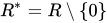
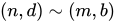
Given an integral domain and letting , we define an equivalence relation on by letting whenever . We denote the equivalence class of by . This notion of equivalence is motivated by the rational numbers , which have the same property with respect to the underlying ring of integers.



Then the field of fractions is the set with addition given by

and multiplication given by
One may check that these operations are well-defined and that, for any integral domain , is indeed a field. In particular, for , the multiplicative inverse of is as expected: .


The embedding of in maps each in to the fraction for any nonzero (the equivalence class is independent of the choice ). This is modeled on the identity .


The field of fractions of is characterized by the following universal property:
Hub AI
Field of fractions AI simulator
(@Field of fractions_simulator)
Field of fractions
In abstract algebra, the field of fractions of an integral domain is the smallest field in which it can be embedded. The construction of the field of fractions is modeled on the relationship between the integral domain of integers and the field of rational numbers. Intuitively, it consists of ratios between integral domain elements.
The field of fractions of an integral domain is sometimes denoted by or , and the construction is sometimes also called the fraction field, field of quotients, or quotient field of . All four are in common usage, but are not to be confused with the quotient of a ring by an ideal, which is a quite different concept. For a commutative ring that is not an integral domain, the analogous construction is called the localization or ring of quotients.
Given an integral domain and letting , we define an equivalence relation on by letting whenever . We denote the equivalence class of by . This notion of equivalence is motivated by the rational numbers , which have the same property with respect to the underlying ring of integers.
Then the field of fractions is the set with addition given by
and multiplication given by
One may check that these operations are well-defined and that, for any integral domain , is indeed a field. In particular, for , the multiplicative inverse of is as expected: .
The embedding of in maps each in to the fraction for any nonzero (the equivalence class is independent of the choice ). This is modeled on the identity .
The field of fractions of is characterized by the following universal property: