
Recent from talks
Fielding (cricket)
Knowledge base stats:
Talk channels stats:
Members stats:
Fielding (cricket)
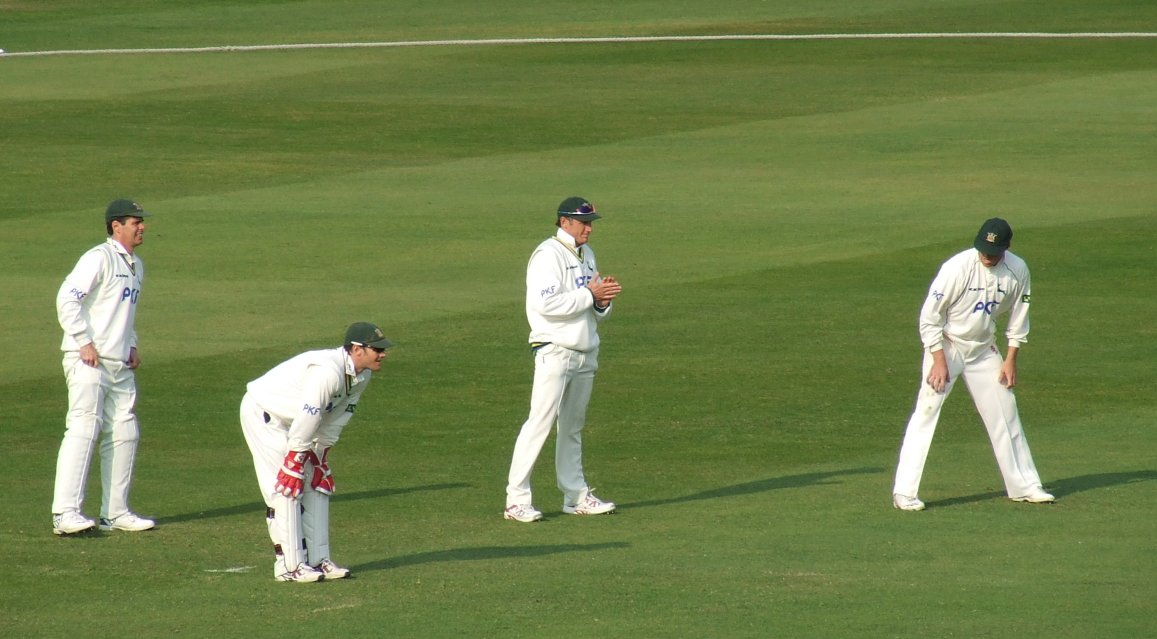
Fielding in the sport of cricket is the action of fielders in collecting the ball after it is struck by the striking batter, to limit the number of runs that the striker scores and/or to get a batter out by either catching a hit ball before it bounces, or by running out either batter before they can complete their current run. There are a number of recognised fielding positions and they can be categorised into the offside and leg side of the field. Fielding also involves trying to prevent the ball from making a boundary where four "runs" are awarded for reaching the perimeter and six for crossing it without touching the grass.
A fielder may field the ball with any part of their body. However, if, while the ball is in play, they wilfully field it otherwise (e.g. by using their hat) the ball becomes dead and five penalty runs are awarded to the batting side, unless the ball previously struck a batter not attempting to hit or avoid the ball. Most of the rules covering fielders are set out in Law 28 of the Laws of cricket. Fake fielding is the action when a fielder makes bodily movements to feign fielding to fool batters into making mistakes and is a punishable offence under the ICC rules.
There are 11 players in a team: one is the bowler and another is the wicket-keeper, so only nine other fielding positions can be occupied at any time. Where fielders are positioned is a tactical decision made by the captain of the fielding team. The captain (usually in consultation with the bowler and sometimes other members of the team) may move players between fielding positions at any time except when a bowler is in the act of bowling to a batter, though there are exceptions for fielders moving in anticipation of the ball being hit to a particular area.
There are a number of named basic fielding positions, some of which are employed very commonly and others that are used less often. However, these positions are neither fixed nor precisely defined, and fielders can be placed in positions that differ from the basic positions. The nomenclature of the positions is somewhat esoteric, but roughly follows a system of polar coordinates – one word (leg, cover, mid-wicket) specifies the angle from the batter, and is sometimes preceded by an adjective describing the distance from the batter (silly, short, deep or long). Words such as "backward", "forward", or "square" can further indicate the angle.
The image shows the location of most of the named fielding positions based on a right-handed batter. The area to the left of a right-handed batter (from the batter's point of view – facing the bowler) is called the leg side or on side, while that to the right is the off side. If the batter is left-handed, the leg and off sides are reversed and the fielding positions are a mirror image of those shown.
Some fielding positions are used offensively. That is, players are put there with the main aim being to catch out the batter rather than to stop or slow down the scoring of runs. These positions include Slip (often there are multiple slips next to each other, designated First slip, Second slip, Third slip, etc., numbered outwards from the wicket-keeper – collectively known as the slip cordon) meant to catch balls that just edge off the bat; Gully; Fly slip; Leg slip; Leg gully; the short and silly positions. Short leg, also known as bat pad, is a position specifically intended to catch balls that unintentionally strike the bat and leg pad, and thus end up only a metre or two to the leg side.
The bowler after delivering the ball must avoid running on the pitch, and so usually ends up fielding near silly mid on or silly mid off. Fast bowlers will continue running to exit the pitch and only change direction for balls dropped in front of the wicket. Spin bowlers with the slowest run-ups will usually cease their movement immediately after their delivery, planting their feet before the ball arrives to the batsman to react to a ball hit back up the pitch toward them. The bowler is generally understood to have the responsibility to defend the stumps at the non-strikers end of the pitch and so after a shot is made they will return to the stumps to catch any incoming throw, on rare occasions where a wicket-keeper has fallen or had to run to gather the ball the bowler may be the closest to the non-strikers stumps as well and so will move to the other end of the pitch. Once the play is dead they will walk back toward their bowling mark. In the laws of cricket the ball play is considered dead after the runners have ceased attempting to score and the ball has been returned to either the wicket-keeper or the bowler.
Additionally, commentators or spectators discussing the details of field placement will often use the terms for descriptive phrases such as "gully is a bit wider than normal" (meaning they are more to the side than normal) or "mid off is standing too deep, they should come in shorter" (meaning they are too far away and should be positioned closer to the batter).
Hub AI
Fielding (cricket) AI simulator
(@Fielding (cricket)_simulator)
Fielding (cricket)
Fielding in the sport of cricket is the action of fielders in collecting the ball after it is struck by the striking batter, to limit the number of runs that the striker scores and/or to get a batter out by either catching a hit ball before it bounces, or by running out either batter before they can complete their current run. There are a number of recognised fielding positions and they can be categorised into the offside and leg side of the field. Fielding also involves trying to prevent the ball from making a boundary where four "runs" are awarded for reaching the perimeter and six for crossing it without touching the grass.
A fielder may field the ball with any part of their body. However, if, while the ball is in play, they wilfully field it otherwise (e.g. by using their hat) the ball becomes dead and five penalty runs are awarded to the batting side, unless the ball previously struck a batter not attempting to hit or avoid the ball. Most of the rules covering fielders are set out in Law 28 of the Laws of cricket. Fake fielding is the action when a fielder makes bodily movements to feign fielding to fool batters into making mistakes and is a punishable offence under the ICC rules.
There are 11 players in a team: one is the bowler and another is the wicket-keeper, so only nine other fielding positions can be occupied at any time. Where fielders are positioned is a tactical decision made by the captain of the fielding team. The captain (usually in consultation with the bowler and sometimes other members of the team) may move players between fielding positions at any time except when a bowler is in the act of bowling to a batter, though there are exceptions for fielders moving in anticipation of the ball being hit to a particular area.
There are a number of named basic fielding positions, some of which are employed very commonly and others that are used less often. However, these positions are neither fixed nor precisely defined, and fielders can be placed in positions that differ from the basic positions. The nomenclature of the positions is somewhat esoteric, but roughly follows a system of polar coordinates – one word (leg, cover, mid-wicket) specifies the angle from the batter, and is sometimes preceded by an adjective describing the distance from the batter (silly, short, deep or long). Words such as "backward", "forward", or "square" can further indicate the angle.
The image shows the location of most of the named fielding positions based on a right-handed batter. The area to the left of a right-handed batter (from the batter's point of view – facing the bowler) is called the leg side or on side, while that to the right is the off side. If the batter is left-handed, the leg and off sides are reversed and the fielding positions are a mirror image of those shown.
Some fielding positions are used offensively. That is, players are put there with the main aim being to catch out the batter rather than to stop or slow down the scoring of runs. These positions include Slip (often there are multiple slips next to each other, designated First slip, Second slip, Third slip, etc., numbered outwards from the wicket-keeper – collectively known as the slip cordon) meant to catch balls that just edge off the bat; Gully; Fly slip; Leg slip; Leg gully; the short and silly positions. Short leg, also known as bat pad, is a position specifically intended to catch balls that unintentionally strike the bat and leg pad, and thus end up only a metre or two to the leg side.
The bowler after delivering the ball must avoid running on the pitch, and so usually ends up fielding near silly mid on or silly mid off. Fast bowlers will continue running to exit the pitch and only change direction for balls dropped in front of the wicket. Spin bowlers with the slowest run-ups will usually cease their movement immediately after their delivery, planting their feet before the ball arrives to the batsman to react to a ball hit back up the pitch toward them. The bowler is generally understood to have the responsibility to defend the stumps at the non-strikers end of the pitch and so after a shot is made they will return to the stumps to catch any incoming throw, on rare occasions where a wicket-keeper has fallen or had to run to gather the ball the bowler may be the closest to the non-strikers stumps as well and so will move to the other end of the pitch. Once the play is dead they will walk back toward their bowling mark. In the laws of cricket the ball play is considered dead after the runners have ceased attempting to score and the ball has been returned to either the wicket-keeper or the bowler.
Additionally, commentators or spectators discussing the details of field placement will often use the terms for descriptive phrases such as "gully is a bit wider than normal" (meaning they are more to the side than normal) or "mid off is standing too deep, they should come in shorter" (meaning they are too far away and should be positioned closer to the batter).
Recent media