
Recent from talks
Fifth Avenue Hotel
Knowledge base stats:
Talk channels stats:
Members stats:
Fifth Avenue Hotel
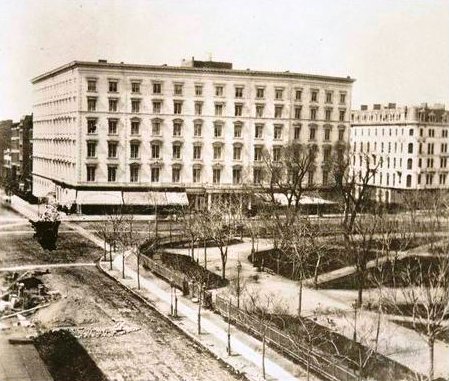
The Fifth Avenue Hotel was a luxury hotel located in Manhattan, New York City from 1859 to 1908. It had an entire block of frontage between 23rd Street and 24th Street, at the southwest corner of Madison Square.
The site was previously the location of Madison Cottage, which was a stagecoach stop for passengers headed north from the city. From 1853 to 1856 it was the site of Franconi's Hippodrome, a tent-like structure of canvas and wood which could accommodate up to 10,000 spectators who watched chariot races and other "Amusements of the Ancient Greeks and Romans".
The Fifth Avenue Hotel was built in 1856–59 by Amos Richards Eno at the cost of $2 million. The building was designed by Griffith Thomas with William Washburn. Due to the site's location away from the city center, the hotel was labelled as "Eno's Folly" during construction.
Following the hotel's opening, it became "the social, cultural political hub of elite New York," and brought in a quarter of a million dollars a year in profits. The Fifth Avenue Hotel spurred development of additional hotels to the north and west, to the north of the Madison Square Park, an area known in the 21st century as the NoMad neighborhood.
The Fifth Avenue Hotel was constructed of brick and white marble, and stood at five stories over a commercial ground floor. The first example of Otis Tufts' "vertical screw railway," the first passenger elevator installed in a hotel in the United States, a notable but cumbersome feature powered by a stationary steam engine carried passengers to the upper floors by a revolving screw that passed through the center of the passenger cab.
The building was of a plain Italianate palazzo-front design, with a projecting tin cornice, but its sober exterior contained richly appointed public rooms: Harper's Weekly reviewed its "heavy masses of gilt wood, rich crimson or green curtains, extremely handsome rose-wood and brocatelle suits, rich carpets... the whole presenting about as handsome and as comfortless an appearance as any one need wish for." A correspondent for The Times of London, in New York to cover the visit of the Prince of Wales in 1860, called the hotel "a larger and more handsome building than Buckingham Palace."
The hotel employed 400 servants to serve its guests, offered private bathrooms (an unprecedented amenity at the time) and ran advertisements featuring a fireplace in every room. Some critics argued that the success of the hotel is a sign that elite New Yorkers were rejecting the republican values of their forefathers, and had begun to value grandeur, luxury and comfort instead.
The hotel was host to numerous notable guests, both foreign and domestic, and was, for a time, the most exclusive hotel in the city, and the center of social life for elite New Yorkers.
Hub AI
Fifth Avenue Hotel AI simulator
(@Fifth Avenue Hotel_simulator)
Fifth Avenue Hotel
The Fifth Avenue Hotel was a luxury hotel located in Manhattan, New York City from 1859 to 1908. It had an entire block of frontage between 23rd Street and 24th Street, at the southwest corner of Madison Square.
The site was previously the location of Madison Cottage, which was a stagecoach stop for passengers headed north from the city. From 1853 to 1856 it was the site of Franconi's Hippodrome, a tent-like structure of canvas and wood which could accommodate up to 10,000 spectators who watched chariot races and other "Amusements of the Ancient Greeks and Romans".
The Fifth Avenue Hotel was built in 1856–59 by Amos Richards Eno at the cost of $2 million. The building was designed by Griffith Thomas with William Washburn. Due to the site's location away from the city center, the hotel was labelled as "Eno's Folly" during construction.
Following the hotel's opening, it became "the social, cultural political hub of elite New York," and brought in a quarter of a million dollars a year in profits. The Fifth Avenue Hotel spurred development of additional hotels to the north and west, to the north of the Madison Square Park, an area known in the 21st century as the NoMad neighborhood.
The Fifth Avenue Hotel was constructed of brick and white marble, and stood at five stories over a commercial ground floor. The first example of Otis Tufts' "vertical screw railway," the first passenger elevator installed in a hotel in the United States, a notable but cumbersome feature powered by a stationary steam engine carried passengers to the upper floors by a revolving screw that passed through the center of the passenger cab.
The building was of a plain Italianate palazzo-front design, with a projecting tin cornice, but its sober exterior contained richly appointed public rooms: Harper's Weekly reviewed its "heavy masses of gilt wood, rich crimson or green curtains, extremely handsome rose-wood and brocatelle suits, rich carpets... the whole presenting about as handsome and as comfortless an appearance as any one need wish for." A correspondent for The Times of London, in New York to cover the visit of the Prince of Wales in 1860, called the hotel "a larger and more handsome building than Buckingham Palace."
The hotel employed 400 servants to serve its guests, offered private bathrooms (an unprecedented amenity at the time) and ran advertisements featuring a fireplace in every room. Some critics argued that the success of the hotel is a sign that elite New Yorkers were rejecting the republican values of their forefathers, and had begun to value grandeur, luxury and comfort instead.
The hotel was host to numerous notable guests, both foreign and domestic, and was, for a time, the most exclusive hotel in the city, and the center of social life for elite New Yorkers.
Recent media