Hubbry Logo
Fifth EmpireFifth EmpireMain
Open search
Fifth Empire
Community hub
Fifth Empire
logo
8 pages, 0 posts
0 subscribers
Be the first to start a discussion here.
Fifth Empire
Fifth Empire
from Wikipedia
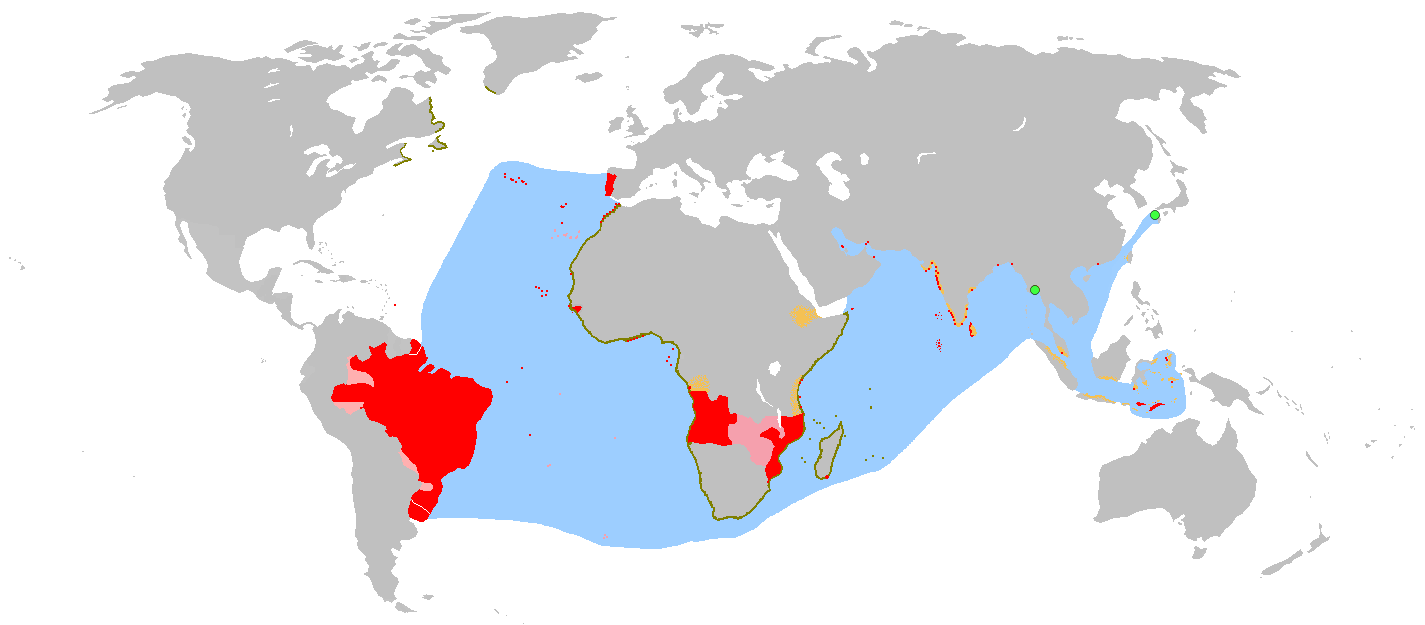
The Portuguese Empire and its interests

The Fifth Empire (Portuguese: Quinto Império) is an esoteric concept of a global Portuguese empire with spiritual and temporal power, based on an interpretation of Daniel 2 and the Book of Revelation, whose origins lay with António Vieira. The concept was re-popularized in the twentieth century with the publication of Mensagem by Fernando Pessoa in 1934.

The concept

[edit]

The Fifth Empire is not a mere territorial empire. It is a spiritual and linguistic body which spreads throughout the entire world. It represents the ultimate form of fusion between material (science, reason, intellectual speculation) and spiritual knowledge: the occult, mystical speculation and Kabbalism. It is the pinnacle of all the work undertaken by the previous empires (according to old principle of the translatio imperii), which are the following under Pessoa's point of view:

  • First Empire - Ancient Greece, all knowledge and experience extracted from the ancient empires;
  • Second Empire - Roman Empire, expansion of the First Empire's culture and knowledge;
  • Third Empire - Christianity, fusion between the First and the Second Empires, with the absorption of several eastern elements (such as Judaism) - the Christian Moral;
  • Fourth Empire - Europe, spreading throughout the entire world the outcome of the previous empires and the British hegemony, its culture and the English-speaking world as a result of the British Empire - the English individualism.[1]

The Fifth Empire, led by "the hidden one" (O Encoberto in the poem, an allusion to Sebastianism), will unite the entire world spiritually and culturally, led by the Portuguese Nation.

Origins

[edit]

The Fifth Empire is a messianic, millenarian (quiliástica) belief, designed by Father António Vieira in the seventeenth century.

The first four empires were, according to Vieira, in order: the Assyro-Chaldeans, the Persians, the Greeks and the Romans. The fifth was the Portuguese Empire.

As seen when viewing the book of Daniel 2, in the Hebrew scriptures (Old Testament), in Bible, Father António Vieira came to this myth based on a biblical passage that tells the story of King Nebuchadnezzar and his dream, with a statue that featured five kinds of materials.

The origins of the myth of the Fifth Empire are intimately connected with the history of Portugal. The death of King Sebastian and subsequent loss of independence were disastrous for the country and its colonial ambitions. The restoration of independence in 1640 did, however, give a new hope for the entire nation. Father António Vieira, in many of his works and sermons, would present John IV as the saviour, who would restore the grandiosity of the Portuguese Empire, leader of the Age of Discovery, and succeed to the four empires of ancient History (Vieira's past empires did not coincide with those advocated by Pessoa and mentioned above). As for the Fifth Monarchists later in England and other authors, although with some differences, Vieira, with an elaborate exegesis based on his vast knowledge of the Bible, believed that the timing was significant because the calendar year 1666 was approaching. The number 666 had been identified in the Book of Revelation with the ultimate human despot to rule the world, but who would be replaced by the second coming of the Messiah; this added to his belief that the Fifth Monarchy was possibly about to begin.

Gonçalo Anes Bandarra, the 16th century shoemaker turned prophet whom interpreters credit with foretelling accurately the coming of a period of 60 years when Portugal was under Spanish rule, the subsequent 1640 revolution and liberation under king John IV (after thirty scissors) and the reigns of Afonso VI, Peter II and John V,[2] was an inspired prophet to António Vieira and the Sebastianists of his time. His work also aroused interest especially among the new Christians. Bandarra had a vast knowledge from the Old Testament and his prophetic Trovas would also be subject to analysis and inspiration for Fernando Pessoa. In his poem "Mensagem", a book so thoroughly steeped in Templar and Rosicrucian symbolism in his own words, Pessoa reveals himself as the author of the third and final warning, which complements the two previous ones, of Bandarra and Vieira.[3]

From the 17th century on, and as the Portuguese Empire slowly crumbled, the dream became increasingly more mystical. Greater importance was given to Luís de Camões and his masterpiece, Os Lusíadas, which exalted Portugal as a nation of heroes aided by the classical gods.

Pessoa

[edit]

The third cycle of "Mensagem", called O Encoberto ("The Hidden One") refers to Fernando Pessoa's vision of a future world of peace and understanding, the Fifth Empire, which will come about through a Portuguese of mystical origin to which he refers by a number of names including "The Hidden One", "The King" or "King Sebastian". The Hidden One represents the fulfillment of the destiny of mankind, designed by God since before Time, and, at the same time, the accomplishment of Portugal which, in Pessoa's vision is the chosen nation, the one that will bear the New Messiah and lead the way towards the Fifth Empire:

There will be a meeting of the two long separated forces, but long approaching: the left side of wisdom – i.e. science, reasoning, intellectual speculation, and the right side of wisdom – that is, the hidden knowledge, intuition, the kabbalistic and mystical speculation. The alliance of D. Sebastian, Emperor of the World, and the Angelic Pope, figure this close alliance, this fusion of the material and the spiritual, perhaps without separation. And the very Second Advent, or even the new incarnation of the same Adept, whom once God has designed His symbol, or Son, seems to show otherwise this same supreme alliance.[4]

According to Pessoa "The Fifth Empire. Portugal's future – which I do not reckon, but I know – it is already written, for those who know how to read it, in the Bandarra's Trovas, and also in quatrains of Nostradamus". In The Prophecies of Nostradamus, Fernando Pessoa probably makes reference to the Tenth and last Century, including the Fifth quatrain and the last of all quatrains of this century, among many others in Nostradamus's Centuries.[5]

In Pessoa's vision, lusophone countries such as Brazil have a key role in this mission, supported by the Portuguese international alliances, including the Iberian nations, Britain, Ireland, the Atlantism, Greece and its legacy, and beyond.[6]

See also

[edit]

References

[edit]
Revisions and contributorsEdit on WikipediaRead on Wikipedia
from Grokipedia
The Fifth Empire (Quinto Império) is an eschatological concept in mysticism envisioning a prophesied universal Christian monarchy led by , succeeding the four historical empires—Babylonian, Persian, Greek, and Roman—as foretold in the visions of the . This idea posits 's divine election to establish a temporal and spiritual kingdom of Christ on Earth, marked by global evangelization, defeat of forces, and a millennial era of peace under a sovereign acting as . Rooted in biblical of and 7, where a divine stone crushes worldly kingdoms to form an everlasting realm, the Fifth Empire reframes 's Age of Discoveries as providential preparation for this cosmic fulfillment. The doctrine gained prominence through 16th- and 17th-century prophets amid national traumas, including the disappearance of King Sebastian I at the in 1578 and subsequent Spanish Habsburg rule until the 1640 Restoration. Early articulations appear in the rustic prophecies of Gonçalo Anes Bandarra, a 16th-century cobbler, while Jesuit missionary (1608–1697) systematized it in sermons and treatises like Esperanças de Portugal and Clavis Prophetarum, interpreting the Restoration under João IV as the empire's dawn and tying it to —the belief in Sebastian's hidden return to inaugurate the realm. Vieira's vision emphasized 's maritime prowess defeating the Ottoman Antichrist at sea, followed by universal conversion of and pagans, though his heterodox claims, diverging from Catholic orthodoxy viewing the Fifth Empire as the 's domain, led to imprisonment in 1663. Despite non-fulfillment, the Fifth Empire profoundly shaped Portuguese cultural identity, inspiring nationalist resilience during invasions and decline, and influencing modernist , notably Fernando Pessoa's esoteric poetry envisioning a spiritual Quinto Império beyond . It persists as a symbol of messianic destiny in Lusophone thought, blending Catholic with imperial nostalgia, though critiqued as millenarian unsubstantiated by historical outcomes.

Origins and Historical Context

Biblical Prophecies and Early Interpretations

The prophecies underpinning the Fifth Empire concept originate in the , a text from the dated to the 2nd century BCE during the Seleucid persecution of . In , , king of from 605–562 BCE, experiences a dream interpreted by Daniel as depicting four successive world empires symbolized by parts of a : a head of gold (), chest and arms of silver (Medo-Persia), belly and thighs of bronze (), and legs of iron with feet of iron and clay ( or a divided Hellenistic successor state). A stone "cut out, but not by human hands" then shatters the statue and expands into a mountain filling the earth, signifying an eternal, divinely established kingdom that supplants all prior powers. Complementing this, Daniel 7 portrays four beasts rising from the sea— a lion with eagle's wings, a bear raised on one side, a leopard with four wings and heads, and a terrifying beast with iron teeth and ten horns—again representing the same imperial sequence, with the fourth beast's dominance curtailed by divine judgment. The "Ancient of Days" then convenes, and "one like a son of man" receives everlasting dominion, glory, and a kingdom given to the "saints of the Most High," unbreakable and enduring forever. These visions employ a periodization scheme of imperial rise and fall, culminating in a transcendent fifth phase under God's sovereignty, distinct from human rule. Early Christian , from patristic writers like (c. 170–235 CE) onward, standardized the four empires as , Medo-Persia, Macedon/, and , interpreting the fifth kingdom as the messianic reign inaugurated by Christ, often equated with the Church's spiritual authority or an eschatological fulfillment. This framework influenced medieval apocalyptic thought, including of Fiore's (c. 1135–1202) trinitarian ages, which layered spiritual progression atop Daniel's model and anticipated a final monastic or evangelical era. In Iberian and contexts, nascent links to national destiny appeared during the and early maritime expansion, with chroniclers viewing Portugal's 12th-century foundation—epitomized by Afonso I's 1139 victory at Ourique, where a promised perpetual sovereignty—as aligning with biblical imperial typology, though explicit "fifth empire" emerged later amid 16th-century prophetic fervor. These interpretations emphasized causal continuity from ancient to contemporary providence, privileging Portugal's evangelizing role as a bridge between temporal conquest and divine universality, without yet specifying a named Quinto Império.

Sebastianism and the Myth of King Sebastian

King Sebastian I ascended to the Portuguese throne in 1557 at age three, following the death of his grandfather John III, and ruled personally from 1568 amid a fervent commitment to Catholic crusading ideals. In 1578, at age 24, he led a expedition to to support a deposed ruler against the Saadi dynasty, culminating in the on August 4, where Portuguese forces suffered catastrophic defeat, with Sebastian and much of the presumed killed amid the chaos, though his body was never definitively identified or recovered. This ambiguity, compounded by the ensuing succession crisis—Sebastian's granduncle Cardinal Henry briefly succeeded him but died in 1580 without an heir, leading to Portuguese annexation by under Philip II—fostered immediate speculation that the king had survived in disguise or captivity. The myth of Sebastian's survival rapidly evolved into Sebastianism (Sebastianismo), a messianic belief positing that the king, known as o Desejado ("the Desired One"), lived on as a hidden redeemer (o Encoberto) who would return during a foggy dawn to reclaim the throne, expel foreign domination, and restore Portugal's global preeminence. Rooted in pre-existing Iberian traditions of a concealed monarch from Andalusian folklore, Sebastianism manifested in popular prophecies, false claimants (such as a 1584 impostor in Spain executed after drawing followers), and suppressed uprisings, reflecting national despair over lost independence rather than empirical evidence of survival. Historians attribute the myth's persistence to psychological and cultural factors, including Portugal's trauma from imperial overreach and defeat, rather than verifiable facts, as contemporary accounts confirmed heavy casualties without Sebastian's confirmed remains. Sebastianism intertwined with Portuguese eschatology, framing the anticipated return as heralding the Quinto Império (Fifth Empire), a divinely ordained universal dominion succeeding the biblical four empires of antiquity (, Persia, , and ) as foretold in the , with positioned as its spiritual vanguard through evangelization and cultural synthesis. This fusion elevated Sebastian from a historical figure undone by hubris—his ill-advised African campaign ignored counsel and depleted resources—to a mythic precursor of renewal, influencing later nationalist and esoteric interpretations despite lacking causal basis in Sebastian's actual reign, which prioritized militant piety over pragmatic governance. The belief endured post-restoration of independence in , adapting to cycles of decline, though empirical assessments view it as a compensatory for geopolitical reversals, unsubstantiated by archival or archaeological evidence.

Prophecies of Gonçalves Bandarra

Gonçalo Anes Bandarra (c. 1500–1556), a shoemaker from the town of Trancoso in east-central , composed a collection of enigmatic prophetic verses known as the Trovas during the mid-16th century. These rustic octosyllabic poems, drawing on popular oral traditions and biblical apocalyptic imagery, critiqued social and ecclesiastical corruption while envisioning Portugal's renewal under divine guidance. Bandarra claimed his visions came through dreams, positioning his work within a tradition of lay prophecy amid the early Inquisition's scrutiny in . The Trovas outline a messianic framework influenced by scriptural sources such as the Book of Daniel, foretelling a sequence of universal ages or monarchies transitioning to a fifth era of spiritual and temporal supremacy led by Portugal. Central to this vision is the Rei Encoberto (Hidden King), a pastoral figure symbolizing a divinely chosen monarch who would emerge to purify the realm, expel foreign influences, and establish a universal empire centered on Lusophone dominion. Prophetic verses employ symbolic language, such as references to lions, infants, and banners, interpreted as allusions to restorations like "Saia, saia esse Infante / Bem andante, / O seu nome he D. Fuão [ou D. João]" or "Ja o Leaõ he experto / Mui alerto... / Desse bom Rei Encuberto," evoking a triumphant return amid trials. Bandarra's prophecies faced immediate censorship; interrogated by the around the 1540s, he was prohibited from discussing sacred matters publicly and ordered to clarify his verses, though his works were later included in banned book lists yet persisted through clandestine manuscripts. Posthumously, after King Sebastian's disappearance at the on August 4, 1578, interpreters retroactively linked the Rei Encoberto to Sebastian's presumed survival and return, fueling Sebastianist expectations of a Fifth Empire as Portugal's redemptive global hegemony. This connection amplified Bandarra's influence on later thinkers, despite the prophecies' original ambiguity predating Sebastian's reign.

Literary and Philosophical Development

Pre-Pessoa Interpretations in Portuguese Thought

In the 17th century, Jesuit priest and preacher António Vieira (1608–1697) provided one of the most influential pre-Pessoa interpretations of the Fifth Empire, framing it as a universalist Christian monarchy destined for Portugal amid its imperial expansions and the 1640 restoration of independence from Spain under the House of Braganza. Vieira drew on the Book of Daniel's vision of successive empires—Assyrian, Persian, Greek, and Roman—positing the fifth as a spiritual and temporal dominion led by a Portuguese "Encoberto" (hidden king), echoing Sebastianist expectations but reoriented toward evangelization and global unity rather than mere national revival. In sermons such as Esperanças de Portugal (1659), he argued that Portugal's maritime discoveries fulfilled providential signs, with Brazil as a pivotal site for the empire's realization, contingent on the mass conversion of Jews to Christianity as a prerequisite for millennial fulfillment. Vieira's História do Futuro, composed around 1676 but unpublished until the , systematized this vision through allegorical exegesis of prophecies from Daniel, , and , envisioning the Fifth Empire as eclipsing prior worldly powers through Portuguese-led spiritual regeneration rather than conquest alone. He integrated empirical elements of Portugal's 16th- and 17th-century achievements—such as the 1498 circumnavigation route and control over trade from to —into a causal framework where historical contingencies like the 1580 dynastic union with served as trials refining Portugal for divine favor. This interpretation diverged from earlier prophetic literalism by emphasizing intellectual and diplomatic agency, including Vieira's advocacy for Jewish resettlement in to harness their mercantile skills for imperial prosperity, though it provoked scrutiny in 1663 for perceived Judaizing tendencies and millenarian excess. Subsequent 18th- and 19th-century Portuguese thinkers occasionally invoked Vieira's framework amid Enlightenment and liberal reforms, but interpretations shifted toward symbolic rather than eschatological urgency; for instance, romantic historians like Alexandre Herculano (1810–1877) critiqued Sebastianist excesses while acknowledging the Fifth Empire motif as a cultural archetype of resilience post-1755 Lisbon earthquake and Napoleonic invasions. These views treated the concept less as predictive and more as a philosophical ideal of lusophone universality, influencing early positivist debates on Portugal's civilizational role without the mystical intensity of Vieira's original synthesis.

Fernando Pessoa's Elaboration in Mensagem

In Mensagem, published on December 1, 1934, presents his most explicit literary articulation of the Fifth Empire through the third cycle, titled O Encoberto ("The Hidden One"), comprising eight poems that envision a transcendent, spiritual dominion succeeding historical empires. This cycle builds on Sebastianist motifs by positing the Encoberto—a veiled, messianic Portuguese figure—as the of a universal era of enlightenment and harmony, distinct from prior territorial powers such as , Roman, Christian (or papal), and contemporary European empires. frames this empire not as geopolitical expansion but as a metaphysical fulfillment of 's latent imperial genius, rooted in esoteric wisdom and national mythology, where historical figures like King Sebastian symbolize latent potential awaiting reactivation. Central to O Encoberto is the poem "O Quinto Império" ("The Fifth Empire"), which sequences the empires as progressive epochs—Greece for , Rome for , Christianity for , and Europe for —culminating in Portugal's role as initiator of a fifth phase defined by integral knowledge and cosmic order. Pessoa employs symbolic and prophetic , drawing from Bandarra's prophecies and biblical echoes, to depict this realm as a synthesis of reason, , and imperial destiny, where Portugal, through the Encoberto's , restores a primordial harmony disrupted by historical decline. The cycle's structure—subdivided into anticipation, , and consummation—mirrors esoteric rites, emphasizing Pessoa's heteronymic of multiple realities converging in national redemption. Pessoa's elaboration elevates the Fifth Empire beyond mere nationalist revivalism, integrating influences from , , and his own visionary experiences, such as those documented in private writings from the 1910s onward, to portray it as an inevitable causal progression toward spiritual universality led by Portuguese cultural inheritance. While the work received the Prémio Antero de Quental from the Salazar regime in , Pessoa's intent, as inferred from contextual analyses, prioritizes metaphysical autonomy over state ideology, critiquing modern Europe's spiritual bankruptcy as a precondition for this imperial . This poetic framework thus reinterprets as a philosophical imperative for Portugal's existential mission, unbound by empirical verification yet grounded in historical symbolism.

Political and Ideological Applications

Invocation During the Estado Novo

The Estado Novo regime (1933–1974) under António de Oliveira Salazar selectively invoked the Fifth Empire concept as part of its imperial mythology to reinforce Portugal's pluricontinental identity and justify colonial retention amid pressures. This invocation drew on historical prophecies, including those of António Vieira and Fernando Pessoa's Mensagem (1934), framing Portugal's global role as a civilizing and evangelizing force destined for spiritual predominance. The regime's apparatus, notably the Secretariado de Propaganda Nacional (SPN, established 1933), integrated these motifs into cultural campaigns, such as the 1934 publication O Mundo Português, which glorified Portugal's exploratory past as a precursor to a renewed empire. Pessoa's Mensagem, awarded the Portuguese Poetry Prize in 1934 by an entity linked to the regime's educational arm, provided a poetic blueprint for the Fifth Empire, envisioning a synthesis of temporal power and universal spirituality led by a messianic figure akin to the "Encoberto" (hidden one). Regime-aligned intellectuals, including João Ameal, referenced this vision to depict Salazar's as an "immense empire in potency," bridging saudosista nostalgia with contemporary . Colonial under Estado Novo further cultivated the , portraying overseas provinces as integral to a national destiny transcending material conquest, thereby countering international criticism of Portugal's holdings in and . Sebastianist undertones, intertwined with Fifth Empire , appeared opportunistically in official rhetoric to foster national cohesion, equating the regime's stability with prophetic fulfillment—Salazar occasionally positioned as a quasi-Sebastic restorer. Events like the Portuguese World Exhibition (1940) amplified this through exhibits linking biblical empires to Portugal's "total empire," emphasizing evangelization over exploitation. However, Salazar's personal doctrine prioritized corporatist pragmatism and fiscal orthodoxy, subordinating esoteric invocations to anti-communist and anti-liberal imperatives, with mystical elements serving more as cultural glue than policy driver. Critics within and outside the noted the selective adaptation, where Fifth Empire idealism masked economic underdevelopment and colonial strains, yet it sustained propaganda until the colonial wars eroded its viability. By the late period under (1968–1974), invocations waned amid liberalization attempts, though the myth lingered in nationalist circles.

Post-1974 Adaptations and Lusophone Identity

Following the on April 25, 1974, which overthrew the Estado Novo dictatorship and prompted rapid , Portuguese interpretations of the Fifth Empire shifted from territorial expansionism to a cultural and linguistic paradigm centered on lusofonia. The independence of key African colonies, including and in November 1975, rendered literal imperial revival obsolete, prompting intellectuals and policymakers to recast the concept as a spiritual union of Portuguese-speaking peoples fulfilling a civilizational mission without political domination. This adaptation drew on pre-1974 thinkers like Agostinho da Silva, who conceived the Fifth Empire as a voluntary "international union of peoples" rooted in 's historical role in global interconnectedness, influencing post-revolutionary discourse on shared Lusophone heritage as a non-imperial legacy. In foreign policy, lusofonia emerged as a cornerstone of , positioning as a bridge between , , and the through language and cultural affinity, rather than colonial hierarchies. The creation of the (CPLP) on July 17, 1996, by founding members including , , , , , , and São Tomé and Príncipe, institutionalized this vision, emphasizing economic, political, and cultural cooperation among over 280 million speakers worldwide. Proponents framed the CPLP as a pragmatic embodiment of the Fifth Empire's utopian ideals, promoting and amid 's integration into the since 1986, though critics note its limited tangible outcomes beyond symbolic solidarity. In contemporary geopolitical thought, lusofonia sustains the Fifth Empire narrative by asserting Portuguese centrality in a post-colonial order, with some discourses invoking it to counter marginalization in global affairs and reinforce identity amid economic challenges. Nationalist fringes adapt the for ethno-cultural revivalism, linking it to anti-globalist sentiments, but mainstream applications prioritize democratic pluralism and linguistic over messianic exclusivity. This evolution reflects causal adaptations to empirical realities—decolonization's irreversibility and globalization's demands—transforming eschatological prophecy into a framework for transnational identity.

Modern Revivals and Cultural Impact

Contemporary Esoteric and Nationalist Movements

In the early , the Quinto Império concept has seen esoteric revivals primarily through reinterpretations emphasizing spiritual and cultural over territorial expansion, drawing on Pessoa's vision of as a global center of wisdom. Organizations like FiVth Empire host summits in , , such as the event scheduled for May 4, 2025, which frames the Fifth as an "empire of " integrating , decentralized economies, and consciousness expansion, inspired by biblical prophecies from the and Pessoa's non-imperialist elaborations. These gatherings attract innovators and visionaries, positioning the idea within a syncretic blend of , , and , though critics note its detachment from historical in favor of a globalist . Esoteric elements persist in niche cultural expressions, including music and influenced by Catholic and Sebastianist motifs. Post-1974 Portuguese pop has invoked the Quinto Império in bands like Heróis do Mar (active mid-1980s), whose New Wave lyrics and imperial aesthetics evoked nostalgic , and Sétima Legião (1980s ), with tracks such as "Glória" channeling Atlantean and oceanic themes tied to a spiritual empire. More recently, groups like Os Golpes, via their Amor Fúria label and 2010s album Cruz Vermelha sobre Fundo Branco, reference prophets like and Pessoa alongside Agostinho da Silva, promoting a Lusophone encompassing former colonies without racial hierarchies. These artistic adaptations reflect a post-colonial shift toward esoteric identity, blending Theosophical and Rosicrucian influences from Pessoa's era with modern esotericism, though they remain subcultural rather than mass movements. Nationalist appropriations in contemporary are more subdued, often appearing in traditionalist or identitarian discourse as a symbol of cultural amid challenges. The idea surfaces in discussions of lusotropical heritage, invoking 's historical discoveries as a precursor to a non-material of language and Catholicism spanning and African Lusophone nations, as rearticulated by thinkers like Glauco Ortolano in 21st-century writings that extend the prophecy to Brazilian resurgence. However, organized nationalist groups rarely center it politically; instead, it informs fringe pagan or monarchist circles linking it to pre-modern and anti-globalist sentiments, as noted in analyses of modern paganism where the Fifth represents a destined spiritual succeeding material ones. Mainstream right-wing platforms, such as those analyzed in studies of nationalist (circa 2023), prioritize and over messianic narratives, suggesting the Quinto Império's nationalist pull is largely rhetorical and confined to or cultural revivalism rather than activist . This marginal status underscores its evolution from Estado Novo to a symbolic tool for identity preservation in a secular, EU-aligned .

Events and Media Representations (e.g., FiVth Empire Summit)

The FiVth Empire Summit, convened in , , exemplifies a contemporary event invoking the Fifth Empire prophecy through lenses of personal enlightenment and civilizational evolution. Held on May 4, 2025, at Quinta da Bella Vista, the gathering assembled visionaries for mind-expanding keynotes, sound journeys, vocal healing sessions, and workshops on sacred connections. Speakers included Robert Edward Grant, a focused on and invention; Adam Roa, a motivational ; and Reachel , a vocal healer, among others such as environmentalist Jarvis Smith and the Human Garage collective on somatic health. Organizers explicitly tied the summit to the Portuguese Fifth Empire tradition, drawing from Fernando Pessoa's Mensagem and ancient prophecies originating in the , reenvisioning the empire as a non-territorial realm of timeless wisdom, art, and synchronicities rather than geopolitical dominance. The accompanying describes , particularly Sintra's mystical heritage, as the epicenter for this shift, merging Pessoa's spiritual universalism with modern elements like AI-enhanced , blockchain-driven , and a "new " of to foster inner mastery amid technological and economic transformations. In April 2025, the FiVth initiative partnered with the for a joint weekend event emphasizing , conscious , and experiential sessions, attracting participants seeking holistic advancement. Beyond the FiVth series, other modern gatherings perpetuate the theme, such as the Ágora do Quinto Império, a venue facilitating congresses, therapeutic dynamics, vodcasts, and spaces centered on the Fifth Empire's esoteric and cultural dimensions. Academic-oriented events like the V Jornadas de História, Filosofia Hermética e Património Simbólico in Oeiras explore the Quinto Império as the prophetic culmination of historical empires into a universal age of concord, tracing its roots to rabbinic interpretations of Daniel's visions. Quinto Império Viagens, meanwhile, organizes themed historical and cultural tours invoking the concept to reinterpret Portugal's imperial legacy. In media, the Fifth Empire motif recurs in strategy video games like , where it manifests as an alternate-history national focus tree for , enabling paths toward authoritarian resurgence, monarchist restoration, or imperial revival through military and diplomatic mechanics. These representations often depict the empire as a vehicle for reclaiming global influence, diverging from mystical origins to emphasize simulations. Such portrayals in gaming communities highlight the concept's adaptability in , though they prioritize gameplay over historical fidelity.

Criticisms and Skeptical Perspectives

Empirical and Rational Critiques

The doctrine of the Fifth Empire, positing a transcendent Portuguese-led global order succeeding the Assyrian, Persian, Greek, and Roman empires, encounters empirical refutation through Portugal's documented imperial contraction and absence of resurgence. After pioneering maritime expansion in the 15th–16th centuries, Portugal's holdings fragmented amid Dutch seizures of Asian entrepôts (e.g., in 1641, Ceylon by 1658) and English commercial encroachments, culminating in Brazil's in and exhaustive colonial wars from to 1974 that precipitated the and rapid by 1975. These events, driven by manpower shortages—Portugal's population hovered at 1–2 million during its imperial zenith—and fiscal overstretch, yielded no reversal toward dominion, with overseas territories reduced to zero by the late . Contemporary metrics further undermine claims of spiritual or temporal primacy: Portugal's 2023 GDP stood at approximately $287 billion, dwarfed by former colony Brazil's $2.1 trillion, while its population of 10.3 million limits demographic heft for global projection. Lusophone networks like the (CPLP, founded 1996) foster through shared language among 280 million speakers, yet trails and in economic and resource influence, with no evidence of the prophesied "empire of the spirit" manifesting in unified cultural or ideological leadership. Historical analyses attribute this stasis to "" effects from Brazilian gold inflows (1690s–1750s), which inflated domestic costs and stifled diversification, rather than any latent messianic potential. From a rational standpoint, the concept's reliance on prophetic —drawing from Daniel's kingdoms, Sebastianist return myths (despite King Sebastian's confirmed death at Alcácer Quibir in 1578), and Kabbalistic sephirot—eschews testable hypotheses or causal pathways, rendering it unfalsifiable akin to millenarian ideologies. Empires arise via material enablers like population scale, innovation sustainment, and alliance networks; Portugal's post-1580 with diluted autonomy, while chronic underinvestment in perpetuated lag behind rivals. Pessoa's Mensagem (1934) articulates this as mythic nationalism amid decline, but lacks predictive rigor, functioning instead as symbolic consolation without grounding in geopolitical determinism or economic modeling. Academic deconstructions frame it as ideological construct for regime legitimacy under the Estado Novo (1933–1974), unsubstantiated by post hoc outcomes.

Associations with Nationalism and Escapism

The Fifth Empire concept has been closely associated with Portuguese , particularly through its invocation as a symbol of enduring cultural and spiritual superiority amid historical decline. Fernando Pessoa's Mensagem (1934) reimagined the idea as a forward-looking to foster national rejuvenation, positioning Portugal as destined for global intellectual leadership following the empires of , , , and industrial , thereby aiming to mobilize sentiment against and fragmentation. During the Estado Novo regime (1933–1974), the mythology was adapted into state propaganda, merging Catholic with imperial nostalgia to reinforce authoritarian unity and justify retention of African colonies as part of a providential mission. In post-1974 contexts, nationalist groups have repurposed it to promote Lusophone solidarity, framing language and shared heritage as tools for revival, though often detached from territorial ambitions. Critics, however, frequently portray the Fifth Empire as an escapist , a millenarian narrative enabling evasion of Portugal's empirical post-imperial realities, such as and geopolitical marginalization after in 1975. Rooted in 17th-century prophecies like those of , it functions as a "mechanism for coping with the and sense of loss," substituting spiritual fantasies for concrete amid the transition from colonial metropolis to peripheral EU member. This utopian dimension persists in cultural expressions, including rock bands like Heróis do Mar and Sétima Legião, where lyrics evoke mythical regeneration as emotional refuge rather than actionable ideology, highlighting its role in sustaining identity amid modernization's discontents. While proponents argue it counters with aspirational realism, skeptics contend its ahistorical hinders rational engagement with global constraints, as evidenced by its marginal influence on despite recurrent rhetorical revivals.

References

Add your contribution
Related Hubs
User Avatar
No comments yet.