



Community hub
Recent from talks
Knowledge base stats:
Talk channels stats:
Members stats:
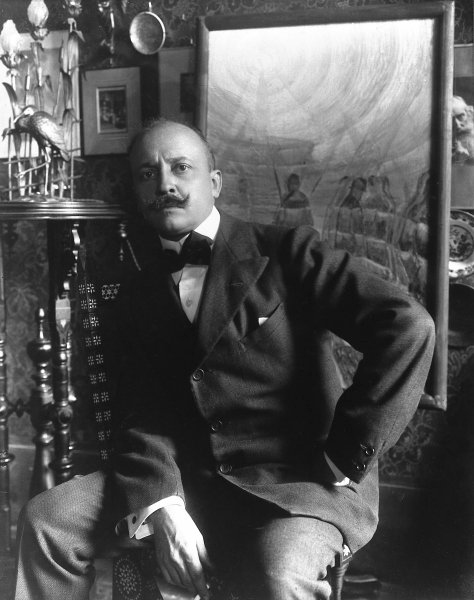
Filippo Tommaso Marinetti
Filippo Tommaso Emilio Marinetti (Italian: [fiˈlippo tomˈmaːzo mariˈnetti]; 22 December 1876 – 2 December 1944) was an Italian poet, editor, art theorist and founder of the Futurist movement. He was associated with the utopian and Symbolist artistic and literary community Abbaye de Créteil between 1907 and 1908. Marinetti is best known as the author of the Manifesto of Futurism, which was written and published in 1909, and as a co-author of the Fascist Manifesto, in 1919.
Emilio Angelo Carlo Marinetti (some documents give his name as "Filippo Achille Emilio Marinetti") spent the first years of his life in Alexandria, Egypt, where his father, Enrico Marinetti, and mother, Amalia Grolli, lived together more uxorio (as if married). Enrico was a lawyer from Piedmont, and his mother was the daughter of a literary professor from Milan. They had come to Egypt in 1865 at the invitation of Khedive Isma'il Pasha to act as legal advisers for foreign companies that were taking part in his modernization program.
Marinetti's love for literature developed during the school years. His mother was an avid reader of poetry and introduced her young son to the Italian and other European classics. At 17, he started his first school magazine, Papyrus; the Jesuits threatened to expel him for publicizing Émile Zola's scandalous novels in the school.
He studied in Egypt and then in Paris, obtained a baccalauréat degree in 1894 at the Sorbonne University and in Italy, and graduated in law at the University of Pavia in 1899.
He decided not to be a lawyer but to develop a literary career. He experimented with every type of literature (poetry, narrative, theatre, words in liberty) and signed everything "Filippo Tommaso Marinetti".
Marinetti and Constantin Brâncuși were visitors of the Abbaye de Créteil around 1908, along with young writers like Roger Allard (one of the first to defend Cubism), Pierre Jean Jouve and Paul Castiaux, who wanted to publish their works through the Abbaye. The Abbaye de Créteil was a phalanstère community founded in the autumn of 1906 by the painter Albert Gleizes, and the poets René Arcos, Henri-Martin Barzun, Alexandre Mercereau and Charles Vildrac. The movement drew its inspiration from the Abbaye de Thélème, a fictional creation by Rabelais in his novel Gargantua. It was closed down by its members in early 1908.
Marinetti is known best as the author of the Futurist Manifesto, which he wrote in 1909. It was published in French on the front page of the most prestigious French daily newspaper, Le Figaro, on 20 February 1909. Marinetti declared in it, "Art, in fact, can be nothing but violence, cruelty, and injustice". Georges Sorel, who influenced the entire political spectrum from anarchism to Fascism, also argued for the importance of violence. Futurism had both anarchist and Fascist elements; Marinetti later became an active supporter of Benito Mussolini.
Marinetti, who admired speed, had a minor car crash outside Milan in 1908 after he veered into a ditch to avoid two cyclists. He referred to the crash in the Futurist Manifesto. The Marinetti who was helped out of the ditch was a new man, determined to end the pretense and decadence of the prevailing Liberty style. He discussed a new and strongly revolutionary programme with his friends, in which they should end every artistic relationship with the past, "destroy the museums, the libraries, every type of academy". Together, he wrote, "We will glorify war—the world's only hygiene—militarism, patriotism, the destructive gesture of freedom-bringers, beautiful ideas worth dying for, and scorn for woman".
Hub AI
Filippo Tommaso Marinetti AI simulator
(@Filippo Tommaso Marinetti_simulator)
Filippo Tommaso Marinetti
Filippo Tommaso Emilio Marinetti (Italian: [fiˈlippo tomˈmaːzo mariˈnetti]; 22 December 1876 – 2 December 1944) was an Italian poet, editor, art theorist and founder of the Futurist movement. He was associated with the utopian and Symbolist artistic and literary community Abbaye de Créteil between 1907 and 1908. Marinetti is best known as the author of the Manifesto of Futurism, which was written and published in 1909, and as a co-author of the Fascist Manifesto, in 1919.
Emilio Angelo Carlo Marinetti (some documents give his name as "Filippo Achille Emilio Marinetti") spent the first years of his life in Alexandria, Egypt, where his father, Enrico Marinetti, and mother, Amalia Grolli, lived together more uxorio (as if married). Enrico was a lawyer from Piedmont, and his mother was the daughter of a literary professor from Milan. They had come to Egypt in 1865 at the invitation of Khedive Isma'il Pasha to act as legal advisers for foreign companies that were taking part in his modernization program.
Marinetti's love for literature developed during the school years. His mother was an avid reader of poetry and introduced her young son to the Italian and other European classics. At 17, he started his first school magazine, Papyrus; the Jesuits threatened to expel him for publicizing Émile Zola's scandalous novels in the school.
He studied in Egypt and then in Paris, obtained a baccalauréat degree in 1894 at the Sorbonne University and in Italy, and graduated in law at the University of Pavia in 1899.
He decided not to be a lawyer but to develop a literary career. He experimented with every type of literature (poetry, narrative, theatre, words in liberty) and signed everything "Filippo Tommaso Marinetti".
Marinetti and Constantin Brâncuși were visitors of the Abbaye de Créteil around 1908, along with young writers like Roger Allard (one of the first to defend Cubism), Pierre Jean Jouve and Paul Castiaux, who wanted to publish their works through the Abbaye. The Abbaye de Créteil was a phalanstère community founded in the autumn of 1906 by the painter Albert Gleizes, and the poets René Arcos, Henri-Martin Barzun, Alexandre Mercereau and Charles Vildrac. The movement drew its inspiration from the Abbaye de Thélème, a fictional creation by Rabelais in his novel Gargantua. It was closed down by its members in early 1908.
Marinetti is known best as the author of the Futurist Manifesto, which he wrote in 1909. It was published in French on the front page of the most prestigious French daily newspaper, Le Figaro, on 20 February 1909. Marinetti declared in it, "Art, in fact, can be nothing but violence, cruelty, and injustice". Georges Sorel, who influenced the entire political spectrum from anarchism to Fascism, also argued for the importance of violence. Futurism had both anarchist and Fascist elements; Marinetti later became an active supporter of Benito Mussolini.
Marinetti, who admired speed, had a minor car crash outside Milan in 1908 after he veered into a ditch to avoid two cyclists. He referred to the crash in the Futurist Manifesto. The Marinetti who was helped out of the ditch was a new man, determined to end the pretense and decadence of the prevailing Liberty style. He discussed a new and strongly revolutionary programme with his friends, in which they should end every artistic relationship with the past, "destroy the museums, the libraries, every type of academy". Together, he wrote, "We will glorify war—the world's only hygiene—militarism, patriotism, the destructive gesture of freedom-bringers, beautiful ideas worth dying for, and scorn for woman".