


Community hub
Recent from talks
Contribute something
Nothing was collected or created yet.
Jesuits
View on Wikipedia
Key Information


 |
| Part of a series on the |
| Society of Jesus |
|---|
 |
| History |
| Hierarchy |
| Spirituality |
| Works |
| Notable Jesuits |
The Society of Jesus (Latin: Societas Iesu; abbreviation: S.J. or SJ), also known as the Jesuit Order or the Jesuits (/ˈdʒɛʒuɪts, ˈdʒɛzju-/ JEZH-oo-its, JEZ-ew-;[2] Latin: Iesuitae),[3] is a religious order of clerics regular of pontifical right for men in the Catholic Church headquartered in Rome. It was founded in 1540 by Ignatius of Loyola and six companions, with the approval of Pope Paul III. The Society of Jesus is the largest religious order in the Catholic Church and has played a significant role in education, charity, humanitarian acts and global policies. The Society of Jesus is engaged in evangelization and apostolic ministry in 112 countries. Jesuits work in education, research, and cultural pursuits. They also conduct retreats, minister in hospitals and parishes, sponsor direct social and humanitarian works, and promote ecumenical dialogue.
The Society of Jesus is consecrated under the patronage of Madonna della Strada, a title of the Blessed Virgin Mary, and it is led by a superior general.[4][5] The headquarters of the society, its general curia, is in Rome.[6] The historic curia of Ignatius is now part of the Collegio del Gesù attached to the Church of the Gesù, the Jesuit mother church.
Members of the Society of Jesus make profession of "perpetual poverty, chastity, and obedience" and "promise a special obedience to the sovereign pontiff in regard to the missions." A Jesuit is expected to be totally available and obedient to his superiors, accepting orders to go anywhere in the world, even if required to live in extreme conditions. Ignatius, its leading founder, was a nobleman who had a military background. The opening lines of the founding document of the Society of Jesus accordingly declare that it was founded for "whoever desires to serve as a soldier of God,[a] to strive especially for the defense and propagation of the faith, and for the progress of souls in Christian life and doctrine".[7] Jesuits are thus sometimes referred to colloquially as "God's soldiers",[8] "God's marines",[9] or "the Company".[10] The Society of Jesus participated in the Counter-Reformation and, later, in the implementation of the Second Vatican Council.
Jesuit missionaries established missions around the world from the 16th to the 18th century and had both successes and failures in Christianizing the native peoples. The Jesuits have always been controversial within the Catholic Church and have frequently clashed with secular governments and institutions. Beginning in 1759, the Catholic Church expelled Jesuits from most countries in Europe and from European colonies. Pope Clement XIV officially suppressed the order in 1773. In 1814, the Church lifted the suppression.
History
[edit]Foundation
[edit]
Ignatius of Loyola, a Basque nobleman from the Pyrenees area of northern Spain, founded the society after discerning his spiritual vocation while recovering from a wound sustained in the Battle of Pamplona.
On 15 August 1534, Ignatius of Loyola (born Íñigo López de Loyola), a Spaniard from the Basque city of Loyola, and six others mostly of Castilian origin, all students at the University of Paris,[11] met in Montmartre outside Paris, in a crypt beneath the church of Saint Denis, now Saint Pierre de Montmartre, to pronounce promises of poverty, chastity, and obedience.[12] Ignatius' six companions were: Francisco Xavier from Navarre (modern Spain), Alfonso Salmeron, Diego Laínez, Nicolás Bobadilla from Castile (modern Spain), Peter Faber from Savoy, and Simão Rodrigues from Portugal.[13]
The meeting is commemorated in the Martyrium of Saint Denis, Montmartre. They called themselves the Compañía de Jesús, and also Amigos en El Señor or "Friends in the Lord", because they felt "they were placed together by Christ." The name "company" had echoes of the military (reflecting perhaps Ignatius' background as captain in the Spanish army) as well as of discipleship (the "companions" of Jesus). The Spanish "company" would be translated into Latin as societas like in socius, a partner or comrade. From this came Societas Iesu (S.J.), in English Society of Jesus, by which they would be known more widely.[14]
Religious orders established in the medieval era were named after particular men: Francis of Assisi (Franciscans); Domingo de Guzmán, later canonized as Saint Dominic (Dominicans); and Augustine of Hippo (Augustinians). Ignatius of Loyola and his followers appropriated the name of Jesus for their new order, provoking resentment by other orders who considered it presumptuous. The resentment was recorded by Jesuit José de Acosta of a conversation with the Archbishop of Santo Domingo.[15]
In the words of one historian: "The use of the name Jesus gave great offense. Both on the Continent and in England, it was denounced as blasphemous; petitions were sent to kings and to civil and ecclesiastical tribunals to have it changed; and even Pope Sixtus V had signed a Brief to do away with it." But nothing came of all the opposition; there were already congregations named after the Trinity and as "God's daughters".[16]
In 1537, the seven travelled to Italy to seek papal approval for their order. Pope Paul III gave them a commendation, and permitted them to be ordained priests. These initial steps led to the official founding in 1540.
They were ordained in Venice by the bishop of Arbe on 24 June. They devoted themselves to preaching and charitable work in Italy. The Italian War of 1536–1538 renewed between Charles V, Holy Roman Emperor, Venice, the Pope, and the Ottoman Empire, had rendered any journey to Jerusalem impossible.
Again in 1540, they presented the project to Paul III. After months of dispute, a congregation of cardinals reported favourably upon the Constitution presented, and Paul III confirmed the order through the bull Regimini militantis ecclesiae ("To the Government of the Church Militant"), on 27 September 1540. This is the founding document of the Society of Jesus as an official Catholic religious order. Ignatius was chosen as the first Superior General. Paul III's bull had limited the number of its members to sixty. This limitation was removed through the bull Exposcit debitum of Julius III in 1550.[17]
In 1543, Peter Canisius entered the company. Ignatius sent him to Messina, where he founded the first Jesuit college in Sicily.
Ignatius laid out his original vision for the new order in the "Formula of the Institute of the Society of Jesus",[18] which is "the fundamental charter of the order, of which all subsequent official documents were elaborations and to which they had to conform".[19] He ensured that his formula was contained in two papal bulls signed by Pope Paul III in 1540 and by Pope Julius III in 1550.[18] The formula expressed the nature, spirituality, community life, and apostolate of the new religious order. Its famous opening statement echoed Ignatius' military background:

Whoever desires to serve as a soldier of God beneath the banner of the Cross in our Society, which we desire to be designated by the Name of Jesus, and to serve the Lord alone and the Church, his spouse, under the Roman Pontiff, the Vicar of Christ on earth, should, after a solemn vow of perpetual chastity, poverty and obedience, keep what follows in mind. He is a member of a Society founded chiefly for this purpose: to strive especially for the defence and propagation of the faith and for the progress of souls in Christian life and doctrine, by means of public preaching, lectures and any other ministration whatsoever of the Word of God, and further by means of retreats, the education of children and unlettered persons in Christianity, and the spiritual consolation of Christ's faithful through hearing confessions and administering the other sacraments. Moreover, he should show himself ready to reconcile the estranged, compassionately assist and serve those who are in prisons or hospitals, and indeed, to perform any other works of charity, according to what will seem expedient for the glory of God and the common good.[20]

In fulfilling the mission of the "Formula of the Institute of the Society", the first Jesuits concentrated on a few key activities. First, they founded schools throughout Europe. Jesuit teachers were trained in both classical studies and theology, and their schools reflected this. These schools taught with a balance of Aristotelian methods with mathematics.[21]
Second, they sent out missionaries across the globe to evangelize those peoples who had not yet heard the Gospel, founding missions in widely diverse regions such as modern-day Paraguay, Japan, Ontario, and Ethiopia. One of the original seven arrived in India already in 1541.[22] Finally, though not initially formed for the purpose, they aimed to stop Protestantism from spreading and to preserve communion with Rome and the pope. The zeal of the Jesuits overcame the movement toward Protestantism in the Polish–Lithuanian Commonwealth and southern Germany.
Ignatius wrote the Jesuit Constitutions, adopted in 1553, which created a centralised organization and stressed acceptance of any mission to which the pope might call them.[23][24][25] His main principle became the unofficial Jesuit motto: Ad Maiorem Dei Gloriam ("For the greater glory of God"). This phrase is designed to reflect the idea that any work that is not evil can be meritorious for the spiritual life if it is performed with this intention, even things normally considered of little importance.[17]
The Society of Jesus is classified among institutes as an order of clerks regular, that is, a body of priests organized for apostolic work, and following a religious rule.
The term Jesuit (of 15th-century origin, meaning "one who used too frequently or appropriated the name of Jesus") was first applied to the society in reproach (1544–1552).[26] The term was never used by Ignatius of Loyola, but over time, members and friends of the society adopted the name with a positive meaning.[16]
While the order is limited to men, Joanna of Austria, Princess of Portugal, favored the order and she is reputed to have been admitted surreptitiously under a male pseudonym.[27]
Early works
[edit]
 | This section needs additional citations for verification. (August 2020) |
The Jesuits were founded just before the Council of Trent (1545–1563) and ensuing Counter-Reformation that would introduce reforms within the Catholic Church, and so counter the Protestant Reformation throughout Catholic Europe.
Ignatius and the early Jesuits did recognize, though, that the hierarchical church was in dire need of reform. Some of their greatest struggles were against corruption, venality, and spiritual lassitude within the Catholic Church. Ignatius insisted on a high level of academic preparation for the clergy in contrast to the relatively poor education of much of the clergy of his time. The Jesuit vow against "ambitioning prelacies" can be seen as an effort to counteract another problem evidenced in the preceding century.
Ignatius and the Jesuits who followed him believed that the reform of the church had to begin with the conversion of an individual's heart. One of the main tools the Jesuits have used to bring about this conversion is the Ignatian retreat, called the Spiritual Exercises. During a four-week period of silence, individuals undergo a series of directed meditations on the purpose of life and contemplations on the life of Christ. They meet regularly with a spiritual director who guides their choice of exercises and helps them to develop a more discerning love for Christ.
The retreat follows a "Purgative-Illuminative-Unitive" pattern in the tradition of the spirituality of John Cassian and the Desert Fathers. Ignatius' innovation was to make this style of contemplative mysticism available to all people in active life. He used it as a means of rebuilding the spiritual life of the church. The Exercises became both the basis for the training of Jesuits and one of the essential ministries of the order: giving the exercises to others in what became known as "retreats".
The Jesuits' contributions to the late Renaissance were significant in their roles both as a missionary order and as the first religious order to operate colleges and universities as a principal and distinct ministry.[21] By the time of Ignatius' death in 1556, the Jesuits were already operating a network of 74 colleges on three continents. A precursor to liberal education, the Jesuit plan of studies incorporated the Classical teachings of Renaissance humanism into the Scholastic structure of Catholic thought.[21] This method of teaching was important in the context of the Scientific Revolution, as these universities were open to teaching new scientific and mathematical methodology. Further, many important thinkers of the Scientific Revolution were educated by Jesuit universities.[21]
In addition to the teachings of faith, the Jesuit Ratio Studiorum (1599) would standardize the study of Latin, Greek, classical literature, poetry, and philosophy as well as non-European languages, sciences, and the arts. Jesuit schools encouraged the study of vernacular literature and rhetoric, and thereby became important centres for the training of lawyers and public officials.
The Jesuit schools played an important part in winning back to Catholicism a number of European countries which had for a time been predominantly Protestant, notably Poland and Lithuania. Today, Jesuit colleges and universities are located in over one hundred nations around the world. Under the notion that God can be encountered through created things and especially art, they encouraged the use of ceremony and decoration in Catholic ritual and devotion. Perhaps as a result of this appreciation for art, coupled with their spiritual practice of "finding God in all things", many early Jesuits distinguished themselves in the visual and performing arts as well as in music. The theater was a form of expression especially prominent in Jesuit schools.[28]
Jesuit priests often acted as confessors to kings during the early modern period. They were an important force in the Counter-Reformation and in the Catholic missions, in part because their relatively loose structure (without the requirements of living and celebration of the Liturgy of Hours in common) allowed them to be flexible and meet diverse needs arising at the time.[29]
Expansion of the order
[edit] | This section may be confusing or unclear to readers. (December 2019) |

After much training and experience in theology, Jesuits went across the globe in search of converts to Christianity. Despite their dedication, they had little success in Asia, except in the Philippines. For instance, early missions in Japan resulted in the government granting the Jesuits the feudal fiefdom of Nagasaki in 1580. This was removed in 1587 due to fears over their growing influence.[30] Jesuits did, however, have much success in Latin America. Their ascendancy in societies in the Americas accelerated during the seventeenth century, wherein Jesuits created new missions in Peru, Colombia, and Bolivia. As early as 1603, there were 345 Jesuit priests in Mexico alone.[31]

In 1541, Francis Xavier, one of the original companions of Loyola, arrived in Goa, Portuguese India, to carry out evangelical service in the Indies. In a 1545 letter to John III of Portugal, he requested an Inquisition to be installed in Goa to combat heresies like crypto-Judaism and crypto-Islam. Under Portuguese royal patronage, Jesuits thrived in Goa and until 1759 successfully expanded their activities to education and healthcare.[32]
In 1594, they founded the first Roman-style academic institution in the East, St. Paul Jesuit College in Macau, China. Founded by Alessandro Valignano, it had a great influence on the learning of Eastern languages (Chinese and Japanese) and culture by missionary Jesuits, becoming home to the first western sinologists such as Matteo Ricci. Jesuit efforts in Goa were interrupted by the expulsion of the Jesuits from Portuguese territories in 1759 by the powerful Marquis of Pombal, the Secretary of State in Portugal.[32]
In 1624, the Portuguese Jesuit António de Andrade founded a mission in Western Tibet. In 1661, two Jesuit missionaries, Johann Grueber and Albert Dorville, reached Lhasa, in Tibet. The Italian Jesuit Ippolito Desideri established a new Jesuit mission in Lhasa and Central Tibet (1716–21) and gained an exceptional mastery of Tibetan language and culture, writing a long and very detailed account of the country and its religion as well as treatises in Tibetan that attempted to refute key Buddhist ideas and establish the truth of Catholic Christianity.

Jesuit missions in the Americas became controversial in Europe, especially in Spain and Portugal, where they were seen as interfering with the proper colonial enterprises of the royal governments. The Jesuits were often the only force standing between the Indigenous and slavery. Together throughout South America but especially in present-day Brazil and Paraguay, they formed Indigenous Christian city-states, called "reductions". These were societies set up according to an idealized theocratic model.[31]
The efforts of Jesuits like Antonio Ruiz de Montoya to protect the natives from enslavement by Spanish and Portuguese colonizers contributed to the call for the society's suppression. Jesuit priests such as Manuel da Nóbrega and José de Anchieta founded several towns in Brazil in the 16th century, including São Paulo and Rio de Janeiro, and were very influential in the pacification, religious conversion, and education of indigenous nations. They built schools, organized people into villages, and created a writing system for the local languages of Brazil.[31] José de Anchieta and Manuel da Nóbrega were the first Jesuits that Ignacio de Loyola sent to the Americas.[33]
Jesuit scholars working in foreign missions were very dedicated in studying the local languages and strove to produce Latinized grammars and dictionaries. This included: Japanese (see Nippo jisho, also known as Vocabvlario da Lingoa de Iapam, "Vocabulary of the Japanese Language", a Japanese–Portuguese dictionary written 1603); Vietnamese (Portuguese missionaries created the Vietnamese alphabet,[34][35] which was later formalized by Avignon missionary Alexandre de Rhodes with his 1651 trilingual dictionary); Tupi, the main language of Brazil, and the pioneering study of Sanskrit in the West by Jean François Pons in the 1740s.
Jesuit missionaries were active among indigenous peoples in New France in North America, many of them compiling dictionaries or glossaries of the First Nations and Native American languages they had learned. For instance, before his death in 1708, Jacques Gravier, vicar general of the Illinois Mission in the Mississippi River valley, compiled a Miami–Illinois–French dictionary, considered the most extensive among works of the missionaries.[36] Extensive documentation was left in the form of The Jesuit Relations, published annually from 1632 until 1673.
-
 A shunkō-in bell made in Portugal for the Nanbanji Church, run by Jesuits in Japan, 1576–1587

Britain
[edit]Whereas Jesuits were active in Britain in the 1500s, due to the persecution of Catholics in the Elizabethan times, an English province was only established in 1623.[37] The first pressing issue for early Jesuits in what today is the United Kingdom, was to establish places for training priests. In 1579, an English College was opened in Rome. In 1589, a Jesuit seminary was opened at Valladolid.
In 1592, an English College was opened in Seville. In 1614, an English college opened in Louvain. This was the earliest foundation of what was later Heythrop College. Campion Hall, founded in 1896, has been a presence within Oxford University since then.
16th and 17th-century Jesuit institutions intended to train priests were hotbeds for the persecution of Catholics in Britain, where men suspected of being Catholic priests were routinely imprisoned, tortured, and executed. Jesuits were among those killed, including the namesake of Campion Hall, as well as Brian Cansfield, Ralph Corbington, and many others. A number of them were canonized among the Forty Martyrs of England and Wales.
In 2022, four Jesuit churches existed in London, with three other places of worship in England and two in Scotland.[38]
China
[edit]


The Jesuits first entered China through the Portuguese settlement on Macau, where they settled on Green Island and founded St. Paul's College.
The Jesuit China missions of the 16th and 17th centuries introduced Western science and astronomy,[39] then undergoing its own revolution, to China. The scientific revolution brought by the Jesuits coincided with a time when scientific innovation had declined in China:
[The Jesuits] made efforts to translate western mathematical and astronomical works into Chinese and aroused the interest of Chinese scholars in these sciences. They made very extensive astronomical observation and carried out the first modern cartographic work in China. They also learned to appreciate the scientific achievements of this ancient culture and made them known in Europe. Through their correspondence, European scientists first learned about the Chinese science and culture.[40]
For over a century, Jesuits such as Michele Ruggieri, Matteo Ricci,[41] Diego de Pantoja, Philippe Couplet, Michal Boym, and François Noël refined translations and disseminated Chinese knowledge, culture, history, and philosophy to Europe. Their Latin works popularized the name "Confucius" and had considerable influence on the Deists and other Enlightenment thinkers, some of whom were intrigued by the Jesuits' attempts to reconcile Confucian morality with Catholicism.[42]
Upon the arrival of the Franciscans and other monastic orders, Jesuit accommodation of Chinese culture and rituals led to the long-running Chinese Rites controversy. Despite the personal testimony of the Kangxi Emperor and many Jesuit converts that Chinese veneration of ancestors and Confucius was a nonreligious token of respect, Pope Clement XI's papal decree Cum Deus Optimus ruled that such behavior constituted impermissible forms of idolatry and superstition in 1704.[43]
His legate Tournon and Bishop Charles Maigrot of Fujian, tasked with presenting this finding to the Kangxi Emperor, displayed such extreme ignorance that the emperor mandated the expulsion of Christian missionaries unable to abide by the terms of Ricci's Chinese catechism.[44][45][46][47] Tournon's summary and automatic excommunication for any violators of Clement's decree[48] – upheld by the 1715 bull Ex Illa Die – led to the swift collapse of all the missions in China.[45] The last Jesuits were expelled after 1721.[49]
Ireland
[edit]The first Jesuit school in Ireland was established at Limerick by the apostolic visitor of the Holy See, David Wolfe. Wolfe was sent to Ireland by Pope Pius IV with the concurrence of the third Jesuit superior general, Diego Laynez.[50] He was charged with setting up grammar schools "as a remedy against the profound ignorance of the people".[51]
Wolfe's mission in Ireland initially concentrated on setting the sclerotic Irish Church on a sound footing, introducing the Tridentine Reforms and finding suitable men to fill vacant sees. He established a house of religious women in Limerick known as the Menabochta ("poor women" ) and in 1565 preparations began for establishing a school at Limerick.[52]
At his instigation, Richard Creagh, a priest of the Diocese of Limerick, was persuaded to accept the vacant Archdiocese of Armagh, and was consecrated in Rome in 1564.
This early Limerick school, Crescent College, operated in difficult circumstances. In April 1566, William Good sent a detailed report to Rome of his activities via the Portuguese Jesuits. He informed the Jesuit superior general that he and Edmund Daniel had arrived at Limerick city two years beforehand and their situation there had been perilous. Both had arrived in the city in very bad health, but had recovered due to the kindness of the people.
They established contact with Wolfe, but were only able to meet with him at night, as the English authorities were attempting to arrest the legate. Wolfe charged them initially with teaching to the boys of Limerick, with an emphasis on religious instruction, and Good translated the catechism from Latin into English for this purpose. They remained in Limerick for eight months.[53]
In December 1565, they moved to Kilmallock under the protection of the Earl of Desmond, where they lived in more comfort than the primitive conditions they experienced in Limerick. They were unable to support themselves at Kilmallock and three months later they returned to Limerick in Easter 1566, and strangely set up their house in accommodation owned by the Lord Deputy of Ireland, which was conveyed to them by certain influential friends.[53]
They recommenced teaching at Castle Lane, and imparting the sacraments, though their activities were restricted by the arrival of Royal Commissioners. Good reported that as he was an Englishman, English officials in the city cultivated him and he was invited to dine with them on a number of occasions, though he was warned to exercise prudence and avoid promoting the Petrine primacy and the priority of the Mass amongst the sacraments with his students and congregation, and that his sermons should emphasize obedience to secular princes if he wished to avoid arrest.[53]
The number of scholars in their care was very small. An early example of a school play in Ireland is sent in one of Good's reports, which was performed on the Feast of St. John in 1566. The school was conducted in one large aula, with the students were divided into distinct classes. Good gives a highly detailed report of the curriculum taught. The top class studied the first and second parts of Johannes Despauterius's Commentarli grammatici, and read a few letters of Cicero or the dialogues of Frusius (André des Freux, SJ). The second class committed Donatus' texts in Latin to memory and read dialogues and works by Ēvaldus Gallus. Students in the third class learned Donatus by heart, translated into English rather than Latin. Young boys in the fourth class were taught to read. Progress was slow because there were too few teachers to conduct classes simultaneously.[53]
In the spirit of Ignatius' Roman College founded 14 years before, no fee was requested from pupils. As a result, the two Jesuits lived in very poor conditions and were very overworked with teaching and administering the sacraments to the public. In late 1568, the Castle Lane School, in the presence of Daniel and Good, was attacked and looted by government agents sent by Sir Thomas Cusack during the pacification of Munster.[54]
The political and religious climate had become more uncertain in the lead up to Pope Pius V's formal excommunication of Queen Elizabeth I, which resulted in a new wave of repression of Catholicism in England, Wales and Ireland. At the end of 1568, the Anglican Bishop of Meath, Hugh Brady, was sent to Limerick charged with a Royal Commission to seek out and expel the Jesuits. Daniel was immediately ordered to quit the city and went to Lisbon, where he resumed his studies with the Portuguese Jesuits.[54] Good moved on to Clonmel, before establishing himself at Youghal until 1577.[55]
In 1571, after Wolfe had been captured and imprisoned at Dublin Castle, Daniel persuaded the Portuguese Province to agree a surety for the ransom of Wolfe, who was quickly banished on release. In 1572, Daniel returned to Ireland, but was immediately captured. Incriminating documents were found on his person, which were taken as proof of his involvement with the rebellious cousin of the Earl of Desmond, James Fitzmaurice and a Spanish plot.[56] He was removed from Limerick, and taken to Cork, "just as if he were a thief or noted evildoer". After being court-martialled by the Lord President of Munster, Sir John Perrot, he was sentenced to be hanged, drawn, and quartered for treason, and refused pardon in return for swearing the Act of Supremacy. His execution was carried out on 25 October 1572. A report of it was sent by Fitzmaurice to the Jesuit Superior General in 1576, where he said that Daniel was "cruelly killed because of me".[57]
With Daniel dead and Wolfe dismissed, the Irish Jesuit foundation suffered a severe setback. Good is recorded as resident at Rome in 1577. In 1586, the seizure of Earl of Desmond's estates resulted in a new permanent Protestant plantation in Munster, making the continuation of the Limerick school impossible for a time. It was not until the early 1600s that the Jesuit mission could again re-establish itself in the city, though the Jesuits kept a low profile existence in lodgings here and there. For instance, a mission led by Fr. Nicholas Leinagh re-established itself at Limerick in 1601,[58] though the Jesuit presence in the city numbered no more than 1 or 2 at a time in the years immediately following.
In 1604, the Lord President of Munster, Sir Henry Brouncker - at Limerick, ordered all Jesuits from the city and Province, and offered £7 to anyone willing to betray a Jesuit priest to the authorities, and £5 for a seminarian.[59] Jesuit houses and schools throughout the province, in the years after, were subject to periodic crackdown and the occasional destruction of schools, imprisonment of teachers and the levying of heavy money penalties on parents are recorded in publications of the time. In 1615–17, the Royal Visitation Books, written up by Thomas Jones, the Anglican Archbishop of Dublin, records the suppression of Jesuit schools at Waterford, Limerick and Galway.[60]
In spite of this occasional persecution, the Jesuits were able to exert a degree of discreet influence within the province and in Limerick. For instance in 1606, largely through their efforts, a Catholic named Christopher Holywood was elected Mayor of the city.[61] In 1602, the resident Jesuit had raised a sum of "200 cruzados" for the purpose of founding a hospital in Limerick, though the project was disrupted by a severe outbreak of plague and repression by the Lord President.[62]
The principal activities of the order within Limerick at this time were devoted to preaching, administration of the sacraments and teaching. The school opened and closed intermittently in or around the area of Castle Lane, near Lahiffy's lane. During demolition work stones marked I.H.S., 1642 and 1609 were, in the 19th century, found inserted in a wall behind a tan yard near St Mary's Chapel which, according to Lenihan, were thought to mark the site of an early Jesuit school and oratory. This building, at other times, had also functioned as a dance house and candle factory.[63]
For much of the 1600s, the Limerick Jesuit foundation established a more permanent and stable presence and the Jesuit Annals record a 'flourishing' school at Limerick in the 1640s.[64] During the Confederacy the Jesuits had been able to go about their business unhindered and were invited to preach publicly from the pulpit of St. Mary's Cathedral on 4 occasions. Cardinal Giovanni Rinuccini wrote to the Jesuit general in Rome, praising the work of the Rector of the Limerick College, Fr. William O'Hurley, who was aided by Fr. Thomas Burke.[65]
A few years later, during the Protectorate era, only 18 of the Jesuits resident in Ireland managed to avoid capture by the authorities. Lenihan records that the Limerick Crescent College in 1656 moved to a hut in the middle of a bog, which was difficult for the authorities to find. This foundation was headed up by Fr. Nicholas Punch, who was aided by Frs. Maurice Patrick, Piers Creagh and James Forde. The school attracted a large number of students from around the locality.[66]
At the Restoration of Charles II, the school moved back to Castle Lane, and remained largely undisturbed for the next 40 years, until the surrender of the city to Williamite forces in 1692. In 1671, Dr. James Douley was appointed Vicar Apostolic of Limerick. During his visitation to the diocese, he reported to the Holy See that the Jesuits had a house and "taught schools with great fruit, instructing the youth in the articles of faith and good morals."[67] Douley also noted that this and other Catholic schools operating in the Diocese were also attended by local Protestants.[68]
The Jesuit presence in Ireland, in the so-called Penal era after the Battle of the Boyne, ebbed and flowed. In 1700 they were only 6 or 7, recovering to 25 in 1750. Small Jesuit houses and schools existed at Athlone, Carrick-on-Suir, Cashel, Clonmel, Kilkenny, Waterford, New Ross, Wexford, and Drogheda, as well as Dublin and Galway. At Limerick there appears to have been a long hiatus following the defeat of the Jacobite forces. Fr. Thomas O'Gorman was the first Jesuit to return to Limerick after the siege, arriving in 1728. He took up residence in Jail Lane, near the Castle in the Englishtown. There he opened a school to "impart the rudiments of the classics to the better class youth of the city."[69]
O'Gorman left in 1737 and was succeeded by Fr. John McGrath.[70] Next came Fr. James McMahon, who was a nephew of the Primate of Armagh, Hugh MacMahon. McMahon lived at Limerick for thirteen years until his death in 1751. In 1746, Fr Joseph Morony was sent from Bordeaux to join McMahon and the others.[71] Morony remained at the Jail Lane site teaching at a "high class school" until 1773, when he was ordered to close the school and oratory following the papal suppression of the Society of Jesus,[72] 208 years after its foundation by Wolfe. Morony then went to live in Dublin and worked as a secular priest.
Despite the efforts of the Castle authorities and English government, the Limerick school managed to survive the Protestant Reformation, the Cromwellian invasion and Williamite Wars, and subsequent Penal Laws. It was forced to close, not for religious or confessional reasons, but due to the political difficulties of the Jesuit Order elsewhere.
Following the restoration of the Society of Jesus in 1814, the Jesuits gradually re-established a number of their schools throughout the country, starting with foundations at Kildare and Dublin. In 1859, they returned to Limerick at the invitation of the Bishop of Limerick, John Ryan, and re-established a school in Galway the same year.
Canada
[edit]
The first Jesuit mission to Canada was on 25 October 1604, when the Jesuit Father Pierre Coton requested his General Superior Claudio Acquaviva to send two missionaries to Terre-Neuve.[73]: 43 During the French colonization of New France in the 17th century, Jesuits played an active role in North America. Samuel de Champlain established the foundations of the French colony at Québec in 1608. The native tribes that inhabited modern day Ontario, Québec, and the areas around Lake Simcoe and Georgian Bay were the Montagnais, the Algonquins, and the Huron.[74] Champlain believed that these had souls to be saved, so in 1614 he obtained the Recollects, a reform branch of the Franciscans in France, to convert the native inhabitants.[75]
In 1624, the French Recollects realized the magnitude of their task[76] and sent a delegate to France to invite the Society of Jesus to help with this mission. The invitation was accepted, and Jesuits Jean de Brébeuf, Énemond Massé, and Charles Lalemant arrived in Quebec in 1625.[77] Lalemant is considered to have been the first author of one of the Jesuit Relations of New France, which chronicled their evangelization during the 17th century.
The Jesuits became involved in the Huron mission in 1626 and lived among the Huron peoples. Brébeuf learned the native language and created the first Huron language dictionary. Outside conflict forced the Jesuits to leave New France in 1629 when Quebec was surrendered to the English. In 1632, Quebec was returned to the French under the Treaty of Saint Germain-en-Laye and the Jesuits returned to the Huron territory.[78] After a series of epidemics of European-introduced diseases beginning in 1634, some Huron began to mistrust the Jesuits and accused them of being sorcerers casting spells from their books.[79]
In 1639, Jesuit Jerome Lalemant decided that the missionaries among the Hurons needed a local residence and established Sainte-Marie near present-day Midland, Ontario, which was meant to be a replica of European society.[80] It became the Jesuit headquarters and an important part of Canadian history. Throughout most of the 1640s the Jesuits had modest success, establishing five chapels in Huronia and baptizing more than one thousand Huron out of a population, which may have exceeded 20,000 before the epidemics of the 1630s.[81] However, the Iroquois of New York, rivals of the Hurons, grew jealous of the Hurons' wealth and control of the fur trade system and attacked Huron villages in 1648. They killed missionaries and burned villages, and the Hurons scattered. Both de Brébeuf and Gabriel Lalemant were tortured and killed in the Iroquois raids. For this, they have been canonized as martyrs in the Catholic Church.[82]
The Jesuit Paul Ragueneau burned down Sainte-Marie, instead of allowing the Iroquois the satisfaction of destroying it. By late June 1649, the French and some Christian Hurons built Sainte-Marie II on Christian Island (Isle de Saint-Joseph). Facing starvation, lack of supplies, and constant threats of Iroquois attack, the small Sainte-Marie II was abandoned in June 1650. The remaining Christian Hurons and Jesuits departed for Quebec and Ottawa.[82] As a result of the Iroquois raids and outbreak of disease, many missionaries, traders, and soldiers died.[83] Today, the Huron tribe, also known as the Wyandot, have a First Nations reserve in Quebec, Canada, and three major settlements in the United States.[84]
After the collapse of the Huron nation, the Jesuits undertook the task of converting the Iroquois, something they had attempted in 1642 with little success. In 1653, the Iroquois nation had a fallout with the Dutch. They then signed a peace treaty with the French and a mission was established. The Iroquois soon turned on the French again. In 1658, the Jesuits were having little success and were under constant threat of being tortured or killed.[83] They continued their effort until 1687, when they abandoned their permanent posts in the Iroquois homeland.[85]
In 1700, Jesuits turned to maintaining Quebec, Montreal, and Ottawa without establishing new posts.[86] During the Seven Years' War, Quebec was captured by the British in 1759 and New France came under British control. The British barred the immigration of more Jesuits to New France. In 1763, only 21 Jesuits were stationed in New France. In 1773, only 11 Jesuits remained. In 1773, the British crown declared that the Society of Jesus in New France was dissolved.[87]
The dissolution of the order left in place substantial estates and investments, amounting to an income of approximately £5,000 a year. The Council for the Affairs of the Province of Quebec, later succeeded by the Legislative Assembly of Quebec, assumed the task of allocating the funds to suitable recipients, chiefly schools.[88]
In 1842, the Jesuit mission in Quebec was re-established. A number of Jesuit colleges were founded in the decades following. One of these colleges evolved into present-day Laval University.[89]
United States
[edit]In the United States, the order is best known for its missions to the Native Americans in the early 17th century, its network of colleges and universities, and in Europe before 1773, its politically conservative role in the Catholic Counter Reformation.
The Society of Jesus, in the United States, is organized into geographic provinces, each of which being headed by a provincial superior. Today, there are four Jesuit provinces operating in the United States: the USA East, USA Central and Southern, USA Midwest, and USA West Provinces. At their height, there were ten provinces. Though there had been mergers in the past, a major reorganization of the provinces began in early 21st century, with the aim of consolidating into four provinces by 2020.[90]
Ecuador
[edit]The Church of the Society of Jesus (Spanish: La Iglesia de la Compañía de Jesús), known colloquially as la Compañía, is a Jesuit church in Quito, Ecuador. It is among the best-known churches in Quito because of its large central nave, which is profusely decorated with gold leaf, gilded plaster and wood carvings. Inspired by two Roman Jesuit churches – the Chiesa del Gesù (1580) and the Chiesa di Sant'Ignazio di Loyola (1650) – la Compañía is one of the most significant works of Spanish Baroque architecture in South America and Quito's most ornate church.
Over the 160 years of its construction, the architects of la Compañía incorporated elements of four architectural styles. Baroque is the most prominent. Mudéjar (Moorish) influence is seen in the geometrical figures on the pillars. Churrigueresque characterizes much of the ornate decoration, especially in the interior walls. The Neoclassical style adorns the Chapel of Saint Mariana de Jesús, which was a winery in its early years.
Mexico
[edit]

The Jesuits in New Spain distinguished themselves in several ways. They had high standards for acceptance to the order and many years of training. They attracted the patronage of elite families whose sons they educated in rigorous newly founded Jesuit colegios ("colleges"), including Colegio de San Pedro y San Pablo, Colegio de San Ildefonso, and the Colegio de San Francisco Javier, Tepozotlan. Those same elite families hoped that a son with a vocation to the priesthood would be accepted as a Jesuit. Jesuits were also zealous in evangelization of the indigenous, particularly on the northern frontiers.
To support their colegios and members of the Society of Jesus, the Jesuits acquired landed estates that were run with the best-practices for generating income in that era. A number of these haciendas were donated by wealthy elites. The donation of a hacienda to the Jesuits was the spark igniting a conflict between 17th-century Bishop Don Juan de Palafox of Puebla and the Jesuit colegio in that city. Since the Jesuits resisted paying the tithe on their estates, this donation effectively took revenue out of the church hierarchy's pockets by removing it from the tithe rolls.[91]
Many of Jesuit haciendas were huge, with Palafox asserting that just two colleges owned 300,000 head of sheep, whose wool was transformed locally in Puebla to cloth; six sugar plantations worth a million pesos and generating an income of 100,000 pesos.[91] The immense Jesuit hacienda of Santa Lucía produced pulque, the alcoholic drink made from fermented agave sap whose main consumers were the lower classes and Indigenous peoples in Spanish cities. Although most haciendas had a free work force of permanent or seasonal labourers, the Jesuit haciendas in Mexico had a significant number of enslaved people of African descent.[92]
The Jesuits operated their properties as an integrated unit with the larger Jesuit order; thus revenues from haciendas funded their colegios. Jesuits did significantly expand missions to the Indigenous in the northern frontier area and a number were martyred, but the crown supported those missions.[91] Mendicant orders that had real estate were less economically integrated, so that some individual houses were wealthy while others struggled economically. The Franciscans, who were founded as an order embracing poverty, did not accumulate real estate, unlike the Augustinians and Dominicans in Mexico.
The Jesuits engaged in conflict with the episcopal hierarchy over the question of payment of tithes, the ten percent tax on agriculture levied on landed estates for support of the church hierarchy from bishops and cathedral chapters to parish priests. Since the Jesuits were the largest religious order holding real estate, surpassing the Dominicans and Augustinians who had accumulated significant property, this was no small matter.[91] They argued that they were exempt, due to special pontifical privileges.[93] Bishop De Palafox took on the Jesuits over this matter and was so soundly defeated that he was recalled to Spain, where he became the bishop of the minor Diocese of Osma.
As elsewhere in the Spanish empire, the Jesuits were expelled from Mexico in 1767. Their haciendas were sold off and their colegios and missions in Baja California were taken over by other orders.[94] Exiled Mexican-born Jesuit Francisco Javier Clavijero wrote an important history of Mexico while in Italy, a basis for creole patriotism. Andrés Cavo also wrote an important text on Mexican history that Carlos María de Bustamante published in the early 19th century.[95] An earlier Jesuit who wrote about the history of Mexico was Diego Luis de Motezuma (1619–99), a descendant of the Aztec monarchs of Tenochtitlan. Motezuma's Corona mexicana, o Historia de los nueve Motezumas was completed in 1696. He "aimed to show that Mexican emperors were a legitimate dynasty in the 17th-century in the European sense".[96][97]
The Jesuits were allowed to return to Mexico in 1840 when General Antonio López de Santa Anna was once more president of Mexico. Their re-introduction to Mexico was "to assist in the education of the poorer classes and much of their property was restored to them".[98]
-
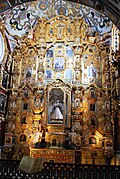 The main altar of the Jesuit colegio in Tepozotlan, now the Museo Nacional del Virreinato

Northern Spanish America
[edit] | This section needs additional citations for verification. (August 2020) |

In 1571, the Jesuits arrived in the Viceroyalty of Peru. It was a key area of the Spanish Empire, with a large indigenous populations and huge deposits of silver at Potosí. A major figure in the first wave of Jesuits was José de Acosta (1540–1600), whose 1590 book Historia natural y moral de las Indias introduced Europeans to Spain's American empire, via fluid prose and keen observation and explanation, based on 15 years in Peru and some time in New Spain (Mexico).[99]
The Viceroy of Peru Don Francisco de Toledo urged the Jesuits to evangelize the Indigenous peoples of Peru, wanting to put them in charge of parishes, but Acosta adhered to the Jesuit position that they were not subject to the jurisdiction of bishops and to catechize in Indigenous parishes would bring them into conflict with the bishops. For that reason, the Jesuits in Peru focused on education of elite men rather than the indigenous populations.[99]

To minister to newly arrived African slaves, Alonso de Sandoval (1576–1651) worked at the port of Cartagena de Indias. Sandoval wrote about this ministry in De instauranda Aethiopum salute (1627),[100] describing how he and his assistant Peter Claver, later canonized, met slave transport ships in the harbour, went below decks where 300–600 slaves were chained, and gave physical aid with water, while introducing the Africans to Christianity. In his treatise, he did not condemn slavery or the ill-treatment of slaves, but sought to instruct fellow Jesuits to this ministry and describe how he catechized the slaves.[101]
Rafael Ferrer was the first Jesuit of Quito to explore and found missions in the upper Amazon regions of South America from 1602 to 1610, which belonged to the Audiencia (high court) of Quito that was a part of the Viceroyalty of Peru until it was transferred to the newly created Viceroyalty of New Granada in 1717. In 1602, Ferrer began to explore the Aguarico, Napo, and Marañon rivers in the Sucumbios region, in what is today Ecuador and Peru. Between 1604 and 1605, he set up missions among the Cofane natives. In 1610, he was martyred by an apostate native.
In 1639, the Audiencia of Quito organized an expedition to renew its exploration of the Amazon river and the Quito Jesuit (Jesuita Quiteño) Cristóbal de Acuña was a part of this expedition. In February 1639, the expedition disembarked from the Napo river. In December 1639, they arrived in what is today Pará, Brazil, on the banks of the Amazon river. In 1641, Acuña published in Madrid a memoir of his expedition to the Amazon river entitled Nuevo Descubrimiento del gran rio de las Amazonas, which for academics became a fundamental reference on the Amazon region.
In 1637, the Jesuits Gaspar Cugia and Lucas de la Cueva from Quito began establishing the Mainas missions in territories on the banks of the Marañón River, around the Pongo de Manseriche region, close to the Spanish settlement of Borja. Between 1637 and 1652 there were 14 missions established along the Marañón River and its southern tributaries, the Huallaga and the Ucayali rivers. Jesuit de la Cueva and Raimundo de Santacruz opened up two new routes of communication with Quito, through the Pastaza and Napo rivers.

Between 1637 and 1715, Samuel Fritz founded 38 missions along the length of the Amazon river, between the Napo and Negro rivers, that were called the Omagua Missions. Beginning in 1705, these missions were continually attacked by the Brazilian Bandeirantes. In 1768, the only Omagua mission that was left was San Joaquin de Omaguas, since it had been moved to a new location on the Napo river away from the Bandeirantes.
In the immense territory of Maynas, the Jesuits of Quito made contact with a number of indigenous tribes which spoke 40 different languages, and founded 173 Jesuit missions, encompassing 150,000 inhabitants. Because of the constant epidemics of smallpox and measles and warfare with other tribes and the Bandeirantes, the number of Jesuit Missions were reduced to 40 by 1744. The Jesuit missions offered the Indigenous people Christianity, iron tools, and a small degree of protection from the slavers and the colonists.[102]
In exchange, the Indigenous had to submit to Jesuit discipline and adopt, at least superficially, a lifestyle foreign to their experience. The population of the missions was sustained by frequent expeditions into the jungle by Jesuits, soldiers, and Christian Indians to capture Indigenous people and force them to return or to settle in the missions.[102] At the time when the Jesuits were expelled from Spanish America in 1767, the Jesuits registered 36 missions run by 25 Jesuits in the Audiencia of Quito – 6 in the Napo and Aguarico Missions and 19 in the Pastaza and Iquitos Missions, with a population at 20,000 inhabitants.[103]
Paraguay
[edit]The Guaraní people of eastern Paraguay and neighboring Brazil and Argentina were in crisis in the early 17th century. Recurrent epidemics of European diseases had reduced their population by up 50 percent and the forced labor of the encomiendas by the Spanish and mestizo colonists had made virtual slaves of many. Franciscan missionaries began establishing missions called reductions in the 1580s.[104] The first Jesuits arrived in Asunción in 1588 and founded their first mission (or reduction) of San Ignacio Guazú in 1609. The objectives of the Jesuits were to make Christians of the Guaraní, impose European values and customs (which were regarded as essential to a Christian life), and isolate and protect the Guaraní from European colonists and slavers.[104][105]

In addition to recurrent epidemics, the Guaraní were threatened by the slave-raiding Bandeirantes from Brazil, who captured natives and sold them as slaves to work in sugar plantations or as concubines and household servants. Having depleted native populations near São Paulo, they discovered the richly populated Jesuit missions. Initially, the missions had few defenses against the slavers and thousands of Guaraní were captured and enslaved.
Beginning in 1631, the Jesuits moved their missions from the Guayrá province (present day Brazil and Paraguay), about 500 km (310 miles) southwest to the three borders region of Paraguay, Argentina, and Brazil. About 10,000 of 30,000 Guaraní in the missions chose to accompany the Jesuits. In 1641 and 1642, armed by the Jesuits, Guaraní armies defeated the Bandeirantes and ended the worst of the slave trade in their region. From this point on the Jesuit missions enjoyed growth and prosperity, punctuated by epidemics. At the peak of their importance in 1732, the Jesuits presided over 141,000 Guaraní (including a sprinkling of other peoples) who lived in about 30 missions.[106]
The opinions of historians differ with regard to the Jesuit missions. The missions are much-romanticized with the Guaraní portrayed as innocent children of nature and the Jesuits as their wise and benevolent guides to an earthly utopia. "Proponents...highlight that the Jesuits protected the Indians from exploitation and preserved the Guaraní language and other aspects of indigenous culture."[107] "By means of religion," wrote the 18th century philosopher Jean d'Alembert, "the Jesuits established a monarchical authority in Paraguay, founded solely on their powers of persuasion and on their lenient methods of government. Masters of the country, they rendered happy the people under their sway." Voltaire called the Jesuit missions "a triumph of humanity".[108]
Detractors say that "the Jesuits took away the Indians' freedom, forced them to radically change their lifestyle, physically abused them, and subjected them to disease." Moreover, the missions were inefficient and their economic success "depended on subsidies from the Jesuit order, special protection and privileges from the Crown, and the lack of competition"[107] The Jesuits are portrayed as "exploiters" who "sought to create a kingdom independent of the Spanish and Portuguese Crowns."[109]
The Comunero Revolt (1721 to 1735) was a serious protest by Spanish and mestizo Paraguayans against the Jesuit missions. The residents of Paraguay violently protested the pro-Jesuit government of Paraguay, Jesuit control of Guaraní labor, and what they regarded as unfair competition for the market for products such as yerba mate. Although the revolt ultimately failed and the missions remained intact, the Jesuits were expelled from institutions they had created in Asunción.[110] In 1756, the Guaraní protested the relocation of seven missions, fighting (and losing) a brief war with both the Spanish and Portuguese. The Jesuits were accused of inciting the Guaraní to rebel.[111] In 1767, Charles III of Spain (1759–88) expelled the Jesuits from the Americas. The expulsion was part of an effort in the Bourbon Reforms to assert more Spanish control over its American colonies.[112] In total, 78 Jesuits departed from the missions leaving behind 89,000 Guaraní in 30 missions.[113]
Philippines
[edit]The Jesuits were among the original five Catholic religious orders, alongside the Augustinians, Franciscans, Dominicans and Augustinian Recollects, who evangelized the Philippines in support of Spanish colonization.[114] The Jesuits worked particularly hard in converting the Muslims of Mindanao and Luzon from Islam to Christianity, in which case, they were successful among the cities of Zamboanga and Manila.[115] Zamboanga in particular was run like the Jesuit reductions in Paraguay and housed a large population of Peruvian and Latin American immigrants whereas Manila eventually became the capital of the Spanish colony.[116][117]

In addition to missionary work, the Jesuits compiled artifacts and chronicled the precolonial history and culture of the Philippines. Jesuit chronicler Pedro Chirino chronicled the history of the Kedatuan of Madja-as in Panay and its war against Rajah Makatunao of Sarawak as well as the histories of other Visayan kingdoms.[118] Meanwhile, another Jesuit, Francisco Combés, chronicled the history of the Venice of the Visayas, the Kedatuan of Dapitan, its temporary conquest by the Sultanate of Ternate, its re-establishment in Mindanao and its alliance against the Sultanates of Ternate and Lanao as vassals under Christian Spain.
The Jesuits also established the first missions in Hindu-dominated Butuan, to convert it to Christianity.[119] The Jesuits also founded many towns, farms, haciendas, educational institutes, libraries, and an observatory in the Philippines.[120] The Jesuits were instrumental in the sciences of medicine, botany, zoology, astronomy and seismology. They trained the Philippines' second saint, Pedro Calungsod, who was martyred in Guam alongside the Jesuit priest Diego Luis de San Vitores.[121]
The eventual temporary suppression of the Jesuits due their role in anti-colonial and anti-slavery revolts among the Paraguay reductions,[105] alongside cooperation with the Recollects, allowed their vacated parishes to be put under control by the local nationalistic diocesan clergy; the martyrdom of three of them, the diocesan priests known as Gomburza,[122] inspired José Rizal (also Jesuit-educated upon the restoration of the order), who became the Philippines' national hero. He successfully started the Philippine Revolution against Spain.
The Jesuits largely discredited the Freemasons, who claimed responsibility for the American and French Revolutions, by reverting Jose Rizal from Freemasonry back to Catholicism.[123] They argued that since the Philippine Revolution was inspired by the allegedly Masonic ideals behind the French and American revolutions, the French and American Freemasons themselves betrayed their own founding ideals when the American Freemasons annexed the Philippines and killed Filipinos in the Philippine-American War and the French Freemasons assented to the Treaty of Paris (1898),[124][125][126] this is compounded by the fact that American Freemason lodges dismissed the Philippine Revolutionary Freemason lodges as "irregular" and illegitimate.[127] For the remainder of this period, Philippine Freemasonry was subservient to the Grand Lodge of California.[128]
In 1953, after being expelled from China by the Communists, the Jesuits relocated their organization's nexus in Asia from China to the Philippines and brought along a sizeable Chinese diaspora.[129] The Jesuits play a pivotal role in the nation-building of the Philippines with its various Ateneos and educational institutes training the country's intellectual elites.[130][131]
Colonial Brazil
[edit]

Tomé de Sousa, first Governor General of Brazil, brought the first group of Jesuits to the colony. The Jesuits were officially supported by the King, who instructed Tomé de Sousa to give them all the support needed to Christianize the indigenous peoples.
The first Jesuits, guided by Manuel da Nóbrega, Juan de Azpilcueta Navarro, Leonardo Nunes, and later José de Anchieta, established the first Jesuit missions in Salvador and in São Paulo dos Campos de Piratininga, the settlement that gave rise to the city of São Paulo. Nóbrega and Anchieta were instrumental in the defeat of the French colonists of France Antarctique by managing to pacify the Tamoio natives, who had previously fought the Portuguese. The Jesuits took part in the foundation of the city of Rio de Janeiro in 1565.
The success of the Jesuits in converting the Indigenous peoples is linked to their efforts to understand the native cultures, especially their languages. The first grammar of the Tupi language was compiled by José de Anchieta and printed in Coimbra in 1595. The Jesuits often gathered the natives in communities (the Jesuit reductions), where the natives worked for the community and were evangelized.
The Jesuits had frequent disputes with other colonists who wanted to enslave the natives. The action of the Jesuits saved many natives from being enslaved by Europeans, but also disturbed their ancestral way of life and inadvertently helped spread infectious diseases against which the natives had no natural defenses. Slave labor and trade were essential for the economy of Brazil and other American colonies, and the Jesuits usually did object to the enslavement of African peoples, criticized the conditions of slavery.[132] In cases where individual Jesuit priests criticized the institution of African slavery, they were censored and sent back to Europe.[133]
Suppression and restoration
[edit]The suppression of the Jesuits alienated the colonial empires from the natives they governed in the Americas and Asia, as the Jesuits were active protectors of native rights against the colonial empires. With the suppression of the Order, the profitable Jesuit reductions which gave wealth and protection to natives were sequestered by royal authorities and the natives enslaved. Faced with this suppression; the natives, mestizos, and creoles were galvanized into starting the Latin American Wars of Independence.[134] The suppression of the Jesuits in Portugal, France, the Two Sicilies, Parma, and the Spanish Empire by 1767 was deeply troubling to Pope Clement XIII, the society's defender.[135] On 21 July 1773 his successor, Pope Clement XIV, issued the papal brief Dominus ac Redemptor, decreeing:
Having further considered that the said Company of Jesus can no longer produce those abundant fruits, ... in the present case, we are determining upon the fate of a society classed among the mendicant orders, both by its institute and by its privileges; after a mature deliberation, we do, out of our certain knowledge, and the fulness of our apostolical power, suppress and abolish the said company: we deprive it of all activity whatever. ...And to this end a member of the regular clergy, recommendable for his prudence and sound morals, shall be chosen to preside over and govern the said houses; so that the name of the Company shall be, and is, for ever extinguished and suppressed.
— Dominus ac Redemptor[136]
The suppression was carried out on political grounds in all countries except Prussia for a time, and Russia, where Catherine the Great had forbidden its promulgation. Because millions of Catholics (including many Jesuits) lived in the Polish provinces recently part-annexed by the Kingdom of Prussia, the Society was able to maintain its continuity and carry on its work all through the stormy period of suppression. Subsequently, Pope Pius VI granted formal permission for the continuation of the society in Russia and Poland, with Stanisław Czerniewicz elected superior of the province in 1782. He was followed by Gabriel Lenkiewicz, Franciszek Kareu and Gabriel Gruber until 1805, all elected locally as Temporary Vicars General. Pope Pius VII had resolved during his captivity in France to restore the Jesuits universally, and on his return to Rome he did so without much delay. On 7 August 1814, with the bull Sollicitudo omnium ecclesiarum, he reversed the suppression of the society, and therewith another Polish Jesuit, Tadeusz Brzozowski, who had been elected as superior in Russia in 1805, acquired universal jurisdiction. On his death in 1820 the Jesuits were expelled from Russia by tsar Alexander I.
The period following the Restoration of the Jesuits in 1814 was marked by tremendous growth, as evidenced by the large number of Jesuit colleges and universities established during the 19th century. During this time in the United States, 22 of the society's 28 universities were founded or taken over by the Jesuits. It has been suggested that the experience of suppression had served to heighten orthodoxy among the Jesuits. While this claim is debatable, Jesuits were generally supportive of papal authority within the church, and some members became associated with the Ultramontanist movement and the declaration of papal infallibility in 1870.[137]
In Switzerland, the constitution was modified and Jesuits were banished in 1848, following the defeat of the Sonderbund Catholic defence alliance. The ban was lifted on 20 May 1973, when 54.9 per cent of voters accepted a referendum modifying the constitution.[138]
Early 20th century
[edit]In the Constitution of Norway from 1814, a relic from the earlier anti-Catholic laws of Denmark–Norway, Paragraph 2, known as the Jesuit clause, originally read: "The Evangelical-Lutheran religion remains the public religion of the State. Those inhabitants, who confess thereto, are bound to raise their children to the same. Jesuits and monastic orders are not permitted. Jews are still prohibited from entry to the Realm." Jews were first allowed into the realm in 1851 after the famous Norwegian poet Henrik Wergeland had campaigned for this permission. Monastic orders were permitted in 1897, but the ban on Jesuits was only lifted in 1956.[139]
Republican Spain in the 1930s passed laws banning the Jesuits on grounds that they were obedient to a power different from the state. Pope Pius XI wrote about this: "It was an expression of a soul deeply hostile to God and the Catholic religion, to have disbanded the Religious Orders that had taken a vow of obedience to an authority different from the legitimate authority of the State. In this way it was sought to do away with the Society of Jesus – which can well glory in being one of the soundest auxiliaries of the Chair of Saint Peter – with the hope, perhaps, of then being able with less difficulty to overthrow in the near future, the Christian faith and morale in the heart of the Spanish nation, which gave to the Church of God the grand and glorious figure of Ignatius Loyola."[140]
Post-Vatican II
[edit]The 20th century witnessed both growth and decline of the order. Following a trend within the Catholic priesthood at large, Jesuit numbers peaked in the 1950s and have declined steadily since. Meanwhile, the number of Jesuit institutions has grown considerably, due in large part to a post–Vatican II focus on the establishment of Jesuit secondary schools in inner-city areas and an increase in voluntary lay groups inspired in part by the Spiritual Exercises. Among the notable Jesuits of the 20th century, John Courtney Murray was called one of the "architects of the Second Vatican Council" and drafted what eventually became the council's endorsement of religious freedom, Dignitatis humanae.
In Latin America, the Jesuits had significant influence in the development of liberation theology, a movement that was controversial in the Catholic community after the negative assessment of it by Pope John Paul II in 1984.[141]
Under Superior General Pedro Arrupe, social justice and the preferential option for the poor emerged as dominant themes of the work of the Jesuits. When Arrupe was paralyzed by a stroke in 1981, Pope John Paul II, not entirely pleased with the progressive turn of the Jesuits, took the unusual step of appointing the venerable and aged Paolo Dezza for an interim to oversee "the authentic renewal of the Church",[142] instead of the progressive American priest Vincent O'Keefe whom Arrupe had preferred.[143] In 1983, John Paul gave leave for the Jesuits to appoint Peter Hans Kolvenbach as a successor to Arrupe.
On 16 November 1989, six Jesuit priests (Ignacio Ellacuría, Segundo Montes, Ignacio Martín-Baró, Joaquin López y López, Juan Ramon Moreno, and Amado López), Elba Ramos their housekeeper, and Celia Marisela Ramos her daughter, were murdered by the Salvadoran military on the campus of the University of Central America in San Salvador, El Salvador, because they had been labeled as subversives by the government.[144] The assassinations galvanized the society's peace and justice movements, including annual protests at the Western Hemisphere Institute for Security Cooperation at Fort Benning, Georgia, United States, where several of the assassins had been trained under US government sponsorship.[145]
In February 2001, the Jesuit priest Avery Dulles, an internationally known author, lecturer, and theologian, was created a cardinal of the Catholic Church by Pope John Paul II. The son of former Secretary of State John Foster Dulles, Avery Dulles was long known for his carefully reasoned argumentation and fidelity to the teaching office of the church. An author of 22 books and over 700 theological articles, Dulles died in December 2008 at Fordham University, where he had taught for twenty years as the Laurence J. McGinley Professor of Religion and Society. He was, at his passing, one of ten Jesuit cardinals in the Catholic Church.
In 2002, Boston College president and Jesuit priest William P. Leahy initiated the Church in the 21st Century program as a means of moving the church "from crisis to renewal". The initiative has provided the society with a platform for examining issues brought about by the worldwide Catholic sex abuse cases, including the priesthood, celibacy, sexuality, women's roles, and the role of the laity.[146]

In April 2005, Thomas J. Reese, editor of the American Jesuit weekly magazine America, resigned at the request of the society. The move was widely published in the media as the result of pressure from the Vatican, following years of criticism by the Congregation for the Doctrine of the Faith on articles touching subjects such as HIV/AIDS, religious pluralism, homosexuality, and the right of life for the unborn. Following his resignation, Reese spent a year-long sabbatical at Santa Clara University before being named a fellow at the Woodstock Theological Center in Washington, D.C., and later senior analyst for the National Catholic Reporter. President Barack Obama appointed him to the United States Commission on International Religious Freedom in 2014 and again in 2016.[147]
In February 2006, Peter Hans Kolvenbach informed members of the Society of Jesus that, with the consent of Pope Benedict XVI, he intended to step down as superior general in 2008, the year he would turn 80.
On 22 April 2006, during the Feast of Our Lady, Mother of the Society of Jesus, Pope Benedict XVI greeted thousands of Jesuits on pilgrimage to Rome, and took the opportunity to thank God "for having granted to your Company the gift of men of extraordinary sanctity and of exceptional apostolic zeal such as St Ignatius of Loyola, St Francis Xavier, and Blessed Peter Faber". He said "St Ignatius of Loyola was above all a man of God, who gave the first place of his life to God, to his greater glory and his greater service. He was a man of profound prayer, which found its center and its culmination in the daily Eucharistic Celebration."[148]
In May 2006, Benedict XVI wrote a letter to Kolvenbach on the occasion of the 50th anniversary of Pope Pius XII's encyclical Haurietis aquas, on devotion to the Sacred Heart, because the Jesuits have always been "extremely active in the promotion of this essential devotion".[149] In his 3 November 2006 visit to the Pontifical Gregorian University, Benedict XVI cited the university as "one of the greatest services that the Society of Jesus carries out for the universal Church".[150]
In January 2008, the 35th General Congregation of the Society of Jesus convened and elected Adolfo Nicolás as the new superior general on 19 January 2008. In a letter to the order, Benedict XVI wrote:[151]
As my Predecessors have said to you on various occasions, the Church needs you, relies on you and continues to turn to you with trust, particularly to reach those physical and spiritual places which others do not reach or have difficulty in reaching. Paul VI's words remain engraved on your hearts: "Wherever in the Church, even in the most difficult and extreme fields, at the crossroads of ideologies, in the social trenches, there has been and there is confrontation between the burning exigencies of man and the perennial message of the Gospel, here also there have been, and there are, Jesuits".
— Address to the 32nd General Congregation of the Jesuits, 3 December 1974; ORE, 12 December, n. 2, p. 4.

In 2013, the Jesuit cardinal Jorge Bergoglio became Pope Francis. Before he became pope, he had been appointed a bishop when he was in "virtual estrangement from the Jesuits" since he was seen as "an enemy of liberation theology" and viewed by others as "still far too orthodox". He was criticized for colluding with the Argentine junta, while biographers characterized him as working to save the lives of other Jesuits.[152][153][154] As a Jesuit pope, he has stressed discernment over following rules, changing the culture of the clergy to steer away from clericalism and to move toward an ethic of service, i.e. to have the "smell of sheep", staying close to the people.[155] After his papal election, Superior General Adolfo Nicolás praised Pope Francis as a "brother among brothers".[152]
In October 2016, the 36th General Congregation convened in Rome, convoked by Nicolás, who had announced his intention to resign at age 80.[156][157][158] On 14 October, the 36th General Congregation of the Society of Jesus elected Arturo Sosa, a Venezuelan, as its thirty-first superior general.[159]
In 2016, the General Congregation that elected Arturo Sosa, asked him to complete the process of discerning Jesuit priorities for the time ahead. Sosa devised a plan that enlisted all Jesuits and their lay collaborators in the process of discernment over a 16-month period. In February 2019, he presented the results of the discernment, a list of four priorities for Jesuit ministries for the next ten years.[160]
- To show the way to God through discernment and the Spiritual Exercises of Ignatius of Loyola;
- To walk with the poor, the outcasts of the world, those whose dignity has been violated, in a mission of reconciliation and justice;
- To accompany young people in the creation of a hope-filled future;
- To collaborate in the care of our Common Home.
Pope Francis gave his approval to these priorities, saying that they were in harmony with the church's present priorities and with the programmatic letter of his pontificate, Evangelii gaudium.[161]
Ignatian spirituality
[edit]The spirituality practiced by the Jesuits, called Ignatian spirituality, ultimately based on the Catholic faith and the gospels, is drawn from the Constitutions, The Letters, and Autobiography, and most specially from Ignatius' Spiritual Exercises, whose purpose is "to conquer oneself and to regulate one's life in such a way that no decision is made under the influence of any inordinate attachment". The Exercises culminate in a contemplation whereby one develops a facility to "find God in all things".
Formation
[edit]The formation (training) of Jesuits seeks to prepare men spiritually, academically, and practically for the ministries they will be called to offer the church and world. Ignatius was strongly influenced by the Renaissance, and he wanted Jesuits to be able to offer whatever ministries were most needed at any given moment and, especially, to be ready to respond to missions (assignments) from the pope. Formation for priesthood normally takes between eight and fourteen years, depending on the man's background and previous education. Final vows are taken several years after that, making Jesuit formation among the longest of any of the religious orders.
Governance of the society
[edit]The society is headed by a Superior General, with the formal title Praepositus Generalis, Latin for "provost-general", more commonly called Father General. He is elected by the General Congregation for life or until he resigns. He is confirmed by the pope and has absolute authority in running the Society. The Superior General of the Jesuits is the Venezuelan Arturo Sosa, who was elected in October 2016.[162]
The Father General is assisted by "assistants". Four are "assistants for provident care" and serve as general advisors and a sort of inner council. Regional assistants head an "assistancy", which is either a geographic area, for instance the North American Assistancy, or an area of ministry, such as higher education. The assistants normally reside with the Father General in Rome and along with others form an advisory council to the General. A vicar general and secretary of the society run day-to-day administration. The General is required to have an admonitor, a confidential advisor whose task is to warn the General honestly and confidentially when he might be acting imprudently or contrary to the church's magisterium. The central staff of the General is known as the Curia.[162]
The society is divided into geographic areas called provinces. Each is headed by a Provincial Superior, formally called Father Provincial, chosen by the Superior General. He has authority over all Jesuits and ministries in his area, and is assisted by a socius who acts as a sort of secretary and chief of staff. With the approval of the Superior General, the Provincial Superior appoints a novice master and a master of tertians to oversee formation, and rectors of local communities of Jesuits.[163] For better cooperation and apostolic efficacy on each continent, the Jesuit provinces are grouped into six Jesuit Conferences worldwide.
Each Jesuit community within a province is normally headed by a rector. He is assisted by a "minister", from the Latin word for "servant", a priest who helps oversee the community's day-to-day needs.[164]
The General Congregation is a meeting of all of the assistants, provincials, and additional representatives who are elected by the professed Jesuits of each province. It meets irregularly and rarely, normally to elect a new superior general or to take up some major policy issues for the order. The Superior General meets more regularly with smaller councils composed of just the provincials.[165]
Statistics
[edit]| Region | Jesuits | Percentage |
|---|---|---|
| Africa | 1,712 | 12% |
| Latin America[167] | 1,859 | 13% |
| South Asia | 3,955 | 27% |
| Asia-Pacific | 1,481 | 10% |
| Europe | 3,386 | 23% |
| North America[168] | 2,046 | 14% |
| Total | 14,439 |
As of 2012[update], the Jesuits formed the largest single religious order of priests and brothers in the Catholic Church.[169] The Jesuits have experienced a decline in numbers in recent decades. In 2022, the society had 14,439 members - 10,432 priests, 837 brothers, 2,587 scholastics, and 583 novices.[166] This represents a 59% percent decline since the Second Vatican Council of 1965, when the society had a total membership of 36,038, of which 20,301 were priests.[170] This decline is most pronounced in Europe and the Americas, with relatively modest membership gains occurring in Asia and Africa.[171][172]
In 2016, according to Patrick Reilly of the National Catholic Register, there seems to be no "Pope Francis effect" in counteracting the fall of vocations among the Jesuits.[173] In 2019, twenty-eight novices took first vows in the Jesuits in the United States and Haiti.[174] In September 2019, the superior general of the Jesuits, Arturo Sosa, estimated that by 2034 the number would decrease to about 10,000 Jesuits, with a much younger average age than in 2019, and with a shift away from Europe and into Latin America, Africa, and India.[175] In 2008, their average age was 57.3 years: 63.4 years for priests, 29.9 years for scholastics, and 65.5 years for brothers.[20]
The Superior General of the Jesuits is Arturo Sosa. The society is characterized by its ministries in the fields of missionary work, human rights, social justice and, most notably, higher education. It operates colleges and universities in countries around the world and is particularly active in the Philippines and India. In the United States, the Jesuits have historical ties to 27 colleges and universities and 61 high schools. The degree to which the Jesuits are involved in the administration of each institution varies. In September 2018, 15 of the 27 Jesuit universities in the US had non-Jesuit lay presidents.[176]
According to a 2014 article in The Atlantic, "the number of Jesuit priests who are active in everyday operations at the schools isn't nearly as high as it once was".[177] Worldwide it runs 322 secondary schools and 172 colleges and universities. A typical conception of the mission of a Jesuit school will often contain such concepts as proposing Christ as the model of human life, the pursuit of excellence in teaching and learning, lifelong spiritual and intellectual growth,[178] and training men and women for others.[179]
Habit and dress
[edit]Jesuits do not have an official habit. The society's Constitutions gives the following instructions: "The clothing too should have three characteristics: first, it should be proper; second, conformed to the usage of the country of residence; and third, not contradictory to the poverty we profess." (Const. 577)
The traditional Jesuit-style cassock, called a "soutane" is similar to a robe which is wrapped around the body and was tied with a cincture, rather than the customary buttoned front cassock worn by diocesan priests.[180] A tuftless biretta (only diocesan clergy wore tufts) and a ferraiolo (cape) completed the look.[181]
Today, most Jesuits in the United States wear the clerical collar and black clothing of diocesan priests[182] while most Jesuits in Europe are dressed in civilian clothes.[citation needed]
Controversies
[edit]Slavery
[edit]Jesuit scholar Andrew Dial has calculated that the Jesuits owned more than 20,000 slaves worldwide in 1760, the great majority of them in the Americas.[183] The Jesuits in some places protected the indigenous people of the Americas from slavers, notably the Guaraní in South America, but in other places they enslaved indigenous people after "just wars" in which indigenous people who resisted European colonization were defeated.
The Jesuits also participated in the Atlantic slave trade, working thousands of African slaves on their large plantations scattered throughout the Americas. Antoine Lavalette, a slave-owning French Jesuit in Martinique, accumulated large debts which he was unable to pay, which led to the banning of the Jesuits in France in 1764.
In the United States, tobacco plantations utilizing African-American slave labor in Maryland and other states supported Jesuit institutions such as Georgetown University, from which were infamously sold 272 slaves in 1838.
In the 16th century, Jesuits were also complicit in the Portuguese trade in enslaved East Asians. In other parts of Europe, slaves were probably employed in Jesuit schools and institutions.
The Jesuits justified their ownership of slaves and participation in the slave trade as a means of converting slaves to Catholicism. "Enslaved people...were a captive audience for evangelization."[184][185]
Power-seeking
[edit]The Monita Secreta (Secret Instructions of the Jesuits), published in 1612 and in 1614 in Kraków, is alleged to have been written by Claudio Acquaviva, the fifth general of the society, but was probably written by former Jesuit Jerome Zahorowski. It purports to describe the methods to be adopted by Jesuits for the acquisition of greater power and influence for the society and for the Catholic Church. The Catholic Encyclopedia states the book is a forgery, fabricated to ascribe a sinister reputation to the Society of Jesus.[186]
| Separation of church and state in the history of the Catholic Church |
|---|
 |
Political intrigue
[edit]The Jesuits were temporarily banished from France in 1594 after a man named Jean Châtel tried to assassinate the king of France, Henri IV. Under questioning, Châtel revealed that he had been educated by the Jesuits of the Collège de Clermont. The Jesuits were accused of inspiring Châtel's attack. Two of his former teachers were exiled and a third was hanged.[187] The Collège de Clermont was closed, and the building was confiscated. The Jesuits were banned from France, although this ban was quickly lifted and the school eventually reopened.[188]
In England, Henry Garnet, one of the leading English Jesuits, was hanged for misprision of treason because of his knowledge of the 1605 Gunpowder Plot. The Plot was the attempted assassination of James VI and I, his family, and most of the Protestant aristocracy in a single attack, by blowing up the Houses of Parliament. Another Jesuit, Oswald Tesimond, managed to escape arrest for his involvement in this plot.[189]
Casuistic justification
[edit]Jesuits have been accused of using casuistry to obtain justifications for unjustifiable actions (cf. formulary controversy and Lettres Provinciales, by Blaise Pascal).[190] Hence, the Concise Oxford Dictionary of the English language lists "equivocating" as a secondary denotation of the word "Jesuit". Modern critics of the Society of Jesus include Avro Manhattan, Alberto Rivera, and Malachi Martin, the latter being the author of The Jesuits: The Society of Jesus and the Betrayal of the Roman Catholic Church (1987).[191]
Exclusion of those of Jewish or Muslim ancestry
[edit]Although in the first 30 years of the existence of the Society of Jesus there were many Jesuits who were conversos (Catholic-convert Jews and Muslims and their descendants), an anti-converso faction led to the Decree de genere (1593) which proclaimed that either Jewish or Muslim ancestry, no matter how distant, was an insurmountable impediment for admission to the Society of Jesus.[192] This new rule was contrary to the original wishes of Ignatius who "said that he would take it as a special grace from our Lord to come from Jewish lineage".[193] The 16th-century Decree de genere was repealed in 1946.[b] Bylaws requiring "blood purity" became common across Early Modern Spain and Portugal.
Theological debates
[edit]Within the Catholic Church, there has existed a sometimes tense relationship between Jesuits and the Holy See, due to questioning of official church teaching and papal directives, such as those on abortion,[irrelevant citation][196][197] birth control,[198][199][200][201] women deacons,[202] homosexuality, and liberation theology.[203][204] At the same time, Jesuits have been appointed to prominent doctrinal and theological positions in the church; under Pope Benedict XVI, Archbishop Luis Ladaria Ferrer was Secretary and later, under Pope Francis, Prefect of the Congregation for the Doctrine of the Faith.[205][206]
Nazi persecution
[edit]The Catholic Church faced persecution in Nazi Germany. Adolf Hitler, though baptized and confirmed in the Catholic faith and raised in a Catholic household, was anticlerical and had particular disdain for the Jesuits. According to John Pollard, the Jesuits' "ethos represented the most intransigent opposition to the philosophy of Nazism",[207] and so the Nazis considered them as one of their most dangerous enemies. A Jesuit college in the city of Innsbruck served as a center for anti-Nazi resistance and was closed down by the Nazis in 1938.[208]
Jesuits were a target for Gestapo persecution, and many Jesuit priests were deported to death camps.[209] Jesuits made up the largest contingent of clergy imprisoned in the Priest Barracks of Dachau Concentration Camp.[210] Vincent Lapomarda lists some 30 Jesuits as having died at Dachau.[211] Of the 152 Jesuits murdered by the Nazis across Europe, 43 died in the death camps and an additional 27 died from captivity or its results.[212]
The Superior General of Jesuits at the outbreak of war was Włodzimierz Ledóchowski, a Pole. The Nazi persecution of the Catholic Church in Poland was particularly severe. Lapomarda wrote that Ledóchowski helped "stiffen the general attitude of the Jesuits against the Nazis" and that he permitted Vatican Radio to carry on its campaign against the Nazis in Poland. Vatican Radio was run by the Jesuit Filippo Soccorsi and spoke out against Nazi oppression, particularly with regard to Poland and to Vichy-French antisemitism.[213]

Several Jesuits were prominent in the small German Resistance.[215] Among the central membership of the Kreisau Circle of the Resistance were the Jesuit priests Augustin Rösch, Alfred Delp, and Lothar König.[216] The Bavarian Jesuit Provincial, Augustin Rösch, ended the war on death row for his role in the July Plot to overthrow Hitler. Another non-military German Resistance group, dubbed the "Frau Solf Tea Party" by the Gestapo, included the Jesuit priest Friedrich Erxleben.[217] The German Jesuit Robert Leiber acted as intermediary between Pius XII and the German Resistance.[218][219]
Among the Jesuit victims of the Nazis, Germany's Rupert Mayer has been beatified. Mayer was a Bavarian Jesuit who clashed with the Nazis as early as 1923. Continuing his critique following Hitler's rise to power, Mayer was imprisoned in 1939 and sent to Sachsenhausen death camp. As his health declined, the Nazis feared the creation of a martyr and sent him to the Abbey of Ettal in 1940. There he continued to give sermons and lectures against the evils of the Nazi régime, until his death in 1945.[220][221]
Rescue efforts during the Holocaust
[edit]In his history of the heroes of the Holocaust, the Jewish historian Martin Gilbert notes that in every country under German occupation, priests played a major part in rescuing Jews, and that the Jesuits were one of the Catholic Orders that hid Jewish children in monasteries and schools to protect them from the Nazis.[222][223]
Fourteen Jesuit priests have been formally recognized by Yad Vashem, the Holocaust Martyrs' and Heroes' Remembrance Authority in Jerusalem, for risking their lives to save Jews during the Holocaust of World War II: Roger Braun (1910–1981) of France,[224] Pierre Chaillet (1900–1972) of France,[225] Jean-Baptist De Coster (1896–1968) of Belgium,[226] Jean Fleury (1905–1982) of France,[227] Emile Gessler (1891–1958) of Belgium, Jean-Baptiste Janssens (1889–1964) of Belgium, Alphonse Lambrette (1884–1970) of Belgium, Emile Planckaert (1906–2006) of France, Jacob Raile (1894–1949) of Hungary, Henri Revol (1904–1992) of France, Adam Sztark (1907–1942) of Poland, Henri Van Oostayen (1906–1945) of Belgium, Ioannes Marangas (1901–1989) of Greece, and Raffaele de Chantuz Cubbe (1904–1983) of Italy.[228]
Several other Jesuits are known to have rescued or given refuge to Jews during that period.[229] A plaque commemorating the 152 Jesuit priests who gave their lives during the Holocaust was installed in April 2007 at the Jesuits' Rockhurst University in Kansas City, Missouri, United States.
In science
[edit]
Between the sixteenth and eighteenth centuries, the teaching of science in Jesuit schools, as laid down in the Ratio atque Institutio Studiorum Societatis Iesu ("The Official Plan of studies for the Society of Jesus") of 1599,[230] was almost entirely based on the works of Aristotle.
The Jesuits, nevertheless, have made numerous significant contributions to the development of science.[21] For example, the Jesuits have dedicated significant study to fields from cosmology to seismology, the latter of which has been described as "the Jesuit science".[231] The Jesuits have been described as "the single most important contributor to experimental physics in the seventeenth century".[232]
According to Jonathan Wright in his book God's Soldiers, by the eighteenth century the Jesuits had "contributed to the development of pendulum clocks, pantographs, barometers, reflecting telescopes and microscopes – to scientific fields as various as magnetism, optics, and electricity. They observed, in some cases before anyone else, the colored bands on Jupiter's surface, the Andromeda nebula, and Saturn's rings. They theorized about the circulation of the blood (independently of Harvey), the theoretical possibility of flight, the way the moon affected the tides, and the wave-like nature of light."[233]
The Jesuit China missions of the 16th and 17th centuries introduced Western science and astronomy. One modern historian writes that in late Ming courts, the Jesuits were "regarded as impressive especially for their knowledge of astronomy, calendar-making, mathematics, hydraulics, and geography".[234] The Society of Jesus introduced, according to Thomas Woods, "a substantial body of scientific knowledge and a vast array of mental tools for understanding the physical universe, including the Euclidean geometry that made planetary motion comprehensible".[235]
Notable members
[edit]Jesuits include missionaries, educators, scientists, artists, philosophers, and a pope. Among many distinguished early Jesuits was Francis Xavier, a missionary to Asia who converted more people to Catholicism than anyone before, and Robert Bellarmine, a Doctor of the Church. José de Anchieta and Manuel da Nóbrega, founders of the city of São Paulo, Brazil, were Jesuit priests. Another famous Jesuit was Jean de Brébeuf, a French missionary who was martyred during the 17th century in New France, the part that became Ontario, in Canada.
In Spanish America, José de Acosta wrote a major work on early Peru and New Spain with important material on indigenous peoples. In South America, Peter Claver was notable for his mission to African slaves, building on the work of Alonso de Sandoval. Francisco Javier Clavijero was expelled from New Spain during the Suppression of the Society of Jesus in 1767 and wrote an important history of Mexico during his exile in Italy. Eusebio Kino is renowned in the southwestern United States and northern Mexico, then called the Pimería Alta. He founded numerous missions and served as the peace-bringer between the tribes and the government of New Spain. Antonio Ruiz de Montoya was an important missionary in the Jesuit reductions of Paraguay.
Baltasar Gracián was a 17th-century Spanish Jesuit and baroque prose writer and philosopher. He was born in Belmonte, near Calatayud (Aragon). His writings, particularly El Criticón (1651–57) and Oráculo Manual y Arte de Prudencia ("The Art of Prudence", 1647) were lauded by Schopenhauer and Nietzsche.
In Scotland, John Ogilvie, a Jesuit, is the nation's only post-Reformation saint.
Gerard Manley Hopkins was one of the first English poets to use sprung verse. Anthony de Mello was a Jesuit priest and psychotherapist who became recognized for his books which introduced Westerners to the East Indian traditions of spirituality.
Dorothy Lawson was a recusant and patroness of the Society of Jesus,[236] who met yearly at her home to discuss the mission in England after the English Reformation.[237]
Cardinal Jorge Bergoglio of Argentina was elected by conclave as Pope Francis on 13 March 2013, the first Jesuit to be elected pope. He served until his death in April 2025.[238]
The Feast of All Jesuit Saints and Blesseds is celebrated on 5 November.[239]
Gallery of Jesuit churches
[edit]-

-

-
 Church of Saint-Pierre de Montmartre, Paris, France
 -
 Jesuit church, Cuzco, Peru
 -
 Colegio de Belén, Havana, "The Palace of Education"
 -
 Christ the King Church in the Ateneo de Naga University campus, Naga City, Philippines
 -
 Fordham University Church at Rose Hill, Bronx, New York, US
 -
 Loyola University Chicago Art Deco Chapel at Lakeshore Campus, Chicago, Illinois, US
 -
 St. John's Church in Creighton University campus, Omaha, Nebraska, US
 -
 Holy Name of Jesus Church in the Loyola University New Orleans campus, New Orleans Louisiana US
 -
 The Church of the Gesu in Milwaukee, Wisconsin, US, is the school church of Marquette University.
 -
 St. Francis Xavier Church, a Jesuit parish church across the street from the Rockhurst University campus, Kansas City, Missouri, US
 -
 St. Francis Xavier College Church in the Saint Louis University campus, St. Louis, Missouri, US
 -
 The Santa Clara University's Mission Church is at the heart of Santa Clara University's historic campus Santa Clara, California, US.
 -
 St. Ignatius Church, parish church of the University of San Francisco, San Francisco, California, US
 -
 the Church of the Gesu, Philadelphia is the school church of St. Joseph's Preparatory School, Philadelphia, Pennsylvania, US.
 -
 The Church of the Gesu in Frascati, province of Rome, Italy
 -
 The Église du Gesù in Montreal, Quebec, Canada, church and cultural venue
 -

-
 Sacred Heart Church, Wimbledon, London


_2013-03-31_002.JPG)


_Holy_Name_of_Jesus_Church.jpg)


.jpg)


Institutions
[edit]Educational institutions
[edit]Although the work of the Jesuits today embraces a wide variety of apostolates, ministries, and civil occupations, they are probably most well known for their educational work, on all continents. Since the inception of the order, Jesuits have been teachers. Besides serving on the faculty of Catholic and secular schools, the Jesuits are the Catholic religious order with the second highest number of schools which they run: 168 tertiary institutions in 40 countries and 324 secondary schools in 55 countries. The Brothers of the Christian Schools have over 560 Lasallian educational institutions. They also run elementary schools, at which they are less likely to teach. Many of the schools are named after Francis Xavier and other prominent Jesuits.
After the Second Vatican Council, Jesuit schools had become a very controversial place of instruction as they abandoned teaching traditional Catholic education with things such as the mastery of Latin and the Baltimore Catechism. Jesuit schools replaced classic theological instruction from people like Thomas Aquinas and Bonaventure to people like Karl Rahner and Pierre Teilhard de Chardin, which was a very controversial move at the time.[240][241]
Jesuit educational institutions aim to promote the values of Eloquentia Perfecta. This is a Jesuit tradition that focuses on cultivating a person as a whole, as one learns to speak and write for the common good.
Social and development institutions
[edit]Jesuits have become increasingly involved in works directed primarily toward social and economic development for the poor and marginalized.[242] Included in this would be research, training, advocacy, and action for human development, as well as direct services. Most Jesuit schools have an office that fosters social awareness and social service in the classroom and through extracurricular programs, usually detailed on their websites. The Jesuits also run over 500 notable or stand-alone social or economic development centres in 56 countries around the world.
Publications
[edit]
Jesuits are also known for their involvement in publications. Most Jesuit colleges and universities have their own presses which produce a variety of books, book series, textbooks, and academic publications.
La Civiltà Cattolica, a periodical produced in Rome by the Jesuits, has often been used as a semi-official platform for popes and officials of the Roman Curia to float ideas for discussion or hint at future statements or positions, though authorship is limited to Jesuits.[243]
The Way is an international journal of contemporary Christian spirituality published by the British Jesuits.[244]
In the United States of America, America magazine has long had a prominent place in Catholic intellectual circles.[245] Ignatius Press, founded by a Jesuit, is an independent publisher of Catholic books, most of which are of the popular academic or lay-intellectual variety.[246]
Manresa is a review of Ignatian spirituality published in Madrid, Spain.[247]
In Australia, the Jesuits produce a number of magazines, including Eureka Street, Madonna, Australian Catholics, and Province Express.
In Germany, the Jesuits publish the journal Geist und Leben and the related publication Weltweit[248] that describes their international work, the Jesuitenmission.
In Sweden the Catholic cultural magazine Signum, edited by the Newman Institute, covers a broad spectrum of issues concerning faith, culture, research, and society. The printed version of Signum is published eight times per year.[249]
Jesuit publishing is not limited to journals and books; they also produce digital content and podcasts to engage modern audiences. Many Jesuit provinces operate media ministries aimed at evangelization, education, and social dialogue. For instance, Jesuit Communications in India runs online platforms and short film projects that address contemporary moral and spiritual issues.[citation needed]
Jesuits in Canada and the U.S. have embraced video storytelling and podcasting, such as the popular "Jesuitical" podcast by America Media. These platforms reflect the Society's ongoing commitment to intellectual engagement and cultural dialogue in an increasingly digital and interconnected world.[citation needed]
See also
[edit]
- Ad maiorem Dei gloriam
- Apostleship of Prayer
- Blas Valera
- Bollandist
- Canadian Indian residential school system
- Church of the Mission of France
- Jesuit conspiracy theories
- Jesuit Ivy
- Jesuit missions among the Guaraní
- Jesuit Missions of Chiquitos
- Jesuit Refugee Service
- List of Jesuit sites
- List of saints of the Society of Jesus
- Misiones Province
- Monumenta Historica Societatis Iesu
- Igreja de São Roque
- Sexual abuse scandal in the Society of Jesus
- Thomas Weld (of Lulworth)
Notes
[edit]- ^ Spanish: "todo el que quiera militar para Dios"[citation needed]
- ^ Jesuit scholar John Padberg states that the restriction on Jewish/Muslim converts was limited only to the degree of parentage. Fourteen years later this was extended back to the fifth degree. Over time the restriction relating to Muslim ancestry was dropped.[194] In 1923, the 27th Jesuit General Congregation specified that "The impediment of origin extends to all who are descended from the Jewish race, unless it is clear that their father, grandfather, and great grandfather have belonged to the Catholic Church." In 1946, the 29th General Congregation dropped the requirement but still called for "cautions to be exercised before admitting a candidate about whom there is some doubt as to the character of his hereditary background". Robert Aleksander Maryks interprets the 1593 "Decree de genere" as preventing, despite Ignatius' desires, any Jewish or Muslim conversos and, by extension, any person with Jewish or Muslim ancestry, no matter how distant, from admission to the Society of Jesus.[195]
References
[edit]Citations
[edit]- ^ a b c "Society of Jesus (Institute of Consecrated Life – Men) [Catholic-Hierarchy]". www.catholic-hierarchy.org. Archived from the original on 23 January 2003. Retrieved 15 October 2018.
- ^ "Jesuit". Dictionary.com Unabridged (Online). n.d.
- ^ "Jesuit". Cambridge Dictionary of English. Cambridge University Press. Archived from the original on 3 May 2022. Retrieved 22 May 2021.
- ^ "News on the elections of the new Superior General". Sjweb.info. Archived from the original on 25 April 2023. Retrieved 4 December 2011.
- ^ Brown, Stephen (9 February 2009). "Spaniard becomes Jesuits' new 'black pope'". Reuters. Archived from the original on 3 January 2009. Retrieved 4 December 2011.
- ^ "The General Curia". Archived from the original on 6 October 2022. Retrieved 7 October 2022.
- ^ O'Malley 2006, p. xxxv.
- ^ "Poverty and Chastity for Every Occasion". Weekend Edition Saturday. National Public Radio. 5 March 2010. Archived from the original on 20 June 2013. Retrieved 15 May 2013.
- ^ "The Jesuits: 'God's marines'". The Week. New York. 23 March 2013. Archived from the original on 11 June 2017. Retrieved 19 June 2017.
- ^ "About Our Jesuits". Atlanta, Georgia: Ignatius House Retreat Center. Archived from the original on 11 April 2013. Retrieved 15 May 2013.
- ^ Francisco Javier Benjamín González Echeverría. "Documents of the Jesuits and of Michael de Villanueva (Servetus) in the register of the University of Paris". Michael Servetus Research. Archived from the original on 11 October 2014. Retrieved 16 January 2023.
- ^ Campbell 1921, p. 24.
- ^ Coyle 1908, p. 142.
- ^ "Chapter 2". www.reformation.org. Archived from the original on 2 January 2018. Retrieved 30 May 2017.
- ^ Brading 1991, p. 166.
- ^ a b Campbell 1921, p. 7.
- ^ a b Höpfl 2004, p. 426.
- ^ a b Text of the Formula of the Institute (1540) Archived 26 July 2022 at the Wayback Machine, Boston College, Institute for Advanced Jesuit Studies, accessed 31 May 2021
- ^ O'Malley 1993, p. 5.
- ^ a b Puca, Pasquale (30 January 2008). "St. Ignatius of Loyola and the Development of the Society of Jesus". L'Osservatore Romano Weekly Edition in English. The Cathedral Foundation. p. 12. Archived from the original on 5 May 2022. Retrieved 23 February 2010.
- ^ a b c d e Principe, Lawrence M. (2011). The Scientific Revolution: A Very Short Introduction. Oxford University Press. doi:10.1093/actrade/9780199567416.003.0002. ISBN 978-0-19-956741-6. Retrieved 17 September 2023.
- ^ Campbell 1921, p. 72.
- ^ Jesuitas (1583). "SEXTA PARS – CAP. 1". Constitutiones Societatis Iesu: cum earum declarationibus (in Latin).
- ^ Ignatius of Loyola (1970). The constitutions of the society of Jesus. Translated by Ganss, George E. Institute of Jesuit Sources. p. 249. ISBN 9780912422206.
Carried and directed by Divine Providence through the agency of the superior as if he were a lifeless body which allows itself to be carried to any place and to be treated in any manner desired.
- ^ Painter 1903, p. 167.
- ^ Pollen 1912.
- ^ "Female Jesuits". www.gc36.org. Archived from the original on 10 July 2016. Retrieved 5 July 2016.
- ^ Campbell 1921, p. 857.
- ^ Gonzalez 1985, p. 144.
- ^ Mullins, Mark R., ed. (2003). Handbook of Christianity in Japan. Leiden: Brill. pp. 9–10. ISBN 9004131566. OCLC 191931641.
- ^ a b c Dussel, Enrique (1981). The History of the Church in Latin America. New York: NYU Press. p. 60.
- ^ a b "The American Catholic quarterly review". archive.org. Philadelphia : Hardy and Mahony. p. 244. Retrieved 31 May 2017.
- ^ "24 de abril de 2014: Santa Misa de acción de gracias por la canonización de San José de Anchieta | Francisco". www.vatican.va. Archived from the original on 29 June 2021. Retrieved 29 June 2021.
- ^ Jacques, Roland (2002). Portuguese Pioneers of Vietnamese Linguistics Prior to 1650 – Pionniers Portugais de la Linguistique Vietnamienne Jusqu'en 1650 (in English and French). Bangkok, Thailand: Orchid Press. ISBN 974-8304-77-9.
- ^ Jacques, Roland (2004). "Bồ Đào Nha và công trình sáng chế chữ quốc ngữ: Phải chăng cần viết lại lịch sử?". Centre Culturel Nguyen-Truong-To (in Vietnamese). Archived from the original on 26 October 2017. Retrieved 16 January 2023.Translated by Nguyễn Đăng Trúc. In Các nhà truyền giáo Bồ Đào Nha và thời kỳ đầu của Giáo hội Công giáo Việt Nam (Quyển 1) – Les missionnaires portugais et les débuts de l'Eglise catholique au Viêt-nam (Tome 1) 2004 (in Vietnamese & French). Reichstett, France: Định Hướng Tùng Thư. ISBN 2-912554-26-8.
- ^ Adelaar 2004.
- ^ "Jesuits in Britain Timeline – Our history". jesuit.org.uk. Archived from the original on 28 May 2022. Retrieved 22 August 2022.
- ^ "Parishes & Outreach – Our work". jesuit.org.uk. Archived from the original on 22 August 2022. Retrieved 22 August 2022.
- ^ Elman, Benjamin (2007). "Global Science and Comparative History: Jesuits, Science, and Philology in China and Europe, 1550–1850". East Asian Science, Technology, and Medicine. 26 (26): 9–16. doi:10.1163/26669323-02601003. ISSN 1562-918X. JSTOR 43150703. Archived from the original on 8 November 2023. Retrieved 10 September 2023.
- ^ Udías 2003.
- ^ Parker 1978, p. 26.
- ^ Hobson 2004, pp. 194–195; Parker 1978, p. 26.
- ^ Rule, Paul (2003), "François Noël, SJ, and the Chinese Rites Controversy", The History of the Relations between the Low Countries and China in the Qing Era, Leuven Chinese Studies, Vol. XIV, Leuven: Leuven University Press, pp. 152, ISBN 9789058673152.
- ^ Ricci, Matteo (1603), 《天主實義》 [Tiānzhŭ Shíyì, The True Meaning of the Lord of Heaven], archived from the original on 26 December 2017, retrieved 1 January 2018. (in Chinese)
- ^ a b Charbonnier, Jean-Pierre (2007), Couve de Murville, Maurice Noël Léon (ed.), Christians in China: AD 600 to 2000, San Francisco: Ignatius Press, pp. 256–262, ISBN 9780898709162.
- ^ Von Collani, Claudia (2009), "Biography of Charles Maigrot MEP", Stochastikon Encyclopedia, Würzburg: Stochastikon, archived from the original on 7 February 2020, retrieved 19 April 2021.
- ^ Seah, Audrey (2017), "The 1670 Chinese Missal: A Struggle for Indigenization amidst the Chinese Rites Controversy", China's Christianity: From Missionary to Indigenous Church, Studies in Christian Mission, Leiden: Koninklijke Brill, p. 115, ISBN 9789004345607.
- ^ Ott, Michael (1913), "Charles-Thomas Maillard de Tournon", Catholic Encyclopedia, vol. Vol. XV, New York: Encyclopedia Press.
- ^ Mungello 1994.
- ^ "From Limerick City.ie" (PDF). Archived from the original (PDF) on 20 February 2023. Retrieved 8 February 2023.
- ^ Morrissey, Thomas J. (2004). "Entry for David Wolfe SJ by Thomas Morrissey SJ". Oxford Dictionary of National Biography (online ed.). Oxford University Press. doi:10.1093/ref:odnb/29832. (Subscription, Wikipedia Library access or UK public library membership required.)
- ^ "Entry for David Wolfe SJ by Judy Barry". Dictionary of Irish Biography. Archived from the original on 28 July 2020. Retrieved 8 February 2023.
- ^ a b c d "Life in Tudor Limerick: William Good's 'Annual Letter' of 1566". By Thomas M. McCoog SJ & Victor Houliston. From Archivium Hibernicum, 2016, Vol. 69 (2016), pp. 7–36
- ^ a b Catholic Encyclopedia (1913), Vol. 11 Edmund O'Donnell by Charles McNeill
- ^ "Entry for William Good SJ by Thomas McCoog SJ". Oxford Dictionary of National Biography (online ed.). Oxford University Press. 2004. doi:10.1093/ref:odnb/10946. (Subscription, Wikipedia Library access or UK public library membership required.)
- ^ "Entry for Edmund Daniel SJ by Stephen Redmond". Oxford Dictionary of National Biography (online ed.). Oxford University Press. 2004. doi:10.1093/ref:odnb/69033. (Subscription, Wikipedia Library access or UK public library membership required.)
- ^ "Entry from Irish Jesuit Archives website by Vera Orschel (archivist & editor) entitled 4 / 2015 Irish Jesuit Documents in Rome: Part 17 (1 April 2015) 'Not giving the Jesuit martyr Edmund Daniel (O'Donnell) a bad name'. This document contains some scanned copies of Good's original correspondence". SJArchives. Archived from the original on 26 March 2023. Retrieved 8 February 2023.
- ^ Vera Moynes, Irish Jesuit Annual Letters 1604–1674 Vol. II, p. 551
- ^ Vera Moynes, Irish Jesuit Annual Letters 1604–1674 Vol. I, p. 32.
- ^ T. Corcoron, "Early Jesuit Educators", in Studies: An Irish Quarterly Review, Vol. 29, No. 116 (Dec. 1940), pp. 545–560
- ^ Vera Moynes, Irish Jesuit Annual Letters 1604–1674 Vol. I, p. 88
- ^ Vera Moynes, Irish Jesuit Annual Letters 1604–1674 Vol. I, p. 40
- ^ Maurice Lenihan Limerick; Its History and Antiquities p. 671 [ISBN missing]
- ^ John Canon Begley, The Diocese of Limerick in the 16th and 17th Centuries p. 440 [ISBN missing]
- ^ Lenihan p. 666
- ^ Lenihan p. 667
- ^ Begley p. 479
- ^ Begley p. 480
- ^ Begley The Diocese of Limerick from 1691 to the Present Time p. 307 [ISBN missing]
- ^ Begley p. 307
- ^ Lenihan p. 671
- ^ Begley p. 308
- ^ Li, Shenwen (2001). Stratégies missionnaires des Jésuites Français en Nouvelle-France et en Chine au XVIIieme siècle (Print). Sainte-Foy, Québec Paris: Les Presses de l'Université Laval L'Harmattan. ISBN 2-7475-1123-5.
- ^ Devine 1925, p. 1.
- ^ Devine 1925, p. 3.
- ^ Paquin 1932, p. 29.
- ^ Devine 1925, p. 5.
- ^ Delaney & Nicholls 1989, p. 1.
- ^ Carpenter 2004, p. 61.
- ^ Delaney & Nicholls 1989, p. 2.
- ^ Kennedy 1950, p. 42.
- ^ a b Delaney & Nicholls 1989, p. 3.
- ^ a b Kennedy 1950, p. 43.
- ^ "First Nations Culture Areas Index". the Canadian Museum of Civilization. Archived from the original on 11 August 2011. Retrieved 10 June 2016.
- ^ Kennedy 1950, p. 46.
- ^ Kennedy 1950, p. 49.
- ^ Kennedy 1950, p. 53.
- ^ "Cap. 44". The provincial statutes of Canada: anno undecimo et duodecimo Victoriae Reginae. Montreal: Stewart Derbishire & George Desbarats. 1847. pp. 1483–1484.
- ^ Meehan, Peter; Thériault, Michel; Cooper, Celine (26 April 2019). "Jesuits". The Canadian Encyclopedia. Archived from the original on 8 June 2019. Retrieved 16 January 2023.
- ^ Langlois, Ed (27 December 2012). "West Coast Jesuits forming new province - gradually". Catholic Sentinel. Archived from the original on 13 November 2019. Retrieved 13 November 2019.
- ^ a b c d Brading 1991, p. 242.
- ^ Konrad 1980.
- ^ Cline 1997, p. 250.
- ^ Van Handel 1991.
- ^ Carlos María de Bustamante, Los tres siglos de México durante el gobierno español, hasta la entrada del ejército trigarante. Obra escrita en Roma por el P. Andrés Cavo, de la Compañía de Jesús; publicada con notas y suplemento. 4 vols. Mexico 1836–38.
- ^ Warren 1973, p. 84.
- ^ Diego Luis de Motezuma, Corona mexicana, o historia de los Motezumas, por el Padre Diego Luis de Motezuma de la Compañía de Jesús. Madrid 1914.
- ^ Mecham 1966, pp. 358–359.
- ^ a b Brading 1991, p. 185.
- ^ Sandoval 2008.
- ^ Brading 1991, pp. 167–169.
- ^ a b Taylor, Anne Christine (1999). "The Western Margins of Amazonia from the Early Sixteenth to the Early Nineteenth Century". The Cambridge History of the Native Peoples of the Americas. Cambridge: Cambridge University Press. pp. 225–226. doi:10.1017/CHOL9780521630764.005. ISBN 978-0521630757.
- ^ Cipolletti, Maria Susana; Magnin, Juan (2008). "'Nostalgia del monte'. Indigenas del Oriente peruano segun un manuscripto del jesuita Juan Magnin (Borja 1743)". Anthropos. 103 (2): 509. doi:10.5771/0257-9774-2008-2-507. ISSN 0257-9774. JSTOR 40467427.
- ^ a b Hebblethwaite, Margaret (2010). Paraguay. Bradt Travel Guides. p. 103.
- ^ a b Sarreal, Julia J.S. (2014). The Guarani and their Missions. Stanford: Stanford University Press. pp. 6–7, 20–28. ISBN 9780804791229.
- ^ Ganson, Barbara (2003). The Guarani Under Spanish Rule in the Rio de la Plata. Stanford: Stanford University Press. pp. 44–53. ISBN 0804736022.
- ^ a b Sarreal 2014, pp. 6–7.
- ^ Durant, Will; Durant, Ariel (1961). The Age of Reason Begins. The Story of Civilization. Simon & Schuster. pp. 250. ISBN 978-0671013202. Retrieved 22 April 2006.
Paraguay founded solely on their powers.
{{cite book}}: ISBN / Date incompatibility (help) the preceding paragraph is based on pp. 249–250 - ^ Wilde, Guillermo (2015). "Imagining Guarinis and Jesuits". ReVista. XIV (3): 4–5. Retrieved 24 March 2022. [permanent dead link]
- ^ Saeger, James Schofield (1972). "Origins of the Rebellion of Paraguay". The Hispanic American Historical Review. 52 (2): 227–229. doi:10.1215/00182168-52.2.215. Retrieved 30 March 2022.
- ^ Ganson 2003, pp. 107–111.
- ^ Guedea, Virginia (2000). The Oxford History of Mexico. Oxford: Oxford University Press. p. 278. ISBN 9780199731985. Edited by Michael Meyer and William Beezley.
- ^ Sarreal 2014, p. 115.
- ^ Ooi, Keat Gin (2004). Southeast Asia: A Historical Encyclopedia, from Angkor Wat to East Timor. ABC-CLIO. p. 524. ISBN 978-1-57607-770-2. Retrieved 23 April 2022.
- ^ Crailsheim, Eberhard (18 January 2022). "Missionaries and Commanders: The Jesuits in Mindanao, 1718–68". Journal of Jesuit Studies. 9 (2): 207–228. doi:10.1163/22141332-09020003. hdl:10261/273146. Archived from the original on 5 January 2024. Retrieved 5 January 2024 – via brill.com.
- ^ Image–Object–Performance: Mediality and Communication in Cultural Contact Zones of Colonial Latin America and the Philippines, ed. Astrid Windus and Eberhard Crailsheim (Munster: Waxmann Verlag, 2013)
- ^ "Moro Pirates' attacks worsen, 1634". www.zamboanga.com. Archived from the original on 8 May 2021. Retrieved 15 April 2024.
- ^ "Today in Philippine history: 16 September 1635, Father Pedro Chirino died in Manila". The Kahimyang Project. Archived from the original on 31 August 2017. Retrieved 30 August 2017.
- ^ Mission, Jesuit Bukidnon. "Jesuit Bukidnon Mission". Jesuit Bukidnon Mission. Archived from the original on 21 February 2024. Retrieved 5 October 2023.
- ^ 2007 Institutional Brochure, Ateneo de Manila University. Published by the Office of International Programs, Ateneo de Manila University.
- ^ Carlomagno Bacaltos. "A Catechetical Primer on the Life, Martyrdom and Glorification of Blessed Pedro Calungsod – Part 1". Archived from the original on 21 October 2014. Retrieved 31 October 2014.
- ^ Escalante, Rene (12 May 2020). "Watch: Gomburza an NHCP Documentary" (video). youtube.com. National Historical Commission of the Philippines. Archived from the original on 27 February 2024. Retrieved 5 January 2024.
- ^ Garcia, Ricardo P. (1964). "The Great Debate: The Rizal Retraction – Preface". R.P. Garcia Publishing Co., Quezon City.
- ^ Spencer C. Tucker (2009). The Encyclopedia of the Spanish–American and Philippine–American Wars: A Political, Social, and Military History. Abc-Clio. p. 477. ISBN 978-1851099528.
- ^ Bullock, Steven C. Revolutionary brotherhood: Freemasonry and the transformation of the American social order, 1730–1840 (UNC Press Books, 2011)
- ^ Daniel Ligou, ed. (2000) [1981]. Histoire des Francs-Maçons en France: De 1815 à nos jours. Vol. 2. Privately published. p. 200. ISBN 2-7089-6839-4.
- ^ [1] Archived 24 February 2025 at the Wayback Machine"The Filipino Lodges felt that the American Lodges had not acted with true Masonic spirit in not inviting to the Convention Lodges working under the Grand Oriente Español. The reason such an invitation was not extended was because most members of Lodges holding Charters from California agreed that it would be considered irregular by many of the Grand Lodges of the United States, which would neither take the time nor show interest enough to investigate the reasons for such action. They would simply have refused to grant recognition to the new Grand Lodge for allowing irregular Lodges to participate in its deliberations."
- ^ "History of Masonry in the Philippines. Chronology, 1901-1918 - Philippine Center for Masonic Studies". Retrieved 28 September 2016.
- ^ "Ateneo de Iloilo Website". www.adi.edu.ph. Archived from the original on 5 January 2024. Retrieved 8 August 2017.
- ^ "Ateneo overtakes UP as top Philippine university in global ranking". The Philippine Star. 12 October 2022. Archived from the original on 30 October 2023. Retrieved 12 October 2022.
- ^ "Ateneo overtakes UP in World University Rankings". The Manila Times. 12 October 2022. Archived from the original on 27 January 2024. Retrieved 12 October 2022.
- ^ Campbell 1921, pp. 87ff.
- ^ Chamberlin, William (4 June 2018). "Silencing Genocide: The Jesuit Ministry in Colonial Cartagena de Indias and its Legacy". Journal of Black Studies. 49 (7): 672–693. doi:10.1177/0021934718778718. S2CID 149464521. Archived from the original on 23 April 2022. Retrieved 23 April 2022.
- ^ D.A. Brading, The First America: The Spanish Monarchy, Creole Patriots, and the Liberal State, 1492–1867. Cambridge: Cambridge University Press 1991, pp. 453–458.
- ^ Maryks, Robert; Wright, Jonathan, eds. (2015). Jesuit Survival and Restoration, A Global History (1773–1900). Brill. ISBN 9789004283879.
- ^ "Dominus ac Redemptor Noster". www.reformation.org. Archived from the original on 3 March 2016. Retrieved 31 May 2017.
- ^ Hasler, A.B., (1981) How the Pope Became Infallible: Pius IX and the Politics of Persuasion (Doubleday; Garden City, NY), p. 58
- ^ "Votation No 236 Tableau récapitulatif: Arrêté fédéral abrogeant les articles de la constitution fédérale sur les jésuites et les couvents (art. 51 et 52)". Chancellerie fédérale ChF (in French). 20 May 1973. Archived from the original on 17 November 2015. Retrieved 23 October 2007.
- ^ "Chronology of Jesuit History" (PDF). Jesuits in Europe. Archived (PDF) from the original on 9 February 2019. Retrieved 8 February 2019.
- ^ Pius XI, dilectissima Nobis, 1933
- ^ Novak, Michael (21 October 1984). "The Case Against Liberation Theology". The New York Times Magazine. Archived from the original on 20 June 2017. Retrieved 31 May 2017.
- ^ John Paul II (20 December 1999). "Eulogy for His Eminence Cardinal Paolo Dezza". The Holy See. Archived from the original on 1 February 2020. Retrieved 31 May 2017.
- ^ "Religion: John Paul Takes On the Jesuits". Time. 9 November 1981. ISSN 0040-781X. Archived from the original on 20 July 2017. Retrieved 31 May 2017.
- ^ Müller et al. 2000.
- ^ Krickl, Tony (3 February 2007). "CGU Student Josh Harris to Spend Two Months in Federal Prison for Protesting". Claremont Courier. Archived from the original on 5 February 2007. Retrieved 19 September 2015.
- ^ Lehigh, Scot (19 June 2002). "BC is leading the way on church reform". The Boston Globe. Archived from the original on 26 September 2018. Retrieved 16 June 2017.
- ^ "Rev. Thomas J. Reese, S.J., Chair". United States Commission on International Religious Freedom. Archived from the original on 2 June 2017. Retrieved 1 June 2017.
- ^ Benedict XVI (22 April 2006). "Address of his Holiness Benedict XVI to the Fathers and Brothers of the Society of Jesus". The Holy See. Archived from the original on 30 September 2007. Retrieved 23 October 2007.
- ^ Benedict XVI (15 May 2006). "Letter to the Superior General of the Society of Jesus on the 50th anniversary of the Encyclical Haurietis Aquas". The Holy See. Archived from the original on 30 September 2007. Retrieved 23 October 2007.
- ^ Benedict XVI (3 November 2006). "Visit of the Holy Father to the Pontifical Gregorian University". The Holy See. Archived from the original on 30 September 2007. Retrieved 23 October 2007.
- ^ Benedict XVI (21 February 2008). "To the Fathers of the General Congregation of the Society of Jesus". The Holy See. Archived from the original on 14 May 2016. Retrieved 31 May 2017.
- ^ a b Gibson, David (12 March 2014). "To understand Pope Francis, look to the Jesuits". National Catholic Reporter. Archived from the original on 28 August 2016. Retrieved 30 May 2017.
- ^ Anderson, Jon Lee (14 March 2013). "Pope Francis and the Dirty War". The New Yorker. Archived from the original on 19 December 2018. Retrieved 1 June 2017.
- ^ "Vatican, Argentine church to open 'dirty war' archives". Crux. Associated Press. 25 October 2016. Archived from the original on 30 June 2017. Retrieved 1 June 2017.
- ^ Bole, William (5 March 2018). "Five Years Later Changes under Pope Francis are Revealing his Jesuit DNA". jesuits.org. Archived from the original on 11 August 2023.
- ^ "General Congregation 36". jesuits.org. Archived from the original on 31 October 2017. Retrieved 30 May 2017.
- ^ Curti, Elena. "Dominican Master urges Jesuits to adopt 'audacity and humility' in electing Superior General". www.thetablet.co.uk. Archived from the original on 23 August 2017. Retrieved 30 May 2017.
- ^ "The first session in the aula and Father Nicolás' resignation – General Congregation 36". General Congregation 36. 3 October 2016. Archived from the original on 10 July 2017. Retrieved 30 May 2017.
- ^ "Jesuits elect first Latin-American general". Crux. 14 October 2016. Archived from the original on 30 June 2017. Retrieved 30 May 2017.
- ^ "How the Jesuits' four new universal apostolic priorities support social enterprise". America Magazine. 28 March 2019. Archived from the original on 2 January 2020. Retrieved 1 October 2019.
- ^ "Pope Francis approves four priorities for the Jesuits' next decade". America Magazine. 19 February 2019. Archived from the original on 19 February 2019. Retrieved 20 February 2019.
- ^ a b "Father General's House". www.sjweb.info. Archived from the original on 19 May 2017. Retrieved 30 May 2017.
- ^ "USA Assistancy". SJWeb.info. Archived from the original on 16 May 2008. Retrieved 30 May 2017.
- ^ "The Jesuit Community at JST – Jesuit School of Theology – Santa Clara University". www.scu.edu. Archived from the original on 1 October 2019. Retrieved 1 October 2019.
- ^ "General Congregation: purpose, delegates, ..." jesuits.org. Archived from the original on 1 October 2019. Retrieved 1 October 2019.
- ^ a b "The Society of Jesus in Numbers, 2022 Edition". Jesuits. 23 March 2022. Archived from the original on 4 June 2023. Retrieved 4 June 2023.
- ^ Including Mexico and the Caribbean.
- ^ Canada and the United States only; not including Mexico and the Caribbean.
- ^ Lapitan, Giselle (22 May 2012). "The changing face of the Jesuits". Province Express. Archived from the original on 28 March 2016. Retrieved 27 June 2013.
- ^ Becker, Joseph M. (January–March 1977). "The Statistics and a Tentative Analysis" (PDF). Studies in the Spirituality of Jesuits. IX (1/2). p. 104, table A-7. Archived (PDF) from the original on 16 May 2021. Retrieved 23 November 2020.
- ^ Gray, Mark M. (9 January 2015). "Nineteen Sixty-four: By the Numbers: Jesuit Demography". nineteensixty-four.blogspot.com. CARA. Archived from the original on 15 April 2017. Retrieved 14 April 2017.
- ^ Raper, Mark (23 May 2012). "Changing to best serve the universal mission". Jesuit Asia Pacific Conference. Archived from the original on 26 February 2014. Retrieved 27 June 2013.
- ^ Reilly, Patrick (28 July 2016). "American Jesuits Are in a Free Fall, and the Crisis is Getting Worse". National Catholic Register. Retrieved 16 June 2017.
- ^ "Twenty-Eight Jesuit Novices Profess First Vows". jesuits.org. Archived from the original on 3 January 2020. Retrieved 29 September 2019.
- ^ O'Connell, Gerard (16 September 2019). "Father Sosa: Attacks against Pope Francis are aimed at influencing the next conclave". America Magazine. Archived from the original on 20 September 2019. Retrieved 25 September 2019.
- ^ "Jesuit universities slowly losing Jesuit presidents". 7 September 2018. Archived from the original on 16 October 2018. Retrieved 15 October 2018.
- ^ Jones, Autumn (30 December 2014). "The New Brand of Jesuit Universities". The Atlantic. Archived from the original on 12 February 2018. Retrieved 22 March 2018.
- ^ "St. Aloysius College mission statement". StAloysius.NSW.edu.au. Archived from the original on 15 March 2018. Retrieved 21 March 2018.
- ^ Martin, James (10 November 2009). "Time Magazine on 'Men for Others'". America Magazine. Archived from the original on 12 February 2018. Retrieved 30 May 2017.
- ^ Edwards, Nina (2011). On The Button. I.B. Tauris. p. 178. ISBN 9781848855847.
- ^ "Habit and dress::Society of Jesus - ::concepts". concepts.org. Archived from the original on 21 June 2021. Retrieved 12 February 2021.
- ^ "The Society of Jesus in the United States: Frequently Asked Questions". Jesuit.org. 19 January 2008. Archived from the original on 25 March 2013. Retrieved 18 March 2013.
- ^ Dial, Andrew (2021). "Antoine Lavalette, Slave Murderer: A Forgotten Scandal of the French West Indies". Journal of Jesuit Studies. 8: 40. Retrieved 30 August 2023.
- ^ Rothman, Adam (2021). "The Jesuits and Slavery". Journal of Jesuit Studies. 8: 1–9. doi:10.1163/22141332-0801P001. S2CID 230540515.
- ^ Whitehead, Maurice (Winter 2014–2015). "From Expulsion to Restoration: The Jesuits in Crisis, 1759–1814". Studies: An Irish Quarterly Review. 103 (412): 454. JSTOR 24347842. Archived from the original on 3 September 2023. Retrieved 3 September 2023.
- ^ Gerard 1911.
- ^ Voltaire (1769), "XXXI", Histoire du Parlement de Paris, archived from the original on 5 February 2012, retrieved 30 November 2014,
Châtel fut écartelé, le jésuite Guignard fut pendu; et ce qui est bien étrange, Jouvency, dans son Histoire des Jésuites, le regarde comme un martyr et le compare à Jésus-Christ. Le régent de Châtel, nommé Guéret, et un autre jésuite, nommé Hay, ne furent condamnés qu'à un bannissement perpétuel.
- ^ Voltaire (1769), "XXXI", Histoire du Parlement de Paris, archived from the original on 5 February 2012,
- ^ Fraser 2005, p. 448.
- ^ Nelson 1981, p. 190.
- ^ see Malachi Martin (1987) The Jesuits: The Society of Jesus and the Betrayal of the Roman Catholic Church, Simon & Schuster, Linden Press, New York, 1987, ISBN 0-671-54505-1
- ^ Rosa, De La; Coello, Alexandre (1932). "El Estatuto de Limpieza de Sangre de la Compañía de Jesús (1593) y su influencia en el Perú Colonial". Archivum Historicum Societatis Iesu. Institutum Societatis Iesu: 45–93. ISSN 0037-8887. Archived from the original on 26 October 2014. Retrieved 7 December 2012.
- ^ Reites 1981, p. 17.
- ^ Padberg 1994, p. 204.
- ^ Maryks 2010, p. xxviii.
- ^ Kavanaugh, John F. (15 December 2008). "Abortion Absolutists". America. Archived from the original on 3 July 2011. Retrieved 2 August 2011.
- ^ O'Brien, Dennis (30 May 2005). "No to Abortion: Posture, Not Policy". America. Archived from the original on 12 June 2011. Retrieved 2 August 2011.
- ^ Rigali, Norbert J. (23 September 2000). "Words and Contraception". America. Archived from the original on 12 June 2011. Retrieved 2 August 2011.
- ^ McCormick, Richard A. (17 July 1993). "'Humanae Vitae' 25 Years Later". America. Archived from the original on 15 July 2011. Retrieved 2 August 2011.
- ^ Dulles, Avery (28 September 1968). "Karl Rahner on 'Humanae Vitae'". America. Archived from the original on 11 May 2011. Retrieved 2 August 2011.
- ^ Reese, Thomas J. (31 March 2009). "Pope, Condoms and AIDS". On Faith. The Washington Post. Archived from the original on 3 April 2009. Retrieved 2 August 2011.
- ^ Zagano, Phyllis (17 February 2003). "Catholic Women Deacons". America. Archived from the original on 28 July 2011. Retrieved 2 August 2011.
- ^ Martin, James (21 November 2008). "Jesuit General: Liberation Theology 'Courageous'". America. Archived from the original on 11 August 2011. Retrieved 2 August 2011.
- ^ Martin, James (29 August 2010). "Glenn Beck and Liberation Theology". America. Archived from the original on 20 September 2011. Retrieved 2 August 2011.
- ^ Thavis, John (8 September 2006). "'Sala Stampa' style change: From toreador to low-key mathematician". Catholic News Service. Archived from the original on 5 October 2009. Retrieved 12 June 2009.
- ^ "Pope Francis names Luis Ladaria as new prefect of Congregation for the Doctrine of the Faith". www.romereports.com. July 2017. Archived from the original on 4 July 2017. Retrieved 11 April 2020.
- ^ Pollard 2006, p. 357.
- ^ Pollard 2006, p. 356.
- ^ Pollard 2006, p. 356–357.
- ^ Lapomarda 2005, pp. 140–141.
- ^ Lapomarda 2005, appx. A.
- ^ Lapomarda 2005, p. 33, appx. A.
- ^ Lapomarda 2005, pp. 266–267.
- ^ Anton Gill; An Honourable Defeat; A History of the German Resistance to Hitler; Heinemann; London; 1994; p. 264.
- ^ Lapomarda 2005, p. 33.
- ^ Peter Hoffmann; The History of the German Resistance 1933–1945; 3rd ed. (1st English ed.); McDonald & Jane's; London; 1977; p. 33.
- ^ Shirer 1960, pp. 1025–1026.
- ^ Peter Hoffmann; The History of the German Resistance 1933–1945; 3rd ed. (1st English ed.); McDonald & Jane's; London; 1977; p. 160
- ^ Shirer 1960, pp. 648–649.
- ^ "Pontiff Praises a Bavarian Foe of Nazism". Zenit News Agency. Archived from the original on 14 October 2013. Retrieved 6 November 2013.
- ^ "Library: The Gentile Holocaust". Catholic Culture. Archived from the original on 24 October 2013. Retrieved 6 November 2013.
- ^ Martin Gilbert. The Righteous – The Unsung Heroes of the Holocaust; Doubleday; 2002; ISBN 0-385-60100-X; p. 299
- ^ Martin Gilbert; The Righteous: the Unsung Heroes of the Holocaust; Holt Paperback; New York; 2004; Preface
- ^ Braun Roger (1910–1981) Archived 4 December 2022 at the Wayback Machine, Yad Vashem
- ^ "Chaillet Pierre". The Righteous Among the Nations Database. Yad Vashem. Archived from the original on 17 May 2021. Retrieved 16 January 2023.
- ^ De Coster, Father Jean-Baptiste Archived 31 May 2020 at the Wayback Machine, Yad Vashem
- ^ yadvashem.org/righteous/family.html?language=en&itemId=4042826 Fleury Jean (1905–1982) Archived 8 December 2015 at the Wayback Machine, Yad Vashem
- ^ Vincent A. Lapomarda, The Jesuits and the Third Reich (Lewiston, New York: Edwin Mellen Press, 1989).
- ^ "Hiatt Holocaust Collection". Holycross. edu. Archived from the original on 28 May 2010. Retrieved 4 December 2011.
- ^ "The Jesuit Ratio Studiorum of 1599" (PDF). Translated by Allan P. Farrell. Conference of Major Supporters of Jesuits. 1970 [1599]. Archived from the original (PDF) on 27 December 2017. Retrieved 16 January 2023.
- ^ Hough 2007, p. 68.
- ^ Ashworth 1986, p. 154.
- ^ Wright 2004, p. 200.
- ^ Ebrey 2010, p. 212.
- ^ Woods 2005, p. 101.
- ^ Lux-Sterritt, Laurence (2011). "'Virgo Becomes Virago': Women in the Accounts of Seventeenth-Century English Catholic Missionaries". British Catholic History. 30 (4): 537–553. doi:10.1017/S0034193200013170. ISSN 0034-1932. Archived from the original on 2 December 2024. Retrieved 28 March 2025.
- ^ Palmes, William (1855). The Life of Mrs. Dorothy Lawson: Of St. Antony's Near Newcastle-on-Tyne. C. Dolman.
- ^ Ivereigh 2014, pp. 1–2.
- ^ "November 5: Feast of all Jesuit Saints and Blessed". tertianship.eu. Archived from the original on 3 July 2017. Retrieved 30 May 2017.
- ^ "How Vatican II Helped the Jesuits Do Their Job". Conversations. Archived from the original on 14 February 2021. Retrieved 7 February 2021.
- ^ Howell, Patrick (1 September 2012). "The 'New' Jesuits: The Response to the Society of Jesus to Vatican II, 1962–2012: Some Alacrity, Some Resistance". Conversations on Jesuit Higher Education. 42 (1). Archived from the original on 16 February 2021. Retrieved 7 February 2021.
- ^ "4th Decree". onlineministries.creighton.edu. Archived from the original on 29 May 2017. Retrieved 30 May 2017.
- ^ "La Civiltà Cattolica". La Civiltà Cattolica. Archived from the original on 29 September 2019. Retrieved 1 October 2019.
- ^ "The Way". www.theway.org.uk. Archived from the original on 1 October 2019. Retrieved 1 October 2019.
- ^ "About America Media". America Magazine. Archived from the original on 9 August 2019. Retrieved 1 October 2019.
- ^ "About Us". www.ignatius.com. Archived from the original on 17 July 2019. Retrieved 1 October 2019.
- ^ "Revista Manresa". manresarev.com. Archived from the original on 1 October 2019. Retrieved 1 October 2019.
- ^ "Weltweit". Archived from the original on 23 March 2024. Retrieved 23 March 2024.
- ^ "Signum". Signum. Archived from the original on 29 June 2021. Retrieved 29 June 2021.
Sources
[edit]- Adelaar, Willem F.H. (2004). "Review of Kaskaskia Illinois-to-French Dictionary edited by Carl Masthay". International Journal of Lexicography. 17 (3): 325–327. doi:10.1093/ijl/17.3.325. ISSN 1477-4577.
- Ashworth, William B. (1986). "Catholicism and Early Modern Science". In Lindberg, David C.; Numbers, Ronald L. (eds.). God and Nature: Historical Essays on the Encounter between Christianity and Science. Berkeley: University of California Press. ISBN 978-0-520-05538-4.
- Bailey, Gauvin Alexander (1999). Art on the Jesuit Missions in Asia and Latin America, 1542–1773. Toronto: University of Toronto Press. ISBN 0-8020-4688-6.
- Bailey, Gauvin Alexander (2003). Between Renaissance and Baroque: Jesuit Art in Rome, 1565–1610. Toronto: University of Toronto Press. ISBN 0-8020-3721-6.
- Brading, D. A. (1991). The First America: Spanish Monarchs, Creole Patriots, and the Liberal State, 1492–1867. Cambridge: Cambridge University Press. ISBN 978-0-521-39130-6.
- Campbell, Thomas J. (1921). The Jesuits, 1534–1921: A History of the Society of Jesus from Its Foundation to the Present Time. New York: The Encyclopedia Press. ISBN 978-0878210183. Retrieved 19 June 2017.
{{cite book}}: ISBN / Date incompatibility (help) - Carpenter, Roger M. (2004). The Renewed, The Destroyed, and the Remade: The Three Thought Worlds of the Iroquois and the Huron, 1609–1650. East Lansing: Michigan State University Press. ISBN 978-0-87013-728-0.
- Cline, Sarah L. (1997). "Church and State: Habsburg New Spain". In Werner, Michael S. (ed.). Encyclopedia of Mexico: History, Society & Culture. Vol. 1. Chicago: Fitzroy Dearborn Publishers. ISBN 978-1-884964-31-2.
- Coyle, Henry (1908). Our church, her Children and Institutions. Vol. 2. Boston: Angel Guardian Press.
- Curran, Robert Emmett (1993). The Bicentennial History of Georgetown University. Washington, D.C.: Georgetown University Press. ISBN 978-0-87840-485-8.
- Delaney, Paul J.; Nicholls, Andrew D. (1989). After The Fire: Sainte-Marie Among the Hurons Since 1649. Elmvale, Ontario: East Georgian Bay Company.
- Devine, E. J. (1925). The Jesuit Martyrs of Canada. Toronto: The Canadian Messenger.
- Durant, Will; Durant, Ariel (1961). The Age of Reason Begins: A History of European Civilization in the Period of Shakespeare, Bacon, Montaigne, Rembrandt, Galileo, and Descartes, 1558–1648. The Story of Civilization. Vol. 7. New York: Simon & Schuster. ISBN 978-0-671-01320-2.
{{cite book}}: ISBN / Date incompatibility (help) - Ebrey, Patricia Buckley (2010). The Cambridge Illustrated History of China. Cambridge: Cambridge University Press. ISBN 978-0-521-12433-1.
- Fraser, Antonia (2005) [1996]. The Gunpowder Plot: Terror and Faith in 1605. London: Phoenix. ISBN 978-0-7538-1401-7.
- Gerard, John (1911). "Monita Secreta". In Herbermann, Charles (ed.). Catholic Encyclopedia. Vol. 10. New York: Robert Appleton Company.
- Gonzalez, Justo L. (1985). The Story of Christianity: The Early Church to the Present Day.
- Hobson, John M. (2004). The Eastern Origins of Western Civilisation. Cambridge: Cambridge University Press.
- Höpfl, Harro (2004). Jesuit Political Thought: The Society of Jesus and the State, c. 1540–1630. Cambridge: Cambridge University Press. ISBN 978-0-521-83779-8.
- Hough, Susan Elizabeth (2007). Richter's Scale: Measure of an Earthquake, Measure of a Man. Princeton, New Jersey: Princeton University Press. ISBN 978-0-691-12807-8.
- Ivereigh, Austen (2014). The Great Reformer: Francis and the Making of a Radical Pope. New York: Henry Holt and Co. ISBN 978-1-62779-157-1.
- Kennedy, J. H. (1950). Jesuit and Savage in New France. New Haven, CN: Yale University Press.
- Konrad, Herman W. (1980). A Jesuit Hacienda in Colonial Mexico: Santa Lucía, 1576–1767. Stanford, CA: Stanford University Press. ISBN 978-0-8047-1050-3.
- Lapomarda, Vincent A. (2005). The Jesuits and the Third Reich (2nd ed.). Lewiston, New York: Edwin Mellen Press. ISBN 978-0-7734-6265-6.
- Mahoney, Kathleen A. (2003). Catholic Higher Education in Protestant America: The Jesuits and Harvard in the Age of the University. Baltimore, Maryland: Johns Hopkins University Press. ISBN 978-0-8018-7340-9.
- Maryks, Robert Aleksander (2010). The Jesuit Order As a Synagogue of Jews: Jesuits of Jewish Ancestry and Purity-of-Blood Laws in the Early Society of Jesus. Studies in Medieval and Reformation Traditions. Vol. 146. Leiden, Netherlands: Brill. ISBN 978-90-04-17981-3.
- Mecham, J. Lloyd (1966). Church and State in Latin America: A History of Politico-Ecclesiastical Relations (2nd ed.). Chapel Hill: University of North Carolina Press.
- Müller, Andreas; Tausch, Arno; Zulehner, Paul M.; Wickens, Henry, eds. (2000). Global Capitalism, Liberation Theology, and the Social Sciences: An Analysis of the Contradictions of Modernity at the Turn of the Millennium. Hauppauge, New York: Nova Science Publishers. ISBN 978-1-56072-679-1.
- Mungello, David E., ed. (1994). The Chinese Rites Controversy: Its History and Meaning. Monumenta Serica Monograph Series. Vol. 33. Nettetal, Germany: Steyler Verlag. ISBN 978-3-8050-0348-3.
- Nelson, Robert J. (1981). Pascal: Adversary and Advocate. Cambridge, Massachusetts.
{{cite book}}: CS1 maint: location missing publisher (link) - O'Malley, John W. (1993). The First Jesuits. Cambridge, Massachusetts: Harvard University Press. ISBN 978-06-7430-313-3.
- ——— (2006). "Introduction". In O'Malley, John W.; Bailey, Gauvin Alexander; Harris, Steven J.; Kennedy, T. Frank (eds.). The Jesuits II: Cultures, Sciences, and the Arts, 1540–1773. University of Toronto Press. ISBN 978-0-8020-3861-6.
- Padberg, John W. (1994). For Matters of Greater Moment:The First Thirty Jesuit General Congregations. St. Louis, Missouri: Institute of Jesuit Sources. ISBN 978-1-880810-06-4.
- Painter, F. V. N. (1903). A History of Education. International Education Series. Vol. 2. New York: D. Appleton and Co.
- Paquin, Julien (1932). The Tragedy of Old Huron. Sault Ste. Marie, Ontario: The Martyrs' Shrine.
- Parker, John (1978). Windows into China: The Jesuits and their Books, 1580–1730. Maury A. Bromsen Lecture in Humanistic Bibliography. Vol. 5. Boston: Trustees of the Public Library of the City of Boston. ISBN 978-0-89073-050-8. Retrieved 18 June 2017.
- Perrin, Pat (1970). Crime and Punishment: The Colonial Period to the New Frontier. Discovery Enterprises.
- Pollard, John (2006). "Jesuits, The". In Blamires, Cyprian P. (ed.). World Fascism: A Historical Encyclopedia. Vol. 1. Santa Barbara, California: ABC-CLIO. pp. 356–357. ISBN 978-1-57607-940-9.
- Pollen, John Hungerford (1912). "Society of Jesus". In Herbermann, Charles (ed.). Catholic Encyclopedia. Vol. 14. New York: Robert Appleton Company.
- Reites, James W. (1981). "St. Ignatius of Loyola and the Jews". Studies in the Spirituality of Jesuits. 13 (4). St. Louis, Missouri: American Assistancy Seminar on Jesuit Spirituality. ISSN 2328-5575. Archived from the original on 6 May 2017. Retrieved 18 June 2017.
- Sacks, Richard S. (1990). "Historical Setting" (PDF). In Hanratty, Dennis M.; Meditz, Sandra (eds.). Paraguay: A Country Study. Area Handbook Series (2nd ed.). Washington, D.C.: U.S. Government Printing Office. pp. 1–49. Archived (PDF) from the original on 26 September 2020. Retrieved 18 June 2017.
- Sandoval, Alonso de (2008). Von Germeten, Nicole (ed.). Treatise on Slavery: Selections from De Instauranda Aethiopum Salute. Translated by von Germeten, Nicole. Indianapolis, Indiana: Hackett Publishing Co. ISBN 978-0-87220-929-9.
- Shirer, William L. (1960). The Rise and Fall of the Third Reich. London: Secker & Warburg.
- Udías, Agustín (2003). Searching the Heavens and the Earth: The History of Jesuit Observatories. Astrophysics and Space Science Library. Berlin: Springer. ISBN 978-1-4020-1189-4.
- Vacalebre, Natale (2016). Come Le Armadure e L'Armi. Per una storia delle antiche biblioteche della Compagnia di Gesù. Con il caso di Perugia. Biblioteca di bibliografia – Documents and Studies in Book and Library History, vol. 205. Florence: Olschki. ISBN 978-8822-26480-0.
- Warren, J. Benedict (1973). "An Introductory Survey of Secular Writings in the European Tradition on Colonial Middle America, 1503–1818". In Cline, Howard F. (ed.). Handbook of Middle American Indians. Vol. 13: Guide to Ethnohistorical Sources, Part Two. Austin: University of Texas Press (published 2015). pp. 42–137. ISBN 978-1-4773-0683-3.
- Van Handel, Robert Michael (1991). The Jesuit and Franciscan Missions in Baja California (MA thesis). University of California, Santa Barbara.
- Woods, Thomas E. (2005). How The Catholic Church Built Western Civilization. Washington, D.C.: Regnery Publishing (published 2012). ISBN 978-1-59698-328-1.
- Wright, Jonathan (2004). God's Soldiers: Adventure, Politics, Intrigue, and Power: A History of the Jesuits. New York: Doubleday Religious Publishing Group (published 2005). ISBN 978-0-385-50080-7.
Further reading
[edit]Surveys
[edit]_Historia_de_las_misiones_jesuitas_en_India,_China_y_Jap%C3%B3n.png)
- Bangert, William V. A History of the Society of Jesus (2nd ed. 1958) 552 pp.
- Barthel, Manfred. Jesuits: History & Legend of the Society of Jesus (1984) 347 pp. online free
- Chapple, Christopher. Jesuit Tradition in Education & Missions: A 450-Year Perspective (1993), 290 pp.
- Mitchell, David. Jesuits: A History (1981) 320 pp.
- Molina, J. Michelle. To Overcome Oneself: The Jesuit Ethic and Spirit of Global Expansion, 1520–1767 (2013) online Archived 18 May 2018 at the Wayback Machine
- O'Malley, John W. The Jesuits: A History from Ignatius to the Present (2014), 138 pp
- Worcester, Thomas. ed. The Cambridge Companion to the Jesuits (2008), to 1773
- Wright, Jonathan. God's Soldiers: Adventure, Politics, Intrigue & Power: A History of the Jesuits (2004) 368 pp online free
Specialized studies
[edit]- Alden, Dauril. Making of an Enterprise: The Society of Jesus in Portugal, Its Empire & Beyond, 1540–1750 (1996).
- Brockey, Liam Matthew. Journey to the East: The Jesuit Mission to China, 1579–1724 (2007).
- Brodrick James (1940). The Origin of the Jesuits. Originally Published Longmans Green. ISBN 9780829409307.
{{cite book}}: ISBN / Date incompatibility (help), Special Edition Published 1997 by Loyola University Press, US. ISBN 0829409300. - Brodrick, James. Saint Francis Xavier (1506–1552) (1952).
- Brodrick, James. Saint Ignatius Loyola: The Pilgrim Years 1491–1538 (1998).
- Burson, Jeffrey D. and Jonathan Wright, eds. The Jesuit Suppression in Global Context: Causes, Events, and Consequences (Cambridge UP, 2015).
- Bygott, Ursula M. L. With Pen & Tongue: The Jesuits in Australia, 1865–1939 (1980).
- Comerford, Kathleen M. Jesuit Libraries. Brill, 2023. [ISBN missing]
- Dalmases, Cándido de. Ignatius of Loyola, Founder of the Jesuits: His Life & Work (1985). [ISBN missing]
- Caraman, Philip. Ignatius Loyola: A Biography of the Founder of the Jesuits (1990).
- Edwards, Francis. Jesuits in England from 1580 to the Present Day (1985).
- Grendler, Paul F. "Jesuit Schools and Universities in Europe 1548–1773." Brill Research Perspectives in Jesuit Studies 1.1 (2019): 1–118. online Archived 23 January 2022 at the Wayback Machine
- Healy, Róisin. Jesuit Specter in Imperial Germany (2003). [ISBN missing]
- Höpfl, Harro. Jesuit Political Thought: The Society of Jesus & the State, c. 1540–1640 (2004).
- Hsia, Ronnie Po-chia. "Jesuit Foreign Missions. A Historiographical Essay." Journal of Jesuit Studies (2014) 1#1, pp. 47–65.
- Kaiser, Robert Blair. Inside the Jesuits: How Pope Francis is Changing the Church and the World (Rowman & Littlefield, 2014)
- Klaiber, Jeffrey. The Jesuits in Latin America: 1549–2000:: 450 Years of Inculturation, Defense of Human Rights, and Prophetic Witness. St Louis, MO: Institute of Jesuit Sources 2009.
- Lapomarda, Vincent A., The Catholic Bishops of Europe and the Nazi Persecutions of Catholics and Jews, Lewiston, New York: Edwin Mellen Press (2012)
- McCoog, Thomas M., ed. Mercurian Project: Forming Jesuit Culture: 1573–1580 (2004) (30 advanced essays by scholars).
- Martin, A. Lynn. Jesuit Mind. The Mentality of an Elite in Early Modern France (1988).
- O'Malley, John. "The Society of Jesus." in R. Po-chia Hsia, ed., A Companion to the Reformation World (2004), pp. 223–236.
- O'Malley, John W. ed. Saints or Devils Incarnate? Studies in Jesuit History (2013).
- Parkman, Francis (1867). The Jesuits in North America in the Seventeenth Century (PDF). p. 637. Archived from the original (PDF) on 9 May 2012. Retrieved 25 April 2012.
- Pomplun, Trent. Jesuit on the Roof of the World: Ippolito Desideri's Mission to Tibet. Oxford University Press (2010).
- Roberts, Ian D. Harvest of Hope: Jesuit Collegiate Education in England, 1794–1914 (1996).
- Ronan, Charles E. and Bonnie B. C. Oh, eds. East Meets West: The Jesuits in China, 1582–1773 (1988).
- Ross, Andrew C. Vision Betrayed: The Jesuits in Japan & China, 1542–1742 (1994).
- Santich, Jan Joseph. Missio Moscovitica: The Role of the Jesuits in the Westernization of Russia, 1582–1689 (1995).
- Schmiedl, Joachim (2011). Religious Orders as Transnational Networks of the Catholic Church Archived 24 September 2021 at the Wayback Machine, EGO – European History Online Archived 8 February 2013 at the Wayback Machine, Mainz: Institute of European History Archived 19 February 2016 at the Wayback Machine, retrieved: 25 March 2021 (pdf Archived 17 January 2022 at the Wayback Machine).
- Wright, Jonathan. "From Immolation to Restoration: The Jesuits, 1773–1814." Theological Studies (2014) 75#4 pp. 729–745.
- Zhang, Qiong. Making the New World their own: Chinese encounters with Jesuit science in the age of discovery (Brill, 2015).
United States
[edit]- Cushner, Nicholas P. Soldiers of God: The Jesuits in Colonial America, 1565–1767 (2002) 402 pp.
- Garraghan, Gilbert J. The Jesuits Of The Middle United States (3 vol 1938) covers Midwest from 1800 to 1919 vol 1 online; vol 2; vol 3
- McDonough, Peter. Men astutely trained : a history of the Jesuits in the American century (1994), covers 1900 to 1960s; online free
- Schroth, Raymond A. The American Jesuits: A History (2009)
Primary sources
[edit]- Desideri, Ippolito. "Mission to Tibet: The Extraordinary Eighteenth-Century Account of Father Ippolito Desideri." Translated by Michael J. Sweet. Edited by Leonard Zwilling. Boston: Wisdom Publications, 2010.
- Donnelly, John Patrick, ed. Jesuit Writings of the Early Modern Period: 1540–1640 (2006)
In German
[edit]- Klaus Schatz. Geschichte der deutschen Jesuiten: Bd. 1: 1814–1872 Münster: Aschendorff Verlag, 2013. XXX, 274 S. ISBN 978-3-402-12964-7. online review
- Schatz. Geschichte der deutschen Jesuiten: Bd. 2: 1872–1917
- Schatz. Geschichte der deutschen Jesuiten: Bd. 3: 1917–1945
- Schatz. Geschichte der deutschen Jesuiten: Bd. 4: 1945–1983
- Schatz. Geschichte der deutschen Jesuiten: Bd. 5: Quellen, Glossar, Biogramme, Gesamtregister
External links
[edit] Media related to Society of Jesus at Wikimedia Commons
 "Society of Jesus" section of Wikisource's Catholicism portal.


Catholic Church documents
[edit]- Benedict XVI's Address to the Members of the Society of Jesus, 22 April 2006 Archived 22 August 2013 at the Wayback Machine
- Benedict XVI's Visit to the Pontifical Gregorian University, 3 November 2006 Archived 21 October 2012 at the Wayback Machine
Jesuit documents
[edit]- The Jesuit Ratio Studiorum of 1599
- The Jesuit Mission Press in Japan, 1591–1610
- Letter of the Jesuit Social Justice Secretariat to the leaders of the G8, July 2005 Archived 30 June 2017 at the Wayback Machine
- The Spiritual Exercises of St. Ignatius of Loyola Archived 2 December 2010 at the Wayback Machine
Other links
[edit]- The Jesuits Archived 22 March 2018 at the Wayback Machine, BBC Radio 4 discussion with Nigel Aston, Simon Ditchfield & Olwen Hutton (In Our Time, 18 January 2007)
- "The Jesuit Curia in Rome". Archived from the original on 26 February 2011. Retrieved 2 April 2012.
- "Archivum Romanum Societatis Iesu – Jesuit Archive in Rome". Archived from the original on 2 July 2013. Retrieved 2 July 2013.
- Archives of Jezuïeten – Belgische (1832–1935) En Vlaamse (1935–) Provincie. 16de Eeuw–2012 in ODIS – Online Database for Intermediary Structures Archived 28 April 2016 at the Wayback Machine
- Journal of Jesuit Studies. Archived 4 September 2021 at the Wayback Machine Institute for Advanced Jesuit Studies. Boston College.


| ||||||||||||||||||||||||||||||||

Jesuits
View on GrokipediaThe Society of Jesus, commonly known as the Jesuits (Latin: Societas Iesu, abbreviated SJ), is a Catholic religious order of clerics regular founded by the Spanish priest and theologian Ignatius of Loyola and six companions, with formal papal approval granted by Pope Paul III on September 27, 1540, via the bull Regimini militantis Ecclesiae.[1][2] The order's foundational vow includes special obedience to the Pope regarding missions, emphasizing an active apostolate over traditional monastic withdrawal, with a focus on education, preaching, and missionary evangelization to combat Protestantism during the Counter-Reformation.[3][4] From its inception, the Jesuits rapidly expanded globally, establishing missions in Asia, Africa, and the Americas, where members like Francis Xavier evangelized in India, Japan, and China, adapting to local cultures while advancing Catholic doctrine.[5] They pioneered extensive educational networks, founding colleges and universities that emphasized rigorous curricula in humanities, sciences, and theology, influencing the development of modern higher education systems and producing notable scholars in fields like astronomy and seismology.[6][7] Jesuit scientific endeavors included observatories, calendar reforms, and geographical mapping, often integrating empirical observation with theological inquiry.[8] The order's influence provoked opposition from absolutist monarchs, leading to expulsions from Portugal, France, and Spain in the 1750s–1760s, culminating in global suppression by Pope Clement XIV in 1773 under pressure from these powers, who viewed Jesuit loyalty to the papacy as a threat to state control.[9][10] Restored by Pope Pius VII in 1814, the Jesuits rebuilt, achieving peak membership in the mid-20th century before recent declines, while historical critiques persist regarding their adaptive missionary methods—such as accommodations in China and India—and perceived political entanglements that fueled conspiracy narratives among opponents.[11][4]
Origins and Foundation
Ignatius of Loyola's Conversion and Vision
Íñigo López de Loyola, born in 1491 in the Basque region of Spain, pursued a career as a soldier and courtier, aspiring to chivalric romances and worldly honors.[12] On May 20, 1521, during the defense of Pamplona against French forces, a cannonball shattered his right leg, necessitating prolonged recovery at his family castle in Loyola.[13][14] Confined to bed, Ignatius initially sought amusement through secular books but turned to available religious texts, including The Life of Christ by Ludolph of Saxony and Flos Sanctorum (Flowers of the Saints).[14] These accounts stirred a profound internal conflict: fantasies of courtly conquests brought fleeting consolation followed by emptiness, while meditations on imitating saints like Francis and Dominic yielded lasting peace, revealing to him the causal distinction between divine and worldly spirits.[14] This discernment precipitated his conversion, resolving to renounce vanities for radical service to God, marked by a vision of the Virgin Mary with the infant Jesus that eradicated his prior temptations.[14] In early 1522, Ignatius undertook a pilgrimage, divesting himself of fine clothes and weapons en route to the monastery of Montserrat.[14] There, on March 24-25, he completed an exhaustive general confession spanning several days and performed an all-night vigil before the altar of the Virgin, hanging his sword in dedication and adopting pilgrim's sackcloth as a symbol of detachment from his soldier's identity.[14][15] Proceeding to Manresa on March 25, 1522, Ignatius embraced severe asceticism for nearly eleven months, subsisting on bread and water, practicing self-flagellation, and praying up to seven hours daily while begging alms.[16][14] Profound visions ensued, particularly by the Cardoner River, where illuminations on the Trinity and scriptural interpretation granted him unprecedented clarity, equating in intensity to the Pamplona wound's transformative force; he later reflected that these insights birthed his foundational understanding of indifference to worldly attachments in pursuit of divine will.[14] This period solidified his shift to a contemplative yet active obedience, discerning God's promptings over personal ambition.[14]Formation of the Society of Jesus
The Society of Jesus originated from the commitment of Ignatius of Loyola and six companions who, while studying at the University of Paris, pronounced private vows on August 15, 1534, in the chapel of Montmartre near Paris.[17] The group consisted of Peter Faber, Francis Xavier, Diego Laínez, Alfonso Salmerón, Simão Rodrigues, and Nicolás Bobadilla, all of whom had been drawn to Ignatius's spiritual leadership and shared vision for apostolic service.[18] These vows committed them to perpetual poverty, chastity, and pilgrimage to the Holy Land, with the alternative of placing themselves entirely at the disposal of the Pope if travel proved impossible.[19] This act formalized their initial grouping as a band dedicated to evangelical poverty and missionary zeal, distinct from traditional monastic enclosures.[20] After completing their studies, Ignatius and five companions were ordained priests on June 24, 1537, in Venice, following a period of preparatory retreat.[21] Attempting to fulfill their vow by sailing to Jerusalem, they were thwarted by war with the Ottomans and lack of safe passage, leading the group to Rome in late 1538 for apostolic activities such as preaching and caring for the sick.[17] Upon arrival, they encountered accusations of heresy from Roman inquisitors, prompting Ignatius to compose a personal declaration of orthodoxy to affirm their Catholic fidelity amid the era's theological tensions.[17] In early 1539, convened in Rome, the companions drafted the Formula Instituti—comprising five chapters—as a foundational charter for their proposed institute.[22] This document articulated the society's aim to labor for the "defense and propagation of the faith" through flexible ministries including preaching, teaching youth, administering sacraments, and missions to non-Christians, unbound by fixed locations like monasteries.[23] Central to its innovation was the incorporation of a fourth vow of special obedience to the Pope in mission assignments, designed to ensure unified loyalty, rapid deployment, and direct alignment with papal directives, thereby enabling a mobile, centralized response to the Church's global needs.[24]Papal Approval and Initial Vows
On August 15, 1534, Ignatius of Loyola and six companions—Diego Laínez, Alfonso Salmerón, Nicholas Bobadilla, Peter Faber, Francis Xavier, and Simon Rodrigues—professed private vows of poverty, chastity, and obedience in the chapel of Martyr Saints Denis and companions on Montmartre hill in Paris, with an additional commitment to undertake a pilgrimage to Jerusalem or place themselves at the disposal of the Pope if unable to do so.[18] These vows formed the nucleus of the nascent group, emphasizing apostolic mobility over traditional monastic stability.[25] Seeking formal ecclesiastical recognition, the companions petitioned Pope Paul III, who on September 27, 1540, issued the bull Regimini militantis Ecclesiae, approving the Society of Jesus as a religious order limited to 60 members, without a distinctive habit, and incorporating a modified vow of poverty that permitted corporate ownership of goods to facilitate missionary travel and adaptability rather than strict mendicancy.[26] [27] This papal endorsement, prioritizing the defense and propagation of the Catholic faith amid the Protestant Reformation, enabled the Jesuits' structured opposition to doctrinal challenges through itinerant preaching and sacramental ministry.[28] Following approval, Ignatius was unanimously elected the first Superior General on April 19, 1541, after initially declining a prior ballot; he accepted on the advice of his confessor, committing to perpetual governance of the order.[29] [30] The early Jesuits established houses in Rome, such as the Professed House, focusing on preaching sermons, hearing confessions, and instructing in catechism to reinforce Catholic orthodoxy in Italy, where Protestant ideas threatened urban and rural populations.[31] This initial deployment underscored the order's role in the Counter-Reformation, leveraging papal authority for rapid ecclesiastical reinforcement without the constraints of enclosure or fixed liturgy.[32]Ignatian Spirituality and Theology
The Spiritual Exercises
The Spiritual Exercises, composed by Ignatius of Loyola between approximately 1522 and 1524, constitute a structured manual intended to guide a 28- to 30-day retreat under the direction of a spiritual advisor, aimed at facilitating personal discernment and commitment to God's will.[33] The methodology employs meditations, contemplations, and prayers to induce psychological introspection and emotional reorientation, progressing through four thematic "weeks" that methodically dismantle self-centered attachments and reconstruct orientation toward divine service.[34] This sequential structure operates on a causal logic: initial confrontation with human frailty erodes rationalizations for sin, paving the way for emulation of Christ's mission, which in turn cultivates resilience against suffering and culminates in sustained love-driven action, thereby channeling emotional energies into missionary purpose.[35] The first week focuses on contemplation of personal and collective sin, including visualizations of hell, to evoke sorrow and humility, stripping away illusions of self-sufficiency and highlighting dependence on divine mercy.[33] Causally, this phase leverages cognitive dissonance—confronting moral failings against ideals—to generate authentic contrition, a psychological pivot that reduces resistance to radical life changes like vows of poverty or mission work. The second week shifts to the "Kingdom of Christ," contemplating Christ's public life and calling disciples to emulate his labors, fostering identification with a narrative of purposeful sacrifice over worldly ease.[34] The third week meditates on the Passion, building endurance by reliving Christ's suffering, while the fourth emphasizes the Resurrection and a "contemplation to attain love," integrating all prior insights into a holistic gratitude that propels outward zeal.[33] Empirical observation of this progression reveals its efficacy in redirecting motivational structures: participants report heightened resolve, as the escalating emotional intensity— from desolation to consolation—reinforces causal attribution of inner peace to alignment with a transcendent call, rather than fleeting sentiment.[36] Integral to the Exercises are Ignatius's rules for the discernment of spirits, outlined in 14 guidelines that classify interior movements as originating from divine or deceptive sources based on their emotional signatures and outcomes.[37] These rules posit that true consolations—characterized by lasting peace, clarity, and zeal for virtue despite initial aridity—indicate God's influence, whereas desolations involving turmoil, doubt, or self-focused despair signal adversarial interference, with causal tests like persistence over time or alignment with scripture distinguishing them.[38] From a first-principles standpoint, this framework functions as a diagnostic tool for emotional causality, training users to parse transient feelings from enduring patterns, thereby mitigating impulsivity and enhancing decision-making fidelity to long-term goods like apostolic labor; for instance, rule one contrasts godly joy's removal of sadness with the enemy's superficial pleasures that mask deeper unrest.[36] In Jesuit formation, the Exercises are adapted as a mandatory 30-day silent retreat during the novitiate, typically in the first year, to imprint this methodology early and repeatedly, with directors tailoring intensity to individual progress.[39] Empirical studies affirm their role in deepening commitment: a 1979 analysis of 42 Jesuit novices found the retreat induced profound conversions, shifting meaning systems toward radical service and correlating with sustained formation perseverance, though broader retention challenges persist due to external factors like cultural secularism.[40] Another investigation validated transformative effects, evidencing causal links between Exercises-induced discernment and heightened missionary orientation, as participants exhibited measurable increases in spiritual freedom and reduced attachment to prior identities.[41] These findings, drawn from self-reported and observational data within Jesuit cohorts, suggest the Exercises' structure causally bolsters retention among those who internalize its logic, countering dropout risks by forging emotional resilience tied to perceived divine endorsement of vocation.[42]Core Principles of Obedience and Discernment
The Jesuit principle of obedience, articulated by Ignatius of Loyola, demands submission to superiors and the Pope "without questioning," enabling the Society to function as a unified instrument for the Church's mission. Rooted in Ignatius's experience as a soldier, this obedience draws on a military analogy, likening Jesuits to disciplined troops deployable at a moment's notice, as formalized in the 1540 papal bull Regimini militantis Ecclesiae approving the order's structure. In his 1553 letter on obedience, Ignatius describes perfect obedience as a "holocaust" offering the entire person—will and intellect—without reserve, extending to "blind" execution of commands devoid of personal inquiry.[43][44] This extends to the famous directive perinde ac cadaver ("as if a corpse") in the Society's Constitutions, emphasizing total docility to authority for swift, coordinated action against spiritual threats.[45] Central to Jesuit discernment is the pursuit of the magis—the greater good—guided by the motto Ad maiorem Dei gloriam ("For the greater glory of God"), which Ignatius invoked 376 times in the Constitutions to orient decisions toward maximal divine service. Discernment involves prayerful indifference to outcomes, weighing interior movements to identify paths advancing God's glory more effectively, rather than lesser alternatives.[46][47] This principle tempers raw obedience by directing it toward ends that amplify apostolic impact, as in prioritizing missions yielding broader evangelization over static monasticism. Ignatius balanced this rigor with allowances for conscience in his letters, permitting Jesuits to represent difficulties to superiors after prayer and discernment, while insisting on ultimate conformity for the "unity which sustains the existence of any society."[44] Such obedience fostered causal unity, enabling rapid deployment during the Counter-Reformation—by 1556, over 1,000 Jesuits operated across Europe and beyond, countering Protestant gains through synchronized intellectual and missionary efforts.[43] Yet, the demand for intellectual submission risks abuse if superiors err, potentially sidelining moral judgment; historical suppressions, like the 1773 papal brief Dominus ac Redemptor, partly stemmed from perceptions of Jesuit overreach enabled by unyielding loyalty, underscoring tensions between hierarchical control and individual agency.[48]Theological Distinctives and Counter-Reformation Role
The Jesuit order distinguished itself theologically by advocating a synergistic understanding of grace and human free will, positing that divine grace initiates salvation but requires human cooperation for its efficacy, in direct opposition to the Protestant doctrines of absolute predestination and irresistible grace articulated by reformers like John Calvin.[49] This position, formalized in Luis de Molina's 1588 Concordia, employed the concept of divine middle knowledge—God's awareness of all possible human choices—to reconcile divine foreknowledge with libertarian free will, allowing God to actualize a world where creatures freely align with his purposes without coercion.[49] Unlike the monergistic soteriology of Calvinism, where grace operates unilaterally to ensure the elect's response, Jesuit theology emphasized gratia congrua (fitting grace), tailored to individual circumstances to elicit voluntary assent, thereby preserving moral responsibility amid original sin's effects.[50] This framework sparked intra-Catholic controversy, notably the De Auxiliis dispute (1598–1607) between Jesuits and Dominicans, where the former defended Molinism against Thomistic views of physical predetermination, a tension unresolved by papal decree to avoid schism.[50] In their Counter-Reformation contributions, Jesuits exerted influence at the Council of Trent (1545–1563), where Diego Laínez and Alfonso Salmerón served as papal theologians, helping shape decrees on justification that affirmed free will's integrity post-fall and the necessity of cooperative merit under grace, countering Lutheran sola fide and Calvinist double predestination.[51] Session VI (1547) explicitly declared that free will, though weakened by sin, remains capable of assenting to grace without being utterly destroyed, enabling humans to perform acts meriting salvation—a causal mechanism rooted in empirical observation of moral agency rather than deterministic decree.[51] This Tridentine synthesis, bolstered by Jesuit advocacy, provided doctrinal ammunition against Protestant sola scriptura by integrating patristic and scholastic sources, though it masked underlying debates on grace's sufficiency that persisted beyond the council.[52] Complementing doctrinal defense, the Ratio Studiorum (1599) institutionalized rigorous scholastic pedagogy across Jesuit colleges to inculcate Thomistic realism and dialectical reasoning, equipping laity and clergy to refute heresy through precise disputation and evidential apologetics.[53] By standardizing curricula emphasizing logic, metaphysics, and scriptural exegesis, it fostered a causal worldview where theological truths were demonstrable via first principles and historical testimony, not mere fideism.[54] Prominent Jesuit polemicists like Robert Bellarmine advanced this in his Disputationes de Controversiis (1586–1593), empirically defending papal primacy through scriptural typology (e.g., Peter's keys in Matthew 16:18–19) and patristic consensus against reformers' episcopal parity claims, arguing the pope's jurisdictional supremacy as a divinely ordained monarchy essential for ecclesial unity.[55] Bellarmine's approach prioritized verifiable succession and functional efficacy over abstract equality, exposing Protestant ecclesiology's causal incoherence in sustaining doctrinal coherence absent a visible head.[56] ![Page from the Ratio Studiorum, the Jesuit educational plan of 1599][center]Organizational Structure and Practices
Vows, Formation, and Training Process
The formation process for members of the Society of Jesus spans approximately 10 to 15 years, encompassing stages of spiritual probation, intellectual training in humanities, philosophy, theology, and sciences, and practical apostolic experience to foster adaptability in missionary and educational roles.[58] [59] This extended timeline, rooted in the order's founding documents, emphasizes discernment through the Spiritual Exercises and community living, with high attrition rates—often exceeding 50% across stages—serving as a mechanism for selective retention of committed candidates amid broader declines in vocations.[60] [61] Candidates enter the novitiate as novices, typically in their late 20s or 30s, for an initial two-year period focused on intensive prayer, the Spiritual Exercises, manual labor, and communal life to test and nurture vocation.[62] [63] Upon completion, they pronounce first vows of poverty, chastity, and obedience, becoming scholastics (for future priests) or coadjutor brothers, with the latter path adapting formation to prioritize practical ministry over extensive theology.[58] Following the novitiate, first studies last three years, covering philosophy, classics, and introductory sciences in a Jesuit community, often at a university setting.[64] Subsequent regency involves 2–3 years of supervised apostolic work, such as teaching in Jesuit schools or social outreach, integrating prior learning with real-world application.[65] Theology studies then span 3–4 years, including specialized cycles and often international components, culminating in ordination to the diaconate and priesthood for scholastics around age 34 on average.[66] [67] Post-ordination, tertianship—known as the "third probation"—constitutes a 9–12 month final testing phase of repeated Spiritual Exercises, simple living, and vocational reflection, after which successful candidates take perpetual vows, including the fourth vow of special obedience to the Pope regarding missions.[68] [69] This structure, while producing versatile clergy, correlates with ongoing vocation shortfalls, as global Jesuit numbers fell from over 17,200 in 2013 to around 14,000 by 2024, with average priestly age nearing 63.[70]Governance and Hierarchical Authority
The Society of Jesus operates under a centralized hierarchical governance led by the Superior General, who holds authority over all members and missions worldwide, with the power to appoint and dismiss superiors, direct personnel movements, and shape strategic priorities. This structure, outlined in the Jesuit Constitutions approved in 1553, emphasizes absolute obedience from members to their superiors, culminating in the fourth vow of special obedience to the Pope on matters of mission assignment, which facilitates swift, unified action across dispersed operations. The Superior General's influence has earned the moniker "Black Pope," originating from the Jesuits' traditional black cassock contrasting the Pope's white, and reflecting perceptions of the General's extensive internal autonomy and advisory role to the Holy See.[71][72] The Superior General is elected by the General Congregation, the order's supreme governing body composed of all provincial superiors and delegates elected by provinces, requiring an absolute majority vote conducted in secret and under oath to ensure discernment over factionalism. Historically elected for life, recent Superiors General, such as Arturo Sosa elected in 2016, have served terms allowing for resignation, with the Congregation convening upon a vacancy to both select a successor and address broader legislative matters like doctrinal emphases or global reallocations. This elective process, while democratic within the order, reinforces centralization by vesting broad executive powers in one individual, enabling decisions such as the 1965-1975 reforms under Pedro Arrupe that reoriented Jesuit priorities toward social justice without prolonged provincial debate.[73][74] Subordinate to the Superior General are provincial superiors, appointed for renewable six-year terms to govern geographic provinces—typically encompassing multiple countries or regions—and supported by consultors and a socius for administrative counsel. Provincials manage local houses, finances, and personnel while reporting directly to the Roman curia, balancing centralized directives with regional adaptations, as in the reallocation of missionaries from Europe to Asia in the 16th century under Ignatius Loyola or later shifts during colonial expansions. Following the 1814 papal restoration after suppression, provinces assumed greater financial self-sufficiency through endowments and local revenues, insulating operations from national confiscations that had previously dismantled the order, though ultimate fiscal oversight remains with the General to prevent fragmentation.[75][76][77] This obedience-driven hierarchy causally promotes operational efficiency by curtailing bureaucratic delays and enabling rapid responses to opportunities or threats, evidenced by the Jesuits' ability to sustain global missions with limited resources through prompt personnel redeployments, yet it concentrates decision-making risks, where a single superior's misjudgment can propagate uniformly absent counterbalancing mechanisms. Empirical instances include General Claudio Acquaviva's 1581-1615 directives standardizing education ratios and mission protocols across provinces, which streamlined expansion but occasionally overrode local cultural insights.[78]Habit, Dress, and Daily Discipline
The Society of Jesus adopted clerical dress rather than a fixed religious habit to prioritize apostolic mobility and cultural adaptation over monastic uniformity. The Constitutions, drafted by Ignatius Loyola in the mid-16th century, mandate "clothing suitable to the person and the place," typically a long black cassock fastened with a black cincture, reflecting contemporary Roman clerical fashion without distinctive insignia.[79][80][81] This simplicity extended to novices, who donned standard clerical garb upon entry, avoiding the elaborate habits of other orders to minimize barriers in evangelization.[82] After the Second Vatican Council (1962–1965), Jesuit attire evolved toward greater flexibility, with many members shifting to black clerical suits paired with a white Roman collar for everyday use, while retaining cassocks for formal or traditional settings.[83] This change aligned with broader liturgical reforms emphasizing inculturation, yet preserved the core principle of unpretentious priestly identification without mandating uniformity.[84] Daily discipline centers on personal ascetic practices integrated with communal life, including the evening examen—a methodical review of the day's actions, emotions, and consolations to detect divine guidance—undertaken privately to cultivate self-awareness amid active ministry.[85] Unlike contemplative orders, Jesuits forgo fixed choral recitation of the Liturgy of the Hours, reciting it individually to maintain readiness for unplanned apostolic demands, as stipulated in the original Constitutions. Community residences enforce shared meals, limited recreation, and accountability, reinforcing interdependence without rigid horarium. Early Constitutions linked such disciplines to mission efficacy, mandating strict poverty—eschewing personal possessions for communal administration—to avert dissipation from worldly contacts, while obedience ensured unified focus despite geographic dispersion.[86][87] These provisions, formalized by 1553, empirically sustained Jesuit resilience in volatile postings, as evidenced by sustained expansion before the 1773 suppression.[88]Missionary Expansion and Global Impact
Early Missions in Europe and Asia
The Jesuit missions in Asia commenced with Francis Xavier's arrival in Goa, India, on May 6, 1542, where he initiated evangelization efforts among Portuguese settlers and local populations, baptizing an estimated 30,000 individuals by the early 1550s despite formidable linguistic and cultural obstacles.[89] Xavier extended his work to the Moluccas and Japan, landing at Kagoshima on August 15, 1549, as the first European missionary there, establishing small Christian communities amid samurai resistance and establishing a foundation for subsequent Jesuit presence.[90] His attempt to reach China in 1552 ended with his death on Shangchuan Island that December, having baptized thousands across Asia but facing limited deep penetration due to entrenched non-Christian traditions.[91] In Europe, Jesuits countered the Protestant Reformation by founding educational institutions, beginning with the College of Messina in Sicily in 1548, which served as a model for rigorous Catholic instruction aimed at clergy and laity to refute Lutheran doctrines.[6] By the 1550s, colleges proliferated in cities like Rome (1551), Vienna (1553), and Ingolstadt (1556), training thousands in theology and humanities to bolster Catholic orthodoxy and reclaim regions swayed by reformist ideas.[6] These establishments emphasized disputational skills and loyalty to papal authority, contributing to the containment of Protestant expansion in Italy, Austria, and Poland. Robert Bellarmine, a prominent Jesuit theologian, advanced these efforts through his Disputationes de Controversiis Christianae Fidei (Disputations on the Controversies of the Christian Faith), first published in Ingolstadt in 1581 and expanded into three volumes by 1593, systematically critiquing Protestant positions on scripture, sacraments, and church governance using patristic and scriptural evidence.[92] As professor at the Roman College and later Louvain, Bellarmine's works influenced Counter-Reformation apologetics, equipping clergy for debates and reinforcing Catholic unity against schismatic challenges.[93] Jesuit outreach in China evolved under Matteo Ricci, who entered Portuguese Macao in 1582 and crossed into mainland China in 1583, employing an accommodation strategy that integrated Christian doctrine with Confucian ethics to appeal to scholar-officials, portraying Christianity as compatible with ancestral rites.[94] Ricci reached Beijing in 1601, presenting scientific instruments like a world map and clock to Emperor Wanli, which facilitated baptisms of elites including Xu Guangqi and secured imperial tolerance, though mass conversions remained elusive due to ritual controversies and isolation.[94] By Ricci's death in 1610, the mission had yielded about 2,500 converts, primarily intellectuals, laying groundwork for scientific exchanges while navigating bans on foreign religions.[95]Colonization-Era Activities in the Americas
Jesuits established missions across the Americas during the 16th to 18th centuries, focusing on evangelization while often positioning themselves as protectors of indigenous populations against colonial exploitation. In Spanish and Portuguese territories, they founded reducciones—organized settlements where natives were gathered for Christian instruction and communal living, shielding them from slave raids by bandeirantes from São Paulo. These efforts prioritized baptism and catechesis, with Jesuits learning local languages to facilitate conversion, though high mortality from European diseases complicated outcomes.[96][97] In the Río de la Plata region, Jesuits initiated Guaraní reducciones in 1609, establishing up to 30 missions by the mid-18th century that housed a peak population of approximately 150,000 indigenous people. These self-sustaining communities emphasized agriculture, livestock herding, and craftsmanship, generating surplus goods traded with colonial economies while avoiding the encomienda labor system. Jesuits protected residents from enslavement, intervening militarily against Portuguese incursions, as seen in the 1641 Battle of Mbororé where they repelled raiders. Empirical data indicate positive long-term effects, with former mission areas showing elevated numeracy and education levels persisting into modern times, attributed to Jesuit emphasis on basic schooling and skills training.[98][99][100] However, the reducciones embodied paternalistic governance, enforcing communal property and daily routines under Jesuit supervision, which fostered dependency and curtailed individual decision-making despite providing security. Literacy was promoted for catechetical purposes, with Guaraní learning to read doctrinal texts, though access remained tied to religious compliance rather than broad empowerment. Conflicts arose with colonial authorities over indigenous rights; Jesuits petitioned crowns against enslavement, as Antonio Ruiz de Montoya did in the 1630s, but such advocacy fueled resentment from settlers seeking cheap labor, contributing to the order's 1767 expulsion.[101][102] In North America, French Jesuits launched missions in New France from 1611, targeting Huron-Wendat and other groups with immersion strategies involving language acquisition and cultural adaptation. Jean de Brébeuf, arriving in 1625, endured hardships to catechize thousands before his 1649 martyrdom alongside seven companions at Iroquois hands during intertribal wars exacerbated by fur trade rivalries. These efforts yielded baptisms numbering in the thousands annually at peaks, but faced high attrition from epidemics and resistance, with Jesuits documenting native skepticism toward sacraments linked to post-baptismal deaths. Tensions with colonial fur traders over native alliances underscored Jesuit prioritization of spiritual over economic imperatives.[103][104][97]Long-Term Evangelization Strategies and Adaptations
The Jesuits developed evangelization strategies centered on cultural accommodation, aiming to present Christian doctrine through familiar local idioms while preserving doctrinal integrity, a method distinct from more confrontational approaches by other orders. This involved mastering indigenous languages, incorporating artistic forms, and engaging existing social structures to foster genuine conversion rather than coerced adherence. In the Philippines, arriving on September 17, 1581, Jesuit pioneers like Antonio Sedeño prioritized learning Tagalog and other vernaculars, translating catechisms and composing devotional texts to embed Gospel teachings in native contexts, which facilitated rapid establishment of missions in Manila's outskirts such as Santa Cruz and Quiapo.[105][106] Such adaptations contributed to sustained Catholic adherence, with the Philippines achieving over 80% Catholic population by the 20th century, reflecting higher retention through culturally resonant practices compared to regions with less linguistic integration.[107] In Latin America, from initial Brazilian missions in 1549, Jesuits extended this approach by adapting liturgical elements and educational methods to indigenous customs, as seen in Paraguayan reductions where communal structures mirrored Guarani social organization, yielding tens of thousands of converts by the 18th century before suppression disrupted continuity.[108] Long-term efficacy hinged on causal factors like communal self-governance, which reduced relapse to pre-Christian animism; historical data indicate these missions sustained Catholic majorities in southern cone countries, with Paraguay retaining around 90% nominal Catholicism into modern eras despite secular drifts.[109] However, adaptations risked syncretism when blurring ancestral veneration with Christian worship, as critiqued in the Chinese Rites Controversy (initiated circa 1630s), where Jesuit allowances for Confucian rituals were deemed incompatible by papal decrees in 1704 and 1742, leading to imperial bans and stalled growth—China's Catholic population remained under 1% post-controversy, underscoring how permissive inculturation could erode conversion depth if not rigorously orthodox.[110][111] Post-restoration in 1814, Jesuit strategies evolved toward dialogical engagement, particularly in Africa from the late 19th century, emphasizing inculturation via local symbols and rites vetted against syncretism—e.g., in Zimbabwean missions (1879 onward), Jesuits integrated Shona proverbs into preaching while rejecting spirit mediumship, achieving convert communities that withstood colonial disruptions.[112] This shift from early modern confrontation—evident in European polemics—to contextual dialogue correlated with improved retention; African Jesuit provinces reported 70-80% post-baptismal persistence in the 20th century, attributed to addressing cultural causalities like kinship ties over abstract theology.[113] Empirical contrasts, such as higher reversion in rigidly imposed missions versus adaptive ones, affirm that sustainable evangelization demands discerning cultural permeation without dilution, avoiding the doctrinal compromises that historically hampered expansion in East Asia.[114]Intellectual and Scientific Achievements
Educational Institutions and Pedagogy
![Title page of the Ratio Studiorum (1599)][float-right] The Jesuits established an extensive network of educational institutions beginning shortly after their founding, with the first college opened in Messina, Sicily, in 1548.[115] By the death of Ignatius Loyola in 1556, 35 schools had been founded, primarily in Europe, emphasizing the teaching of classics, rhetoric, and humanities to form pious and intellectually rigorous Catholics.[115] A prominent example is the Roman College, established by Loyola in 1551 as a center for grammar, humanities, and Christian doctrine, later evolving into the Pontifical Gregorian University.[116] This rapid expansion continued, resulting in hundreds of colleges across Europe and missionary territories by the 17th century, focusing curricula on Latin and Greek authors, rhetorical exercises, and dramatic performances to cultivate eloquence and moral virtue.[117] Central to Jesuit pedagogy was the Ratio Studiorum, formally promulgated in 1599, which standardized teaching methods across institutions.[118] It prescribed innovations such as emulation of classical models, where students imitated exemplary texts to internalize style and substance; systematic repetition through daily reviews to reinforce memory; and disputations to sharpen logical argumentation.[119] These techniques were explicitly linked to moral formation, aiming to integrate intellectual discipline with spiritual exercises drawn from Loyola's Spiritual Exercises, fostering habits of self-examination and obedience to Church authority.[120] The Ratio rejected overly speculative innovations, prioritizing proven classical methods adapted for Christian ends, with teachers serving as moral exemplars rather than mere lecturers.[119] Empirically, Jesuit education demonstrated success in producing influential elites who reinforced Catholic loyalty during the Counter-Reformation. Alumni from Jesuit colleges, often drawn from nobility and upper echelons, filled roles in Church hierarchies, courts, and administrations, providing a bulwark against Protestant inroads by promoting Tridentine orthodoxy and cultural resistance.[121] For instance, the formation of lay and clerical leaders educated in Jesuit schools correlated with strengthened Catholic adherence in regions like Poland and Austria, where alumni defended papal authority and suppressed heretical movements. This outcome stemmed causally from the Ratio's emphasis on rhetorical prowess and moral indoctrination, equipping graduates to articulate and embody Counter-Reformation ideals effectively.[122] Critiques of elitism have persisted, noting that Jesuit institutions historically prioritized tuition-free education for elites while limiting access for lower classes, potentially exacerbating social hierarchies under the guise of merit.[123] Such selectivity, while enabling influence among decision-makers, drew accusations of fostering an insulated Catholic aristocracy disconnected from broader societal needs, though proponents argue it strategically targeted leverage points for ecclesiastical preservation.[123] This approach's long-term efficacy is evidenced by the disproportionate representation of Jesuit alumni in 16th- and 17th-century Catholic leadership, sustaining institutional resilience amid confessional conflicts.Contributions to Astronomy, Mathematics, and Natural Sciences
Jesuits advanced astronomy and mathematics through Church-supported institutions, enabling empirical observations and calculations that refuted claims of wholesale opposition to scientific progress. Christopher Clavius, S.J. (1538–1612), a mathematician at the Roman College, led the commission under Pope Gregory XIII for the 1582 Gregorian calendar reform, which corrected the Julian calendar's drift by omitting 10 days and refining leap year rules—skipping them in century years not divisible by 400—to better synchronize with solar cycles based on precise astronomical data.[124][125] This adjustment, implemented October 4–15, 1582, remains in use, demonstrating Jesuit integration of mathematics and observation under papal directive.[124] In observational astronomy, Christoph Scheiner, S.J. (1575–1650), began systematic sunspot studies in March 1611 using projected telescope images to protect his eyes, independently of Galileo; his publications, including Three Letters on Sunspots (1612), mapped spots' motion to infer the Sun's axial rotation tilted relative to the ecliptic.[126][127] Scheiner's work, conducted at Ingolstadt and later in Rome, contributed to understanding solar dynamics despite priority disputes.[126] Jesuits established observatories across Europe, Asia, and the Americas by the late 17th century, such as at the Roman College, facilitating comet tracking, planetary positions, and geophysical measurements; by 1700, nearly every major Jesuit college housed such facilities for astronomy and related fields.[128] In natural sciences, Athanasius Kircher, S.J. (1602–1680), explored geology in Mundus Subterraneus (1665), proposing subterranean fluid channels and fires as causes of volcanic activity and earthquakes, informed by visits to Mount Vesuvius and Etna; he also pioneered microscopy, observing "invisible little worms" in plague-infested blood, prefiguring germ theory by linking microbes to contagion.[129][130] These efforts, often mission-based, extended to ethnography-tied natural history in the Americas and Asia, yielding data on botany and cartography.[131] Post-1633 condemnation of heliocentrism, Jesuit astronomers like Christoph Grienberger, S.J., continued telescopic observations of satellites and comets at the Roman College, incorporating Keplerian elements pragmatically while adhering to official geocentrism publicly; privately, many adopted hybrid models or heliocentric computations for accuracy in calendars and ephemerides, as seen in Chinese missions where Jesuits calibrated predictions using Copernican methods from 1644 onward, reflecting empirical prioritization over dogma.[128][132] This pragmatic engagement, funded by ecclesiastical networks, sustained Jesuit leadership in 18th–19th-century observatories for meteorology and seismology, underscoring patronage's role in fostering data-driven inquiry.[133]Philosophical and Theological Scholarship
Jesuit theological scholarship in the early modern period emphasized rigorous defenses of Catholic orthodoxy, particularly in response to Protestant challenges on grace, free will, and moral obligation. Through the Second Scholasticism, Jesuits systematized Thomistic principles while innovating to reconcile divine sovereignty with human agency, producing voluminous treatises that upheld doctrines like efficacious grace and predestination without compromising libertarian freedom. This body of work, spanning metaphysics, soteriology, and ethics, prioritized causal explanations of divine-human interaction, arguing that God's foreknowledge and providence operate through created contingencies rather than deterministic coercion.[134][135] Luis de Molina's Concordia liberi arbitrii cum gratiae donis (1588) exemplified this approach by introducing "middle knowledge," positing that God possesses exhaustive comprehension of counterfactuals—what free creatures would do in any possible circumstance—enabling divine predestination to align seamlessly with human volition. Molina contended that grace efficaciously moves the will without violating its liberty, as God's arrangement of circumstances leverages innate creaturely responses, thus preserving orthodoxy against both Pelagian overemphasis on merit and Calvinist predestinarianism. This framework influenced subsequent Jesuit soteriology, providing a causal mechanism for salvation history that integrated empirical observations of human behavior with scriptural mandates.[49][135] Francisco Suárez advanced metaphysical foundations in his Disputationes Metaphysicae (1597), delineating being as the proper object of philosophy and deriving natural law from rational participation in eternal law, which laid groundwork for ius gentium as a universal norm binding nations. Suárez's ontology emphasized real distinctions between essence and existence, supporting theological claims of created contingency under divine causation, and his legal theories—positing popular sovereignty and just war criteria—influenced secular international jurisprudence by rooting rights in metaphysical realism rather than arbitrary will.[134][136] Juan de Lugo extended grace theories in the 17th century, arguing that sufficient grace is universally proffered, even to non-Christians, sufficient for basic moral acts and salvation if implicitly accepted through natural reason, though explicit faith remains normative for full incorporation into the Church. His views balanced doctrinal exclusivity with causal efficacy, positing that divine assistance operates proximately through human faculties, avoiding both universalism and limited atonement.[137] In moral theology, Jesuit adoption of probabilism—initially articulated by Bartolomé de Medina but refined by figures like Suárez—permitted adherence to solidly probable opinions dissenting from more rigorous interpretations of law, when grounded in authoritative sources. This method acknowledged the complexity of conscience formation, causally prioritizing actionable fidelity over speculative severity, as strict rigorism risked paralyzing decision-making in ambiguous cases, whereas probabilism facilitated pastoral guidance aligned with observed human limitations and divine mercy. Jesuits defended it as orthodox, citing Aquinas's allowance for doubt resolution, though it demanded intellectual probity to avoid laxity.[138][139] From the late 16th to 18th centuries, Jesuits dominated Catholic philosophical and theological output, comprising a majority of influential scholastics in centers like Salamanca and Coimbra, with treatises numbering in the thousands that shaped seminary curricula and papal encyclicals until the 19th-century rise of neoscholasticism. Their quantitative preeminence—evidenced by over 500 major works in theology alone by 1700—stemmed from institutional mandates for disputation and publication, ensuring orthodoxy's intellectual vigor amid confessional strife.[140]Suppression, Restoration, and Modern Evolution
Causes and Execution of the 1773 Suppression
The suppression of the Society of Jesus culminated in the papal brief Dominus ac Redemptor Noster issued by Pope Clement XIV on July 21, 1773, which formally disbanded the order worldwide following a series of national expulsions driven by absolutist monarchs seeking to consolidate power. These expulsions began in Portugal in 1759 under the Marquis of Pombal, who targeted the Jesuits for their control over education, missions, and colonial enterprises, viewing them as obstacles to royal authority and papal mediation. Pombal's campaign intensified after the 1755 Lisbon earthquake and the 1758 attempted assassination of King Joseph I, in which he falsely implicated the Jesuits via the fabricated Távora plot, leading to their arrest, property seizure, and deportation of over 1,000 members.[141][142] Similar dynamics unfolded in Spain in 1767 under Charles III, where the Jesuits were expelled amid Bourbon reforms aimed at curbing ecclesiastical influence; accusations of inciting the 1766 Esquilache riots in Madrid, though unsubstantiated, provided pretext for rounding up approximately 2,700 Spanish Jesuits and confiscating their assets, including missions in the Americas.[141] Underlying these actions were political-economic grievances, including monarchial envy of the Jesuits' accumulated influence and resources, particularly through the prosperous reducciones in Paraguay, where by the mid-18th century, 30 missions housed over 140,000 Guaraní indigenous people in self-sustaining communities producing yerba mate, cattle, and crafts for export, generating communal wealth that rivaled colonial encomiendas and fueled resentment among settlers deprived of cheap labor. While claims of personal Jesuit opulence were exaggerated—much of the economic output supported mission sustainability and defense against slave raids—these enterprises symbolized a perceived "state within a state," clashing with royal efforts to centralize colonial extraction following the 1750 Madrid Treaty, which provoked Guaraní uprisings that Pombal and Spanish officials attributed to Jesuit instigation.[143] Additional charges of regicidal plots and moral laxity via probabilism drew from longstanding anti-Jesuit polemics, but empirical scrutiny reveals many as fabricated to justify seizures; for instance, Pombal's execution of Jesuit Gabriele Malagrida on heresy charges in 1761 lacked credible evidence, serving instead to dismantle papal loyalty amid Enlightenment-era absolutism that prioritized state sovereignty over ultramontane orders.[141] The universal suppression via Dominus ac Redemptor was executed under intense pressure from Bourbon courts, with Clement XIV, compelled to avert schism, ordering the Society's dissolution, dispersal of its members, and transfer of properties to local bishops or states; this affected approximately 22,589 Jesuits across 49 provinces, who faced arrest, exile to Corsica or the Papal States, and forced secularization or absorption into other orders.[144][9] Assets, including colleges and missions, were seized, disrupting global operations and scattering personnel, though the brief cited internal scandals and disobedience as pretexts, reflecting coerced papal capitulation to secular powers rather than isolated Jesuit failings.[141]Underground Survival and 1814 Restoration
Following the 1773 papal suppression, the Society of Jesus persisted primarily through the refusal of Catherine II of Russia to promulgate the bull Dominus ac Redemptor within her territories, allowing approximately 200 Jesuits to continue operations centered in Polotsk.[10] This preservation stemmed from Catherine's pragmatic valuation of Jesuit educational expertise in managing schools and academies, which served state interests, alongside her geopolitical motive to defy the Bourbon monarchs who had pressured Pope Clement XIV into the suppression.[10] The irony lay in an Orthodox autocrat safeguarding a Catholic order against papal dissolution, enabling the maintenance of Jesuit governance structures, including the election of superiors and adherence to the Ratio Studiorum, which formed the nucleus for eventual revival.[145] Elsewhere in Europe and the Americas, suppression enforcement varied, fostering clandestine continuations where Jesuits operated sub rosa as secular clergy or in dispersed groups, particularly in British Maryland—where the English Province had evaded full dissolution—and scattered missions in Latin America under nominal diocesan oversight.[9] These informal networks, numbering a few hundred at most, preserved Ignatian spirituality and rudimentary formation but lacked official status, relying on remittances from Russian brethren and occasional recruits who took private vows.[145] By the early 1800s, Russian Jesuits began discreet outreach, dispatching members to England, the United States, Switzerland, and Holland, laying groundwork for reestablishment amid post-Napoleonic realignments.[9] The turning point came on August 7, 1814, when Pope Pius VII issued the bull Sollicitudo omnium ecclesiarum, universally restoring the Society after consultations with surviving leaders, including Russian Provincial Tadeusz Brzozowski, whom Pius appointed vicar general.[10] This decree, motivated by Pius's recognition of Jesuit loyalty during his Napoleonic captivity and the order's utility against revolutionary secularism, nullified the 1773 suppression and mandated global reincorporation, with the Russian contingent providing administrative continuity.[146] Alessandro Fortis was elected as the first superior general of the restored Society in 1823, succeeding Brzozowski, and oversaw initial reorganization amid hostilities from states wary of clerical revival.[77] Post-restoration, membership surged from around 600 in 1814 to over 5,000 by 1848, driven by aggressive recruitment in Europe and renewed missions, peaking near 20,000 by the late 19th century through establishment of colleges and adaptations to nationalist pressures via localized governance and emphasis on universal education over direct political entanglement.[147] This expansion reflected causal resilience: the Russian safeguard, unintended by Catholic hierarchy, supplied the institutional core that propelled recovery, underscoring how external political contingencies could sustain religious orders beyond doctrinal fidelity alone.[10]20th-Century Adaptations and Post-Vatican II Shifts
Under Pedro Arrupe's generalate from 1965 to 1983, the Society of Jesus underwent a pronounced reorientation toward social activism, encapsulated in his 1973 address challenging Jesuits to pursue a "faith that does justice," which prioritized structural societal change alongside spiritual formation.[148][149] This shift built on the Second Vatican Council's (1962–1965) calls for ecclesial renewal, including greater lay involvement and ecumenical dialogue, but manifested in Jesuits through diminished emphasis on classical contemplative practices and increased immersion in political advocacy.[150] Arrupe's framework integrated Ignatian spirituality with preferential options for the marginalized, influencing Jesuit operations in Latin America and beyond, where members engaged in grassroots organizing against perceived systemic injustices.[151] The Council's liturgical reforms, promoting vernacular Masses and active participation, further altered Jesuit communal life, fostering a less hierarchical and more outward-facing identity that aligned with ecumenism's push for interfaith cooperation.[152] However, this adaptation correlated with a marked erosion in traditional disciplines like rigorous philosophical training and ascetic formation, as resources pivoted toward social analysis and advocacy training. Jesuit involvement in liberation theology, particularly in Latin America during the 1970s, exemplified this trend; proponents like Jon Sobrino framed Christ's mission through class struggle lenses, drawing Jesuits into contentious alliances with revolutionary movements despite Vatican cautions against Marxist influences.[153][154] Arrupe defended such engagements as faithful extensions of Gospel imperatives, yet critics within the Church argued they diluted the order's contemplative core, substituting doctrinal depth for temporal activism.[155] Empirical trends underscore this causal pivot: Jesuit membership peaked at approximately 36,000 worldwide in the mid-1960s, coinciding with pre-conciliar highs in vocations, but ordinations and entrants plummeted thereafter, with U.S. seminarians dropping from 3,559 in 1965 to under 400 by 2000, reflecting broader disinvestment from formation pipelines amid justice-oriented reallocations.[156][157] This decline, sharper than in unaltered contemplative orders, suggests that the post-Vatican II emphasis on activism—evident in Jesuit advocacy for refugees and environmental causes by the late 20th century—eroded the appeal of the society's historic intellectual and spiritual rigor, prioritizing immediate societal interventions over sustained evangelical contemplation.[158][159]Current Membership Decline and Institutional Challenges
The Society of Jesus experienced its peak membership of 36,038 in 1965, but numbers have since plummeted to 13,995 as of 2024, reflecting a decline of over 60% in less than six decades.[70] By 2022, total professed members stood at 14,439, including 10,432 priests, with the drop attributed to fewer entrants and higher attrition rates amid broader secularization trends in Western societies.[160] In the United States, Jesuit numbers fell from 8,377 in 1965 to around 2,500 by the early 21st century, exacerbating regional shortages.[161] Demographic aging compounds the crisis, particularly in Europe and North America, where the average Jesuit age exceeds 60 and in some areas, like Spain, 10% are over 90 years old.[162] Vocation scarcity persists globally, with only 22 ordinations to the priesthood announced for the United States, Canada, and Haiti in 2025, signaling insufficient replenishment to offset deaths and departures.[163] This has led to institutional contractions, including the effective disappearance of Jesuit presence in certain countries within years and consolidations of provinces to manage dwindling personnel for schools and missions.[164] Internal challenges include debates over doctrinal orthodoxy, with critics attributing decline to post-Vatican II adaptations that prioritized social activism over traditional spiritual rigor, deterring conservative vocations.[165] Financial pressures arise from clerical abuse scandals, such as €7.4 million in settlements paid to 78 survivors in Ireland alone by 2022, alongside reparations for cases involving figures like former Jesuit Marko Rupnik, straining resources amid shrinking donor bases.[166][167] Secular cultural shifts further erode appeal, as evidenced by novice entries dropping from hundreds annually in the mid-20th century to tens today in key regions.[168]Controversies and Criticisms
Political Influence and Intrigue Accusations
Jesuits frequently served as confessors to European monarchs, gaining access to advise on matters of conscience and policy, which fueled perceptions of undue political sway. For instance, François d'Aix de La Chaise held the position of confessor to Louis XIV from 1675 until his death in 1709, reportedly influencing the king's decisions on religious uniformity, including the 1685 revocation of the Edict of Nantes that suppressed Protestantism in France.[169] Similarly, early Jesuits like Simão Rodrigues acted as confessor to King João III of Portugal starting in the 1540s, facilitating the order's expansion in colonial administration while prioritizing missionary goals over purely secular interests.[170] This proximity to power enabled Jesuits to promote Counter-Reformation objectives, such as forging Catholic alliances against Protestant states, but it also invited charges of manipulating rulers for ecclesiastical ends rather than transparent counsel.[10] Accusations of outright intrigue often lacked empirical substantiation, as seen in the 1605 Gunpowder Plot in England, where Jesuits were scapegoated despite no direct organizational involvement. The plot, orchestrated by lay Catholic conspirators including Guy Fawkes, aimed to assassinate King James I and destroy Parliament; Jesuit superior Henry Garnet learned of it indirectly through the seal of confession but neither initiated nor endorsed the scheme, leading to his execution in 1606 amid anti-Catholic hysteria that branded the event the "Jesuit Treason."[171] Contemporary Protestant polemics amplified claims of Jesuit orchestration, yet archival evidence from Jesuit correspondence shows directives against violent sedition, emphasizing persuasion and loyalty to the papacy over subversive acts.[172] Such narratives persisted, contributing to expulsions like Portugal's 1759 decree under Marquis of Pombal, who fabricated Jesuit ties to the Tavora family's alleged regicide attempt against King Joseph I to seize their assets and curb papal influence.[9] The Jesuits' fourth vow of special obedience to the pope, instituted by Ignatius Loyola in 1534 and formalized in the 1550 bull Regimini militantis Ecclesiae, underscored their prioritization of Church authority, providing causal grounds for monarchial suspicions of divided allegiance.[173] This fidelity manifested in resistance to state encroachments, such as Jesuit refusals to swear oaths subordinating papal supremacy during suppressions in France (1764) and Spain (1767), where rulers cited the order's international structure as a threat to absolutism.[174] While critics, including Enlightenment philosophes and Jansenist factions, decried this as casuistic evasion enabling hidden agendas, verifiable records indicate Jesuits' policy impacts—such as bolstering Catholic monarchies against Ottoman or Protestant threats—stemmed more from ideological consistency than clandestine puppetry.[141] The 1773 papal suppression under Clement XIV, pressured by Bourbon monarchs, reflected these tensions, dissolving the order globally amid claims of political overreach, though subsequent historiography attributes much anti-Jesuit propaganda to secular rulers' bids for control over education and missions.[175] Empirical patterns thus reveal advisory influence rooted in confessional trust, contrasted against unsubstantiated plots amplified by state propaganda to neutralize a rival power center.Involvement in Slavery and Colonial Exploitation
In colonial Maryland, Jesuits operated plantations such as those at St. Inigoes, Newtown, and White Marsh, employing enslaved African labor to sustain agricultural production and fund educational institutions like Georgetown College. By the early 19th century, these holdings encompassed six plantations covering nearly 12,000 acres worked by hundreds of enslaved individuals, whose labor generated revenue through tobacco and other crops despite papal prohibitions on certain forms of enslavement, such as Paul III's 1537 bull Sublimis Deus condemning the subjugation of indigenous peoples—though African chattel slavery faced less uniform ecclesiastical opposition.[176][177] In Brazil during the 18th century, Jesuit establishments including the Bahia college owned approximately 70 enslaved Africans and participated in transatlantic slave shipments to support mission economies, monopolizing indigenous labor for ranches and plantations while importing African slaves for intensive agriculture like sugar production, prioritizing financial self-sufficiency over divestment amid colonial demands.[178][179] An exception occurred in the Jesuit reducciones of Paraguay and the Río de la Plata region, where from the early 17th century, missionaries aggregated over 30 Guarani communities into semi-autonomous settlements housing up to 150,000 indigenous residents by the mid-18th century, shielding them from Portuguese bandeirante slave raids that annually captured thousands for Brazilian markets. These missions implemented communal labor systems, craft workshops, and defenses—including armed resistance in the 1750s Guaraní War—fostering population stability and economic output via herds of 300,000 cattle and exports of yerba mate, contrasting broader Jesuit complicity by prioritizing indigenous protection from encomienda bondage over exploitation.[180][99] After the Society's 1814 restoration, Maryland Jesuits continued slave ownership until financial pressures prompted the 1838 sale of 272 enslaved individuals—many families separated—to Louisiana planters for $115,000 (equivalent to about $3.5 million today), enabling Georgetown's solvency but delaying full divestment until U.S. abolition in 1865, as mission funding imperatives persisted in a slave-based economy. In contemporary acknowledgments, the Jesuits have condemned historical slaveholding as "evil" and sinful, launching initiatives like the Slavery, History, Memory, and Reconciliation Project and pledging $100 million in 2021 for descendant education and support, reflecting retrospective causal analysis of economic dependencies without excusing participation.[176][181][182]Casuistry, Moral Theology Debates, and Probabilism
Probabilism, a moral theological doctrine permitting adherence to a solidly probable opinion favoring personal liberty even when opposed by a more probable stricter interpretation of law, originated with the Dominican theologian Bartolomé de Medina's 1577 formulation in his commentary on Aquinas's Summa Theologica.[183] Although not a Jesuit invention, the Society extensively adopted and systematized it within casuistry—the case-specific application of ethical principles—particularly after the Council of Trent's emphasis on frequent confession and pastoral accommodation, which necessitated practical resolutions for penitents facing doubtful obligations. Jesuit theologians like Luis Molina and Gabriel Vázquez defended probabilism as enabling confessors to navigate ethical ambiguities without undue rigor, prioritizing conscience formation over inflexible prohibitions.[184] This approach contrasted sharply with Jansenist advocacy for tutiorism, which demanded adherence to the safer, stricter opinion in cases of doubt, often resulting in scrupulosity and reduced sacramental participation. Jesuits argued that such rigidity ignored human frailty and the complexity of real-world decisions, offering instead a flexible framework rooted in equitable interpretation of divine and natural law. Proponents viewed it as pastorally efficacious, allowing adaptation to diverse cultural and situational contexts while upholding core prohibitions, though critics contended it veered toward license by equating mere scholarly probability with moral safety.[185] Extreme laxist interpretations, however, provoked backlash, exemplified by Spanish Jesuit Antonio Escobar y Mendoza's Summula casuum conscientiae (1627), which cataloged thousands of casuistic opinions, some permitting actions like dueling or usury under attenuated "probable" justifications supported by prior authorities. Blaise Pascal's Lettres provinciales (1656–1657), written pseudonymously from a Jansenist perspective, satirized these via direct quotations, portraying Jesuit casuistry as sophistic evasion that eroded moral absolutes and public trust in confessional integrity.[186] Such polemics amplified perceptions of doctrinal looseness, fostering scandals that, alongside political factors, intensified ecclesiastical scrutiny and contributed to the Society's reputational vulnerabilities by the 18th century, despite defenses emphasizing probabilism's alignment with Tridentine pastoral realism over abstract severity.[187]Exclusionary Policies and Ancestral Restrictions
In 1593, the Fifth General Congregation of the Society of Jesus enacted statutes excluding candidates with Jewish or Muslim ancestry from admission to the order, regardless of generational distance or prior conversion to Christianity.[188][189] This decree, promulgated under Superior General Claudio Acquaviva amid pressures from Spanish authorities, mirrored Iberian limpieza de sangre laws designed to bar conversos (Jewish converts) and moriscos (Muslim converts) from institutions due to fears of crypto-Judaism or Islamic recidivism.[188] In the Portuguese provinces, analogous restrictions were adopted, prohibiting New Christians—defined as those with documented Jewish lineage within five generations—from entering Jesuit ranks, as evidenced by provincial directives aligning with Lisbon's statutes.[190] These measures were confined to initial entry and vows, exempting professed members already in the Society, including prominent early conversos like Diego Laínez, Loyola's successor.[188] Proponents, including Acquaviva's administration, rationalized the policy as a pragmatic defense against infiltration, pointing to Inquisition records of converso networks accused of undermining Catholic orthodoxy through feigned loyalty—such as the 1580s Portuguese cases where New Christians allegedly maintained Judaizing synagogues under Christian guise.[189] This reflected causal suspicions rooted in the 1492-1497 expulsions and forced baptisms, where empirical patterns of apostasy among converso elites fueled distrust of ancestral reliability over professed faith.[191] Opponents, such as Jesuit García Girón de Alarcón, countered that the statutes embodied discriminatory inconsistency, contradicting the order's foundational openness to diverse recruits and Ignatius Loyola's explicit rejection of blood-based barriers in his 1540s constitutions.[192] The restrictions persisted through the 18th-century suppression and into the 19th-century restoration, with reform efforts like Fernando de Valdés's 1632 treatise failing to repeal them amid entrenched Iberian customs.[193] Full abrogation occurred in 1946, prompted by global scrutiny of racial exclusion post-World War II, though earlier 19th-century papal pressures had softened enforcement in non-Iberian provinces.[194]Modern Theological Heterodoxies and Internal Divisions
Following the Second Vatican Council (1962–1965), the Society of Jesus experienced deepening internal divisions between a progressive wing emphasizing adaptation to modern culture and a traditionalist faction prioritizing doctrinal fidelity, with the former gaining dominance in leadership and institutions.[195][196] This schism manifested in theological deviations from the Catechism of the Catholic Church, such as ambiguities on core doctrines, contributing to a causal erosion of orthodoxy as evidenced by public statements from high-ranking Jesuits.[197] In August 2019, Jesuit Superior General Arturo Sosa asserted in an interview with the Italian magazine Tempi that "the devil exists as a symbolic reality," rejecting the personal existence of Satan as a fallen angel, directly contradicting the Catechism's teaching that "Satan was at first a good angel, made by God: 'The devil and the other demons were indeed created naturally good by God, but they became evil by their own doing.'"[198][199] This view echoed Sosa's earlier 2017 remarks to El Mundo, framing the devil as a symbolic figure for evil rather than a real entity, prompting rebuttals from exorcists like Father Sante Babolin, who affirmed Satan's objective existence.[200] Similar heterodoxies appeared in Jesuit treatments of sexuality, where figures like Father James Martin, S.J., advocated for pastoral ambiguities toward homosexuality, suggesting Church teaching on sexual behavior requires revision since the term "homosexuality" postdated traditional formulations, diverging from the Catechism's condemnation of homosexual acts as intrinsically disordered.[201] Jesuit publications and conferences have amplified syncretistic elements, blending Catholic liturgy with indigenous rituals—such as during the 2019 Amazon Synod, where Jesuit-influenced events featured Pachamama figures in Vatican settings—raising concerns of doctrinal compromise over evangelization.[198] Papal interventions highlighted these issues; in 1982, Pope St. John Paul II issued a correction to the Jesuits via Cardinal Joseph Ratzinger, critiquing their "theological drift" and urging fidelity to orthodoxy, yet implementation lagged, as progressive influences persisted.[202] Surveys of U.S. Jesuits reveal widespread divergence, with many endorsing views on moral issues at odds with the Catechism, correlating with vocational collapse: membership fell from over 17,200 in 2013 to approximately 14,000 by 2024, a decline exceeding 18% in a decade, attributed by insiders to heterodox emphases on liberation theology over supernatural focus.[70][203] This erosion has exacerbated schisms, with traditionalist Jesuits marginalized while progressive stances alienate potential recruits seeking doctrinal clarity.[204]Persecutions, Martyrdom, and Rescue Efforts
Reformation-Era and Counter-Reformation Conflicts
The Society of Jesus emerged in 1540 as a direct response to the Protestant Reformation, committing its members to rigorous education, missionary zeal, and defense of Catholic doctrine, which precipitated clashes across Europe and beyond during the Counter-Reformation. Jesuits undertook clandestine missions into Protestant territories, prioritizing orthodoxy over safety, often resulting in capture, torture, and execution as heretics under secular laws enforcing religious uniformity. This causal dedication to reconversion—rooted in vows of obedience to the Pope—contrasted with Protestant critiques portraying Jesuit tactics as subversive intrigue, though empirical records emphasize the order's sacrificial engagements over alleged aggression.[205] In England, Elizabethan statutes criminalized Catholic priesthood, targeting Jesuits as threats to the Protestant settlement; between 1580 and 1603, at least 25 Jesuits were executed, exemplifying the regime's systematic suppression. Edmund Campion, ordained in 1578 and dispatched to England in 1580, evaded capture while composing Decem Rationes to debate Reformation tenets publicly, before his arrest in July 1581, repeated tortures on the rack, and martyrdom on December 1, 1581, via hanging, drawing, and quartering at Tyburn—his remains dismembered and displayed as deterrence.[206][205] Similar ordeals afflicted companions like Alexander Briant and Ralph Sherwin, hanged alongside Campion, highlighting Jesuits' willingness to infiltrate hostile domains despite papal warnings of peril.[207] Jesuit missions in non-European theaters amplified these conflicts, as initial evangelization successes provoked backlash; in Japan, where Jesuits had established footholds since Francis Xavier's 1549 arrival, Toyotomi Hideyoshi's 1587 edict banning Christianity culminated in the February 5, 1597, crucifixion of 26 faithful at Nagasaki's Nishizaka Hill, including Jesuit novice Paul Miki, a native preacher impaled alive while proclaiming doctrine from the cross.[208][209] This event, blending Jesuit and Franciscan efforts, marked the onset of intensified persecutions that claimed over 200 Japanese Christians by 1600, with Jesuits bearing disproportionate risks due to their vanguard role.[210] Amid Europe's Wars of Religion (1562–1648), Jesuits fortified Catholic resistance in France, the Holy Roman Empire, and Low Countries, preaching against Calvinism and Lutheranism while educating clergy, yet faced reprisals in Huguenot strongholds and imperial skirmishes. Beatification records tally 67 Jesuits martyred in these post-Reformation upheavals, predominantly French, for refusing recantation amid civil strife—evidence of doctrinal fidelity amid chaos, though Protestant polemics decried their involvement as fueling sectarian violence.[211] These sacrifices, numbering in the hundreds for the era per order annals, empirically validated Jesuits' self-conception as "soldiers of Christ," prioritizing eternal truths over temporal accommodation.[212]Nazi Persecution and Holocaust Interventions
The Nazi regime viewed the Society of Jesus with particular suspicion due to its supranational structure, emphasis on papal obedience, and historical associations with intellectual resistance, leading to targeted persecution across occupied Europe. From 1933 onward, German Jesuits faced arrests, property seizures, and dissolution attempts, with the Gestapo monitoring sermons and publications for anti-regime content. By war's end, approximately 152 Jesuits had perished as victims of Nazi actions, including 82 killed directly during the Holocaust and 43 who died in concentration camps from maltreatment or execution.[213][214] Prominent cases illustrate this opposition. Rupert Mayer, a German Jesuit and World War I chaplain who lost a leg in combat, openly denounced Nazi ideology from Munich pulpits, warning of its incompatibility with Christian ethics; arrested repeatedly from 1939, he endured imprisonment in Dachau and other sites until health collapse, dying on November 1, 1945, from complications of captivity.[215][216] Alfred Delp, another German Jesuit, participated in the Kreisau Circle resistance group, authoring critiques of totalitarianism; implicated in the July 20, 1944, plot against Hitler, he was arrested, tortured, and hanged on February 2, 1945, at Plötzensee Prison, leaving behind prison writings on spiritual resilience amid tyranny.[217][218] Amid such risks, individual Jesuits engaged in discreet rescue efforts for Jews, often leveraging networks of schools, residences, and false documents, though institutional directives prioritized survival to avoid mass reprisals against clergy and laity. In France, Pierre Chaillet, a Jesuit theologian, founded Amitié Chrétienne in 1941 to aid Jews targeted by Vichy statutes; he infiltrated detention camps, smuggled children to safety, provided legal aid and shelter, and distributed forged papers, saving dozens directly while coordinating broader networks despite his own arrest and internment.[219][220] In Italy, Jesuit properties like Villa Mondragone near Rome sheltered Jewish children during the 1943 German occupation, with eight priests arrested by the SS for hiding hundreds; such actions reflected personal moral imperatives but were constrained by fears of escalating Nazi retaliation against Catholic institutions already under pressure.[221][222] These interventions highlight a pattern of ad hoc heroism amid systemic caution: verifiable rescues numbered in the hundreds via Jesuit channels in France and Italy, yet the order's leadership, confronting dissolution threats and the execution of resisters like Delp, avoided public confrontation to preserve operational capacity for aid, a calculus rooted in the observed Nazi pattern of punishing collective defiance with intensified purges. Critiques of broader Catholic silence, including Jesuit-aligned Vatican diplomacy under Eugenio Pacelli (who received detailed Holocaust reports from German Jesuits by 1942), underscore tensions between empirical rescue networks and strategic restraint to avert worse outcomes, though empirical evidence prioritizes documented individual acts over unsubstantiated institutional narratives.[223][219]Communist Regimes and 20th-Century Oppressions
In the Soviet Union, Jesuits encountered systematic persecution after the 1917 Bolshevik Revolution, as the atheist regime targeted religious orders to eliminate perceived threats to state ideology. Walter Ciszek, S.J., exemplified this toll when arrested in 1941 on fabricated espionage charges; he endured 23 years in Siberian gulags and prisons, including 15 in solitary confinement, before release in 1963 via prisoner exchange.[224] This reflected broader anti-clerical policies that closed churches, confiscated properties, and imprisoned or executed thousands of clergy, with defectors like those interviewed post-Cold War attesting to deliberate campaigns eradicating monastic life to enforce materialist doctrine. China's communist government, upon establishing the People's Republic in 1949, escalated suppression through "anti-imperialist" drives, expelling nearly all foreign Jesuits by 1954; of the approximately 50 California Province Jesuits active there from 1928, most departed amid arrests and forced labor, with local Chinese members driven underground or imprisoned.[225][226] Quantitative estimates from missionary records indicate over 800 foreign priests, including Jesuits, expelled or detained in the early 1950s, as regimes prioritized "sinicization" to sever Vatican ties and promote self-reliant patriotic associations over loyalist networks.[227] Across Eastern Europe, communist states imprisoned hundreds of Jesuits in labor camps and psychiatric wards for refusing state control over religious education and sacraments; in Lithuania, Sigitas Tamkevičius, S.J., served six years from 1983 for founding the Chronicle of the Catholic Church, a samizdat publication documenting abuses.[228] In Czechoslovakia, Slovak Jesuits faced execution or internment post-1948 coup, with underground networks sustaining sacraments amid surveillance.[229] During Hungary's 1956 uprising against Soviet-imposed rule, which demanded religious freedoms, reprisals included clergy executions, though Jesuits persisted clandestinely, mirroring patterns in Albania where figures like Gjon Fausti, S.J., were shot in 1946 for resisting totalitarian edicts.[230] In Vietnam, post-1975 unification under communism, Jesuits joined thousands of clergy in re-education camps, with reports of over 1,000 priests detained by 1980; martyrdoms and forced renunciations decimated visible structures, yet underground cells preserved formation and aid, as defectors' accounts from the 1980s boat people exodus detailed coerced apostasy and familial surveillance enforcing anti-clerical isolation.[231][232] Jesuits contributed to resistances akin to Poland's Solidarity, operating secret seminaries and moral support networks that undermined regime legitimacy, with Polish Jesuits influencing anti-communist education at institutions like Kraków's, fostering generational opposition documented in post-1989 archives.[233] Overall, across these regimes, thousands of religious faced incarceration—defector testimonies and regime files reveal causal mechanisms like quotas for "unreliable" elements, prioritizing eradication of orders like the Jesuits for their international obedience and intellectual resistance.[234]Notable Jesuits and Legacy Figures
Founders, Reformers, and Theologians
Ignatius of Loyola (1491–1556), born Íñigo López de Oñaz y Loyola in the Basque region of Spain, established the foundational principles of the Society of Jesus through his Spiritual Exercises, a structured retreat program emphasizing discernment and obedience to God's will, which became central to Jesuit formation and doctrinal discipline. After a military career ended by cannonball injuries at the 1521 siege of Pamplona, Ignatius experienced a religious conversion, leading him to pilgrimage and study theology in Paris, where he gathered initial companions. On August 15, 1534, Ignatius and six companions—including Peter Faber and Francis Xavier—professed vows of poverty, chastity, and obedience at Montmartre, Paris, laying the groundwork for the order's commitment to papal obedience and missionary zeal.[1] The papal bull Regimini militantis Ecclesiae, issued by Pope Paul III on September 27, 1540, formally approved the Society of Jesus, initially limiting membership to 60 but confirming its unique structure without traditional monastic elements like communal prayer, prioritizing mobility and education to counter Protestant challenges. Peter Faber (1506–1546), the first ordained Jesuit priest in 1534, exemplified early reforming efforts through his gentle approach to reconciling Catholics and Protestants in Germany and Spain, conducting confessions, preaching, and directing spiritual exercises that reinforced Tridentine orthodoxy amid Reformation divisions.[235][236] Francis Xavier (1506–1552), another co-founder, extended Jesuit influence through evangelization in Asia, reportedly baptizing hundreds of thousands—traditional accounts claim over 700,000, though modern estimates suggest around 30,000—establishing missions in India, Japan, and beyond, which demonstrated the order's adaptive methods while upholding Catholic sacramental essentials against local syncretism. Later theologians like Robert Bellarmine (1542–1621), a Jesuit cardinal, bolstered doctrinal firmness via his Disputationes de controversiis fidei Christianae (1586–1593), a comprehensive apologetic defending Council of Trent decrees on scripture, tradition, sacraments, and papal authority against Protestant critiques, influencing Counter-Reformation education and ecclesiology.[237][238]Missionaries, Explorers, and Martyrs
Jesuit missionaries undertook extensive evangelization efforts in Asia beginning in the mid-16th century, with Francis Xavier arriving in Goa, India, in 1542 to establish missions among Portuguese settlers and local populations. Xavier's letters detail the causal difficulties of conversion, including linguistic barriers, entrenched Hindu customs, and resistance from pearl fishers whom he baptized en masse—up to 10,000 in a single month—yet noted high relapse rates due to superficial understanding and lack of follow-up instruction.[239][240] His journeys extended to Japan in 1549, where he adapted preaching to samurai culture, achieving initial daimyo patronage before facing persecution.[241] In southern India, Roberto de Nobili commenced the Madurai Mission in 1606, disguising himself as a sannyasi ascetic to appeal to Brahmin elites averse to foreign influences. Nobili's diaries and reports emphasize causal strategies for inculturation, such as rejecting meat and European dress to argue Christianity's compatibility with purity rituals, yielding over 100 high-caste converts by 1610 despite Vatican scrutiny over perceived syncretism.[242][243] Jesuit frontier work in Japan culminated in the martyrdom of 26 Catholics, including three Jesuits—Paul Miki, a seminarian, and brothers John Goto and James Kisai—crucified in Nagasaki on February 5, 1597, following Toyotomi Hideyoshi's edict against Christianity amid fears of Spanish invasion. Eyewitness accounts from Jesuit superiors describe the martyrs' procession with ears severed, their public professions of faith, and the crowd's mixed awe and hostility, underscoring persecution's role in galvanizing underground communities numbering 200,000 by 1600.[208][244] In the Americas, Peter Claver arrived in Cartagena, Colombia, in 1610, dedicating four decades to ministering arriving African slaves, boarding ships to wash, feed, and catechize them in basic faith tenets using interpreters. Claver's records report baptizing 300,000 individuals, confronting causal horrors like disease and despair that hindered sustained conversion, while advocating post-arrival care to counter owners' exploitation.[245][246]Scientists, Educators, and Intellectuals
The Jesuit emphasis on education, rooted in the order's foundational commitment to teaching as outlined in the 1540 papal bull Regimini militantis Ecclesiae, led to the establishment of over 300 colleges and universities by the early 17th century, training elites in humanities, mathematics, and natural philosophy.[7] Under Superior General Claudio Acquaviva (1581–1615), the Ratio Studiorum was finalized and promulgated in 1599, standardizing a curriculum that balanced classical languages, rhetoric, and Aristotelian logic with empirical observation in physics and astronomy, fostering disciplined inquiry compatible with Catholic doctrine.[247] [248] This framework influenced secular education models and produced scholars who integrated faith with scientific progress, challenging retrospective claims of inevitable conflict between religion and emerging sciences.[249] Jesuit mathematicians like Christoph Clavius (1538–1612) exemplified this synthesis; as professor at the Roman College, he collaborated on the 1582 Gregorian calendar reform, correcting the Julian system's 10-day drift based on precise astronomical calculations, which was adopted worldwide by 1752.[7] In the 18th century, Roger Joseph Boscovich (1711–1787) proposed a unified theory of matter as point centers of force in his 1758 Theoria philosophiae naturalis, anticipating field theories and atomic models without invoking materialism, thus preserving causal realism aligned with theistic principles.[250] These contributions arose from Jesuit observatories and colleges, which by 1700 spanned Europe, Asia, and the Americas, promoting observational data over speculative metaphysics. In astrophysics, Angelo Secchi (1818–1878), director of the Vatican Observatory from 1855, developed stellar spectroscopy in the 1860s, classifying stars into spectral types (e.g., Type I for white stars like Sirius) using prism analysis of light, laying groundwork for modern stellar classification and demonstrating empirical harmony between cosmic order and divine creation.[251] [252] Jesuit naturalists such as José de Acosta (1539–1600) documented New World geography and climatology in his 1590 Historia natural y moral de las Indias, attributing environmental variations to latitude rather than divine whim, enabling causal explanations that prefigured Enlightenment empiricism while rooted in teleological realism.[7] This legacy counters conflict theses by evidencing institutional support for data-driven discovery, with Jesuits comprising a disproportionate share of early modern astronomers and educators who viewed scientific laws as manifestations of rational divine intent.[253]Modern Leaders and Influencers
Pedro Arrupe, who served as the 28th Superior General of the Society of Jesus from 1965 to 1983, redirected the order toward a greater emphasis on social justice, coining the phrase "faith that does justice" to integrate Gospel imperatives with advocacy for the poor and marginalized.[254] Under his leadership, the Jesuits established the Jesuit Refugee Service in 1980 to aid displaced persons, reflecting a post-Vatican II pivot toward active engagement in global inequities, with over 200,000 refugees assisted annually by the 21st century.[255] Arrupe's 1973 address "Men for Others" urged Jesuit education to prioritize justice formation, influencing curricula at institutions like Georgetown University, though critics argue this shift diluted traditional spiritual formation in favor of activism.[256] Pierre Teilhard de Chardin, a Jesuit paleontologist and theologian active in the early 20th century until his death in 1955, exerted posthumous influence through his synthesis of evolutionary science and Christian eschatology, proposing concepts like the noosphere—a collective human consciousness—and the Omega Point as Christ's cosmic fulfillment.[257] His works, such as The Phenomenon of Man (1955), faced Vatican scrutiny, with restrictions imposed from 1924 to 1937 and a 1962 monitum from the Holy Office citing ambiguities and errors in reconciling evolution with doctrine, yet they inspired later ecological and process theologies.[258] Teilhard's directional view of evolution as purposeful rather than random has been praised for bridging faith and science but critiqued for pantheistic undertones that subordinate orthodox revelation to speculative cosmology.[259] Jorge Mario Bergoglio, elected Pope Francis in 2013 as the first Jesuit pontiff, drew on his formation as Jesuit provincial in Argentina (1973–1979) to emphasize mercy, poverty, and environmental stewardship, evident in the 2015 encyclical Laudato Si', which advocates "integral ecology" linking human dignity to planetary care and cites empirical data on climate impacts like a 1.1°C global temperature rise since pre-industrial levels.[260] The document, influenced by Jesuit social teachings, calls for systemic economic shifts to address poverty and degradation, impacting policy in over 30 Catholic dioceses committing to sustainability by 2016.[261] Detractors, including conservative outlets, contend this reflects a progressive tilt, prioritizing secular environmentalism over doctrinal clarity on issues like migration and family, with Francis's tenure seeing a 20% rise in Jesuit focus on "frontiers" like interfaith dialogue per General Congregation 36.[262] Arturo Sosa Abascal, elected the 31st Superior General in 2016, continues this trajectory from Venezuela, promoting discernment amid cultural peripheries and integral ecology assemblies that convened over 100 delegates in 2025 to address poverty and migration.[73][263] Sosa's leadership has steered the Society—numbering about 14,000 members in 2023—toward dialogue with modernity, including endorsements of synodality, though internal voices question if such adaptations risk diluting Ignatian rigor amid declining vocations in the West.[264]References
- ./assets/Ratiostudiorum.jpg