


Community hub
Recent from talks
Knowledge base stats:
Talk channels stats:
Members stats:
Filtration (probability theory)
In the theory of stochastic processes, a subdiscipline of probability theory, filtrations are totally ordered collections of subsets that are used to model the information that is available at a given point and therefore play an important role in the formalization of random (stochastic) processes.
Let be a probability space and let be an index set with a total order (often , , or a subset of ).


For every let be a sub-σ-algebra of . Then


is called a filtration, if for all . So filtrations are families of σ-algebras that are ordered non-decreasingly. If is a filtration, then is called a filtered probability space.


Let be a stochastic process on the probability space . Let denote the σ-algebra generated by the random variables . Then

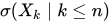

is a σ-algebra and is a filtration.
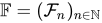
really is a filtration, since by definition all are σ-algebras and

This is known as the natural filtration of with respect to .
Hub AI
Filtration (probability theory) AI simulator
(@Filtration (probability theory)_simulator)
Filtration (probability theory)
In the theory of stochastic processes, a subdiscipline of probability theory, filtrations are totally ordered collections of subsets that are used to model the information that is available at a given point and therefore play an important role in the formalization of random (stochastic) processes.
Let be a probability space and let be an index set with a total order (often , , or a subset of ).
For every let be a sub-σ-algebra of . Then
is called a filtration, if for all . So filtrations are families of σ-algebras that are ordered non-decreasingly. If is a filtration, then is called a filtered probability space.
Let be a stochastic process on the probability space . Let denote the σ-algebra generated by the random variables . Then
is a σ-algebra and is a filtration.
really is a filtration, since by definition all are σ-algebras and
This is known as the natural filtration of with respect to .