Hubbry Logo
Probability spaceProbability spaceMain
Open search
Probability space
Community hub
Probability space
logo
8 pages, 0 posts
0 subscribers
Be the first to start a discussion here.
Probability space
Probability space
from Wikipedia

In probability theory, a probability space or a probability triple is a mathematical construct that provides a formal model of a random process or "experiment". For example, one can define a probability space which models the throwing of a dice.

A probability space consists of three elements:[1][2]

  1. A sample space, , which is the set of all possible outcomes of a random process under consideration.
  2. An event space, , which is a set of events, where an event is a subset of outcomes in the sample space.
  3. A probability function, , which assigns, to each event in the event space, a probability, which is a number between 0 and 1 (inclusive).

In order to provide a model of probability, these elements must satisfy probability axioms.

In the example of the throw of a standard die,

  1. The sample space is typically the set where each element in the set is a label which represents the outcome of the die landing on that label. For example, represents the outcome that the die lands on 1.
  2. The event space could be the set of all subsets of the sample space, which would then contain simple events such as ("the die lands on 5"), as well as complex events such as ("the die lands on an even number").
  3. The probability function would then map each event to the number of outcomes in that event divided by 6 – so for example, would be mapped to , and would be mapped to .

When an experiment is conducted, it results in exactly one outcome from the sample space . All the events in the event space that contain the selected outcome are said to "have occurred". The probability function must be so defined that if the experiment were repeated arbitrarily many times, the number of occurrences of each event as a fraction of the total number of experiments, will most likely tend towards the probability assigned to that event.

The Soviet mathematician Andrey Kolmogorov introduced the notion of a probability space and the axioms of probability in the 1930s. In modern probability theory, there are alternative approaches for axiomatization, such as the algebra of random variables.

Introduction

[edit]
Probability space for throwing a die twice in succession: The sample space consists of all 36 possible outcomes; three different events (colored polygons) are shown, with their respective probabilities (assuming a discrete uniform distribution).

A probability space is a mathematical triplet that presents a model for a particular class of real-world situations. As with other models, its author ultimately defines which elements , , and will contain.

  • The sample space is the set of all possible outcomes. An outcome is the result of a single execution of the model. Outcomes may be states of nature, possibilities, experimental results and the like. Every instance of the real-world situation (or run of the experiment) must produce exactly one outcome. If outcomes of different runs of an experiment differ in any way that matters, they are distinct outcomes. Which differences matter depends on the kind of analysis we want to do. This leads to different choices of sample space.
  • The σ-algebra is a collection of all the events we would like to consider. This collection may or may not include each of the elementary events. Here, an "event" is a set of zero or more outcomes; that is, a subset of the sample space. An event is considered to have "happened" during an experiment when the outcome of the latter is an element of the event. Since the same outcome may be a member of many events, it is possible for many events to have happened given a single outcome. For example, when the trial consists of throwing two dice, the set of all outcomes with a sum of 7 pips may constitute an event, whereas outcomes with an odd number of pips may constitute another event. If the outcome is the element of the elementary event of two pips on the first die and five on the second, then both of the events, "7 pips" and "odd number of pips", are said to have happened.
  • The probability measure is a set function returning an event's probability. A probability is a real number between zero (impossible events have probability zero, though probability-zero events are not necessarily impossible) and one (the event happens almost surely, with almost total certainty). Thus is a function The probability measure function must satisfy two simple requirements: First, the probability of a countable union of mutually exclusive events must be equal to the countable sum of the probabilities of each of these events. For example, the probability of the union of the mutually exclusive events and in the random experiment of one coin toss, , is the sum of probability for and the probability for , . Second, the probability of the sample space must be equal to 1 (which accounts for the fact that, given an execution of the model, some outcome must occur). In the previous example the probability of the set of outcomes must be equal to one, because it is entirely certain that the outcome will be either or (the model neglects any other possibility) in a single coin toss.

Not every subset of the sample space must necessarily be considered an event: some of the subsets are simply not of interest, others cannot be "measured". This is not so obvious in a case like a coin toss. In a different example, one could consider javelin throw lengths, where the events typically are intervals like "between 60 and 65 meters" and unions of such intervals, but not sets like the "irrational numbers between 60 and 65 meters".

Definition

[edit]

In short, a probability space is a measure space such that the measure of the whole space is equal to one.

The expanded definition is the following: a probability space is a triple consisting of:

  • the sample space – an arbitrary non-empty set,
  • the σ-algebra (also called σ-field) – a set of subsets of , called events, such that:
    • contains the sample space: ,
    • is closed under complements: if , then also ,
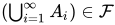
    • is closed under countable unions: if for , then also
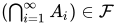
      • The corollary from the previous two properties and De Morgan's law is that is also closed under countable intersections: if for , then also
  • the probability measure – a function on such that:
    • P is countably additive (also called σ-additive): if is a countable collection of pairwise disjoint sets, then
    • the measure of the entire sample space is equal to one: .

Discrete case

[edit]

Discrete probability theory needs only at most countable sample spaces . Probabilities can be ascribed to points of by the probability mass function such that . All subsets of can be treated as events (thus, is the power set). The probability measure takes the simple form

The greatest σ-algebra describes the complete information. In general, a σ-algebra corresponds to a finite or countable partition , the general form of an event being . See also the examples.


The case is permitted by the definition, but rarely used, since such can safely be excluded from the sample space.

General case

[edit]

If Ω is uncountable, still, it may happen that P(ω) ≠ 0 for some ω; such ω are called atoms. They are an at most countable (maybe empty) set, whose probability is the sum of probabilities of all atoms. If this sum is equal to 1 then all other points can safely be excluded from the sample space, returning us to the discrete case. Otherwise, if the sum of probabilities of all atoms is between 0 and 1, then the probability space decomposes into a discrete (atomic) part (maybe empty) and a non-atomic part.

Non-atomic case

[edit]

If P(ω) = 0 for all ω ∈ Ω (in this case, Ω must be uncountable, because otherwise P(Ω) = 1 could not be satisfied), then equation () fails: the probability of a set is not necessarily the sum over the probabilities of its elements, as summation is only defined for countable numbers of elements. This makes the probability space theory much more technical. A formulation stronger than summation, measure theory is applicable. Initially the probabilities are ascribed to some "generator" sets (see the examples). Then a limiting procedure allows assigning probabilities to sets that are limits of sequences of generator sets, or limits of limits, and so on. All these sets are the σ-algebra . For technical details see Carathéodory's extension theorem. Sets belonging to are called measurable. In general they are much more complicated than generator sets, but much better than non-measurable sets.

Complete probability space

[edit]

A probability space is said to be a complete probability space if for all with and all one has . Often, the study of probability spaces is restricted to complete probability spaces.

Examples

[edit]

Discrete examples

[edit]

Example 1

[edit]

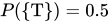
If the experiment consists of just one flip of a fair coin, then the outcome is either heads or tails: . The σ-algebra contains events, namely: ("heads"), ("tails"), ("neither heads nor tails"), and ("either heads or tails"); in other words, . There is a fifty percent chance of tossing heads and fifty percent for tails, so the probability measure in this example is , , , .

Example 2

[edit]

The fair coin is tossed three times. There are 8 possible outcomes: Ω = {HHH, HHT, HTH, HTT, THH, THT, TTH, TTT} (here "HTH" for example means that first time the coin landed heads, the second time tails, and the last time heads again). The complete information is described by the σ-algebra of 28 = 256 events, where each of the events is a subset of Ω.

Alice knows the outcome of the second toss only. Thus her incomplete information is described by the partition Ω = A1A2 = {HHH, HHT, THH, THT} ⊔ {HTH, HTT, TTH, TTT}, where ⊔ is the disjoint union, and the corresponding σ-algebra . Bryan knows only the total number of tails. His partition contains four parts: Ω = B0B1B2B3 = {HHH} ⊔ {HHT, HTH, THH} ⊔ {TTH, THT, HTT} ⊔ {TTT}; accordingly, his σ-algebra contains 24 = 16 events.

The two σ-algebras are incomparable: neither nor ; both are sub-σ-algebras of 2Ω.

Example 3

[edit]

If 100 voters are to be drawn randomly from among all voters in California and asked whom they will vote for governor, then the set of all sequences of 100 Californian voters would be the sample space Ω. We assume that sampling without replacement is used: only sequences of 100 different voters are allowed. For simplicity an ordered sample is considered, that is a sequence (Alice, Bryan) is different from (Bryan, Alice). We also take for granted that each potential voter knows exactly his/her future choice, that is he/she does not choose randomly.

Alice knows only whether or not Arnold Schwarzenegger has received at least 60 votes. Her incomplete information is described by the σ-algebra that contains: (1) the set of all sequences in Ω where at least 60 people vote for Schwarzenegger; (2) the set of all sequences where fewer than 60 vote for Schwarzenegger; (3) the whole sample space Ω; and (4) the empty set ∅.

Bryan knows the exact number of voters who are going to vote for Schwarzenegger. His incomplete information is described by the corresponding partition Ω = B0B1 ⊔ ⋯ ⊔ B100 and the σ-algebra consists of 2101 events.

In this case, Alice's σ-algebra is a subset of Bryan's: . Bryan's σ-algebra is in turn a subset of the much larger "complete information" σ-algebra 2Ω consisting of 2n(n−1)⋯(n−99) events, where n is the number of all potential voters in California.

Non-atomic examples

[edit]

Example 4

[edit]

A number between 0 and 1 is chosen at random, uniformly. Here Ω = [0,1], is the σ-algebra of Borel sets on Ω, and P is the Lebesgue measure on [0,1].

In this case, the open intervals of the form (a,b), where 0 < a < b < 1, could be taken as the generator sets. Each such set can be ascribed the probability of P((a,b)) = (ba), which generates the Lebesgue measure on [0,1], and the Borel σ-algebra on Ω.

Example 5

[edit]

A fair coin is tossed endlessly. Here one can take Ω = {0,1}, the set of all infinite sequences of numbers 0 and 1. Cylinder sets {(x1, x2, ...) ∈ Ω : x1 = a1, ..., xn = an} may be used as the generator sets. Each such set describes an event in which the first n tosses have resulted in a fixed sequence (a1, ..., an), and the rest of the sequence may be arbitrary. Each such event can be naturally given the probability of 2n.

These two non-atomic examples are closely related: a sequence (x1, x2, ...) ∈ {0,1} leads to the number 2−1x1 + 2−2x2 + ⋯ ∈ [0,1]. This is not a one-to-one correspondence between {0,1} and [0,1] however: it is an isomorphism modulo zero, which allows for treating the two probability spaces as two forms of the same probability space. In fact, all non-pathological non-atomic probability spaces are the same in this sense. They are so-called standard probability spaces. Basic applications of probability spaces are insensitive to standardness. However, non-discrete conditioning is easy and natural on standard probability spaces, otherwise it becomes obscure.

[edit]

Probability distribution

[edit]

Random variables

[edit]

A random variable X is a measurable function X: Ω → S from the sample space Ω to another measurable space S called the state space.

If AS, the notation Pr(XA) is a commonly used shorthand for .

Defining the events in terms of the sample space

[edit]

If Ω is countable, we almost always define as the power set of Ω, i.e. which is trivially a σ-algebra and the biggest one we can create using Ω. We can therefore omit and just write (Ω,P) to define the probability space.

On the other hand, if Ω is uncountable and we use we get into trouble defining our probability measure P because is too "large", i.e. there will often be sets to which it will be impossible to assign a unique measure. In this case, we have to use a smaller σ-algebra , for example the Borel algebra of Ω, which is the smallest σ-algebra that makes all open sets measurable.

Conditional probability

[edit]

Kolmogorov's definition of probability spaces gives rise to the natural concept of conditional probability. Every set A with non-zero probability (that is, P(A) > 0) defines another probability measure on the space. This is usually pronounced as the "probability of B given A".
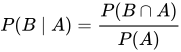
For any event A such that P(A) > 0, the function Q defined by Q(B) = P(B | A) for all events B is itself a probability measure.

Independence

[edit]

Two events, A and B are said to be independent if P(AB) = P(A) P(B).

Two random variables, X and Y, are said to be independent if any event defined in terms of X is independent of any event defined in terms of Y. Formally, they generate independent σ-algebras, where two σ-algebras G and H, which are subsets of F are said to be independent if any element of G is independent of any element of H.

Mutual exclusivity

[edit]

Two events, A and B are said to be mutually exclusive or disjoint if the occurrence of one implies the non-occurrence of the other, i.e., their intersection is empty. This is a stronger condition than the probability of their intersection being zero.

If A and B are disjoint events, then P(AB) = P(A) + P(B). This extends to a (finite or countably infinite) sequence of events. However, the probability of the union of an uncountable set of events is not the sum of their probabilities. For example, if Z is a normally distributed random variable, then P(Z = x) is 0 for any x, but P(ZR) = 1.

The event AB is referred to as "A and B", and the event AB as "A or B".

See also

[edit]

References

[edit]

Bibliography

[edit]
[edit]
Revisions and contributorsEdit on WikipediaRead on Wikipedia
from Grokipedia
A probability space is a fundamental in that formalizes the modeling of random phenomena, defined as a triple (Ω,F,P)(\Omega, \mathcal{F}, P), where Ω\Omega is the representing all possible outcomes, F\mathcal{F} is a σ\sigma-algebra of measurable events (subsets of Ω\Omega), and PP is a probability measure assigning non-negative probabilities to events in F\mathcal{F} that sum to 1 for the entire space. This framework ensures a rigorous, axiomatic approach to probability, enabling the analysis of complex stochastic processes across fields like statistics, physics, and finance. The sample space Ω\Omega captures the totality of outcomes in an experiment, such as drawing a ball from an where Ω={red,blue}\Omega = \{\text{red}, \text{blue}\}, while the σ\sigma-algebra F\mathcal{F} specifies the collection of events to which probabilities can be assigned, satisfying closure under complements and countable unions to handle infinite or continuous cases. The P:F[0,1]P: \mathcal{F} \to [0,1] quantifies the likelihood of events, adhering to Kolmogorov's axioms: non-negativity (P(A)0P(A) \geq 0 for all AFA \in \mathcal{F}), normalization (P(Ω)=1P(\Omega) = 1), and countable additivity (P(i=1Ai)=i=1P(Ai)P(\bigcup_{i=1}^\infty A_i) = \sum_{i=1}^\infty P(A_i) for disjoint events AiA_i). These components allow probability spaces to model both discrete and continuous distributions. This axiomatic foundation was established by in his 1933 monograph Foundations of the Theory of Probability (originally published in German as Grundbegriffe der Wahrscheinlichkeitsrechnung), which unified disparate probabilistic concepts under measure theory, providing a logically consistent basis that resolved earlier inconsistencies in classical and frequentist approaches. 's work provided the modern axiomatic foundations of . In practice, probability spaces are central to and its applications.

Fundamentals

Introduction

A probability space forms the foundational structure in modern , providing a rigorous mathematical framework for modeling uncertainty and randomness. This concept originated with Andrey Kolmogorov's seminal 1933 work, Grundbegriffe der Wahrscheinlichkeitsrechnung, which axiomatized probability using measure theory to unify the previously disparate treatments of discrete and continuous probabilities. Prior to this, probability calculations often relied on methods suited to specific cases, but Kolmogorov's approach established a general foundation that connected empirical observations of frequencies to abstract mathematical principles. The primary purpose of a probability space is to serve as a for random experiments, enabling the clear distinction between individual sample outcomes, collections of such outcomes known as events, and the assignment of probabilities to those events. By formalizing these elements, it allows probabilists to analyze the likelihood of occurrences in a consistent manner, bridging intuitive notions of chance with precise computations applicable across diverse fields such as , physics, and . This modeling capability ensures that probabilities reflect both long-run frequencies in repeated trials and the inherent unpredictability of single events. At its core, the intuition behind a probability space lies in conceptualizing the as the collection of all possible outcomes from an experiment, with events represented as subsets of this space and probability functioning as a measure quantifying their relative likelihood. This structure assumes basic knowledge of , including notions of sets and subsets, to build toward more advanced topics like the explored in subsequent sections.

Basic Components

A probability space consists of three fundamental components that provide the foundation for modeling in random experiments: the , the event space, and the probability assignment. These elements work together to describe all possible outcomes, the observable groupings of those outcomes, and the likelihoods associated with them, respectively. The , denoted Ω\Omega, is the set encompassing all possible outcomes of a random experiment. It represents the universal collection of results that could occur, and it may be finite, countably infinite, or uncountably infinite depending on the nature of the experiment. The event space, often denoted Σ\Sigma or F\mathcal{F}, is a collection of subsets of the sample space Ω\Omega that correspond to the events of interest—measurable groupings of outcomes that can be observed or queried. This collection must be structured to allow logical combinations of events, being closed under complements and countable unions (and thus countable intersections); these properties ensure that if one event occurs, related events can also be meaningfully defined. Such a structure is known as a σ\sigma-algebra, though its formal properties are detailed later. The probability assignment, denoted PP, is a function that maps each event in the event space to a real number between 0 and 1, indicating the likelihood or "degree of belief" in that event occurring. Informally, it satisfies key requirements: P(Ω)=1P(\Omega) = 1, reflecting certainty that some outcome in the sample space will occur; P()=0P(\emptyset) = 0, as the empty set (impossible event) has no chance of occurring; and for a countable collection of disjoint events (mutually exclusive), the probability of their union equals the sum of their individual probabilities, capturing countable additivity. These ensure the assignment behaves intuitively as a measure of chance.

Formal Framework

General Definition

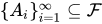
A probability space is formally defined as a triple (Ω,Σ,P)(\Omega, \Sigma, P), where Ω\Omega is the sample space representing the set of all possible outcomes of a random experiment, Σ\Sigma is a σ\sigma-algebra of subsets of Ω\Omega (called events), and P:Σ[0,1]P: \Sigma \to [0,1] is a probability measure assigning probabilities to events. The σ\sigma-algebra Σ\Sigma provides the structure for measurable events and is defined as a collection of subsets of Ω\Omega that includes Ω\Omega and the empty set \emptyset, and is closed under complements (if EΣE \in \Sigma, then ΩEΣ\Omega \setminus E \in \Sigma) and countable unions (if {Ei}i=1Σ\{E_i\}_{i=1}^\infty \subseteq \Sigma, then i=1EiΣ\bigcup_{i=1}^\infty E_i \in \Sigma). It is also closed under countable intersections as a consequence of the closure under complements and unions. The probability measure PP satisfies the Kolmogorov axioms, which form the foundational principles of modern : (1)P(E)0for all EΣ,(2)P(Ω)=1,(3)P(i=1Ei)=i=1P(Ei)for any countable collection of pairwise disjoint events {Ei}i=1Σ.\begin{align*} &(1) && P(E) \geq 0 && \text{for all } E \in \Sigma, \\ &(2) && P(\Omega) = 1, \\ &(3) && P\left( \bigcup_{i=1}^\infty E_i \right) = \sum_{i=1}^\infty P(E_i) && \text{for any countable collection of pairwise disjoint events } \{E_i\}_{i=1}^\infty \subseteq \Sigma. \end{align*} This general framework applies to both discrete and continuous cases, as detailed in subsequent sections.

Probability Measure

In a probability space (Ω,Σ,P)(\Omega, \Sigma, P), the probability measure PP is a function that assigns to each event AΣA \in \Sigma a real number P(A)P(A) between 0 and 1, representing the probability of AA occurring. This measure is distinguished from a general measure by its normalization property: P(Ω)=1P(\Omega) = 1, ensuring the total probability over the sample space is unity. The core defining PP is countable additivity, which states that if {En}n=1\{E_n\}_{n=1}^\infty is a countable collection of pairwise disjoint events in Σ\Sigma, then P(n=1En)=n=1P(En).P\left( \bigcup_{n=1}^\infty E_n \right) = \sum_{n=1}^\infty P(E_n). This property extends finite additivity to infinite collections, allowing the measure to handle uncountably many outcomes in continuous spaces while maintaining consistency. Non-negativity, P(A)0P(A) \geq 0 for all AΣA \in \Sigma, and the normalization complete the axiomatic foundation established by Kolmogorov. From these axioms, several derived properties follow. Monotonicity holds: if ABA \subseteq B, then P(A)P(B)P(A) \leq P(B), as B=A(BA)B = A \cup (B \setminus A) and the sets are disjoint. is also implied: for any A,BΣA, B \in \Sigma, P(AB)P(A)+P(B),P(A \cup B) \leq P(A) + P(B), with equality if AA and BB are disjoint. These ensure the measure behaves intuitively for unions and inclusions. The construction of PP often begins with finite additivity on a simpler collection, such as an algebra of sets in discrete cases where PP counts outcomes proportionally. For general spaces, Carathéodory's extension theorem provides a method to extend a finitely additive, non-negative set function μ\mu on an algebra A\mathcal{A} (with μ(Ω)=1\mu(\Omega) = 1) to a countably additive probability measure on the generated σ\sigma-algebra σ(A)\sigma(\mathcal{A}), via the outer measure μ(E)=inf{μ(Ai):EAi,AiA}\mu^*(E) = \inf \left\{ \sum \mu(A_i) : E \subseteq \bigcup A_i, A_i \in \mathcal{A} \right\} and identifying measurable sets. This theorem guarantees existence for probability measures like the Lebesgue measure on [0,1][0,1], starting from interval lengths. Uniqueness of PP on Σ\Sigma is ensured if it is specified on a π\pi-system P\mathcal{P} (closed under finite intersections) that generates Σ\Sigma, by : any two probability measures agreeing on P\mathcal{P} coincide on σ(P)\sigma(\mathcal{P}). This relies on the π\pi-λ\lambda theorem, showing the collection where measures agree forms a λ\lambda-system containing P\mathcal{P}, hence equals σ(P)\sigma(\mathcal{P}).

Special Cases

Discrete Probability Spaces

A discrete probability space is a specialization of the general probability space framework where the sample space Ω\Omega is a , either finite or countably infinite. This structure aligns with the axiomatic foundations of , where the sample space consists of discrete outcomes that can be enumerated. In such spaces, every of Ω\Omega is measurable, so the σ\sigma- F\mathcal{F} is the power set of Ω\Omega, comprising all possible subsets. The probability measure PP on a discrete probability space assigns a non-negative probability pω=P({ω})0p_\omega = P(\{\omega\}) \geq 0 to each singleton {ω}\{\omega\} for ωΩ\omega \in \Omega, satisfying the normalization condition ωΩpω=1\sum_{\omega \in \Omega} p_\omega = 1. This measure extends additively to any event EΩE \subseteq \Omega by P(E)=ωEpωP(E) = \sum_{\omega \in E} p_\omega, ensuring that the Kolmogorov axioms of non-negativity, normalization, and countable additivity are met automatically due to the discrete nature of the space. A classic example of constructing a discrete probability space is the uniform distribution on a finite , such as the outcomes of rolling a fair six-sided die, where Ω={1,2,3,4,5,6}\Omega = \{1, 2, 3, 4, 5, 6\} and pω=16p_\omega = \frac{1}{6} for each ωΩ\omega \in \Omega. For countably infinite spaces, the provides an illustration: let Ω={0,1,2,}\Omega = \{0, 1, 2, \dots \} represent the number of failures before the first success in independent Bernoulli trials with success probability p(0,1)p \in (0,1), and set pk=(1p)kpp_k = (1-p)^k p for kΩk \in \Omega, which sums to 1 over the natural numbers. Discrete probability spaces offer the advantage of straightforward , as probabilities of events can be calculated using finite or convergent infinite sums without requiring integration or advanced measure-theoretic tools. This simplicity facilitates explicit calculations and simulations in applications like and analysis.

Continuous Probability Spaces

In continuous probability spaces, the sample space Ω\Omega is uncountable, such as the interval [0,1][0,1] or Rn\mathbb{R}^n, representing outcomes that form a continuum rather than discrete points. The associated σ\sigma-algebra F\mathcal{F} is typically the Borel σ\sigma-algebra generated by the open sets in the standard topology on Rn\mathbb{R}^n, or the Lebesgue σ\sigma-algebra, which is its completion with respect to . The probability measure P:F[0,1]P: \mathcal{F} \to [0,1] is often taken to be absolutely continuous with respect to the μ\mu on Rn\mathbb{R}^n. By the Radon-Nikodym theorem, under this absolute continuity, PP admits a representation via a f:Rn[0,)f: \mathbb{R}^n \to [0,\infty) that is measurable and integrable, such that P(E)=EfdμP(E) = \int_E f \, d\mu for all EFE \in \mathcal{F}, with the normalization condition Rnfdμ=1\int_{\mathbb{R}^n} f \, d\mu = 1. This density ff uniquely determines PP up to μ\mu-almost everywhere equivalence. A defining property of such spaces is the absence of point masses: for any singleton {ω}F\{\omega\} \in \mathcal{F}, P({ω})=0P(\{\omega\}) = 0, reflecting the diffuse nature of the measure across the continuum. Continuous probability spaces are thus non-atomic, meaning no single outcome carries positive probability.

Non-Atomic Probability Spaces

A non-atomic probability space, also known as an atomless probability space, is a probability space (Ω,F,P)(\Omega, \mathcal{F}, P) where the PP satisfies the condition that for every event AFA \in \mathcal{F} with P(A)>0P(A) > 0, there exists a subevent BFB \in \mathcal{F} such that BAB \subset A and 0<P(B)<P(A)0 < P(B) < P(A). This property ensures that no indivisible "atoms" exist in the space, meaning the measure can be subdivided arbitrarily without concentrating positive probability on single points or irreducible sets. Non-atomic probability spaces are measure-theoretically isomorphic to the unit interval [0,1][0,1] equipped with the Lebesgue measure, up to a null set. This equivalence, known as Rokhlin's theorem, establishes that any separable, complete, non-atomic probability space can be mapped continuously onto [0,1][0,1] in a way that preserves the measure structure, generalizing the uniform distribution on the interval. A key result characterizing non-atomic spaces is the Lyapunov convexity theorem, which states that for a non-atomic vector measure taking values in a finite-dimensional Euclidean space, the range of the measure—namely, the set {μ(E):EΣ}\{ \mu(E) : E \in \Sigma \}, where Σ\Sigma is the σ\sigma-algebra—is compact and convex. This convexity property arises from the atomless nature of the underlying measure and has significant implications for optimization and control theory by ensuring that intermediate values in the range can be achieved through suitable partitions of sets. The canonical example of a non-atomic probability space is the unit interval [0,1][0,1] with the Borel σ\sigma-algebra and the Lebesgue measure, where subsets of any positive measure can be split into subintervals with measures filling the continuum between 0 and the original measure. More generally, any space with a measure absolutely continuous with respect to Lebesgue measure on Rn\mathbb{R}^n, such as Gaussian distributions on R\mathbb{R}, inherits this non-atomic structure, excluding discrete point masses. In applications, non-atomic probability spaces model infinite-player games in cooperative game theory, where players form a continuum without individual significance, as developed in the framework of non-atomic games. Here, coalitions are measurable sets in the space, and the atomless property ensures that no single player affects outcomes, facilitating the extension of value concepts like the Shapley value to such settings.

Advanced Properties

Completeness

A probability space (Ω,Σ,P)(\Omega, \Sigma, P) is complete if, for every null set NΣN \in \Sigma with P(N)=0P(N) = 0, every subset ANA \subset N belongs to Σ\Sigma and satisfies P(A)=0P(A) = 0. This property guarantees that all negligible events—subsets of sets with probability zero—are treated as measurable and assigned zero probability, preventing subtle measurability issues in subsequent analyses. The completion of an arbitrary probability space (Ω,Σ,P)(\Omega, \Sigma, P) involves constructing a larger σ-algebra Σˉ\bar{\Sigma} that incorporates all subsets of null sets. Specifically, Σˉ\bar{\Sigma} consists of all sets of the form BΔCB \Delta C, where BΣB \in \Sigma and CC is a subset of some null set NΣN \in \Sigma with P(N)=0P(N) = 0, or equivalently, all unions BDB \cup D with BΣB \in \Sigma and DND \subset N for such an NN. The probability measure is then extended to Pˉ(BD)=P(B)\bar{P}(B \cup D) = P(B), ensuring Pˉ\bar{P} agrees with PP on Σ\Sigma. This augmentation results in the complete probability space (Ω,Σˉ,Pˉ)(\Omega, \bar{\Sigma}, \bar{P}), where Σˉ\bar{\Sigma} is a σ-algebra containing Σ\Sigma. Every probability space admits a completion, which is unique up to sets of measure zero; this follows from standard measure-theoretic extensions that preserve the original measure on the initial σ-algebra. For instance, the Lebesgue measure on R\mathbb{R}, defined on the Lebesgue σ-algebra (the completion of the Borel σ-algebra), is inherently complete, making (R,L,λ)(\mathbb{R}, \mathcal{L}, \lambda) a canonical example of a complete probability space when restricted to intervals of finite length. Completeness plays a vital role in ensuring the measurability of limits in sequences of events or functions, particularly in the context of almost sure convergence, where convergence holds except on sets of probability zero. Without completeness, limits might fail to be measurable even if they agree almost everywhere with measurable objects, undermining key results in stochastic processes and integration theory. Although the completion process enlarges the σ-algebra, potentially complicating explicit verification of measurability, the standard extension preserves σ-additivity and other measure properties, avoiding violations of the core axioms.

Standard Extensions

Standard extensions of probability spaces include constructions that combine multiple spaces or extend them to infinite dimensions while preserving key probabilistic properties. The product probability space for a finite collection of independent probability spaces (Ωi,Σi,Pi)(\Omega_i, \Sigma_i, P_i) for i=1,,ni = 1, \dots, n is defined on the Cartesian product Ω=i=1nΩi\Omega = \prod_{i=1}^n \Omega_i, equipped with the product σ\sigma-algebra i=1nΣi\bigotimes_{i=1}^n \Sigma_i generated by the measurable rectangles i=1nAi\prod_{i=1}^n A_i where AiΣiA_i \in \Sigma_i. The product measure P=i=1nPiP = \prod_{i=1}^n P_i is the unique probability measure satisfying P(i=1nAi)=i=1nPi(Ai)P\left( \prod_{i=1}^n A_i \right) = \prod_{i=1}^n P_i(A_i) for all such rectangles, and extends by σ\sigma-additivity to the full product σ\sigma-algebra; this construction assumes the spaces are σ\sigma-finite to ensure uniqueness. For infinite products, direct construction is more subtle due to potential inconsistencies, but the framework applies similarly when finite-dimensional marginals are consistent. The Kolmogorov extension theorem addresses infinite products by guaranteeing the existence and uniqueness of a probability measure under appropriate consistency conditions. Given a sequence of probability measures {μn}n=1\{\mu_n\}_{n=1}^\infty on (Rn,B(Rn))(\mathbb{R}^n, \mathcal{B}(\mathbb{R}^n)) that are consistent—meaning for every n1n \geq 1, k1k \geq 1, and Borel set ERnE \subset \mathbb{R}^n, μn+k(E×Rk)=μn(E)\mu_{n+k}(E \times \mathbb{R}^k) = \mu_n(E)—there exists a unique probability measure μ\mu on the infinite product space (R,B(R))(\mathbb{R}^\infty, \mathcal{B}(\mathbb{R}^\infty)), where B(R)\mathcal{B}(\mathbb{R}^\infty) is the σ\sigma-algebra generated by cylinder sets, such that the finite-dimensional marginals satisfy μ(E×R)=μn(E)\mu(E \times \mathbb{R}^\infty) = \mu_n(E) for all nn and Borel ERnE \subset \mathbb{R}^n. This theorem, in its basic form for R\mathbb{R}-valued spaces, extends to more general settings and is pivotal for rigorous constructions beyond finite dimensions. Standard probability spaces provide a canonical form for many extensions, often isomorphic to the unit interval [0,1][0,1] equipped with Lebesgue measure or, more broadly, to Polish spaces (separable complete metric spaces) with their Borel σ\sigma-algebra and a Borel probability measure. A key result is the isomorphism theorem, which asserts that every separable, complete, non-atomic probability space—where separability means the σ\sigma-algebra is countably generated modulo null sets, completeness ensures all subsets of null sets are measurable, and non-atomicity means no atoms exist (sets of positive measure with no proper subsets of the same measure)—is isomorphic to ([0,1],B([0,1]),m)([0,1], \mathcal{B}([0,1]), m), with mm the Lebesgue measure. The isomorphism is a measure-preserving bijection (modulo null sets) between the spaces, preserving the σ\sigma-algebra structure. These extensions find essential applications in stochastic processes, particularly for defining measures on path spaces. The Kolmogorov extension theorem enables the construction of processes in continuous time, such as on R0\mathbb{R}_{\geq 0}-valued paths, by specifying consistent finite-dimensional distributions with given mean and covariance functions, yielding a unique probability measure on the space of cadlag functions or continuous paths. Similarly, standard space isomorphisms simplify the analysis of process realizations by mapping them to Lebesgue spaces, facilitating computations in areas like Markov processes and .

Illustrative Examples

Discrete Examples

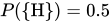
A classic finite discrete probability space is provided by the experiment of flipping a fair coin once. The sample space is Ω={H,T}\Omega = \{H, T\}, where HH denotes heads and TT denotes tails. The σ\sigma-algebra Σ\Sigma is the power set of Ω\Omega, consisting of \emptyset, {H}\{H\}, {T}\{T\}, and {H,T}\{H, T\}. The probability measure PP is defined by P({H})=12P(\{H\}) = \frac{1}{2} and P({T})=12P(\{T\}) = \frac{1}{2}, which extends to all events in Σ\Sigma via additivity, such as P({H,T})=1P(\{H, T\}) = 1. Another finite example arises from rolling a fair six-sided die. Here, Ω={1,2,3,4,5,6}\Omega = \{1, 2, 3, 4, 5, 6\}, with Σ\Sigma again the power set of Ω\Omega. The uniform probability measure assigns P({k})=16P(\{k\}) = \frac{1}{6} for each kΩk \in \Omega, ensuring equal likelihood for each face and extending additively to subsets, for instance P({1,2,3})=12P(\{1, 2, 3\}) = \frac{1}{2}. This setup models scenarios with equally probable discrete outcomes. For a countably infinite discrete space, consider a sequence of independent Bernoulli trials, each with success probability p(0,1)p \in (0,1). The sample space is Ω={0,1}N\Omega = \{0,1\}^{\mathbb{N}}, the set of all infinite sequences of 0s (failure) and 1s (success). The σ\sigma-algebra Σ\Sigma is the product σ\sigma-algebra generated by cylinder sets, which are sets defined by fixing finitely many coordinates. The probability measure PP is the infinite product of Bernoulli measures, where for a cylinder set specified by outcomes in the first nn trials, PP is the product i=1npxi(1p)1xi\prod_{i=1}^n p^{x_i} (1-p)^{1-x_i} with xi{0,1}x_i \in \{0,1\}, and extended to all of Σ\Sigma via Kolmogorov's extension theorem to ensure consistency. A further countable example derives from the discretization of a Poisson point process, focusing on the number of arrivals in a fixed interval. The sample space is Ω={0,1,2,}\Omega = \{0, 1, 2, \dots \}, the non-negative integers representing possible counts. The σ\sigma-algebra Σ\Sigma is the power set of Ω\Omega. The probability measure is given by P({k})=eλλkk!,k=0,1,2,,P(\{k\}) = e^{-\lambda} \frac{\lambda^k}{k!}, \quad k = 0,1,2,\dots, where λ>0\lambda > 0 is the expected number of arrivals; this arises as the distribution of the count when interarrival times are independent exponential random variables with rate λ\lambda, summed to yield the total count. Each of these examples constitutes a valid probability space, as the measure [P](/page/P′′)[P](/page/P′′) satisfies normalization [P](/page/P′′)(Ω)=1[P](/page/P′′)(\Omega) = 1 and countable additivity: for any countable collection of disjoint events {Ai}i=1Σ\{A_i\}_{i=1}^\infty \subseteq \Sigma, [P](/page/P′′)(i=1Ai)=i=1[P](/page/P′′)(Ai)[P](/page/P′′)\left(\bigcup_{i=1}^\infty A_i\right) = \sum_{i=1}^\infty [P](/page/P′′)(A_i). In the finite cases of the and die, additivity reduces to the finite case, while the countable cases of Bernoulli trials and the Poisson count require the full countable property.

Continuous Examples

Continuous probability spaces typically feature an uncountable Ω, often a subset of the real line or higher-dimensional , equipped with the Borel generated by open sets, and a P defined via a with respect to . These spaces are non-atomic, meaning no single point has positive probability, which aligns with their continuous nature. A fundamental example is the uniform distribution on the unit interval, where the is Ω = [0,1], the σ-algebra Σ is the Borel σ-algebra on [0,1], and the is P(E) = λ(E) for Borel sets E ⊆ [0,1], with λ denoting the normalized to total probability 1. This setup models scenarios requiring equal likelihood across a continuum, such as selecting a random point in a . The density function is f(x) = 1 for x ∈ [0,1] and 0 otherwise, ensuring ∫_{[0,1]} f(x) dx = 1. Another canonical continuous space arises from the standard , with Ω = ℝ, the Borel on ℝ, and P(E) = ∫_E φ(x) dx, where the is given by ϕ(x)=12πexp(x22)\phi(x) = \frac{1}{\sqrt{2\pi}} \exp\left(-\frac{x^2}{2}\right)
Add your contribution
Related Hubs
User Avatar
No comments yet.