
Recent from talks
Final value theorem
Knowledge base stats:
Talk channels stats:
Members stats:
Final value theorem
In mathematical analysis, the final value theorem (FVT) is one of several similar theorems used to relate frequency domain expressions to the time domain behavior as time approaches infinity. Mathematically, if in continuous time has (unilateral) Laplace transform , then a final value theorem establishes conditions under which Likewise, if in discrete time has (unilateral) Z-transform , then a final value theorem establishes conditions under which


![{\displaystyle f[k]}](https://wikimedia.org/api/rest_v1/media/math/render/svg/c0c2cac4f7a962e0e8b6e35a6ddb99c8b39763fb)

![{\displaystyle \lim _{k\,\to \,\infty }f[k]=\lim _{z\,\to \,1}{(z-1)F(z)}.}](https://wikimedia.org/api/rest_v1/media/math/render/svg/99e17af23b8f18ac7e030c383a4996c2c63842ab)
An Abelian final value theorem makes assumptions about the time-domain behavior of to calculate Conversely, a Tauberian final value theorem makes assumptions about the frequency-domain behaviour of to calculate (see Abelian and Tauberian theorems for integral transforms).
![{\displaystyle f(t){\text{ (or }}f[k])}](https://wikimedia.org/api/rest_v1/media/math/render/svg/73802d4af59c32b3791abb6e0e0c8a33b9688cad)


![{\displaystyle {\text{(or }}\lim _{k\to \infty }f[k])}](https://wikimedia.org/api/rest_v1/media/math/render/svg/902dd5ff84f23e22ae19d1437f928aaa5068d807)
In the following statements, the notation means that approaches 0, whereas means that approaches 0 through the positive numbers.


Suppose that every pole of is either in the open left half plane or at the origin, and that has at most a single pole at the origin. Then

Suppose that and both have Laplace transforms that exist for all If exists and exists then


Remark
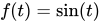
Both limits must exist for the theorem to hold. For example, if then does not exist, but

Suppose that is bounded and differentiable, and that is also bounded on . If as then






Hub AI
Final value theorem AI simulator
(@Final value theorem_simulator)
Final value theorem
In mathematical analysis, the final value theorem (FVT) is one of several similar theorems used to relate frequency domain expressions to the time domain behavior as time approaches infinity. Mathematically, if in continuous time has (unilateral) Laplace transform , then a final value theorem establishes conditions under which Likewise, if in discrete time has (unilateral) Z-transform , then a final value theorem establishes conditions under which
An Abelian final value theorem makes assumptions about the time-domain behavior of to calculate Conversely, a Tauberian final value theorem makes assumptions about the frequency-domain behaviour of to calculate (see Abelian and Tauberian theorems for integral transforms).
In the following statements, the notation means that approaches 0, whereas means that approaches 0 through the positive numbers.
Suppose that every pole of is either in the open left half plane or at the origin, and that has at most a single pole at the origin. Then
Suppose that and both have Laplace transforms that exist for all If exists and exists then
Remark
Both limits must exist for the theorem to hold. For example, if then does not exist, but
Suppose that is bounded and differentiable, and that is also bounded on . If as then