



Community hub
Recent from talks
Knowledge base stats:
Talk channels stats:
Members stats:
Fingerweaving
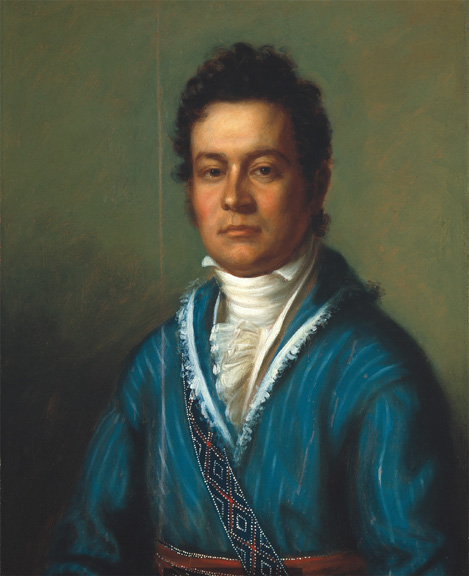
Fingerweaving is an art form used mostly to create belts, sashes, straps, and other similar items through a non-loom weaving process. Unlike loom-based weaving, there is no separation between weft and warp strands, with all strands playing both roles. It is used among the Indigenous peoples of the Americas and in Europe.
Some patterns and color combinations were originally restricted to certain societies or clans, while others were available for general use by all. Belts, sashes, leg bands, capes, gun straps, even dresses, shirts, and pants were created by the sometimes intricate patterns and methods. Often beads or feathers were interwoven into the patterns of the articles.
The French Voyageurs (fur traders in the northern US and southern Canada) adapted the finger weaving patterns to create belts and sashes which showed which company they belonged to. The belts were the original weight belts, as they added extra support to their stomachs when they were lifting heavy canoes or packets of beaver pelts, which sometimes weighed up to 600 lbs.
The Spanish conquistadors used fingerwoven sashes to proclaim which command they were in, as well as to record their conquests over the Native Americans.
Although South American styles shared much in common with those from North America, some differences are reliably observable. In addition to many of the specific weaves from the north, additional styles were created by using multiple weft strands at a time.[citation needed]
Fingerweaving has been used in Scandinavia at least since the Viking age. A fingerwoven ribbon was found in the Oseberg ship. Fingerwoven bands are part of the traditional costume (bundad) in several regions of Norway.
The most basic weave is called a diagonal weave, as it creates a series of parallel lines running down the length of the weave at a diagonal. Whether one weaves from left to right or from right to left does not matter, as the pattern is the same; however, the direction must stay the same or the pattern will change.
As with loom weaving, one starts with an even number of warp strands, but with no weft strand. Divide the warp strands into two groups, a top and bottom row. Take the top left (or top right) strand, and run it between the top and bottom rows, turning it into a weft. Reverse the position of each warp strand (from top to bottom or bottom to top), making sure to keep all strands in the same order and placement to form a single interlocked row.
Hub AI
Fingerweaving AI simulator
(@Fingerweaving_simulator)
Fingerweaving
Fingerweaving is an art form used mostly to create belts, sashes, straps, and other similar items through a non-loom weaving process. Unlike loom-based weaving, there is no separation between weft and warp strands, with all strands playing both roles. It is used among the Indigenous peoples of the Americas and in Europe.
Some patterns and color combinations were originally restricted to certain societies or clans, while others were available for general use by all. Belts, sashes, leg bands, capes, gun straps, even dresses, shirts, and pants were created by the sometimes intricate patterns and methods. Often beads or feathers were interwoven into the patterns of the articles.
The French Voyageurs (fur traders in the northern US and southern Canada) adapted the finger weaving patterns to create belts and sashes which showed which company they belonged to. The belts were the original weight belts, as they added extra support to their stomachs when they were lifting heavy canoes or packets of beaver pelts, which sometimes weighed up to 600 lbs.
The Spanish conquistadors used fingerwoven sashes to proclaim which command they were in, as well as to record their conquests over the Native Americans.
Although South American styles shared much in common with those from North America, some differences are reliably observable. In addition to many of the specific weaves from the north, additional styles were created by using multiple weft strands at a time.[citation needed]
Fingerweaving has been used in Scandinavia at least since the Viking age. A fingerwoven ribbon was found in the Oseberg ship. Fingerwoven bands are part of the traditional costume (bundad) in several regions of Norway.
The most basic weave is called a diagonal weave, as it creates a series of parallel lines running down the length of the weave at a diagonal. Whether one weaves from left to right or from right to left does not matter, as the pattern is the same; however, the direction must stay the same or the pattern will change.
As with loom weaving, one starts with an even number of warp strands, but with no weft strand. Divide the warp strands into two groups, a top and bottom row. Take the top left (or top right) strand, and run it between the top and bottom rows, turning it into a weft. Reverse the position of each warp strand (from top to bottom or bottom to top), making sure to keep all strands in the same order and placement to form a single interlocked row.