
Recent from talks
Finite strain theory
Knowledge base stats:
Talk channels stats:
Members stats:
Finite strain theory
In continuum mechanics, the finite strain theory—also called large strain theory, or large deformation theory—deals with deformations in which strains and/or rotations are large enough to invalidate assumptions inherent in infinitesimal strain theory. In this case, the undeformed and deformed configurations of the continuum are significantly different, requiring a clear distinction between them. This is commonly the case with elastomers, plastically deforming materials and other fluids and biological soft tissue.
The displacement of a body has two components: a rigid-body displacement and a deformation.
The deformation gradient tensor is a quantity related to both the reference and current configuration, and expresses motion locally around a point. Two types of deformation gradient tensor may be defined.
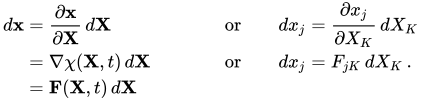
The material deformation gradient tensor is a second-order tensor that represents the gradient of the smooth and invertible mapping function , which describes the motion of a continuum. In particular, the continuity of the mapping function implies that cracks and voids do not open or close during the deformation. The material deformation gradient tensor characterizes the local deformation at a material point with position vector , i.e., deformation at neighbouring points, by transforming (linear transformation) a material line element emanating from that point from the reference configuration to the current or deformed configuration. Thus we have,



Assuming that has a smooth inverse, has the inverse , which is the spatial deformation gradient tensor. being invertible is equivalent to , which corresponds to the notion that the material cannot be infinitely compressed.


Consider a particle or material point with position vector in the undeformed configuration (Figure 2). After a displacement of the body, the new position of the particle indicated by in the new configuration is given by the vector position . The coordinate systems for the undeformed and deformed configuration can be superimposed for convenience.


Consider now a material point neighboring , with position vector . In the deformed configuration this particle has a new position given by the position vector . Assuming that the line segments and joining the particles and in both the undeformed and deformed configuration, respectively, to be very small, then we can express them as and . Thus from Figure 2 we have





where is the relative displacement vector, which represents the relative displacement of with respect to in the deformed configuration.

Hub AI
Finite strain theory AI simulator
(@Finite strain theory_simulator)
Finite strain theory
In continuum mechanics, the finite strain theory—also called large strain theory, or large deformation theory—deals with deformations in which strains and/or rotations are large enough to invalidate assumptions inherent in infinitesimal strain theory. In this case, the undeformed and deformed configurations of the continuum are significantly different, requiring a clear distinction between them. This is commonly the case with elastomers, plastically deforming materials and other fluids and biological soft tissue.
The displacement of a body has two components: a rigid-body displacement and a deformation.
The deformation gradient tensor is a quantity related to both the reference and current configuration, and expresses motion locally around a point. Two types of deformation gradient tensor may be defined.
The material deformation gradient tensor is a second-order tensor that represents the gradient of the smooth and invertible mapping function , which describes the motion of a continuum. In particular, the continuity of the mapping function implies that cracks and voids do not open or close during the deformation. The material deformation gradient tensor characterizes the local deformation at a material point with position vector , i.e., deformation at neighbouring points, by transforming (linear transformation) a material line element emanating from that point from the reference configuration to the current or deformed configuration. Thus we have,
Assuming that has a smooth inverse, has the inverse , which is the spatial deformation gradient tensor. being invertible is equivalent to , which corresponds to the notion that the material cannot be infinitely compressed.
Consider a particle or material point with position vector in the undeformed configuration (Figure 2). After a displacement of the body, the new position of the particle indicated by in the new configuration is given by the vector position . The coordinate systems for the undeformed and deformed configuration can be superimposed for convenience.
Consider now a material point neighboring , with position vector . In the deformed configuration this particle has a new position given by the position vector . Assuming that the line segments and joining the particles and in both the undeformed and deformed configuration, respectively, to be very small, then we can express them as and . Thus from Figure 2 we have
where is the relative displacement vector, which represents the relative displacement of with respect to in the deformed configuration.