


Community hub
Recent from talks
Contribute something
Nothing was collected or created yet.
Tensor
View on Wikipedia



In mathematics, a tensor is an algebraic object that describes a multilinear relationship between sets of algebraic objects associated with a vector space. Tensors may map between different objects such as vectors, scalars, and even other tensors. There are many types of tensors, including scalars and vectors (which are the simplest tensors), dual vectors, multilinear maps between vector spaces, and even some operations such as the dot product. Tensors are defined independent of any basis, although they are often referred to by their components in a basis related to a particular coordinate system; those components form an array, which can be thought of as a high-dimensional matrix.
Tensors have become important in physics because they provide a concise mathematical framework for formulating and solving physics problems in areas such as mechanics (stress, elasticity, quantum mechanics, fluid mechanics, moment of inertia, ...), electrodynamics (electromagnetic tensor, Maxwell tensor, permittivity, magnetic susceptibility, ...), and general relativity (stress–energy tensor, curvature tensor, ...). In applications, it is common to study situations in which a different tensor can occur at each point of an object; for example the stress within an object may vary from one location to another. This leads to the concept of a tensor field. In some areas, tensor fields are so ubiquitous that they are often simply called "tensors".
Tullio Levi-Civita and Gregorio Ricci-Curbastro popularised tensors in 1900 – continuing the earlier work of Bernhard Riemann, Elwin Bruno Christoffel, and others – as part of the absolute differential calculus. The concept enabled an alternative formulation of the intrinsic differential geometry of a manifold in the form of the Riemann curvature tensor.[1]
Definition
[edit]
Although seemingly different, the various approaches to defining tensors describe the same geometric concept using different language and at different levels of abstraction.
As multidimensional arrays
[edit]A tensor may be represented as a (potentially multidimensional) array. Just as a vector in an n-dimensional space is represented by a one-dimensional array with n components with respect to a given basis, any tensor with respect to a basis is represented by a multidimensional array. For example, a linear operator is represented in a basis as a two-dimensional square n × n array. The numbers in the multidimensional array are known as the components of the tensor. They are denoted by indices giving their position in the array, as subscripts and superscripts, following the symbolic name of the tensor. For example, the components of an order-2 tensor T could be denoted Tij , where i and j are indices running from 1 to n, or also by T i
j. Whether an index is displayed as a superscript or subscript depends on the transformation properties of the tensor, described below. Thus while Tij and T i
j can both be expressed as n-by-n matrices, and are numerically related via index juggling, the difference in their transformation laws indicates it would be improper to add them together.
The total number of indices (m) required to identify each component uniquely is equal to the dimension or the number of ways of an array, which is why a tensor is sometimes referred to as an m-dimensional array or an m-way array. The total number of indices is also called the order, degree or rank of a tensor,[2][3][4] although the term "rank" generally has another meaning in the context of matrices and tensors.
Just as the components of a vector change when we change the basis of the vector space, the components of a tensor also change under such a transformation. Each type of tensor comes equipped with a transformation law that details how the components of the tensor respond to a change of basis. The components of a vector can respond in two distinct ways to a change of basis (see Covariance and contravariance of vectors), where the new basis vectors are expressed in terms of the old basis vectors as,


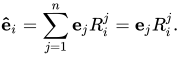
Here R ji are the entries of the change of basis matrix, and in the rightmost expression the summation sign was suppressed: this is the Einstein summation convention, which will be used throughout this article.[Note 1] The components vi of a column vector v transform with the inverse of the matrix R,
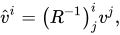
where the hat denotes the components in the new basis. This is called a contravariant transformation law, because the vector components transform by the inverse of the change of basis. In contrast, the components, wi, of a covector (or row vector), w, transform with the matrix R itself,

This is called a covariant transformation law, because the covector components transform by the same matrix as the change of basis matrix. The components of a more general tensor are transformed by some combination of covariant and contravariant transformations, with one transformation law for each index. If the transformation matrix of an index is the inverse matrix of the basis transformation, then the index is called contravariant and is conventionally denoted with an upper index (superscript). If the transformation matrix of an index is the basis transformation itself, then the index is called covariant and is denoted with a lower index (subscript).
As a simple example, the matrix of a linear operator with respect to a basis is a rectangular array that transforms under a change of basis matrix by . For the individual matrix entries, this transformation law has the form so the tensor corresponding to the matrix of a linear operator has one covariant and one contravariant index: it is of type (1,1).


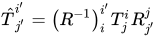
Combinations of covariant and contravariant components with the same index allow us to express geometric invariants. For example, the fact that a vector is the same object in different coordinate systems can be captured by the following equations, using the formulas defined above:
- ,

where is the Kronecker delta, which functions similarly to the identity matrix, and has the effect of renaming indices (j into k in this example). This shows several features of the component notation: the ability to re-arrange terms at will (commutativity), the need to use different indices when working with multiple objects in the same expression, the ability to rename indices, and the manner in which contravariant and covariant tensors combine so that all instances of the transformation matrix and its inverse cancel, so that expressions like can immediately be seen to be geometrically identical in all coordinate systems.


Similarly, a linear operator, viewed as a geometric object, does not actually depend on a basis: it is just a linear map that accepts a vector as an argument and produces another vector. The transformation law for how the matrix of components of a linear operator changes with the basis is consistent with the transformation law for a contravariant vector, so that the action of a linear operator on a contravariant vector is represented in coordinates as the matrix product of their respective coordinate representations. That is, the components are given by . These components transform contravariantly, since

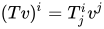
![{\displaystyle \left({\widehat {Tv}}\right)^{i'}={\hat {T}}_{j'}^{i'}{\hat {v}}^{j'}=\left[\left(R^{-1}\right)_{i}^{i'}T_{j}^{i}R_{j'}^{j}\right]\left[\left(R^{-1}\right)_{k}^{j'}v^{k}\right]=\left(R^{-1}\right)_{i}^{i'}(Tv)^{i}.}](https://wikimedia.org/api/rest_v1/media/math/render/svg/a08d1c77a9be55af5d64e3a8cbaede2da77c528b)
The transformation law for an order p + q tensor with p contravariant indices and q covariant indices is thus given as,



Here the primed indices denote components in the new coordinates, and the unprimed indices denote the components in the old coordinates. Such a tensor is said to be of order or type (p, q). The terms "order", "type", "rank", "valence", and "degree" are all sometimes used for the same concept. Here, the term "order" or "total order" will be used for the total dimension of the array (or its generalization in other definitions), p + q in the preceding example, and the term "type" for the pair giving the number of contravariant and covariant indices. A tensor of type (p, q) is also called a (p, q)-tensor for short.
This discussion motivates the following formal definition:[5][6]
Definition. A tensor of type (p, q) is an assignment of a multidimensional array
to each basis f = (e1, ..., en) of an n-dimensional vector space such that, if we apply the change of basis
then the multidimensional array obeys the transformation law
![{\displaystyle T_{j_{1}\dots j_{q}}^{i_{1}\dots i_{p}}[\mathbf {f} ]}](https://wikimedia.org/api/rest_v1/media/math/render/svg/5c5971d3e9c4311001522ff021018a8210a3b184)

![{\displaystyle T_{j'_{1}\dots j'_{q}}^{i'_{1}\dots i'_{p}}[\mathbf {f} \cdot R]=\left(R^{-1}\right)_{i_{1}}^{i'_{1}}\cdots \left(R^{-1}\right)_{i_{p}}^{i'_{p}}}](https://wikimedia.org/api/rest_v1/media/math/render/svg/e58c6ad944ce4ade82f82a8f5fe78375fcc949d1)
![{\displaystyle T_{j_{1},\ldots ,j_{q}}^{i_{1},\ldots ,i_{p}}[\mathbf {f} ]}](https://wikimedia.org/api/rest_v1/media/math/render/svg/7076a7d3a987273f780cb2149bf3b75bf5b88a57)
The definition of a tensor as a multidimensional array satisfying a transformation law traces back to the work of Ricci.[1]
An equivalent definition of a tensor uses the representations of the general linear group. There is an action of the general linear group on the set of all ordered bases of an n-dimensional vector space. If is an ordered basis, and is an invertible matrix, then the action is given by




Let F be the set of all ordered bases. Then F is a principal homogeneous space for GL(n). Let W be a vector space and let be a representation of GL(n) on W (that is, a group homomorphism ). Then a tensor of type is an equivariant map . Equivariance here means that




When is a tensor representation of the general linear group, this gives the usual definition of tensors as multidimensional arrays. This definition is often used to describe tensors on manifolds,[7] and readily generalizes to other groups.[5]
As multilinear maps
[edit]A downside to the definition of a tensor using the multidimensional array approach is that it is not apparent from the definition that the defined object is indeed basis independent, as is expected from an intrinsically geometric object. Although it is possible to show that transformation laws indeed ensure independence from the basis, sometimes a more intrinsic definition is preferred. One approach that is common in differential geometry is to define tensors relative to a fixed (finite-dimensional) vector space V, which is usually taken to be a particular vector space of some geometrical significance like the tangent space to a manifold.[8] In this approach, a type (p, q) tensor T is defined as a multilinear map,

where V∗ is the corresponding dual space of covectors, which is linear in each of its arguments. The above assumes V is a vector space over the real numbers, . More generally, V can be taken over any field F (e.g. the complex numbers), with F replacing as the codomain of the multilinear maps.

By applying a multilinear map T of type (p, q) to a basis {ej} for V and a canonical cobasis {εi} for V∗,

a (p + q)-dimensional array of components can be obtained. A different choice of basis will yield different components. But, because T is linear in all of its arguments, the components satisfy the tensor transformation law used in the multilinear array definition. The multidimensional array of components of T thus form a tensor according to that definition. Moreover, such an array can be realized as the components of some multilinear map T. This motivates viewing multilinear maps as the intrinsic objects underlying tensors.
In viewing a tensor as a multilinear map, it is conventional to identify the double dual V∗∗ of the vector space V, i.e., the space of linear functionals on the dual vector space V∗, with the vector space V. There is always a natural linear map from V to its double dual, given by evaluating a linear form in V∗ against a vector in V. This linear mapping is an isomorphism in finite dimensions, and it is often then expedient to identify V with its double dual.
Using tensor products
[edit]For some mathematical applications, a more abstract approach is sometimes useful. This can be achieved by defining tensors in terms of elements of tensor products of vector spaces, which in turn are defined through a universal property as explained here and here.
A type (p, q) tensor is defined in this context as an element of the tensor product of vector spaces,[9][10]

A basis vi of V and basis wj of W naturally induce a basis vi ⊗ wj of the tensor product V ⊗ W. The components of a tensor T are the coefficients of the tensor with respect to the basis obtained from a basis {ei} for V and its dual basis {εj}, i.e.

Using the properties of the tensor product, it can be shown that these components satisfy the transformation law for a type (p, q) tensor. Moreover, the universal property of the tensor product gives a one-to-one correspondence between tensors defined in this way and tensors defined as multilinear maps.
This 1 to 1 correspondence can be achieved in the following way, because in the finite-dimensional case there exists a canonical isomorphism between a vector space and its double dual:

The last line is using the universal property of the tensor product, that there is a 1 to 1 correspondence between maps from and .[11]


Tensor products can be defined in great generality – for example, involving arbitrary modules over a ring. In principle, one could define a "tensor" simply to be an element of any tensor product. However, the mathematics literature usually reserves the term tensor for an element of a tensor product of any number of copies of a single vector space V and its dual, as above.
Tensors in infinite dimensions
[edit]This discussion of tensors so far assumes finite dimensionality of the spaces involved, where the spaces of tensors obtained by each of these constructions are naturally isomorphic.[Note 2] Constructions of spaces of tensors based on the tensor product and multilinear mappings can be generalized, essentially without modification, to vector bundles or coherent sheaves.[12] For infinite-dimensional vector spaces, inequivalent topologies lead to inequivalent notions of tensor, and these various isomorphisms may or may not hold depending on what exactly is meant by a tensor (see topological tensor product). In some applications, it is the tensor product of Hilbert spaces that is intended, whose properties are the most similar to the finite-dimensional case. A more modern view is that it is the tensors' structure as a symmetric monoidal category that encodes their most important properties, rather than the specific models of those categories.[13]
Tensor fields
[edit]In many applications, especially in differential geometry and physics, it is natural to consider a tensor with components that are functions of the point in a space. This was the setting of Ricci's original work. In modern mathematical terminology such an object is called a tensor field, often referred to simply as a tensor.[1]
In this context, a coordinate basis is often chosen for the tangent vector space. The transformation law may then be expressed in terms of partial derivatives of the coordinate functions,
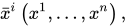
defining a coordinate transformation,[1]

History
[edit]The concepts of later tensor analysis arose from the work of Carl Friedrich Gauss in differential geometry, and the formulation was much influenced by the theory of algebraic forms and invariants developed during the middle of the nineteenth century.[14] The word "tensor" itself was introduced in 1846 by William Rowan Hamilton[15] to describe something different from what is now meant by a tensor.[Note 3] Gibbs introduced dyadics and polyadic algebra, which are also tensors in the modern sense.[16] The contemporary usage was introduced by Woldemar Voigt in 1898.[17]
Tensor calculus was developed around 1890 by Gregorio Ricci-Curbastro under the title absolute differential calculus, and originally presented in 1892.[18] It was made accessible to many mathematicians by the publication of Ricci-Curbastro and Tullio Levi-Civita's 1900 classic text Méthodes de calcul différentiel absolu et leurs applications (Methods of absolute differential calculus and their applications).[19] In Ricci's notation, he refers to "systems" with covariant and contravariant components, which are known as tensor fields in the modern sense.[16]
In the 20th century, the subject came to be known as tensor analysis, and achieved broader acceptance with the introduction of Albert Einstein's theory of general relativity, around 1915. General relativity is formulated completely in the language of tensors. Einstein had learned about them, with great difficulty, from the geometer Marcel Grossmann.[20] Levi-Civita then initiated a correspondence with Einstein to correct mistakes Einstein had made in his use of tensor analysis. The correspondence lasted 1915–17, and was characterized by mutual respect:
I admire the elegance of your method of computation; it must be nice to ride through these fields upon the horse of true mathematics while the like of us have to make our way laboriously on foot.
— Albert Einstein[21]
Tensors and tensor fields were also found to be useful in other fields such as continuum mechanics. Some well-known examples of tensors in differential geometry are quadratic forms such as metric tensors, and the Riemann curvature tensor. The exterior algebra of Hermann Grassmann, from the middle of the nineteenth century, is itself a tensor theory, and highly geometric, but it was some time before it was seen, with the theory of differential forms, as naturally unified with tensor calculus. The work of Élie Cartan made differential forms one of the basic kinds of tensors used in mathematics, and Hassler Whitney popularized the tensor product.[16]
From about the 1920s onwards, it was realised that tensors play a basic role in algebraic topology (for example in the Künneth theorem).[22] Correspondingly there are types of tensors at work in many branches of abstract algebra, particularly in homological algebra and representation theory. Multilinear algebra can be developed in greater generality than for scalars coming from a field. For example, scalars can come from a ring. But the theory is then less geometric and computations more technical and less algorithmic.[23] Tensors are generalized within category theory by means of the concept of monoidal category, from the 1960s.[24]
Examples
[edit]An elementary example of a mapping describable as a tensor is the dot product, which maps two vectors to a scalar. A more complex example is the Cauchy stress tensor T, which takes a directional unit vector v as input and maps it to the stress vector T(v), which is the force (per unit area) exerted by material on the negative side of the plane orthogonal to v against the material on the positive side of the plane, thus expressing a relationship between these two vectors, shown in the figure (right). The cross product, where two vectors are mapped to a third one, is strictly speaking not a tensor because it changes its sign under those transformations that change the orientation of the coordinate system. The totally anti-symmetric symbol nevertheless allows a convenient handling of the cross product in equally oriented three dimensional coordinate systems.

This table shows important examples of tensors on vector spaces and tensor fields on manifolds. The tensors are classified according to their type (n, m), where n is the number of contravariant indices, m is the number of covariant indices, and n + m gives the total order of the tensor. For example, a bilinear form is the same thing as a (0, 2)-tensor; an inner product is an example of a (0, 2)-tensor, but not all (0, 2)-tensors are inner products. In the (0, M)-entry of the table, M denotes the dimensionality of the underlying vector space or manifold because for each dimension of the space, a separate index is needed to select that dimension to get a maximally covariant antisymmetric tensor.
m n
|
0 | 1 | 2 | 3 | ⋯ | M | ⋯ |
|---|---|---|---|---|---|---|---|
| 0 | scalar, e.g. scalar curvature | covector, linear functional, 1-form, e.g. dipole moment, gradient of a scalar field | bilinear form, e.g. inner product, quadrupole moment, metric tensor, Ricci curvature, 2-form, symplectic form | 3-form e.g. octupole moment | e.g. M-form i.e. volume form | ||
| 1 | vector | linear transformation,[25] Kronecker delta | e.g. cross product in three dimensions | e.g. Riemann curvature tensor | |||
| 2 | bivector, e.g. Poisson structure, inverse metric tensor | e.g. elasticity tensor | |||||
| ⋮ | |||||||
| N | multivector | ||||||
| ⋮ |
Raising an index on an (n, m)-tensor produces an (n + 1, m − 1)-tensor; this corresponds to moving diagonally down and to the left on the table. Symmetrically, lowering an index corresponds to moving diagonally up and to the right on the table. Contraction of an upper with a lower index of an (n, m)-tensor produces an (n − 1, m − 1)-tensor; this corresponds to moving diagonally up and to the left on the table.


Properties
[edit]Assuming a basis of a real vector space, e.g., a coordinate frame in the ambient space, a tensor can be represented as an organized multidimensional array of numerical values with respect to this specific basis. Changing the basis transforms the values in the array in a characteristic way that allows to define tensors as objects adhering to this transformational behavior. For example, there are invariants of tensors that must be preserved under any change of the basis, thereby making only certain multidimensional arrays of numbers a tensor. Compare this to the array representing not being a tensor, for the sign change under transformations changing the orientation.
Because the components of vectors and their duals transform differently under the change of their dual bases, there is a covariant and/or contravariant transformation law that relates the arrays, which represent the tensor with respect to one basis and that with respect to the other one. The numbers of, respectively, vectors: n (contravariant indices) and dual vectors: m (covariant indices) in the input and output of a tensor determine the type (or valence) of the tensor, a pair of natural numbers (n, m), which determine the precise form of the transformation law. The order of a tensor is the sum of these two numbers.
The order (also degree or rank) of a tensor is thus the sum of the orders of its arguments plus the order of the resulting tensor. This is also the dimensionality of the array of numbers needed to represent the tensor with respect to a specific basis, or equivalently, the number of indices needed to label each component in that array. For example, in a fixed basis, a standard linear map that maps a vector to a vector, is represented by a matrix (a 2-dimensional array), and therefore is a 2nd-order tensor. A simple vector can be represented as a 1-dimensional array, and is therefore a 1st-order tensor. Scalars are simple numbers and are thus 0th-order tensors. This way the tensor representing the scalar product, taking two vectors and resulting in a scalar has order 2 + 0 = 2, the same as the stress tensor, taking one vector and returning another 1 + 1 = 2. The -symbol, mapping two vectors to one vector, would have order 2 + 1 = 3.
The collection of tensors on a vector space and its dual forms a tensor algebra, which allows products of arbitrary tensors. Simple applications of tensors of order 2, which can be represented as a square matrix, can be solved by clever arrangement of transposed vectors and by applying the rules of matrix multiplication, but the tensor product should not be confused with this.
Notation
[edit]There are several notational systems that are used to describe tensors and perform calculations involving them.
Ricci calculus
[edit]Ricci calculus is the modern formalism and notation for tensor indices: indicating inner and outer products, covariance and contravariance, summations of tensor components, symmetry and antisymmetry, and partial and covariant derivatives.
Einstein summation convention
[edit]The Einstein summation convention dispenses with writing summation signs, leaving the summation implicit. Any repeated index symbol is summed over: if the index i is used twice in a given term of a tensor expression, it means that the term is to be summed for all i. Several distinct pairs of indices may be summed this way.
Penrose graphical notation
[edit]Penrose graphical notation is a diagrammatic notation which replaces the symbols for tensors with shapes, and their indices by lines and curves. It is independent of basis elements, and requires no symbols for the indices.
Abstract index notation
[edit]The abstract index notation is a way to write tensors such that the indices are no longer thought of as numerical, but rather are indeterminates. This notation captures the expressiveness of indices and the basis-independence of index-free notation.
Component-free notation
[edit]A component-free treatment of tensors uses notation that emphasises that tensors do not rely on any basis, and is defined in terms of the tensor product of vector spaces.
Operations
[edit]There are several operations on tensors that again produce a tensor. The linear nature of tensors implies that two tensors of the same type may be added together, and that tensors may be multiplied by a scalar with results analogous to the scaling of a vector. On components, these operations are simply performed component-wise. These operations do not change the type of the tensor; but there are also operations that produce a tensor of different type.
Tensor product
[edit]The tensor product takes two tensors, S and T, and produces a new tensor, S ⊗ T, whose order is the sum of the orders of the original tensors. When described as multilinear maps, the tensor product simply multiplies the two tensors, i.e., which again produces a map that is linear in all its arguments. On components, the effect is to multiply the components of the two input tensors pairwise, i.e., If S is of type (l, k) and T is of type (n, m), then the tensor product S ⊗ T has type (l + n, k + m).


Contraction
[edit]Tensor contraction is an operation that reduces a type (n, m) tensor to a type (n − 1, m − 1) tensor, of which the trace is a special case. It thereby reduces the total order of a tensor by two. The operation is achieved by summing components for which one specified contravariant index is the same as one specified covariant index to produce a new component. Components for which those two indices are different are discarded. For example, a (1, 1)-tensor can be contracted to a scalar through , where the summation is again implied. When the (1, 1)-tensor is interpreted as a linear map, this operation is known as the trace.


The contraction is often used in conjunction with the tensor product to contract an index from each tensor.
The contraction can also be understood using the definition of a tensor as an element of a tensor product of copies of the space V with the space V∗ by first decomposing the tensor into a linear combination of simple tensors, and then applying a factor from V∗ to a factor from V. For example, a tensor can be written as a linear combination


The contraction of T on the first and last slots is then the vector

In a vector space with an inner product (also known as a metric) g, the term contraction is used for removing two contravariant or two covariant indices by forming a trace with the metric tensor or its inverse. For example, a (2, 0)-tensor can be contracted to a scalar through (yet again assuming the summation convention).


Raising or lowering an index
[edit]When a vector space is equipped with a nondegenerate bilinear form (or metric tensor as it is often called in this context), operations can be defined that convert a contravariant (upper) index into a covariant (lower) index and vice versa. A metric tensor is a (symmetric) (0, 2)-tensor; it is thus possible to contract an upper index of a tensor with one of the lower indices of the metric tensor in the product. This produces a new tensor with the same index structure as the previous tensor, but with lower index generally shown in the same position of the contracted upper index. This operation is quite graphically known as lowering an index.
Conversely, the inverse operation can be defined, and is called raising an index. This is equivalent to a similar contraction on the product with a (2, 0)-tensor. This inverse metric tensor has components that are the matrix inverse of those of the metric tensor.
Applications
[edit]Continuum mechanics
[edit]Important examples are provided by continuum mechanics. The stresses inside a solid body or fluid[28] are described by a tensor field. The stress tensor and strain tensor are both second-order tensor fields, and are related in a general linear elastic material by a fourth-order elasticity tensor field. In detail, the tensor quantifying stress in a 3-dimensional solid object has components that can be conveniently represented as a 3 × 3 array. The three faces of a cube-shaped infinitesimal volume segment of the solid are each subject to some given force. The force's vector components are also three in number. Thus, 3 × 3, or 9 components are required to describe the stress at this cube-shaped infinitesimal segment. Within the bounds of this solid is a whole mass of varying stress quantities, each requiring 9 quantities to describe. Thus, a second-order tensor is needed.
If a particular surface element inside the material is singled out, the material on one side of the surface will apply a force on the other side. In general, this force will not be orthogonal to the surface, but it will depend on the orientation of the surface in a linear manner. This is described by a tensor of type (2, 0), in linear elasticity, or more precisely by a tensor field of type (2, 0), since the stresses may vary from point to point.
Other examples from physics
[edit]Common applications include:
- Electromagnetic tensor (or Faraday tensor) in electromagnetism
- Finite deformation tensors for describing deformations and strain tensor for strain in continuum mechanics
- Permittivity and electric susceptibility are tensors in anisotropic media
- Four-tensors in general relativity (e.g. stress–energy tensor), used to represent momentum fluxes
- Spherical tensor operators are the eigenfunctions of the quantum angular momentum operator in spherical coordinates
- Diffusion tensors, the basis of diffusion tensor imaging, represent rates of diffusion in biological environments
- Quantum mechanics and quantum computing utilize tensor products for combination of quantum states
Computer vision and optics
[edit]The concept of a tensor of order two is often conflated with that of a matrix. Tensors of higher order do however capture ideas important in science and engineering, as has been shown successively in numerous areas as they develop. This happens, for instance, in the field of computer vision, with the trifocal tensor generalizing the fundamental matrix.
The field of nonlinear optics studies the changes to material polarization density under extreme electric fields. The polarization waves generated are related to the generating electric fields through the nonlinear susceptibility tensor. If the polarization P is not linearly proportional to the electric field E, the medium is termed nonlinear. To a good approximation (for sufficiently weak fields, assuming no permanent dipole moments are present), P is given by a Taylor series in E whose coefficients are the nonlinear susceptibilities:

Here is the linear susceptibility, gives the Pockels effect and second harmonic generation, and gives the Kerr effect. This expansion shows the way higher-order tensors arise naturally in the subject matter.


Machine learning
[edit]The properties of tensors, especially tensor decomposition, have enabled their use in machine learning to embed higher dimensional data in artificial neural networks. This notion of tensor differs significantly from that in other areas of mathematics and physics, in the sense that a tensor is the same thing as a multidimensional array. Abstractly, a tensor belongs to tensor product of spaces, each of which has a fixed basis, and the dimensions of the factor spaces can be different. Thus, an example of a tensor in this context is a rectangular matrix. Just as a rectangular matrix has two axes, a horizontal and vertical axis to indicate the position of each entry, a more general tensor has as many axes as there are factors in the tensor product to which it belongs, and an entry of the tensor is referred to be a tuple of integers. The various axes have different dimensions in general.
Generalizations
[edit]Tensor products of vector spaces
[edit]The vector spaces of a tensor product need not be the same, and sometimes the elements of such a more general tensor product are called "tensors". For example, an element of the tensor product space V ⊗ W is a second-order "tensor" in this more general sense,[29] and an order-d tensor may likewise be defined as an element of a tensor product of d different vector spaces.[30] A type (n, m) tensor, in the sense defined previously, is also a tensor of order n + m in this more general sense. The concept of tensor product can be extended to arbitrary modules over a ring.
Tensors in infinite dimensions
[edit]The notion of a tensor can be generalized in a variety of ways to infinite dimensions. One, for instance, is via the tensor product of Hilbert spaces.[31] Another way of generalizing the idea of tensor, common in nonlinear analysis, is via the multilinear maps definition where instead of using finite-dimensional vector spaces and their algebraic duals, one uses infinite-dimensional Banach spaces and their continuous dual.[32] Tensors thus live naturally on Banach manifolds[33] and Fréchet manifolds.
Tensor densities
[edit]Suppose that a homogeneous medium fills R3, so that the density of the medium is described by a single scalar value ρ in kg⋅m−3. The mass, in kg, of a region Ω is obtained by multiplying ρ by the volume of the region Ω, or equivalently integrating the constant ρ over the region:
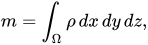
where the Cartesian coordinates x, y, z are measured in m. If the units of length are changed into cm, then the numerical values of the coordinate functions must be rescaled by a factor of 100:

The numerical value of the density ρ must then also transform by 100−3 m3/cm3 to compensate, so that the numerical value of the mass in kg is still given by integral of . Thus (in units of kg⋅cm−3).


More generally, if the Cartesian coordinates x, y, z undergo a linear transformation, then the numerical value of the density ρ must change by a factor of the reciprocal of the absolute value of the determinant of the coordinate transformation, so that the integral remains invariant, by the change of variables formula for integration. Such a quantity that scales by the reciprocal of the absolute value of the determinant of the coordinate transition map is called a scalar density. To model a non-constant density, ρ is a function of the variables x, y, z (a scalar field), and under a curvilinear change of coordinates, it transforms by the reciprocal of the Jacobian of the coordinate change. For more on the intrinsic meaning, see Density on a manifold.
A tensor density transforms like a tensor under a coordinate change, except that it in addition picks up a factor of the absolute value of the determinant of the coordinate transition:[34]
![{\displaystyle T_{j'_{1}\dots j'_{q}}^{i'_{1}\dots i'_{p}}[\mathbf {f} \cdot R]=\left|\det R\right|^{-w}\left(R^{-1}\right)_{i_{1}}^{i'_{1}}\cdots \left(R^{-1}\right)_{i_{p}}^{i'_{p}}T_{j_{1},\ldots ,j_{q}}^{i_{1},\ldots ,i_{p}}[\mathbf {f} ]R_{j'_{1}}^{j_{1}}\cdots R_{j'_{q}}^{j_{q}}.}](https://wikimedia.org/api/rest_v1/media/math/render/svg/5f140bbb8af061851d8d4b060ee3907e0455ce5c)
Here w is called the weight. In general, any tensor multiplied by a power of this function or its absolute value is called a tensor density, or a weighted tensor.[35][36] An example of a tensor density is the current density of electromagnetism.
Under an affine transformation of the coordinates, a tensor transforms by the linear part of the transformation itself (or its inverse) on each index. These come from the rational representations of the general linear group. But this is not quite the most general linear transformation law that such an object may have: tensor densities are non-rational, but are still semisimple representations. A further class of transformations come from the logarithmic representation of the general linear group, a reducible but not semisimple representation,[37] consisting of an (x, y) ∈ R2 with the transformation law

Geometric objects
[edit]The transformation law for a tensor behaves as a functor on the category of admissible coordinate systems, under general linear transformations (or, other transformations within some class, such as local diffeomorphisms). This makes a tensor a special case of a geometrical object, in the technical sense that it is a function of the coordinate system transforming functorially under coordinate changes.[38] Examples of objects obeying more general kinds of transformation laws are jets and, more generally still, natural bundles.[39][40]
Spinors
[edit]When changing from one orthonormal basis (called a frame) to another by a rotation, the components of a tensor transform by that same rotation. This transformation does not depend on the path taken through the space of frames. However, the space of frames is not simply connected (see orientation entanglement and plate trick): there are continuous paths in the space of frames with the same beginning and ending configurations that are not deformable one into the other. It is possible to attach an additional discrete invariant to each frame that incorporates this path dependence, and which turns out (locally) to have values of ±1.[41] A spinor is an object that transforms like a tensor under rotations in the frame, apart from a possible sign that is determined by the value of this discrete invariant.[42][43]
Spinors are elements of the spin representation of the rotation group, while tensors are elements of its tensor representations. Other classical groups have tensor representations, and so also tensors that are compatible with the group, but all non-compact classical groups have infinite-dimensional unitary representations as well.
See also
[edit] The dictionary definition of tensor at Wiktionary
- Array data type, for tensor storage and manipulation
- Bitensor

Foundational
[edit]Applications
[edit]- Application of tensor theory in engineering
- Continuum mechanics
- Covariant derivative
- Curvature
- Diffusion tensor MRI
- Einstein field equations
- Fluid mechanics
- Gravity
- Multilinear subspace learning
- Riemannian geometry
- Structure tensor
- Tensor Contraction Engine
- Tensor decomposition
- Tensor derivative
- Tensor software
Explanatory notes
[edit]- ^ The Einstein summation convention, in brief, requires the sum to be taken over all values of the index whenever the same symbol appears as a subscript and superscript in the same term. For example, under this convention
- ^ The double duality isomorphism, for instance, is used to identify V with the double dual space V∗∗, which consists of multilinear forms of degree one on V∗. It is typical in linear algebra to identify spaces that are naturally isomorphic, treating them as the same space.
- ^ Namely, the norm operation in a vector space.

References
[edit]Specific
[edit]- ^ a b c d Kline, Morris (1990). Mathematical Thought From Ancient to Modern Times. Vol. 3. Oxford University Press. ISBN 978-0-19-506137-6.
- ^ De Lathauwer, Lieven; De Moor, Bart; Vandewalle, Joos (2000). "A Multilinear Singular Value Decomposition" (PDF). SIAM J. Matrix Anal. Appl. 21 (4): 1253–1278. doi:10.1137/S0895479896305696. S2CID 14344372.
- ^ Vasilescu, M.A.O.; Terzopoulos, D. (2002). "Multilinear Analysis of Image Ensembles: TensorFaces" (PDF). Computer Vision — ECCV 2002. Lecture Notes in Computer Science. Vol. 2350. pp. 447–460. doi:10.1007/3-540-47969-4_30. ISBN 978-3-540-43745-1. S2CID 12793247. Archived from the original (PDF) on 2022-12-29. Retrieved 2022-12-29.
- ^ Kolda, Tamara; Bader, Brett (2009). "Tensor Decompositions and Applications" (PDF). SIAM Review. 51 (3): 455–500. Bibcode:2009SIAMR..51..455K. doi:10.1137/07070111X. S2CID 16074195.
- ^ a b Sharpe, R.W. (2000). Differential Geometry: Cartan's Generalization of Klein's Erlangen Program. Springer. p. 194. ISBN 978-0-387-94732-7.
- ^ Schouten, Jan Arnoldus (1954), "Chapter II", Tensor analysis for physicists, Courier Corporation, ISBN 978-0-486-65582-6
{{citation}}: ISBN / Date incompatibility (help) - ^ Kobayashi, Shoshichi; Nomizu, Katsumi (1996), Foundations of Differential Geometry, vol. 1 (New ed.), Wiley Interscience, ISBN 978-0-471-15733-5
- ^ Lee, John (2000), Introduction to smooth manifolds, Springer, p. 173, ISBN 978-0-387-95495-0
- ^ Dodson, C.T.J.; Poston, T. (2013) [1991]. Tensor geometry: The Geometric Viewpoint and Its Uses. Graduate Texts in Mathematics. Vol. 130 (2nd ed.). Springer. p. 105. ISBN 9783642105142.
- ^ "Affine tensor", Encyclopedia of Mathematics, EMS Press, 2001 [1994]
- ^ "Why are Tensors (Vectors of the form a⊗b...⊗z) multilinear maps?". Mathematics Stackexchange. June 5, 2021.
- ^ Bourbaki, N. (1998). "3". Algebra I: Chapters 1-3. Springer. ISBN 978-3-540-64243-5. where the case of finitely generated projective modules is treated. The global sections of sections of a vector bundle over a compact space form a projective module over the ring of smooth functions. All statements for coherent sheaves are true locally.
- ^ Joyal, André; Street, Ross (1993), "Braided tensor categories", Advances in Mathematics, 102: 20–78, doi:10.1006/aima.1993.1055
- ^ Reich, Karin (1994). Die Entwicklung des Tensorkalküls. Science networks historical studies. Vol. 11. Birkhäuser. ISBN 978-3-7643-2814-6. OCLC 31468174.
- ^ Hamilton, William Rowan (1854–1855). Wilkins, David R. (ed.). "On some Extensions of Quaternions" (PDF). Philosophical Magazine (7–9): 492–9, 125–137, 261–9, 46–51, 280–290. ISSN 0302-7597. From p. 498: "And if we agree to call the square root (taken with a suitable sign) of this scalar product of two conjugate polynomes, P and KP, the common TENSOR of each, ... "
- ^ a b c Guo, Hongyu (2021-06-16). What Are Tensors Exactly?. World Scientific. ISBN 978-981-12-4103-1.
- ^ Voigt, Woldemar (1898). Die fundamentalen physikalischen Eigenschaften der Krystalle in elementarer Darstellung [The fundamental physical properties of crystals in an elementary presentation]. Von Veit. pp. 20–.
Wir wollen uns deshalb nur darauf stützen, dass Zustände der geschilderten Art bei Spannungen und Dehnungen nicht starrer Körper auftreten, und sie deshalb tensorielle, die für sie charakteristischen physikalischen Grössen aber Tensoren nennen. [We therefore want [our presentation] to be based only on [the assumption that] conditions of the type described occur during stresses and strains of non-rigid bodies, and therefore call them "tensorial" but call the characteristic physical quantities for them "tensors".]
- ^ Ricci Curbastro, G. (1892). "Résumé de quelques travaux sur les systèmes variables de fonctions associés à une forme différentielle quadratique". Bulletin des Sciences Mathématiques. 2 (16): 167–189.
- ^ Ricci & Levi-Civita 1900.
- ^ Pais, Abraham (2005). Subtle Is the Lord: The Science and the Life of Albert Einstein. Oxford University Press. ISBN 978-0-19-280672-7.
- ^ Goodstein, Judith R. (1982). "The Italian Mathematicians of Relativity". Centaurus. 26 (3): 241–261. Bibcode:1982Cent...26..241G. doi:10.1111/j.1600-0498.1982.tb00665.x.
- ^ Spanier, Edwin H. (2012). Algebraic Topology. Springer. p. 227. ISBN 978-1-4684-9322-1.
the Künneth formula expressing the homology of the tensor product...
- ^ Hungerford, Thomas W. (2003). Algebra. Springer. p. 168. ISBN 978-0-387-90518-1.
...the classification (up to isomorphism) of modules over an arbitrary ring is quite difficult...
- ^ MacLane, Saunders (2013). Categories for the Working Mathematician. Springer. p. 4. ISBN 978-1-4612-9839-7.
...for example the monoid M ... in the category of abelian groups, × is replaced by the usual tensor product...
- ^ Bamberg, Paul; Sternberg, Shlomo (1991). A Course in Mathematics for Students of Physics. Vol. 2. Cambridge University Press. p. 669. ISBN 978-0-521-40650-5.
- ^ Penrose, R. (2007). The Road to Reality. Vintage. ISBN 978-0-679-77631-4.
- ^ Wheeler, J.A.; Misner, C.; Thorne, K.S. (1973). Gravitation. W.H. Freeman. p. 83. ISBN 978-0-7167-0344-0.
- ^ Schobeiri, Meinhard T. (2021). "Vector and Tensor Analysis, Applications to Fluid Mechanics". Fluid Mechanics for Engineers. Springer. pp. 11–29.
- ^ Maia, M. D. (2011). Geometry of the Fundamental Interactions: On Riemann's Legacy to High Energy Physics and Cosmology. Springer. p. 48. ISBN 978-1-4419-8273-5.
- ^ Hogben, Leslie, ed. (2013). Handbook of Linear Algebra (2nd ed.). CRC Press. pp. 15–7. ISBN 978-1-4665-0729-6.
- ^ Segal, I. E. (January 1956). "Tensor Algebras Over Hilbert Spaces. I". Transactions of the American Mathematical Society. 81 (1): 106–134. doi:10.2307/1992855. JSTOR 1992855.
- ^ Abraham, Ralph; Marsden, Jerrold E.; Ratiu, Tudor S. (February 1988). "5. Tensors". Manifolds, Tensor Analysis and Applications. Applied Mathematical Sciences. Vol. 75 (2nd ed.). Springer. pp. 338–9. ISBN 978-0-387-96790-5. OCLC 18562688.
Elements of Trs are called tensors on E, [...].
- ^ Lang, Serge (1972). Differential manifolds. Addison-Wesley. ISBN 978-0-201-04166-8.
- ^ Schouten, Jan Arnoldus, "§II.8: Densities", Tensor analysis for physicists
- ^ McConnell, A.J. (2014) [1957]. Applications of tensor analysis. Dover. p. 28. ISBN 9780486145020.
- ^ Kay 1988, p. 27.
- ^ Olver, Peter (1995), Equivalence, invariants, and symmetry, Cambridge University Press, p. 77, ISBN 9780521478113
- ^ Haantjes, J.; Laman, G. (1953). "On the definition of geometric objects. I". Proceedings of the Koninklijke Nederlandse Akademie van Wetenschappen: Series A: Mathematical Sciences. 56 (3): 208–215.
- ^ Nijenhuis, Albert (1960), "Geometric aspects of formal differential operations on tensor fields" (PDF), Proc. Internat. Congress Math.(Edinburgh, 1958), Cambridge University Press, pp. 463–9, archived from the original (PDF) on 2017-10-27, retrieved 2017-10-26.
- ^ Salviori, Sarah (1972), "On the theory of geometric objects", Journal of Differential Geometry, 7 (1–2): 257–278, doi:10.4310/jdg/1214430830.
- ^ Penrose, Roger (2005). The road to reality: a complete guide to the laws of our universe. Knopf. pp. 203–206.
- ^ Meinrenken, E. (2013). "The spin representation". Clifford Algebras and Lie Theory. Ergebnisse der Mathematik undihrer Grenzgebiete. 3. Folge / A Series of Modern Surveys in Mathematics. Vol. 58. Springer. pp. 49–85. doi:10.1007/978-3-642-36216-3_3. ISBN 978-3-642-36215-6.
- ^ Dong, S. H. (2011), "2. Special Orthogonal Group SO(N)", Wave Equations in Higher Dimensions, Springer, pp. 13–38
General
[edit]- Bishop, Richard L.; Samuel I. Goldberg (1980) [1968]. Tensor Analysis on Manifolds. Dover. ISBN 978-0-486-64039-6.
- Danielson, Donald A. (2003). Vectors and Tensors in Engineering and Physics (2/e ed.). Westview (Perseus). ISBN 978-0-8133-4080-7.
- Dimitrienko, Yuriy (2002). Tensor Analysis and Nonlinear Tensor Functions. Springer. ISBN 978-1-4020-1015-6.
- Jeevanjee, Nadir (2011). An Introduction to Tensors and Group Theory for Physicists. Birkhauser. ISBN 978-0-8176-4714-8.
- Lawden, D. F. (2003). Introduction to Tensor Calculus, Relativity and Cosmology (3/e ed.). Dover. ISBN 978-0-486-42540-5.
- Lebedev, Leonid P.; Cloud, Michael J. (2003). Tensor Analysis. World Scientific. ISBN 978-981-238-360-0.
- Lovelock, David; Rund, Hanno (1989) [1975]. Tensors, Differential Forms, and Variational Principles. Dover. ISBN 978-0-486-65840-7.
- Munkres, James R. (1997). Analysis On Manifolds. Avalon. ISBN 978-0-8133-4548-2. Chapter six gives a "from scratch" introduction to covariant tensors.
- Ricci, Gregorio; Levi-Civita, Tullio (March 1900). "Méthodes de calcul différentiel absolu et leurs applications". Mathematische Annalen. 54 (1–2): 125–201. doi:10.1007/BF01454201. S2CID 120009332.
- Kay, David C (1988-04-01). Schaum's Outline of Tensor Calculus. McGraw-Hill. ISBN 978-0-07-033484-7.
- Schutz, Bernard F. (28 January 1980). Geometrical Methods of Mathematical Physics. Cambridge University Press. ISBN 978-0-521-29887-2.
- Synge, John Lighton; Schild, Alfred (1969). Tensor Calculus. Courier Corporation. ISBN 978-0-486-63612-2.
- This article incorporates material from tensor on PlanetMath, which is licensed under the Creative Commons Attribution/Share-Alike License.
External links
[edit]
- Weisstein, Eric W. "Tensor". MathWorld.
- Bowen, Ray M.; Wang, C.C. (1976). Linear and Multilinear Algebra. Introduction to Vectors and Tensors. Vol. 1. Plenum Press. hdl:1969.1/2502. ISBN 9780306375088.
- Bowen, Ray M.; Wang, C.C. (2006). Vector and Tensor Analysis. Introduction to Vectors and Tensors. Vol. 2. hdl:1969.1/3609. ISBN 9780306375095.
- Kolecki, Joseph C. (2002). "An Introduction to Tensors for Students of Physics and Engineering". Cleveland, Ohio: NASA Glenn Research Center. 20020083040.
- Kolecki, Joseph C. (2005). "Foundations of Tensor Analysis for Students of Physics and Engineering With an Introduction to the Theory of Relativity" (PDF). Cleveland, Ohio: NASA Glenn Research Center. 20050175884.
- A discussion of the various approaches to teaching tensors, and recommendations of textbooks
- Sharipov, Ruslan (2004). "Quick introduction to tensor analysis". arXiv:math.HO/0403252.
- Feynman, Richard (1964–2013). "31. Tensors". The Feynman Lectures. California Institute of Technology.
| Authority control databases: National |
|---|

Tensor
View on GrokipediaDefinitions
Multidimensional arrays
In a fixed basis, a tensor of type is represented as a multidimensional array of components , where the upper indices are contravariant and the lower indices are covariant, each ranging over the dimension of the underlying vector space.[6] This array generalizes lower-rank objects: a rank-0 tensor (scalar) is a single number with no indices; a rank-1 contravariant tensor (vector) is a one-dimensional array ; and a rank-1 covariant tensor is . For rank-2 tensors, a tensor forms a two-dimensional array like a contravariant matrix, while a tensor is explicitly a two-dimensional array, such as in two dimensions, representing mixed contravariant and covariant components.[7] The key property distinguishing such arrays as tensors is their transformation law under a change of basis. If the coordinates transform via , the components in the new basis are given by where the partial derivatives account for the Jacobian of the coordinate change.[6] For the scalar case (), the components are invariant: . A contravariant vector () transforms as , while a covariant vector () uses . This law ensures the array encodes a basis-independent object, as the numerical values adjust to preserve the tensor's intrinsic meaning across coordinate systems.[7] Although the multidimensional array provides a concrete representation, it is inherently basis-dependent without the accompanying transformation rule, which specifies how components must vary to qualify as a tensor rather than an arbitrary collection of numbers.[8] For instance, a matrix array alone might describe a linear map in one basis, but only the transformation law confirms it as a tensor. This array view corresponds to the components of an abstract multilinear map expressed in a specific basis.[6]Multilinear maps
In multilinear algebra, a tensor can be defined abstractly and in a basis-independent manner as a multilinear map between vector spaces.[9] Specifically, a -tensor over a vector space with dual space and field is a multilinear map , meaning is linear in each of its arguments when the others are fixed.[9] This definition captures the essential structure of tensors as higher-order generalizations of linear functionals, where linearity holds separately in every slot.[10] Multilinearity ensures that tensors behave predictably under scalar multiplication and addition in each input, facilitating their use in algebraic constructions. For instance, a bilinear form, which is a -tensor, maps linearly in both arguments; the standard inner product on exemplifies this, satisfying and similarly for the second argument.[9] Such forms are foundational, as they extend scalar products to more variables while preserving the multilinear property.[11] The space of all -tensors, denoted , forms a vector space itself, isomorphic to the space of -dimensional arrays via a choice of basis for . Given a basis for and dual basis for , the components of are given by which represent uniquely in coordinates and highlight the array manifestation of the abstract map.[9] This functional perspective distinguishes pure tensors, which arise from mappings on a single space like (all contravariant) or (all covariant), from mixed tensors that combine inputs from both and . The multilinear map definition emphasizes invariance under basis changes, contrasting with the coordinate-dependent view of multidimensional arrays.[9]Tensor products of modules
In the context of module theory, the tensor product of two modules and over a commutative ring , denoted , is defined as an -module equipped with a bilinear map given by , such that this map satisfies the universal property for bilinear maps.[2] Specifically, for any -module and any -bilinear map , there exists a unique -linear map such that , or equivalently, .[2] The elements are called pure or elementary tensors, and they generate as an -module, subject to the relations enforcing bilinearity: , , and for .[2] This construction extends naturally to multi-fold tensor products. The -fold tensor power is the iterated tensor product ( times), which serves as the universal module for -linear maps from to another module.[2] For -tensors over a module , the tensor space is given by , where is the dual module and is the -fold tensor power of the dual.[12] Pure -tensors take the form with and , while general elements are finite sums of such pure tensors.[12] The universality of the tensor product ensures that any -linear map from to a module factors uniquely through , and similarly for mixed -linear maps through .[2] Explicitly, the tensor product can be constructed as a quotient module: let be the free -module on the set , generated by symbols ; then , where is the submodule generated by the bilinearity relations , , and (with symmetric relations for the second argument).[2] This quotient construction generalizes to multi-fold products by taking the free module on the Cartesian product and quotienting by the corresponding multilinearity relations.[2]Historical Development
Early concepts in geometry and physics
The concept of tensors emerged intuitively in 19th-century physics and geometry through structures that captured multilinear relationships. In continuum mechanics, Augustin-Louis Cauchy introduced the stress tensor in 1822 to describe internal forces in deformable bodies, formalizing the idea of a second-rank tensor representing traction on surfaces. This provided an early example of a multilinear map relating surface elements to force vectors.[13] In geometry, Bernhard Riemann laid foundational ideas in his 1854 habilitation lecture (published 1867), introducing metric tensors and the curvature tensor to describe intrinsic geometry of manifolds, enabling the study of non-Euclidean spaces through multilinear forms on tangent spaces. These concepts prefigured modern tensor analysis in differential geometry. Elwin Bruno Christoffel contributed further in 1869 with his introduction of symbols—now known as Christoffel symbols—that encoded the curvature of surfaces and higher-dimensional manifolds through third-order quantities derived from metric tensors, enabling the computation of geodesic deviations without explicit coordinate dependence.[14] These symbols facilitated the study of intrinsic geometry on curved spaces, influencing subsequent developments in differential geometry. During the 1880s, Josiah Willard Gibbs developed vector analysis, incorporating dyadics—multilinear products of vectors—that functioned similarly to second-rank tensors, used to express physical laws like stress and strain in a coordinate-independent manner. This work bridged quaternionic methods and modern vector calculus, highlighting multilinear structures in physics. William Rowan Hamilton's quaternions, introduced in 1843, represented rotations in three-dimensional space through bilinear operations and were associated with quadratic forms. Hamilton used the term "tensor" in 1846 to describe such forms in quaternion algebra, marking an early, though distinct, recognition of transformation properties under coordinate changes.[15] In electromagnetism, James Clerk Maxwell employed a similar tensorial construct in the 1870s, developing the stress tensor to describe the mechanical stresses induced by electric and magnetic fields, as detailed in his 1873 Treatise on Electricity and Magnetism, where it quantified momentum flux and forces in electromagnetic media. This second-rank tensor provided a mathematical framework for the interaction between fields and matter, prefiguring broader applications in continuum mechanics. The term "tensor" in its modern sense, referring to multilinear forms transforming in specific ways, was coined by Woldemar Voigt in 1898 to describe the elastic properties of crystals, where symmetric tensors captured anisotropic responses.[16] Gregorio Ricci-Curbastro advanced these notions in the late 1880s and 1890s through his formulation of absolute differential calculus, a coordinate-independent approach to differentiation on manifolds, where he introduced the covariant derivative in 1886 to extend ordinary derivatives to tensor fields while preserving their transformation properties under curvilinear coordinates.[17] Ricci's work emphasized "absolute" quantities free from arbitrary reference frames, laying groundwork for tensor manipulation in non-Euclidean settings. In collaboration with his student Tullio Levi-Civita, Ricci synthesized these ideas in the seminal 1900 memoir Méthodes de calcul différentiel absolu et leurs applications, which systematically outlined rules for tensor operations, including contraction and differentiation, and demonstrated their utility in solving partial differential equations on manifolds.[18] This publication crystallized early tensor concepts, bridging geometry and physics before their abstract algebraic reformulation in the 20th century.Abstract algebraic formulation
The abstract algebraic formulation of tensors marked a significant shift in the early 20th century toward coordinate-free definitions, emphasizing multilinear structures in a rigorous, axiomatic manner applicable across algebra, geometry, and analysis. This approach abstracted tensors from their origins in specific coordinate systems, viewing them instead as universal constructions that preserve multilinearity without reliance on bases. Building briefly on the tensor calculus of Gregorio Ricci-Curbastro, this development prioritized intrinsic properties over explicit components, enabling broader generalizations in pure mathematics.[19] In the 1920s, Oswald Veblen advanced an axiomatic treatment of differential geometry at Princeton, defining tensors as multilinear maps between the tangent spaces of a manifold and their duals, or more generally between finite direct sums of these spaces. This framework, elaborated in collaborative works such as those with J.H.C. Whitehead, established tensors as geometric objects invariant under diffeomorphisms, providing a foundation for modern differential geometry without coordinate dependence. Veblen's postulationist method integrated tensors into a systematic axiomatic system, influencing subsequent geometric theories.[19] The 1940s and 1950s saw Jean Dieudonné and the Bourbaki collective formalize tensor theory within multilinear algebra over arbitrary modules, presenting tensors as elements of iterated tensor products of modules with a ring. Their treatment in the "Éléments de mathématique" series, particularly Algèbre Chapter 3 (developed in seminars from the late 1940s and published in 1958), defined tensor products functorially, incorporating alternatization for exterior powers and symmetrization for symmetric algebras. This axiomatic synthesis unified tensors across commutative and non-commutative settings, prioritizing module-theoretic generality.[20] A pivotal milestone in the 1950s was the identification of tensor categories, where categories equipped with a monoidal structure (tensor product) and compatible natural isomorphisms capture tensorial phenomena abstractly. Exemplified by the category of finite-dimensional representations of finite groups, which forms a semisimple tensor category, this concept arose amid the maturation of category theory and facilitated reconstructions of algebraic structures from representation data.[21][22]Fundamental Examples
Scalar, vector, and matrix as tensors
A scalar is a tensor of rank 0, consisting of a single component that remains invariant under changes of basis or coordinate transformations.[23] For example, a scalar field φ, such as φ = 5, does not change its value regardless of the coordinate system used.[24] Tensors of rank 1 include contravariant vectors and covariant covectors. A contravariant vector transforms under a coordinate change from to according to the law where the components adjust to maintain the vector's directional properties relative to the new basis.[25] In contrast, a covariant covector follows the transformation ensuring it pairs correctly with contravariant vectors to yield scalars invariant under basis changes.[25] A matrix can represent a tensor of rank 2 with type (1,1), such as a linear transformation , which mixes contravariant and covariant indices. Its components transform as reflecting the combined behavior of one contravariant and one covariant index.[25] In Euclidean space, an example is the rotation tensor for a counterclockwise rotation by angle θ around the z-axis, given by the 3×3 matrix This matrix acts as a (1,1)-tensor, transforming vectors while preserving lengths and angles in the space.[26]Covariant and contravariant tensors
In tensor analysis, contravariant tensors are defined by their transformation properties under a change of coordinates. For a rank-one contravariant tensor, or vector, with components in coordinates , the components in new coordinates transform according to the law where is the Jacobian matrix of the coordinate transformation.[27] This transformation ensures that the tensor scales with the basis vectors, preserving the geometric object it represents. A classic example is the displacement vector, whose components satisfy , reflecting how infinitesimal displacements change with the coordinate system.[28] For higher-rank contravariant tensors, each upper index introduces an additional factor of the Jacobian, resulting in a product of such matrices for a (k,0)-tensor. Covariant tensors, in contrast, transform with the inverse Jacobian to maintain invariance of scalar products and inner operations. A rank-one covariant tensor, or covector, with components transforms as This law applies because covariant components align with the dual basis, scaling inversely to the coordinate differentials.[27] An illustrative example is the gradient of a scalar field , whose components satisfy the transformation since remains unchanged under coordinate shifts, requiring the partial derivatives to adjust oppositely to .[29] Higher-rank covariant tensors of type (0,l) involve factors of the inverse Jacobian, one per lower index. Mixed tensors combine both types, with upper indices transforming contravariantly and lower indices covariantly. For a (1,1)-tensor , the transformation is The velocity gradient tensor , which describes the rate of change of velocity components with respect to position, exemplifies a mixed (1,1)-tensor in continuum mechanics.[30] In general, a (k,l)-tensor has contravariant and covariant indices, with the transformation law multiplying the appropriate Jacobians. The metric tensor , a covariant (0,2)-tensor, plays a crucial role in interconverting between covariant and contravariant forms by raising and lowering indices. To lower an index on a contravariant vector , one computes ; conversely, the inverse metric raises an index via .[31] In the context of general relativity, the metric often adopts the signature , where the time component is positive and the spatial components are negative, ensuring compatibility with the Lorentzian geometry of spacetime.[32] Covariant and contravariant tensors represent special cases of general (k,l)-tensors where either the number of covariant or contravariant indices is zero.Algebraic Properties
Rank, order, and components
In multilinear algebra, a tensor is classified by its type as a -tensor, where denotes the number of contravariant indices and the number of covariant indices, with the total order or rank defined as .[33] This order quantifies the tensor's multilinearity, as it acts as a multilinear map from copies of the dual space and copies of the vector space to the base field.[33] Given a basis for of dimension , the components of a -tensor are the scalars , where the upper indices range from 1 to and the lower indices range from 1 to , fully specifying in that basis.[34] The total number of independent components is thus , reflecting the dimension of the tensor space .[33] These components transform covariantly under change of basis, preserving the tensor's intrinsic structure. Any tensor of order admits a decomposition as a finite sum of pure rank-$1v_1 \otimes \dots \otimes v_rv_iVV^*.[](https://www.sas.rochester.edu/mth/undergraduate/honorspaperspdfs/mandarjuvekar2022.pdf) The tensor rank is defined as the minimal number of such rank-$1 terms required in the sum, generalizing the matrix rank for order-$2NP$-hard in general for orders greater than 2, but it provides a measure of the tensor's "complexity" or minimal dimensionality.[35] Certain scalar quantities derived from tensors remain invariant under orthogonal transformations of the basis, serving as structural invariants. For a rank-$2T\operatorname{Tr}(T) = T^i_ii) is such an invariant, as the trace equals the sum of eigenvalues of the associated linear [endomorphism](/page/Endomorphism) and is preserved under [change of basis](/page/Change_of_basis).[](http://www.damtp.cam.ac.uk/user/tong/vc/vc7.pdf) This invariance extends to higher-order cases via contractions, but for rank-$2, the trace captures the tensor's volumetric or isotropic component.[36]Symmetry and skew-symmetry
In multilinear algebra, a symmetric tensor of order over a vector space is a -linear map that remains invariant under any permutation of its arguments, meaning for any permutation in the symmetric group .[37] This property implies that the tensor lies in the symmetric subspace of the full tensor space , which is obtained as the quotient of by the ideal generated by elements of the form .[38] A classic example is the metric tensor , a rank-2 covariant tensor satisfying , which defines an inner product on the tangent space by symmetrizing the bilinear form.[39] In contrast, a skew-symmetric (or antisymmetric) tensor changes sign under the transposition of any two arguments, so for , and it vanishes if any two arguments are identical.[40] The space of such tensors, denoted or , is the quotient of by the relations enforcing this antisymmetry, with dimension for .[41] For rank 2, an antisymmetric tensor has independent components; in 3 dimensions, this yields 3 components, corresponding to the cross product via the identification . The electromagnetic field tensor exemplifies this, with , encoding the antisymmetric structure of the field strengths.[42] For higher-rank tensors, partial symmetries arise when the tensor is symmetric or skew-symmetric only in specific subsets of indices. The Riemann curvature tensor , for instance, is skew-symmetric in the last two indices, satisfying , while also exhibiting other paired symmetries such as for antisymmetry in the first pair of indices (up to sign conventions).[43] These partial symmetries reduce the number of independent components: for the Riemann tensor in dimensions, the skew-symmetry in alone imposes constraints per fixed , contributing to an overall count of independent entries.[44] Such structures often emerge in the alternation or symmetrization projectors applied to the full tensor space, facilitating decomposition into irreducible representations under the action of the general linear group.[41] The quotient construction for symmetric and skew-symmetric subspaces highlights dimension reduction: the full rank- tensor space has dimension , but the symmetric quotient has dimension , while the skew-symmetric one has , reflecting the orbits under index permutations.[38] This algebraic framework underlies efficient computations, such as in contractions where symmetric tensors pair naturally with symmetric test functions to yield scalars.[33]Notational Conventions
Index-based notations
Index-based notations for tensors rely on coordinate systems where tensors are expressed through their components using indices, facilitating algebraic manipulations in specific bases. These notations emphasize the transformation properties of tensors under changes of coordinates, distinguishing between contravariant (upper indices) and covariant (lower indices) components. Such representations are essential in fields like differential geometry and physics, where explicit calculations in local coordinates are required. The Ricci calculus, developed by Gregorio Ricci-Curbastro and Tullio Levi-Civita, forms the foundation of index-based tensor notation. In this system, contravariant tensors are denoted with upper indices, such as , while covariant tensors use lower indices, like . A mixed tensor combines both, for example, . The position of indices indicates how the components transform: contravariant indices scale inversely with the coordinate differentials, and covariant indices scale directly. This notation extends to operations like the covariant derivative, denoted , which accounts for the curvature of the space by incorporating Christoffel symbols.[45] A key feature of index-based notations is the Einstein summation convention, introduced by Albert Einstein to streamline expressions involving sums over indices. Under this convention, repeated indices in a term—once upper and once lower—are implicitly summed over their range, eliminating the need for explicit summation symbols. For instance, the scalar product of a contravariant vector and a covariant vector is written as , equivalent to . This applies only to adjacent repeated indices within the same term, and free indices (appearing once) remain as is. The convention enhances readability in complex tensor equations, particularly in general relativity. Abstract index notation, proposed by Roger Penrose, refines index-based methods by treating indices as abstract labels that specify tensor type rather than concrete component values. In this approach, an expression like denotes a tensor of type (1,1), where and are placeholders indicating one contravariant and one covariant slot, without reference to a particular basis. Operations follow the same rules as concrete index notation, including Einstein summation for contractions, but the notation remains basis-independent in form. This allows seamless transitions between abstract tensor equations and their component expansions, aiding proofs of tensorial character.[46] Common symbols in index-based notations include the Kronecker delta , which serves as the identity tensor and is defined as 1 if and 0 otherwise, enabling index substitutions and projections. It was first employed by Leopold Kronecker in the context of discrete mathematics.[47] Complementing this is the Levi-Civita symbol , a totally antisymmetric tensor that equals the sign of the permutation of indices from 1 to , +1 for even permutations, -1 for odd, and 0 for repeats; it facilitates computations of determinants, cross products, and orientations in -dimensions. This symbol, introduced by Tullio Levi-Civita, is defined in flat space but extends to curved manifolds via the metric determinant.[48]Component-free and diagrammatic notations
Component-free notation expresses tensors as multilinear maps without reference to specific bases or indices, emphasizing their intrinsic properties. A tensor of type is denoted as a map (or ), where is a vector space and its dual, such that applies the tensor to vectors and covectors .[10] This formulation highlights the tensor's multilinearity, where scaling any argument scales the output linearly. For instance, a rank-1 contravariant tensor (vector) acts as , akin to an inner product .[10] Diagrammatic notations provide visual representations that abstract away indices, facilitating manipulation of tensor expressions. In Penrose graphical notation, tensors are depicted as boxes with lines (wires) emanating from them, where each line represents an index: upward lines for contravariant indices and downward for covariant. Contractions occur when lines connect between tensors, implicitly summing over the shared index, while unconnected lines denote free indices. For example, the trace of a rank-2 tensor , which sums , is shown as a box with a loop connecting its upper and lower lines.[49] This notation, introduced by Roger Penrose, simplifies verification of tensor identities through graphical rewritings, such as sliding lines or rotating diagrams without altering connectivity.[49] In quantum mechanics, bra-ket notation serves as a component-free representation for tensors on Hilbert spaces. A rank-2 tensor is expressed as the outer product , which acts multilinearly on a ket to yield , effectively a linear map from to a scaled .[50] This Dirac notation treats states as abstract vectors, with the tensor product underlying multi-particle systems, such as for separable states.[50] These notations prove particularly advantageous in tensor networks, where high-rank tensors model complex systems like quantum many-body states. Diagrammatic forms, extending Penrose's approach, visualize network contractions and decompositions, reducing computational complexity by revealing symmetries and enabling efficient algorithms for tasks like ground-state approximation in condensed matter physics. For instance, matrix product states (MPS) and projected entangled pair states (PEPS) leverage such diagrams to manage exponential state spaces with polynomial resources.[51] This visual abstraction minimizes errors in index tracking and fosters intuitive proofs of equivalences, outperforming algebraic manipulations for networks exceeding low ranks.[52]Core Operations
Tensor product construction
The tensor product provides a means to combine two tensors into a higher-rank tensor while preserving multilinearity. For a -tensor , which is a multilinear map from copies of the dual space and copies of the vector space to the scalar field, and an -tensor , similarly defined, their tensor product is a -tensor given by where the inputs to and are the initial and remaining segments of the full argument list, respectively.[53] This construction extends the bilinear case, where the product of two linear forms (1,0)-tensors acts by separate application followed by scalar multiplication.[2] In component notation, assuming a basis for , the components of the product tensor are the products of the corresponding components of the factors, with indices concatenated. Specifically, This form arises naturally from the multilinearity and the choice of basis, ensuring the product tensor's components reflect the direct multiplication without summation.[53] A concrete example is the outer product of two vectors, which are (1,0)-tensors. For vectors and , their tensor product is a (2,0)-tensor whose matrix representation in a basis is the rank-1 matrix , with components . This operation generalizes matrix multiplication in the sense of forming dyads but avoids contraction by keeping all indices free.[53] More abstractly, the tensor product construction satisfies a universality property when viewed over a commutative ring , where and are -modules. The product is the universal -module equipped with a bilinear map such that any bilinear map from to another -module factors uniquely through it; this extends to tensors as elements of iterated tensor products, providing a foundation for multilinear algebra over rings.[2]Contraction and trace
In tensor algebra, contraction is a fundamental operation that reduces the rank of a tensor by summing over a pair of indices, typically one contravariant (upper) and one covariant (lower), according to the Einstein summation convention.[54] For a general (k,l)-tensor with and , the contraction between the r-th upper index and the s-th lower index yields a new tensor , where the sum is over the dimension of the space, and the hats denote omitted indices; this results in a tensor of rank (k-1, l-1).[54] The operation is associative and can be applied multiple times to further reduce the rank, effectively generalizing the inner product to higher-order tensors.[54] The trace represents a specific instance of contraction for a rank-2 tensor, where all indices are contracted to produce a scalar invariant. For a (1,1)-tensor , the trace is defined as , which corresponds to the sum of the diagonal elements in a chosen basis.[54] This operation is basis-independent and plays a key role in determining invariants under linear transformations.[54] A practical example of contraction arises in the computation of the divergence of a vector field , expressed as , which is the trace of the tensor formed by the partial derivative (covariant derivative in flat space) acting on the vector components.[54] Such contractions are essential in deriving conservation laws and are briefly utilized in analyzing tensor symmetries, such as those in representation theory.[54]Index manipulation
Index manipulation refers to the techniques employed in tensor calculus to convert between contravariant and covariant indices using the metric tensor, thereby altering the placement of indices on a tensor while preserving its overall rank and type classification. This process is essential for adapting tensor components to different coordinate systems or for facilitating computations in various geometric settings. The metric tensor and its inverse , which satisfy , serve as the operators for these transformations.[55] For a contravariant vector , the corresponding covariant vector is obtained by lowering the index through contraction with the metric: Conversely, to raise a covariant index, the inverse metric is used: These operations define an isomorphism between the contravariant and covariant vector spaces, ensuring that the inner product remains invariant under the transformation.[55][56] Tensors of higher rank undergo index manipulation by successive application of these rules to each index. For a rank-two contravariant tensor , the fully covariant version is formed as where the metrics are contracted over the respective upper indices. This method extends analogously to mixed or higher-order tensors, such as lowering one index of to yield , allowing flexible reconfiguration of tensor components without loss of information.[55][56] In non-Euclidean manifolds, the efficacy of index manipulation relies on the metric tensor's compatibility with the underlying affine connection, which guarantees that the metric remains covariantly constant, thereby preserving the consistency of raising and lowering operations under parallel transport. This property ensures that tensor manipulations align with the geometry's curvature without introducing inconsistencies.[57]Applications in Physics and Engineering
Continuum mechanics and relativity
In continuum mechanics, tensors provide a mathematical framework for describing the deformation, stress, and flow of continuous media, capturing how materials respond to forces without regard to microscopic structure. Rank-2 tensors, such as the strain and stress tensors, are particularly central, as they transform appropriately under coordinate changes and encode directional dependencies. In the context of relativity, tensors extend this to curved spacetime, where the stress-energy tensor serves as the source of gravitational curvature, linking matter distribution to the geometry of the universe. The infinitesimal strain tensor, a symmetric rank-2 tensor, quantifies small deformations in elastic solids under the assumption of linear elasticity. It is defined as where is the displacement vector field and indices run over spatial coordinates.[58] This symmetrization ensures the tensor represents pure deformation, excluding rigid-body rotations, and its trace gives the volumetric strain. In Hooke's law, the stress tensor relates linearly to via the elasticity tensor, enabling predictions of material behavior under applied loads. For larger deformations, where nonlinear effects dominate, finite strain theory employs the deformation gradient tensor, a rank-2 tensor that maps infinitesimal line elements from the reference (undeformed) configuration to the current (deformed) one: with the current position and the reference position.[59] This tensor, generally non-symmetric, decomposes into stretch and rotation components via polar decomposition, allowing derivation of strain measures like the Green-Lagrange tensor for constitutive modeling in rubber-like materials or metal plasticity. In rigid body dynamics, the inertia tensor governs rotational motion by relating angular velocity to angular momentum. Defined as where is the position vector from the center of mass, is mass density, and is the body volume, it is a symmetric rank-2 tensor.[60] Diagonalization of yields the principal moments of inertia along the principal axes, simplifying Euler's equations for torque-free motion; for example, in spacecraft attitude control, these axes align with the body's symmetry to minimize energy dissipation. In general relativity, the stress-energy tensor , a symmetric rank-2 tensor, encodes the density and flux of energy and momentum, serving as the source term in the Einstein field equations: where is the Einstein tensor derived from the metric, and units are chosen such that .[61] For a perfect fluid, , with energy density, pressure, four-velocity, and the metric tensor; this form explains phenomena like the expansion of the universe or black hole formation by coupling matter to spacetime curvature. Conservation laws follow from the Bianchi identities, ensuring .Electromagnetism and fluid dynamics
In electromagnetism, the Faraday tensor, denoted , is a fundamental antisymmetric rank-2 tensor that encapsulates the electric and magnetic fields in a covariant manner. It is defined as , where is the four-potential.[62] The antisymmetry arises naturally from this curl-like construction, ensuring six independent components that correspond to the three electric field components and three magnetic field components . Specifically, in the mostly-plus metric signature, the time-space components are , while the spatial components satisfy , where is the Levi-Civita symbol.[63] This tensor formulation unifies Maxwell's equations into a single set of four equations, and , highlighting the gauge invariance and Lorentz covariance of electromagnetic phenomena.[64] An analogous structure appears in fluid dynamics through the vorticity tensor , which bears a formal resemblance to the Faraday tensor by representing local rotation in the fluid flow. Defined similarly as (or often scaled by in three dimensions to match the vorticity vector ), this antisymmetric tensor captures the rotational component of the velocity field, with corresponding to the curl in spatial indices.[65] The analogy to is direct in relativistic hydrodynamics, where both are traceless rank-2 tensors encoding "field strengths" derived from potentials—in this case, the four-velocity —and both satisfy similar Bianchi identities or conservation laws in ideal flows.[66] This parallel facilitates cross-insights, such as treating vorticity transport equations like Maxwell's equations in magnetohydrodynamics, emphasizing conserved helicity in inviscid flows.[65] In the Navier-Stokes equations governing viscous incompressible flows, the velocity gradient tensor plays a central role in describing local deformation and rotation of fluid elements. This rank-2 tensor decomposes uniquely into a symmetric part, the strain rate tensor , which quantifies irreversible stretching and shearing (contributing to viscous dissipation), and an antisymmetric part, the rotation tensor , which represents rigid-body rotation without energy loss.[67] The trace of relates to the divergence , enforcing incompressibility when zero, while links directly to the vorticity vector via .[68] This decomposition is essential for deriving the stress tensor in Newtonian fluids, where viscous stresses are linear in , and it underscores the balance between dissipative and inertial effects in boundary layers and shear flows.[69] For turbulent flows, the Reynolds stress tensor, a symmetric rank-2 tensor defined as , models the momentum flux due to velocity fluctuations .[70] Arising in the Reynolds-averaged Navier-Stokes equations, it accounts for enhanced transport beyond molecular viscosity, with diagonal elements representing normal stresses (like turbulent kinetic energy contributions) and off-diagonal elements capturing shear correlations.[71] In turbulence modeling, such as Reynolds stress models (RSM), transport equations for each component are solved, incorporating production, dissipation, and redistribution terms to predict anisotropic effects in complex geometries like jets or wakes, improving accuracy over eddy-viscosity approximations.[71] This tensor's trace relates to the turbulent kinetic energy , providing a scale for fluctuation intensity, though full RSM requires careful closure for pressure-strain terms to ensure realizability.[72]Applications in Mathematics and Computing
Differential geometry and topology
In differential geometry, tensors play a central role in describing geometric structures on smooth manifolds, where they generalize the notion of multilinear maps to tangent and cotangent spaces at each point. A tensor field of type (k, l) on a manifold M is a smooth section of the tensor bundle T^k_l M, assigning to each point p ∈ M a multilinear map from l copies of the tangent space T_p M and k copies of the cotangent space T^*_p M to the real numbers. This framework allows for the coordinate-free treatment of geometric invariants, such as metrics and curvatures, essential for studying the intrinsic properties of manifolds. The covariant derivative provides a means to differentiate tensor fields along vector fields while preserving their tensorial nature under coordinate changes. For a vector field X and a tensor field T of type (k, l), the covariant derivative ∇X T is defined such that it satisfies the Leibniz rule and transforms correctly under parallelism. In local coordinates (x^i), the components of ∇X T are given by (∇X T)^{i_1 \dots i_k}{j_1 \dots j_l} = X^m \partial_m T^{i_1 \dots i_k}{j_1 \dots j_l} + \sum{r=1}^k \Gamma^{i_r}{m p} T^{i_1 \dots p \dots i_k}{j_1 \dots j_l} - \sum_{s=1}^l \Gamma^{q}{m j_s} T^{i_1 \dots i_k}{j_1 \dots q \dots j_l}, where Γ^k_{ij} are the Christoffel symbols encoding the connection's action. These symbols are symmetric in the lower indices for torsion-free connections like the Levi-Civita connection on Riemannian manifolds. Curvature arises naturally from the non-commutativity of covariant derivatives, quantifying how parallel transport deviates on manifolds. The Riemann curvature tensor R, a (1,3)-tensor field, measures this through its action on vector fields: R(X, Y)Z = ∇X ∇Y Z - ∇Y ∇X Z - ∇{[X,Y]} Z, where [X,Y] is the Lie bracket. In components, R^i{jkl} = ∂k Γ^i{jl} - ∂l Γ^i{jk} + Γ^i{km} Γ^m{jl} - Γ^i_{lm} Γ^m_{jk}, capturing sectional curvatures that determine the local geometry up to isometry. This tensor vanishes on flat spaces like Euclidean space but is nonzero on spheres, illustrating manifold rigidity. For conformal geometry, the Weyl tensor addresses the conformal invariance of the Riemann tensor under metric scalings g → e^{2φ} g. Defined as the trace-free part of the Riemann tensor, W^i_{jkl} = R^i_{jkl} - (1/(n-2)) (δ^i_k R_{jl} - ... ) + ..., the Weyl tensor in dimensions n ≥ 3 remains unchanged under such transformations, making it a key invariant for conformal classes of metrics. It vanishes in dimensions 2 or 3 but in higher dimensions, as in four-dimensional Lorentzian manifolds, it encodes gravitational degrees of freedom beyond Ricci curvature. In topology, tensors facilitate the study of manifold invariants via differential forms, which are antisymmetric covariant tensors. The de Rham cohomology groups H^k_{dR}(M) classify closed k-forms up to exact ones, where a k-form ω is a section of ∧^k T^* M, alternating under permutations. The cohomology is computed from the complex 0 → Ω^0(M) → Ω^1(M) → ... → Ω^n(M) → 0 with differential d satisfying d^2 = 0, and by de Rham's theorem, these groups are isomorphic to singular cohomology with real coefficients, linking smooth and topological structures. For example, on the torus T^2, H^1_{dR}(T^2) ≅ ℝ^2 reflects the two independent 1-cycles.Machine learning and data processing
In machine learning, tensors serve as multi-way arrays to represent complex, multidimensional data structures beyond simple matrices, enabling efficient analysis of high-dimensional datasets such as images, videos, or relational data.[73] Tensor decomposition techniques factorize these arrays into lower-rank components, uncovering latent patterns and reducing computational complexity in data processing tasks. A key method is the CANDECOMP/PARAFAC (CP) decomposition, which approximates a tensor as a sum of rank-one tensors, expressed for a 3D tensor as , where are vectors along each mode and is the rank.[73] This approach is widely applied in machine learning for tasks like latent factor discovery in multi-way data, such as recommender systems or topic modeling, where it extracts interpretable components from sparse, high-dimensional inputs. For instance, in analyzing 3D arrays from sensor data (e.g., time, frequency, and spatial dimensions), CP decomposition identifies underlying structures while minimizing storage needs.[73] The Tucker decomposition, also known as higher-order singular value decomposition (HOSVD), extends this by factoring a tensor into a core tensor and orthogonal factor matrices , given by , where denotes mode-n multiplication.[73] In machine learning, it facilitates dimensionality reduction for multidimensional data like images or videos by truncating the core tensor's singular values, preserving essential features while reducing parameters— for example, compressing hyperspectral video tensors to enable real-time analysis on resource-constrained devices. This method has demonstrated superior performance in unsupervised learning, such as feature extraction in video datasets, where it outperforms matrix-based PCA by capturing multi-linear interactions, leading to improvements in downstream classification accuracy.[74] In deep learning, tensors underpin the architecture of neural networks, particularly in convolutional layers where weights form 4D filter tensors with dimensions (out_channels, in_channels, height, width), enabling the application of learnable kernels to input feature maps.[75] These tensors process spatial hierarchies in data, such as RGB images represented as 3D arrays (channels, height, width), by sliding filters to detect edges or textures, which are then stacked across output channels for hierarchical feature learning.[75] This tensor-based formulation allows efficient parallel computation on GPUs, scaling to models like ResNet that handle millions of parameters while maintaining spatial invariance.[75] Graph neural networks (GNNs) leverage adjacency tensors to model higher-order interactions in non-Euclidean data, extending pairwise edges to multi-node relations via m-order tensors where entries indicate hyperedge presence. In hypergraph settings, this representation captures group dependencies, such as in social networks or molecular structures, through message passing that aggregates features via tensor outer products, approximated efficiently using CP decomposition to linearize complexity. For example, tensorized hypergraph neural networks (THNNs) have achieved state-of-the-art results on benchmarks like ModelNet40, with accuracies exceeding 96% by modeling uniform hyperedges as adjacency tensors, outperforming traditional GNNs on tasks requiring multi-relational reasoning.[76]Extensions and Generalizations
Infinite-dimensional tensors
Infinite-dimensional tensors extend the algebraic and analytic structure of finite-dimensional tensors to infinite-dimensional vector spaces, particularly Hilbert spaces, which arise naturally in functional analysis and quantum mechanics. The tensor product of two Hilbert spaces and is constructed as the completion of the algebraic tensor product with respect to an inner product defined by for simple tensors, ensuring the resulting space is itself a Hilbert space. This completion addresses continuity issues, as the algebraic tensor product of infinite-dimensional spaces may not be complete, allowing for the extension of multilinear maps and operators to bounded functionals on the product space.[77] In this framework, nuclear operators on Hilbert spaces play a role analogous to finite-rank tensors in the finite-dimensional case, as they can be expressed as limits of finite-rank operators and admit a trace defined via singular values. Specifically, a nuclear operator satisfies , where are the singular values, mirroring the nuclear norm on tensor products and enabling decompositions into rank-one components.[78] Trace-class operators, which coincide with nuclear operators on Hilbert spaces, thus generalize the notion of finite-rank approximations, preserving properties like compactness and the existence of a well-defined trace independent of the orthonormal basis.[79] In quantum field theory, infinite tensor products of Hilbert spaces model systems with infinitely many degrees of freedom, such as free Bose fields, where the Hilbert space is constructed as an infinite direct sum of symmetric tensor powers. Field operators are then realized as operator-valued distributions on these spaces, acting on test functions to yield bounded operators, as direct pointwise evaluation would lead to ill-defined products due to the non-separability of the infinite product.[80] This construction, pioneered by von Neumann, ensures the theory accommodates continuous spectra and vacuum states while avoiding divergences in expectation values.[81] A key challenge in infinite-dimensional tensor theory is the absence of a finite orthonormal basis, which complicates spectral decompositions and the definition of unbounded operators like position and momentum. To resolve this, rigged Hilbert spaces—triads where is a dense subspace of test functions and its dual of distributions—are employed, allowing generalized eigenvectors and enabling the Dirac formalism for continuous observables without violating domain invariance.[82] This structure mitigates issues like non-normalizability of states in infinite dimensions, providing a rigorous foundation for tensor operations in unbounded settings.Tensor densities and weighted variants
In differential geometry and tensor analysis, tensor densities generalize the concept of tensor fields by incorporating an additional scaling factor in their transformation laws under coordinate changes, which accounts for variations in volume elements. Specifically, a tensor density of type (p, q) and weight is a multilinear map that transforms according to the rule where the determinant factor distinguishes it from ordinary tensors (for which ).[83] This weight , typically an integer, determines the density's behavior: positive values correspond to densities that scale with volume expansion, while negative values yield "contradensities" that scale inversely.[84] The weight arises naturally in contexts requiring invariant integration over manifolds, such as when defining volume forms. For instance, the Riemannian volume density , where is the metric tensor, is a scalar density of weight 1, ensuring that integrals remain coordinate-independent for scalar functions .[85] In general relativity, the Levi-Civita symbol serves as a tensor density of weight -1, which can be converted to a true tensor by multiplication with .[83] These objects are sections of density bundles like , enabling their use on non-orientable manifolds via pseudodensities that incorporate the sign of the determinant.[83] Variants of tensor densities include even and odd types, distinguished by whether the transformation uses the absolute value (even, invariant under orientation reversal) or the signed determinant (odd, sensitive to orientation).[84] More broadly, weighted tensors extend this framework in conformal and projective differential geometry, where sections of bundles such as (tensor bundles tensored with the density line bundle ) transform under conformal rescalings as , with now allowing finer scaling properties.[86] This conformal weighting is crucial for constructing invariant operators, like the Paneitz operator, and underlies tractor constructions that bundle weighted tensors into higher-rank structures for ambient metrics.[86] In weighted manifolds, such as smooth metric measure spaces, these tensors incorporate a measure factor (with a potential), leading to Bakry-Émery Ricci curvature as a weighted variant of the standard Ricci tensor.[87]Related structures like spinors
Spinors represent a class of mathematical objects that furnish the finite-dimensional, half-integer spin representations of the Lorentz group, contrasting with the integer-spin representations realized by ordinary tensors. These representations arise in the context of the proper orthochronous Lorentz group SO(3,1)^+, whose universal cover is SL(2,ℂ), allowing for projective representations that double-cover the group action.[88] A prototypical example is the Dirac spinor , a four-component object transforming under the fundamental representation of SL(2,ℂ) ⊗ SL(2,ℂ), capturing the spin-1/2 degrees of freedom for relativistic fermions.[89] Weyl spinors provide a chiral decomposition of the Dirac spinor, corresponding to the irreducible representations (1/2,0) for left-handed components and (0,1/2) for right-handed ones. These two-component spinors can be mapped to self-dual antisymmetric tensors in four dimensions; specifically, a Weyl spinor relates to a self-dual rank-2 tensor via contractions with the Pauli matrices , yielding , where .[90] This equivalence highlights how spinors encode the same information as certain tensor fields but transform projectively under Lorentz boosts, essential for describing massless particles with definite helicity.[91] Multispinors extend this framework by combining multiple spinor indices, often generated through the Clifford algebra associated with Minkowski spacetime. The gamma matrices satisfy the anticommutation relations , forming a basis for the Clifford algebra Cl(1,3), which acts on the spinor space to produce higher-rank multispinors from vectorial inputs; for instance, bilinear forms like recover vector representations.[89] This algebraic structure underpins the unification of vector and spinor transformations in relativistic quantum field theories.[92] In supersymmetry, supertensors generalize tensors by incorporating both bosonic indices (transforming as tensors under the Lorentz group) and fermionic indices (transforming as spinors), forming representations of the super-Poincaré algebra that mix bosons and fermions in supermultiplets. These objects, such as superfields in superspace, enable the construction of invariant Lagrangians that preserve the extended symmetry, with the fermionic components carrying spinor indices while bosonic ones carry tensor indices.[93]References
- https://en.wikisource.org/wiki/Translation:The_Field_Equations_of_Gravitation