Hubbry Logo
Firing portFiring portMain
Open search
Firing port
Community hub
Firing port
logo
8 pages, 0 posts
0 subscribers
Be the first to start a discussion here.
Firing port
Firing port
from Wikipedia
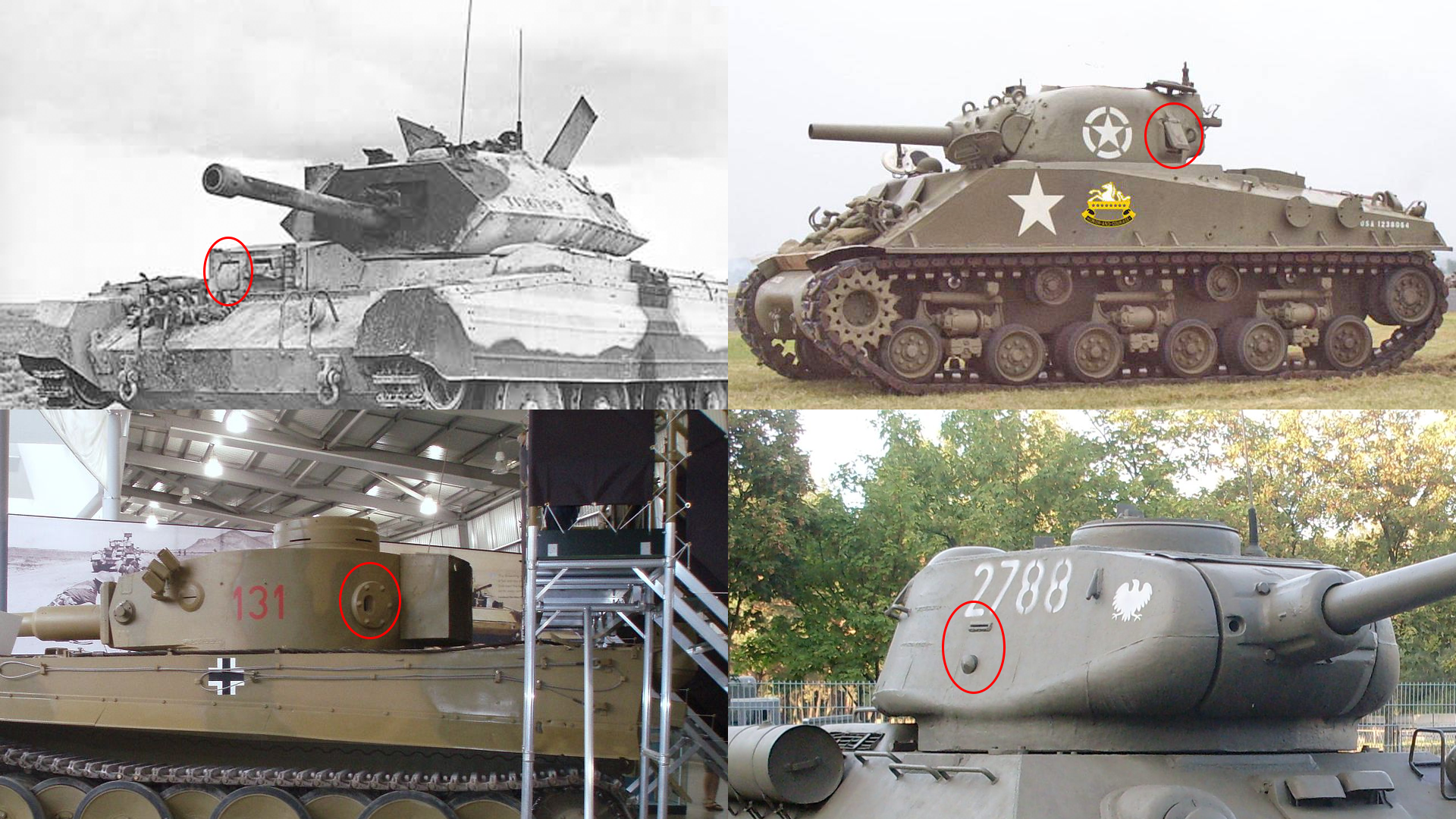
Firing ports (Clockwise from top left) of a Crusader tank, Sherman tank, T-34-85, Tiger I. The T-34-85 features an armor plug over the firing port.[1]

A firing port, sometimes called a pistol port, is a small opening in armored vehicles, fortified structures like bunkers,[2] or other armored equipment that allows small arms to be safely fired out of the vehicle at enemy infantry, often to cover vehicle or building blindspots. Examples of this can be seen in the Crusader tank,[3] Sherman tank,[4] Tiger I,[5] T-34-85,[6][1] and even modern armored vehicles today such as the Mechanized Infantry Combat Vehicle (MICV) program, its successor the Bradley Fighting Vehicle (BFV) featuring the M231 Firing Port Weapon, and Russian armored personnel carriers.[7][8] Some firing ports are improvised for such use. For example a late production Tiger I manual shows the Nahverteidigungswaffe being used as a firing port.[9]

Some pistol ports, such as on the Sherman, included vision slits such as "protectoscopes" increasing visibility around the tank.[10]: 51 [11]

The welded over firing port of a Sherman tank and a Tiger I with the loader escape hatch on the rear of the turret and the absent 2nd firing port.

Ballistic weakspot

[edit]

Being a ballistic weak spot,[12] firing ports are often reinforced with additional armor,[13] and in subsequent designs reduced in number (BFV), or deleted altogether (Sherman and Tiger I [January 1944]).[4][9][14] Other armor is improvised such as slat armor to stop shaped charges or chicken wire to stop grenades.[2]

However, due to strong crew demand,[10] they are sometimes brought back, as happened with the Sherman.[4] This was in part due to its use during ammunition resupply in the Sherman, eliminating the need for an additional crew member to pass ammunition through the loader's hatch, instead of being able to simply pass the ammunition from the ground through the firing port.[10]

One of the Tiger I's firing ports (right) was converted into a loader's escape hatch and the other covered with an armored plug and eventually deleted from the design to improve production time and reduce costs.[5]

See also

[edit]

References

[edit]
[edit]
Revisions and contributorsEdit on WikipediaRead on Wikipedia
from Grokipedia
A firing port is a narrow or opening in a fortified structure, such as a or wall, or in an armored vehicle, designed to allow occupants to fire while remaining shielded from enemy retaliation. Historically, firing ports evolved from medieval loopholes and balistrariae, which were elongated slits in walls or battlements enabling archers or crossbowmen to shoot with minimal exposure, often accompanied by vision slits for aiming. By the , these developed into gun ports or gun loops—circular openings with splayed interiors to accommodate the recoil of early cannons fired from behind parapets or within casemates—enhancing defensive firepower in structures like blockhouses and earthworks. In field fortifications, such as those used during the , firing ports took the form of embrasures for artillery and simple loopholes for muskets, integrated into log or earthen defenses to create overlapping fields of fire. These features were critical for static defenses, balancing offensive capability with protection against assaults. In Cold War-era military applications, firing ports were prominent in infantry fighting vehicles (IFVs) and armored personnel carriers, enabling embarked to engage threats without leaving the protection of the hull. For instance, the Soviet IFV features nine firing ports—two forward for 7.62mm machine guns, seven for assault rifles—equipped with exhaust systems to clear fumes and vision ports for , allowing a full to provide with hit probabilities up to 50% at 1,000 meters for machine guns against area targets. Similarly, the U.S. M2 Bradley IFV incorporates firing ports serviced by the , a lightweight M16 variant developed in the to deliver from inside the vehicle during operations. These ports are governed by strict safety protocols in training, with surface danger zones defined for their use in small arms firing. While effective for close-range defense, modern designs increasingly prioritize remote weapon systems; however, as of 2025, their use has diminished in favor of enhanced hull protection against drones and chemical threats in conflicts like the , though firing ports remain in legacy vehicles for scenarios requiring rapid, protected engagement.

Definition and Overview

Definition

A firing port is a narrow, protected opening in a , , or fortified structure designed to permit defensive fire from concealed positions while minimizing the exposure of personnel to incoming enemy fire. This feature allows occupants to engage targets without fully emerging from cover, thereby enhancing survivability in combat scenarios. Key characteristics of firing ports include or narrow through which weapons can be directed. Unlike larger windows or open battlements, which emphasize broad , firing ports prioritize ballistic by limiting the aperture's size and splaying the interior to deflect incoming projectiles, though they may introduce potential weak spots in the overall defensive envelope. The term originates from , where "port" refers to a gateway or , evolving from the medieval concept of "loopholes" documented as early as the . These early iterations were narrow in fortifications for archers to shoot through while remaining shielded. Basic types encompass the simple , a vertical or horizontal slit optimized for or arrows, and the port, an opening integrated into an enclosed, armored compartment () for heavier weaponry in fortified positions.

Historical Development

The origins of firing ports trace back to ancient fortifications in the and Mediterranean regions, where narrow vertical openings known as arrow slits were incorporated into city walls to allow archers to defend against attackers while minimizing exposure. Earliest evidence appears in Egyptian fortifications around 1860 BCE, with slits integrated into walls for defensive archery.[](https://www.britannica.com/technology arrowslit) Similarly, Roman fortifications featured slit-type openings for defensive archery, adapting earlier designs to protect and walls from sieges; innovations are attributed to during the siege of Syracuse in 214–212 BCE. These early slits prioritized narrow vertical apertures to restrict incoming projectiles while providing a limited for outgoing arrows. During the medieval period, firing ports evolved significantly in European castles between the 12th and 15th centuries, incorporating and crenels to enhance defensive capabilities against advancing tactics and the rise of crossbows. , permanent stone galleries overhanging walls, allowed defenders to drop stones or boiling substances on attackers below, replacing temporary wooden hoardings and becoming a hallmark of fortress in and . Crenels, the indented gaps in battlements paired with merlons, facilitated from protected positions, often combined with arrow slits to enable crossbowmen and longbowmen to fire while sheltered; this design was widespread in structures like Fénis Castle (first documented 1191) and Cly Castle (extended 1376). In during the , such ports proved vital for longbowmen in castle defenses, allowing rapid volleys against besiegers, as seen in the era's fortified positions where archers exploited slits for enfilading . The early marked a pivotal adaptation of firing ports for weapons, particularly in 16th- to 18th-century star forts designed to counter . French engineer Sébastien Le Prestre de Vauban revolutionized these in the 1670s through systems that featured angled embrasures, projecting from walls to eliminate dead angles and expand firing arcs for musketeers along curtains and neighboring bastions. These innovations, implemented in fortifications like those bordering , integrated slits widened for barrels, optimizing defensive fire while protecting gunners from return volleys. By the gunpowder age's transition into the , firing ports shifted from vertical arrow slits to broader horizontal embrasures to accommodate and , reflecting advancements in and . Early adaptations in the cut low gunports into walls for over ditches, evolving into sunken profiles behind by the 17th century to support recoil and smoke venting. This culminated in 19th-century designs distinguishing embrasures from musket loopholes, placed in parapets for flanking fire until rifled rendered many traditional ports obsolete.

Design and Functionality

Structural Components

A firing port's primary structural elements include the , which is an opening in a or designed to allow weapon fire while providing protection; it typically widens internally to accommodate and maneuvering for the shooter. The 's cheeks form a splay, often inclined at ratios from 1:1 to 4:1 to expand the field of view and deflect incoming projectiles. Merlons serve as the solid, raised sections of protective between adjacent embrasures in battlements, offering cover for defenders repositioning along the line. A functions as a movable or fixed armored positioned over the port to further safeguard the opening when not in use. For rifle-compatible ports, external widths generally range from 20 to 50 cm, balancing visibility and ballistic coverage. Materials for firing ports have evolved from durable natural substances in historical contexts to advanced alloys and synthetics in contemporary designs, prioritizing resistance to penetration and . In early fortifications, ports were constructed using stone or masonry, which provided inherent mass for impact absorption and longevity against weapons. Field adaptations employed fascines (bundled brushwood), gabions ( earth-filled baskets), sods, or sandbags for temporary around embrasures, with gabions achieving slopes of 2:1 to 3:1 for stability. Modern implementations favor steel plating for its high tensile strength and weldability, often layered with composites like molded or ballistic polymers to reduce weight while maintaining resistance to small-arms fire up to NIJ Level IV standards. Construction techniques emphasize deflection and structural integrity, with walls angled to minimize direct hits on the port. Embrasures incorporate splayed interiors and cheeks sloped at 1:3 or steeper to ricochet projectiles away, while entrances in earthworks or shelters may use 45-degree inclines for oblique protection. Stability is ensured through integration of sills (low horizontal supports for the port base) and lintels (overhead beams), often formed from reinforced concrete or timber in field settings to bear loads and prevent collapse under recoil or bombardment. These elements collectively address the port's role as a ballistic weak spot by distributing stress and limiting exposure. Accessories enhance usability and maintenance, including shutter mechanisms such as bolted plates or sliding/hinged covers to seal ports against and when idle. Vision slits, typically narrow ballistic glass panels integrated adjacent to the main opening, allow aiming without full exposure, often customized to approximately 12 cm x 18 cm for precision. Drainage features, like sloped soles at 1:24, prevent water accumulation in earth or concrete ports, ensuring operational reliability in wet conditions.

Ballistic and Operational Features

Firing ports, also known as embrasures, represent potential weak points in defensive structures due to the edge effects in materials like , which concentrate stress and make these openings susceptible to penetration or structural under impact. Their restricted fields of fire limit projectile trajectories, often to direct or slant angles of approximately 30 degrees, thereby exposing the ports to from glancing shots or direct hits that can cause spalling and fragmentation inside the . To optimize the firing arc, designers calculate deflection angles using basic , where the angle θ is determined by θ = arctan(opposite/adjacent), with the opposite side representing the vertical or horizontal span of the desired coverage and the adjacent side the distance from the port to the target boundary; this ensures the embrasure's splay aligns the weapon's muzzle for maximal lateral sweep without excessive exposure. Operationally, firing ports are tailored to specific weapon types to balance protection and effectiveness, with narrower apertures—typically 18 inches to 2 feet wide—for to minimize vulnerability while permitting precise aiming, and wider embrasures for guns to accommodate greater traverse and volume of fire, as seen in designs accommodating light machine guns like the Bren. These ports often integrate with adjacent observation slits or periscopic devices, which require less height than firing openings and allow gunners to aim indirectly without full exposure, enhancing through reflected optics while maintaining the port's ballistic enclosure. Key vulnerabilities include exploitation by enfilade fire, where attackers position to rake the length of a defensive line through aligned ports, or by lobbing grenades into the openings to neutralize occupants, as embrasures provide direct access points for such indirect threats. Ricochet risks are heightened at oblique impact angles exceeding 40 degrees, where projectiles may deflect into the port rather than away, potentially injuring defenders or damaging the structure. Mitigation strategies involve arranging ports in defensive layouts with overlapping fields of fire, ensuring mutual coverage to counter enfilade approaches and reduce dead angles where attackers could maneuver undetected. Performance metrics for firing ports emphasize elevation's role in extending effective range, particularly for downward fire; positioning ports at heights of 2-3 meters above ground level allows for a command of 20 feet or more over adjacent terrain, increasing projectile travel time and horizontal distance before impact, thereby enhancing coverage against approaching forces without requiring excessive barrel depression. For instance, this elevation can extend small-arms range beyond standard flat-fire distances at a 4-5 degree angle, providing defensive depth while the port's sloped sole—elevated 2.75 to 4 feet internally—facilitates stable firing positions.

Applications

In Fortifications

In medieval fortifications, firing ports, often referred to as embrasures or gunports, were essential openings in walls and city ramparts that enabled defenders to deliver enfilading fire on approaching attackers, thereby maximizing defensive coverage along vulnerable approaches. These ports typically featured an inverted keyhole design, with a narrow slit for aiming and a wider circular base to accommodate small cannons or hand-held firearms, positioned low to the ground to target effectively. A prominent example is found in England's , constructed around 1450, which incorporated at least 32 such gunports, primarily in gates and towers to concentrate fire on assaulting forces. The , particularly the Theodosian Walls built in the 5th century CE, exemplified early adaptations of firing ports in large-scale urban defenses, with platforms and openings integrated into the structure for launching projectiles such as from catapults to repel sieges. Later Byzantine adaptations from the onward included the use of incendiary weapons like from siphons in towers, allowing defenders elevated positions to fire downward onto attackers crossing the or scaling the outer barriers and contributing to the walls' reputation for withstanding assaults for over a millennium until the Ottoman conquest in 1453. In modern fortifications, firing ports evolved to support heavier weaponry, as seen in the French Maginot Line bunkers of the 1930s, where embrasures in blocks housed twin machine guns alongside 37mm or 47mm anti-tank guns to counter armored advances. Designs often included multiple angled ports and retractable turrets to achieve near-360-degree coverage, with stepped interiors to deflect ricocheting projectiles back toward threats rather than endangering the crew. For instance, Ouvrage de la Ferté featured sealed loopholes and inclined tubes adjacent to anti-tank embrasures, ensuring layered protection around entrances. Tactically, firing ports were arranged in configurations across fortifications to eliminate dead zones, where attackers might otherwise find cover, by positioning ports to overlap fields of fire along walls or perimeters. This enfilade extended to , with ports in elevated cloches or towers providing spots for directing barrages while minimizing exposure. In trench systems, such as those in the during 1915, machine gun embrasures were recessed into breastworks to sweep with interlocking fire, as employed by British forces to repel German assaults amid the Second . These adaptations highlighted firing ports' role in static defenses, though they created ballistic weak spots that required careful fort layout to mitigate vulnerability to .

In Armored Vehicles

Firing ports in armored vehicles emerged as a means to enable defensive small-arms fire from members without exposing them to enemy fire, particularly in the context of close-quarters combat during mobile operations. In , early tanks like the British Mark I, introduced in 1916, featured auxiliary openings including side and rear access that allowed rifle fire by the , supporting while advancing through no-man's-land. These features addressed the limitations of the tank's primary armament against threats, though they compromised hull integrity by creating potential weak points in the armor. During , firing ports continued to play a role in vehicle design for countering close assaults. The Soviet incorporated pistol ports in the turret and hull sides, typically small openings suited for handguns or submachine guns, to repel infantry attacks at short range without requiring dismount. These features highlighted the tactical need for all-around protection in fluid battlefields, where vehicles might be surrounded by enemy forces. A key design challenge for firing ports in armored vehicles involved balancing armor integrity with operational functionality, as larger openings increased vulnerability to enemy projectiles while smaller ones restricted aiming and reloading. Pistol ports, often measuring 10-15 cm in diameter, were favored to minimize ballistic weaknesses, allowing only defensive fire with compact weapons during infantry assaults but limiting effectiveness against distant threats. This trade-off was exacerbated by the curved hulls of vehicles, which required adapted structural components to maintain sealing and mobility without excessive weight penalties. In the post-World War II era, firing ports became rare in main battle tanks, where rotating turrets and advanced optics prioritized centralized firepower and crew safety. However, they persisted in armored personnel carriers like the U.S. M113, introduced in the , which included four side firing ports per hull side equipped with vision blocks, enabling embarked to engage threats with while under protection during transport and urban operations. This retention reflected the ongoing emphasis on troop survivability in infantry-centric doctrines, though evolving threats later prompted debates over their utility.

Modern and Specialized Uses

Contemporary Implementations

In modern military contexts, firing ports remain integral to urban combat vehicles, enabling defensive fire without exposing personnel. The Israeli , in service since 2008, incorporates a sniper port in its redesigned rear ramp, derived from the Mark IV chassis, to support infantry engagement during high-threat maneuvers. The U.S. M2 Bradley IFV includes ramp firing ports for mounted infantry to engage threats from inside the vehicle using the . While deployed in urban operations (2003–2011), the use of these ports was limited, and side ports were removed in later variants due to ineffectiveness. Post-2000 technological advancements have enhanced firing port designs with ballistic glass and modular components for improved survivability and versatility. Kontek Industries' GP3-M turret-port system, introduced in 2022, offers .50 caliber armor-piercing resistance and compatibility with remote weapon stations, facilitating sensor-linked targeting for semi-unmanned operations in armored platforms. Automated shutters, such as ballistic rolling variants from GG Defense Systems, provide rapid deployment and retraction in fortified positions, minimizing vulnerability during urban engagements. Beyond combat, firing ports serve non-lethal roles in secure facilities and . In embassy bunkers and other hardened structures, pivoting gun ports from Armortex enable controlled defensive responses while maintaining ballistic integrity against intrusions. vehicles, like the Rhino from International Armored Group, integrate side gun ports for launching non-lethal munitions such as rubber rounds or canisters, allowing operators to manage crowds from protected positions. India has constructed thousands of civilian bunkers along the (LoC) since 2018 to shelter border villages from Pakistani shelling, with approximately 8,000 completed by 2021. Military fortifications along the LoC and (LAC) incorporate bunkers, but family-sized shelters lack firing ports. As of November 2025, the received over 500 3D-printed blast-resistant bunkers, potentially featuring advanced defensive openings. In the , firing ports continue in static defenses amid conflicts like the Russia-Ukraine war, with loopholes in fortifications providing protected fire. However, their role in vehicles has declined, often with ports welded shut in upgrades due to limited utility against modern threats.

Advantages and Limitations

Firing ports offer significant advantages in defensive strategies by enhancing crew and defender safety through substantial cover. In fortifications, protected firing positions such as embrasures reduce the exposed target area for defenders from approximately 9 square feet when standing to less than 1 square foot behind cover, thereby minimizing vulnerability to enemy fire and shrapnel. Historical testing of firing ports in armored personnel carriers like the M113 during the demonstrated that they enable to engage targets effectively at ranges up to 250 meters without dismounting, reducing exposure delays and improving situational awareness to lower casualty risks. Additionally, these ports are cost-effective for static defenses, requiring minimal modifications to existing structures, and allow for sustained without necessitating repositioning of personnel. Despite these benefits, firing ports have notable limitations that can compromise their utility. They inherently restrict and , often creating blind spots of up to 180 degrees due to the narrow openings and fixed orientations, which limit and responsiveness to flanking threats. Maintenance challenges, such as weapon jamming within the confined ports or debris accumulation, further reduce reliability in prolonged engagements. Firing ports may be vulnerable to modern precision threats. In comparative terms, firing ports provide superior protection compared to open turrets by shielding personnel from , but they sacrifice mobility and flexibility; for instance, while open turrets allow 360-degree engagement, ports confine fire to predefined sectors, reducing overall maneuverability in dynamic scenarios. Advancements like active protection systems may reduce reliance on firing ports in future designs. However, they may retain niche roles in , where low-tech static defenses prioritize crew survival in resource-constrained environments against less advanced adversaries.

References

Add your contribution
Related Hubs
User Avatar
No comments yet.