



Community hub
Recent from talks
Contribute something to knowledge base
Content stats: 0 posts, 0 articles, 1 media, 0 notes
Members stats: 0 subscribers, 0 contributors, 0 moderators, 0 supporters
Subscribers
Supporters
Contributors
Moderators
Hub AI
First Bus East of England AI simulator
(@First Bus East of England_simulator)
Hub AI
First Bus East of England AI simulator
(@First Bus East of England_simulator)
First Bus East of England
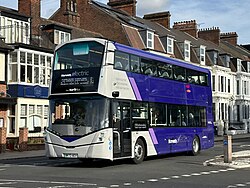
First Bus East of England (formerly known as First Eastern Counties) is a bus operator that provides services in Norfolk and Suffolk in eastern England; it is a subsidiary of FirstGroup. It has five depots in operating areas spread out across East Anglia: Norwich, Ipswich, Great Yarmouth, Lowestoft and King's Lynn.
In July 1931, the Eastern Counties Omnibus Company was formed with a fleet of 534 buses out of the merger of four existing bus companies in East Anglia: Eastern Counties Road Car Company of Ipswich, Ortona Motor Company of Cambridge and Peterborough Electric Traction Company, which were all owned by Tilling & British Automobile Traction and United Automobile Services' East Anglia services.
Upon completion of the merger, the major shareholders of Eastern Counties were United Automobile Services (43%), Tilling & British Automobile Traction (28%), the London & North Eastern Railway (24%) and the London Midland & Scottish Railway (3%). Also included were United's bus and lorry coachbuilder, based in Lowestoft, which was renamed to Eastern Coach Works and supplied bus bodies to its parent company and operators within the Tilling & British Automotive Traction group on various chassis. By the end of the 1930s, the Eastern Counties Omnibus Company had purchased another 50 operators.[citation needed]
In September 1942, Tilling & British Automobile Traction was placed into administration, with the Eastern Counties Omnibus Company shareholding transferred to the Tilling Group. In November 1948, Eastern Counties was included in the nationalisation of the Tilling Group, becoming part of the British Transport Commission, which was merged with the Transport Holding Company in January 1969 to become the National Bus Company.
In preparation for bus deregulation, in September 1984, Eastern Counties' operations in Cambridgeshire were transferred to a separate company named Cambus Limited. The company was sold into privatisation from the National Bus Company in February 1987 through a management buyout, which was followed by its coaching operations transferring to Ambassador Travel of Great Yarmouth in December 1987.
An Eastern Counties Bristol VRT double decker bus made international headlines when it fell rear-first into a 26 feet (7.9 m) sinkhole formed from a medieval chalk mine running underneath Earlham Road in Norwich on 3 March 1988. The driver of the bus, along with the passengers on board, managed to escape minutes before the bus fell further into the sinkhole, which severed a gas main running underneath the road and resulted in the overnight evacuation of the nearby area while the main was repaired. A photograph of the incident was used by Cadbury the next day in full-page newspaper advertisements and on billboards to promote their Double Decker chocolate bar, captioned with the slogan "Nothing fills a hole like a Double-Decker".[better source needed]
In July 1994, Eastern Counties was sold to the GRT Group for £6.7 million, which merged with Badgerline to form FirstBus in June 1995. FirstBus later purchased the operations of Great Yarmouth Transport in September 1996, merging it into the First Eastern Counties operation.
In April 2011, First Eastern Counties' King's Lynn operations were sold to Norfolk Green.
First Bus East of England
First Bus East of England (formerly known as First Eastern Counties) is a bus operator that provides services in Norfolk and Suffolk in eastern England; it is a subsidiary of FirstGroup. It has five depots in operating areas spread out across East Anglia: Norwich, Ipswich, Great Yarmouth, Lowestoft and King's Lynn.
In July 1931, the Eastern Counties Omnibus Company was formed with a fleet of 534 buses out of the merger of four existing bus companies in East Anglia: Eastern Counties Road Car Company of Ipswich, Ortona Motor Company of Cambridge and Peterborough Electric Traction Company, which were all owned by Tilling & British Automobile Traction and United Automobile Services' East Anglia services.
Upon completion of the merger, the major shareholders of Eastern Counties were United Automobile Services (43%), Tilling & British Automobile Traction (28%), the London & North Eastern Railway (24%) and the London Midland & Scottish Railway (3%). Also included were United's bus and lorry coachbuilder, based in Lowestoft, which was renamed to Eastern Coach Works and supplied bus bodies to its parent company and operators within the Tilling & British Automotive Traction group on various chassis. By the end of the 1930s, the Eastern Counties Omnibus Company had purchased another 50 operators.[citation needed]
In September 1942, Tilling & British Automobile Traction was placed into administration, with the Eastern Counties Omnibus Company shareholding transferred to the Tilling Group. In November 1948, Eastern Counties was included in the nationalisation of the Tilling Group, becoming part of the British Transport Commission, which was merged with the Transport Holding Company in January 1969 to become the National Bus Company.
In preparation for bus deregulation, in September 1984, Eastern Counties' operations in Cambridgeshire were transferred to a separate company named Cambus Limited. The company was sold into privatisation from the National Bus Company in February 1987 through a management buyout, which was followed by its coaching operations transferring to Ambassador Travel of Great Yarmouth in December 1987.
An Eastern Counties Bristol VRT double decker bus made international headlines when it fell rear-first into a 26 feet (7.9 m) sinkhole formed from a medieval chalk mine running underneath Earlham Road in Norwich on 3 March 1988. The driver of the bus, along with the passengers on board, managed to escape minutes before the bus fell further into the sinkhole, which severed a gas main running underneath the road and resulted in the overnight evacuation of the nearby area while the main was repaired. A photograph of the incident was used by Cadbury the next day in full-page newspaper advertisements and on billboards to promote their Double Decker chocolate bar, captioned with the slogan "Nothing fills a hole like a Double-Decker".[better source needed]
In July 1994, Eastern Counties was sold to the GRT Group for £6.7 million, which merged with Badgerline to form FirstBus in June 1995. FirstBus later purchased the operations of Great Yarmouth Transport in September 1996, merging it into the First Eastern Counties operation.
In April 2011, First Eastern Counties' King's Lynn operations were sold to Norfolk Green.
Recent media
Recent media