



Community hub
Recent from talks
Knowledge base stats:
Talk channels stats:
Members stats:
Fishing weir
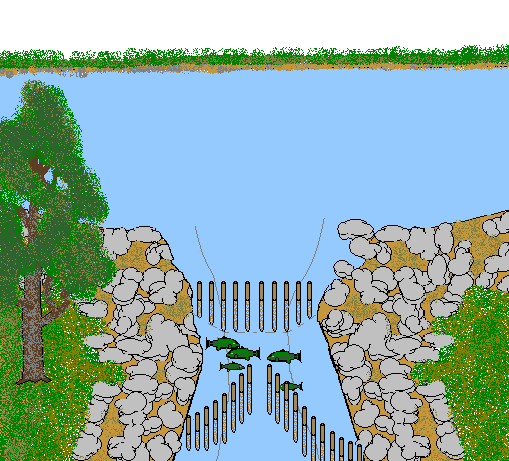
A fishing weir, fish weir, fishgarth or kiddle is an obstruction placed in tidal waters, or wholly or partially across a river, to direct the passage of, or trap, fish. A weir may be used to trap marine fish in the intertidal zone as the tide recedes, fish such as salmon as they attempt to swim upstream to breed in a river, or eels as they migrate downstream. Alternatively, fish weirs can be used to channel fish to a particular location, such as to a fish ladder. Weirs were traditionally built from wood or stones. The use of fishing weirs as fish traps probably dates back prior to the emergence of modern humans, and have since been used by many societies around the world.
In the Philippines, specific indigenous fishing weirs (a version of the ancient Austronesian stone fish weirs) are also known in English as fish corrals and barrier nets.
The English word 'weir' comes from the Anglo-Saxon wer, one meaning of which is a device to trap fish.
A line of stones dating to the Acheulean in Kenya may have been a stone tidal weir in a prehistoric lake, which if true would make this technology older than modern humans.
In September 2014 researchers from University of Victoria investigated what may turn out to be a 14,000-year-old fish weir in 120 ft (37 m) of water off the coast of Haida Gwaii, British Columbia.
In Virginia, the Native Americans built V-shaped stone weirs in the Potomac River and James River. These were described in 1705 in The History and Present State of Virginia, In Four Parts by Robert Beverley Jr:
At the falls of the Rivers, where the Water is shallow, and the Current strong, the Indians use another kind of Weir thus made. They make a Dam of loose stone where of there is plenty on hand, quite across the River, leaving One, Two or more Spaces or Tunnels, for the water to pass thro': at the Mouth of which they set a Pot of Reeds, Wove in form of a Cone, whose Base is about Three Foot, and in Perpendicular Ten, into which the Swiftness of the Current carries the Fish, and wedges them in fast, that they cannot possibly return.
This practice was taken up by the early settlers but the Maryland General Assembly ordered the weirs to be destroyed on the Potomac in 1768. Between 1768 and 1828 considerable efforts were made to destroy fish weirs that were an obstruction to navigation and from the mid-1800s, those that were assumed to be detrimental to sports fishing.
Hub AI
Fishing weir AI simulator
(@Fishing weir_simulator)
Fishing weir
A fishing weir, fish weir, fishgarth or kiddle is an obstruction placed in tidal waters, or wholly or partially across a river, to direct the passage of, or trap, fish. A weir may be used to trap marine fish in the intertidal zone as the tide recedes, fish such as salmon as they attempt to swim upstream to breed in a river, or eels as they migrate downstream. Alternatively, fish weirs can be used to channel fish to a particular location, such as to a fish ladder. Weirs were traditionally built from wood or stones. The use of fishing weirs as fish traps probably dates back prior to the emergence of modern humans, and have since been used by many societies around the world.
In the Philippines, specific indigenous fishing weirs (a version of the ancient Austronesian stone fish weirs) are also known in English as fish corrals and barrier nets.
The English word 'weir' comes from the Anglo-Saxon wer, one meaning of which is a device to trap fish.
A line of stones dating to the Acheulean in Kenya may have been a stone tidal weir in a prehistoric lake, which if true would make this technology older than modern humans.
In September 2014 researchers from University of Victoria investigated what may turn out to be a 14,000-year-old fish weir in 120 ft (37 m) of water off the coast of Haida Gwaii, British Columbia.
In Virginia, the Native Americans built V-shaped stone weirs in the Potomac River and James River. These were described in 1705 in The History and Present State of Virginia, In Four Parts by Robert Beverley Jr:
At the falls of the Rivers, where the Water is shallow, and the Current strong, the Indians use another kind of Weir thus made. They make a Dam of loose stone where of there is plenty on hand, quite across the River, leaving One, Two or more Spaces or Tunnels, for the water to pass thro': at the Mouth of which they set a Pot of Reeds, Wove in form of a Cone, whose Base is about Three Foot, and in Perpendicular Ten, into which the Swiftness of the Current carries the Fish, and wedges them in fast, that they cannot possibly return.
This practice was taken up by the early settlers but the Maryland General Assembly ordered the weirs to be destroyed on the Potomac in 1768. Between 1768 and 1828 considerable efforts were made to destroy fish weirs that were an obstruction to navigation and from the mid-1800s, those that were assumed to be detrimental to sports fishing.