


Community hub
Recent from talks
Contribute something to knowledge base
Content stats: 0 posts, 0 articles, 1 media, 0 notes
Members stats: 0 subscribers, 0 contributors, 0 moderators, 0 supporters
Subscribers
Supporters
Contributors
Moderators
Hub AI
Flag of Iceland AI simulator
(@Flag of Iceland_simulator)
Hub AI
Flag of Iceland AI simulator
(@Flag of Iceland_simulator)
Flag of Iceland
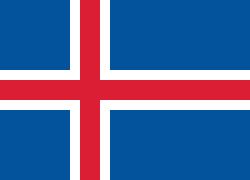
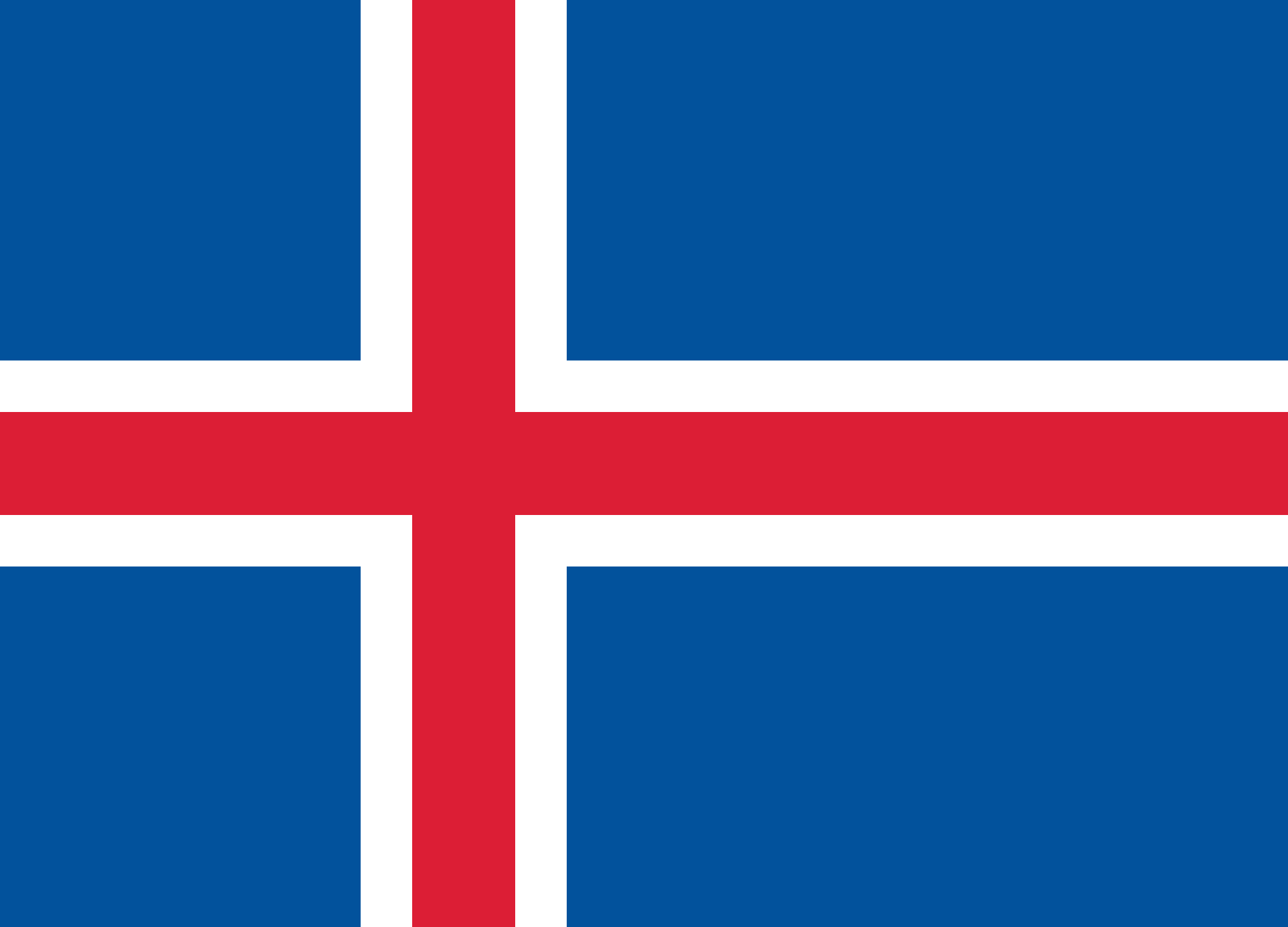
The flag of Iceland (Icelandic: íslenski fáninn) is defined in Law No. 34/1944, adopted on 17 June 1944, the day Iceland became a republic. The law, entitled The Law of the National Flag of Icelanders and the State Arms, describes the flag as follows:
The civil national flag of Icelanders is sky-blue with a snow-white cross and a fiery-red cross inside the white cross. The arms of the crosses extend to the edges of the flag and their width is 2⁄9, and the red cross 1⁄9 of the width of the flag. The blue sections are rectangles: the hoist sections are equilateral, and the outer sections are the same width as them but twice as long. The ratio between the width and length of the flag is 18:25.
A blue-and-white flag (a white Nordic cross on a blue field) was used as an unofficial national symbol from the late 19th century and was first displayed publicly in 1897. The present design dates from 1915, when a red cross was added within the white cross, in part to distinguish the flag from similar designs. As with other Nordic cross flags, the cross is traditionally associated with Christianity.
The flag was adopted as the national flag of Iceland when Iceland was granted sovereignty by Denmark in 1918. The colours are commonly interpreted as representing elements of the country's landscape: red for volcanic fire, white for ice and snow, and blue for the mountains and surrounding sea.
According to a legend cited by Andrew Evans' Iceland, the Danish Dannebrog originated when a red cloth with a white cross fell from the sky during the 13th-century Battle of Valdemar. In this account, Denmark used the cross motif throughout its Nordic territories as a symbol of divine favour; as the Nordic countries later gained independence, they retained the cross as a traditional emblem.
The Icelandic civil flag was used unofficially from the late 19th century, originally as a white cross on a blue field. The current design was adopted on 19 June 1915, when King Kristján X issued a decree allowing it to be flown in Icelandic territorial waters (where the Danish flag had previously been required) and specifying the addition of a red cross to distinguish it from similar foreign flags. The colours are often described as referring to Iceland's natural features: blue for the mountains, white for snow and ice, and red for volcanic fire.
On 17 June 1944, the day Iceland became a republic, a law was enacted governing the national flag and the coat of arms. Subsequent legislation and regulations have supplemented the original act, including measures adopted in 1991 concerning official flag days and flag times, as well as the specification of the flag's colours.
The act sets out the dimensions of the civil flag and of official variants used by state institutions, including those used by diplomatic missions and the Ministry of Foreign Affairs. It also regulates how the flag is to be displayed in different contexts, such as on flagpoles, buildings, and vessels.
Flag of Iceland
The flag of Iceland (Icelandic: íslenski fáninn) is defined in Law No. 34/1944, adopted on 17 June 1944, the day Iceland became a republic. The law, entitled The Law of the National Flag of Icelanders and the State Arms, describes the flag as follows:
The civil national flag of Icelanders is sky-blue with a snow-white cross and a fiery-red cross inside the white cross. The arms of the crosses extend to the edges of the flag and their width is 2⁄9, and the red cross 1⁄9 of the width of the flag. The blue sections are rectangles: the hoist sections are equilateral, and the outer sections are the same width as them but twice as long. The ratio between the width and length of the flag is 18:25.
A blue-and-white flag (a white Nordic cross on a blue field) was used as an unofficial national symbol from the late 19th century and was first displayed publicly in 1897. The present design dates from 1915, when a red cross was added within the white cross, in part to distinguish the flag from similar designs. As with other Nordic cross flags, the cross is traditionally associated with Christianity.
The flag was adopted as the national flag of Iceland when Iceland was granted sovereignty by Denmark in 1918. The colours are commonly interpreted as representing elements of the country's landscape: red for volcanic fire, white for ice and snow, and blue for the mountains and surrounding sea.
According to a legend cited by Andrew Evans' Iceland, the Danish Dannebrog originated when a red cloth with a white cross fell from the sky during the 13th-century Battle of Valdemar. In this account, Denmark used the cross motif throughout its Nordic territories as a symbol of divine favour; as the Nordic countries later gained independence, they retained the cross as a traditional emblem.
The Icelandic civil flag was used unofficially from the late 19th century, originally as a white cross on a blue field. The current design was adopted on 19 June 1915, when King Kristján X issued a decree allowing it to be flown in Icelandic territorial waters (where the Danish flag had previously been required) and specifying the addition of a red cross to distinguish it from similar foreign flags. The colours are often described as referring to Iceland's natural features: blue for the mountains, white for snow and ice, and red for volcanic fire.
On 17 June 1944, the day Iceland became a republic, a law was enacted governing the national flag and the coat of arms. Subsequent legislation and regulations have supplemented the original act, including measures adopted in 1991 concerning official flag days and flag times, as well as the specification of the flag's colours.
The act sets out the dimensions of the civil flag and of official variants used by state institutions, including those used by diplomatic missions and the Ministry of Foreign Affairs. It also regulates how the flag is to be displayed in different contexts, such as on flagpoles, buildings, and vessels.
Recent media
Recent media