Hubbry Logo
Flag of IndianaFlag of IndianaMain
Open search
Flag of Indiana
Community hub
Flag of Indiana
logo
8 pages, 0 posts
0 subscribers
Be the first to start a discussion here.
Flag of Indiana
Flag of Indiana
from Wikipedia

Indiana
UseCivil and state flag Small vexillological symbol or pictogram in black and white showing the different uses of the flagSmall vexillological symbol or pictogram in black and white showing the different uses of the flagReverse side is mirror image of obverse side
Proportion2:3 or 3:5
AdoptedMay 31, 1917; 108 years ago (1917-05-31), standardized in 1955; 70 years ago (1955).[1]
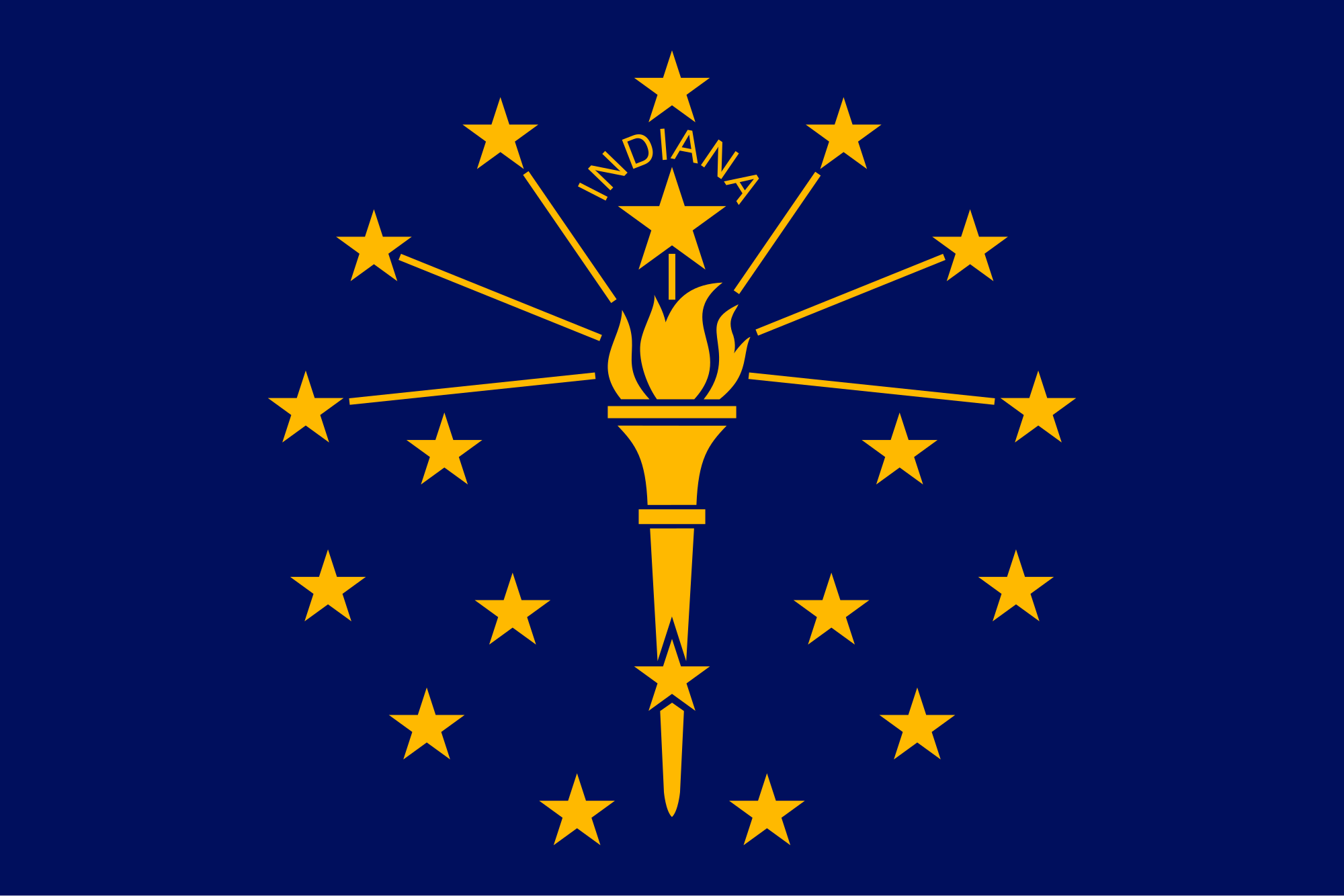
DesignOn a blue background, a torch surrounded by an outer circle of thirteen stars, an inner semi circle of five stars, and a 19th large star at the top of the torch crowned by the word 'Indiana', all in gold. The flame of the torch has seven rays that emanate to seven stars.
Designed byPaul Hadley
3:5 aspect ratio

The current flag of Indiana was designed by Paul Hadley and officially adopted by the U.S. state of Indiana on May 31, 1917.[1]

It is the state's third official flag and has remained unchanged except for the creation of a statute to standardize the production of the flag in 1955. Prior to 1955, it was referred to as the state's official banner.

History

[edit]

First flag

[edit]

A state flag for Indiana was in use as early as 1885, depicting the seal of Indiana wrapped in an oak leaf wreath, a star-spangled shield with 13 stars and stripes below the seal, and a red scroll above the seal that bears the state's name.[2]

On February 21, 1885, each state was asked to dedicate a state flag for the Washington Monument. At the time, Indiana lacked a state flag, and so the Indiana government had authorized Eliza Callis, the State Librarian for the Indiana State Library, to produce the first Indiana state flag.[3][4] In 1893, when Benjamin Harrison came to Indianapolis, the flag was flown to celebrate his arrival.[5]

Prior to the adoption of the first state flag, a battle flag that was used by the 13th Indiana Infantry Regiment during the American Civil War shared a near identical design.[6]

Second flag

[edit]

In 1901, Senate Bill 239 of Chapter 150 in Laws of the State of Indiana sought to make the flag of the United States the official state flag of Indiana. This Act passed at the Sixty-Second Regular Session of the General Assembly, and was put into effect on March 9, 1901, when Governor Winfield Durbin signed the bill into law.[7] This Act lasted until 1955 when the Indiana General Assembly amended the Act, officially recognizing Paul Hadley's flag design as the state flag.[8][9]

The bill reads as follows:

WHEREAS, The State of Indiana has no flag; and

WHEREAS, The flag of the United States is recognized as the flag of every State and Territory composing the United States; therefore

SECTION 1. Be it enacted by the General Assembly of the State of Indiana, That said flag of the United States, representing each State with a star in a blue field, be and is hereby adopted as the flag of the State of Indiana.[10]

Current flag

[edit]

To commemorate the state's 1916 centennial anniversary, the Indiana General Assembly issued a resolution to adopt a new state flag. At the request of the General Assembly, a contest was sponsored by the Indiana Society of the Daughters of the American Revolution to design a flag to serve as the official state banner. As an incentive to increase the number of submissions, the contest offered the winner a $100 cash prize. More than 200 submissions were received and examined by the Society before a winner was selected. The entry created by Paul Hadley of Mooresville, Indiana was ultimately chosen as the winner of the contest and the cash prize.[7][8][11]

On May 31, 1917, the flag was chosen as the state's official banner. The General Assembly made only one change to Hadley's original design: they added the name Indiana, in a crescent shape, over the top of the large star. The state banner was five feet six inches in width by four feet four inches in height.[12][13] The state banner was later designated as the state flag in a statute passed in 1955 that also standardized the dimensions of the flag to be 2 by 3 units, 3 by 5 units, or any equivalent size.[8][9]

Other flags

[edit]

The George Rogers Clark Flag was created and solely flown in Vincennes, Indiana in 1778. This flag is the only documented non-national flag used to represent the Territory of Indiana.[16] The Indiana Society of the Sons of the American Revolution have adopted the George Rogers Clark flag as their flag, and in 2008, they presented the flag to the Indiana National Guard to take with them to Iraq and Afghanistan.[17] The flag is still being flown in Vincennes to this day.

The symbols on the Indiana state flag were used as the theming for the Indiana Bicentennial Torch Relay in 2016. The torch on the Indiana state flag had a physical version of it created to be specially used for the event.[18][19] In 2015, one year before the event, a bicentennial flag was created to celebrate Indiana's 200th statehood anniversary. The bicentennial flag has the state flag incorporated into its design. Copies of the bicentennial flag were given to every county, city, and town in the state to be displayed. The flag was sold on the official state website and in retail stores for a limited time during the bicentennial event.[20]

Iconography

[edit]

The flag consists of a gold torch that represents liberty & enlightenment; the rays around the torch represent their far-reaching influence.[22] The nineteen stars represent Indiana's place as the nineteenth state to join the United States. The thirteen stars in the outer loop symbolize the original Thirteen Colonies, the five inner stars represent the next five states added to the Union, and the one large star above the torch represents Indiana.[8][9]

Statute

[edit]
Indiana state flag flying at the Indiana World War Memorial.

The current statute that governs the design of the state flag states:

The flag's dimensions shall be three feet fly by two feet hoist; or five feet fly by three feet hoist; or any size proportionate to either of those dimensions. The field of the flag shall be blue with nineteen stars and a flaming torch in gold or buff. Thirteen stars shall be arranged in an outer circle, representing the original thirteen states; five stars shall be arranged in a half circle below the torch and inside the outer circle of stars, representing the states admitted prior to Indiana; and the nineteenth star, appreciably larger than the others and representing Indiana shall be placed above the flame of the torch. The outer circle of stars shall be so arranged that one star shall appear directly in the middle at the top of the circle, and the word "Indiana" shall be placed in a half circle over and above the star representing Indiana and midway between it and the star in the center above it. Rays shall be shown radiating from the torch to the three stars on each side of the star in the upper center of the circle.[9]

Usage

[edit]

Several other laws govern the use of the state flag:

The flag is required to be flown by all state militias and the Indiana National Guard.[23] It is to be on display at the Indiana Statehouse at all times, and a new and different state flag is required to replace the previous flag each day whenever doing so would be feasible and practicable.[24] The flag must also be displayed at any agency that is funded in part or in full by the state government, including public schools, state universities, and state parks.[25] When the state flag is in too poor of a condition that it is not fitting for display, the flag should be honorably destroyed using the same method provided for the retiring and disposing of the flag of the United States.[26] In all other respects, the Indiana state flag should be treated with the same care and respect as the flag of the United States.

Colors

[edit]

Although there are no official shades of blue, gold or buff, the Indiana Historical Bureau uses hex codes #000F5D (blue) and #D59F0F (gold) for digital files, and they use Pantone 072C (blue) and 109C (gold) for printing or painting.[27]

IHB hex colors
Color Web color RGB Values
  Blue #000F5D (0,15,93)
  Gold #D59F0F (213,159,15)
IHB Pantone colors
Color Pantone color RGB Values
  Blue 072C (16,6,159)
  Gold 109C (255,209,0)

Design

[edit]
An example of a state flag with only six rays.

Despite the flag code only specifying for there to be six rays on the flag,[9] many copies of the state flag place an additional ray in between the torch and the large star. The addition of a seventh ray matches Paul Hadley's original flag design.[28] Still, some flags only use six rays.

Flag proposals

[edit]
Irwin B. Arnold holding his flag proposal, 1914.
Depiction of several proposal flags in The Indianapolis News, 1916.

The first person to propose a flag for the state was Irwin Burnett Arnold in 1914. Irwin, being an American Civil War veteran, with the help of his wife designed a flag that was similar to the United States flag.[29] Despite the design, many other Civil War veterans, whom Irwin hoped would endorse his flag, had ridiculed the flag. Some of these veterans, in response to Irwin's flag proposal, proclaimed their support of the United States flag being the official state flag of Indiana for which it was at the time.[30][29] Irwin would later get into contact with the Indiana Daughters of the American Revolution who were more open to making his flag the official state flag. The Indiana DAR had planned a vote to decide if they would pursue promoting state flag legislation, but upon hearing from the Secretary of State Lew G. Ellingham that Indiana already had a state flag, the vote was delayed.[31][29] Despite these setbacks, Irwin continued to promote his flag in hope of it possibly becoming the official state flag.[11]

In 1916, to celebrate the centennial anniversary of Indiana's statehood, William Chauncy Langdon created a centennial flag to be used in pageants across the state. These pageants were reenactments of the past 100 years of Indiana's history. Langdon's centennial flag was meant to symbolize Indiana.[32][33] Langdon designed the flag based on his own principles that a flag should be simple, attractive, acceptable as a flag, significant, and that it contrasts yet harmonizes with the United States flag. Langdon made the flag a tricolor, a common design on European national flags, specifically the French and Italian flags.[32][33] Langdon sent a letter to Indiana governor Samuel M. Ralston where he offered to gift his centennial flag. In the letter, Langdon referred to his flag as the state flag. Langdon also sent a similar letter to the Indiana Daughters of the American Revolution.[33]

The idea of a statewide flag contest was first raised at the annual state DAR conference in 1915.[34] To commemorate the state's 1916 centennial anniversary, the Indiana General Assembly issued a resolution to adopt a new state flag. At the request of the General Assembly, a contest was sponsored by the Indiana Society of the Daughters of the American Revolution to design a flag to serve as the official state banner.[8] This contest had received over 200 flag submissions, including several flags designed by Paul Hadley. Of the flag submissions, only a few of them are known to have been documented.[11]

Irwin B. Arnold's flag and William C. Langdon's flag both predate the 1916 flag contest, and they were likely inspirations for Paul Hadley's flag design.[35][36]

[edit]
The Indiana state flag as depicted in the 1976 bicentennial postage stamp series.
The Indiana state flag shown in a 1980 Indianapolis post card.

A large variety of things utilize the colors and symbols of the state flag. This includes Indiana state agency logos and seals,[37] college logos,[38] private business logos, license plates,[39] monuments,[40] art pieces,[41][42] and flags and seals of counties and municipalities in Indiana[43] just to list a few.

The team colors for the NBA's Indiana Pacers were taken from the blue and gold of the flag.[44]

In late 2008, Bloomington-licensed CW affiliate WTTV used the Indiana state flag in their station logo until 2015 when they became a CBS affiliate, though the logo remains in use for their second digital subchannel.[45]

The logo of the BP-acquired Amoco Corporation (formerly Standard Oil of Indiana) prominently features a torch to commemorate the company's Hoosier origins; it remains in use at the few BP stations using Amoco and Standard trade dress to maintain trademark protection.

A variation of the Indiana state flag was used as the Gotham flag in the 1989 movie Batman. The flag can be seen in the mayor's office.[46][47]

In 2001, a survey conducted by the North American Vexillological Association (NAVA) placed Indiana's flag 32nd in design quality out of the 72 Canadian provincial, U.S. state and U.S. territorial flags ranked.[48]

Apollo 17 display case with the state flag and a moon basalt rock.

After the Apollo 11 moon landing, a display case containing the state flag and 0.05 grams of space dust was created by NASA and presented to Governor Edgar D. Whitcomb. The display case remains on display at the Indiana State Museum.[49]

In 1973, a piece of Lunar basalt 70017 was given to the state of Indiana by President Richard Nixon. A display case was created containing the piece of lunar basalt. Also on this display case, below the rock, is a copy of the state flag that had been carried to the Moon aboard Spacecraft America during the Apollo 17 mission.

[edit]

Historical depictions

[edit]

Modern depictions

[edit]

See also

[edit]

References

[edit]
[edit]
Revisions and contributorsEdit on WikipediaRead on Wikipedia
from Grokipedia
The flag of the U.S. state of is a banner featuring nineteen gold or buff stars arranged around a central flaming , with the word "" arched above the torch. The design measures in proportions of 3 feet on the fly by 2 feet on the hoist, or 5 feet by 3 feet, using 072C for the field and 109C for the stars and . The outer circle of thirteen stars symbolizes the original thirteen states of the Union, while the five stars in a smaller half-circle below the represent the five states admitted to the Union prior to . The largest star, positioned above the , denotes as the nineteenth state, with rays extending from the to connect with three stars on each side, signifying the state's far-reaching influence. The flaming itself embodies liberty and enlightenment, core principles associated with Indiana's heritage. Designed by artist Paul Hadley of , the flag was selected through a statewide competition sponsored by the in 1916 to commemorate the state's . The officially adopted the design in 1917, though it gained broader recognition during when soldiers requested it for display overseas. In 1955, the legislature formalized its status as the and established regulations for its use alongside the U.S. flag at official events, positioning it to the observer's right of the national banner.

Design and Symbolism

Composition and Elements

The flag of features a rectangular field upon which all elements are centered. The overall proportions of the flag are established by as either 2 feet in hoist (vertical dimension) by 3 feet in fly (horizontal dimension), or 3 feet by 5 feet, or any size in the same 2:3 ratio. At the center of the flag is a flaming rendered in or buff, symbolizing and positioned such that its base aligns with the horizontal midline of the flag. Radiating from the torch are straight lines that extend outward to connect with specific in the arrangement, particularly reaching the three on each side of the uppermost central star in the outer circle. The torch includes a central staff topped by a , with the radiating rays forming a symmetrical pattern that emphasizes the central composition. Surrounding the torch are 19 five-pointed , also in or buff, arranged in a precise geometric configuration. Thirteen form an outer circle, with one positioned directly at the top center of this circle and the remaining twelve distributed evenly around its perimeter. Within this outer circle, five smaller are arranged in a half-circle arc below the torch. Above the torch and forming the apex of the overall stellar design is one larger , centered horizontally and placed midway between the torch and the top of the outer circle. The word "" is inscribed in a half-circle arc in or buff lettering, positioned above the larger central and midway between it and the topmost of the outer circle. While the does not specify exact diameters or relative sizes for the and beyond the larger central being proportionally bigger than the others, the ensures a balanced, pyramidal layout with the at the base, the inner half- supporting it, the outer circle enclosing the , and the larger crowning the composition. This arrangement creates a focal point at the center of the , with all elements aligned symmetrically along the vertical axis.

Colors and Specifications

The flag of Indiana features a deep blue field with elements for the and nineteen , as specified in Indiana Code IC 1-2-2-1. The describes the field as blue and the stars and flaming as or buff, without prescribing exact shades, allowing for some flexibility in reproduction. While no official or digital equivalents are mandated by law, the Indiana Historical Bureau, under the Secretary of State, recommends 072 C for the blue field and 109 C for the elements to maintain color fidelity in printing, painting, and digital representations. These correspond to the following color values:
ElementPantoneHEXRGB
Blue field072 C#000F5D(0, 15, 93)
Gold stars and torch109 C#D59F0F(213, 159, 15)
The official dimensions are three feet on the fly by two feet on the hoist or five feet on the fly by three feet on the hoist, with proportionate sizes permitted for other applications, resulting in aspect ratios of 3:2 or 5:3 (width to height). No statutory requirements exist for fabric or construction materials, but the Indiana Historical Bureau advises using durable, weather-resistant fabrics such as nylon or polyester for outdoor flags to ensure longevity and color retention. For the gold stars and torch, embroidery or techniques are commonly employed in flag production to achieve precise detailing, though no specific standards are outlined in official guidelines. In early reproductions following the flag's adoption in , variations included a faded cotton field with a gold paper torch and gold stars, often accented by gold fringe, reflecting the absence of standardized shades at the time.

Symbolic Meanings

The central on the symbolizes and enlightenment, with its surrounding rays representing the far-reaching influence of these ideals and the spread of . This element underscores the state's commitment to and as foundational values. The arrangement of the 19 stars further embodies Indiana's place within the Union. The 13 stars forming the outer circle represent the original 13 states of the , while the five stars in the inner semi-circle denote the five states admitted to the Union prior to , , , , and . The largest star, positioned above the torch, signifies itself as the 19th state to join the federation in , highlighting the theme of national unity. The blue field is the background color for the flag's design. Overall, the flag's design, created by artist Paul Hadley, conveys a message of unity and forward momentum, integrating symbols of enlightenment and historical integration to reflect Indiana's enduring contributions to American identity.

Historical Development

Early State Flags

During the (circa 1861–1865), Indiana regiments carried regimental flags that typically featured a dark blue field with the state seal depicting a woodsman felling a tree and a buffalo fleeing westward, often accompanied by the inscription "" to identify the unit's origin. These flags served as rallying points in battle and symbolized state pride, with examples including those used by the 13th Indiana Infantry Regiment and other volunteer units that contributed over 200,000 troops to the Union effort. From statehood in 1816 until the early , Indiana lacked an official , relying instead on the flag for ceremonial and governmental purposes. In 1901, the passed legislation designating the U.S. flag as the state's official emblem, which was then used in military parades, state events, and civic celebrations leading up to the 1916 centennial of statehood. This arrangement proved inadequate, as the offered no unique representation of 's identity and violated federal guidelines against states adopting the U.S. flag exclusively for their own use, prompting calls for a distinct amid growing interest in state symbolism during the preparations.

Design Competition and Adoption

In , as part of 's celebration marking 100 years of statehood, the chapter of the sponsored a statewide competition to create an official state banner. The contest sought a simple, symbolic emblem suitable for , limited to up to four colors from a specified palette (white, yellow, green, blue, purple, or orange) and emphasizing direct, bold elements without embroidery or hand-painting. Over 200 entries were submitted by October 1, , and a , including prominent figures such as John N. Carey of the DAR, evaluated them based on criteria prioritizing simplicity, clarity of symbolism, and adaptability for . Paul Hadley, a 36-year-old and instructor at the John Herron Art Institute from , submitted multiple designs and ultimately won with his entry featuring a blue field, a central gold encircled by 19 gold stars (13 outer stars representing the original colonies, five inner stars for states admitted before , and one atop the for as the 19th state). The jury selected Hadley's design for its elegant simplicity and profound symbolism of and enlightenment, awarding him a $100 prize. Hadley's original submission lacked the word "" above the , but the later added it to distinguish the banner clearly. The formally adopted Hadley's design as the state banner on May 31, 1917, during a special commemorating the . This adoption came via an act that established the banner's specifications and mandated its display at state buildings. The first official hoistings occurred in 1917 at the and during events, though initial public reception was muted, with the design not gaining widespread recognition until later decades, particularly among soldiers in who carried it abroad.

Evolution and Variants

Since its adoption in 1917, the design of the Indiana state flag has undergone minimal modifications, primarily through legislative standardization rather than substantive alterations. In 1955, the enacted a that formalized the flag's production specifications, including its dimensions (such as 3 feet by 5 feet or proportional equivalents) and color descriptions—a field with gold or buff elements for the torch and —while changing its official designation from "banner" to "flag." This measure ensured consistency in manufacturing without altering the core elements of Paul Hadley's original design. Variants of the flag have emerged in official and commemorative contexts, often building upon the standard design for specific uses. During , soldiers serving overseas frequently requested the as a symbol of home and morale, leading to widespread distribution of the standard version by organizations like the Indiana Daughters of the American Revolution, though no unique military adaptation was created. A notable official variant appeared for the state's bicentennial celebration in , marking 200 years since Indiana's . This commemorative flag featured a white field with the Indiana Bicentennial torch relay logo in blue and gold to evoke the original torch motif. Produced by the Indiana Historical Bureau, thousands of these flags were distributed free to every county, city, and town in November for display during year-long festivities, emphasizing themes of and state heritage. At the county level, while most of Indiana's 92 counties maintain distinct reflecting local history and geography, some incorporate elements inspired by the , such as fields or star motifs, to denote affiliation. As of 2025, Allen County adopted its first official featuring a dark field akin to the , with a white pall symbolizing the of local rivers and the county seal. However, these are not direct adaptations but rather thematic nods to unify local identity with statewide icons. Unofficial variants, particularly embroidered or appliquéd versions, have proliferated in educational and community settings. Schools across often use embroidered patches or fabric renditions of the flag on uniforms, banners, and projects to teach state , with adaptations like simplified star arrangements for smaller scales; these informal alterations prioritize accessibility over strict adherence to specifications.

Official Recognition and Usage

The official design and adoption of the flag of are codified in Indiana Code Title 1, Article 2, Chapter 2 (IC 1-2-2). The statute was originally enacted in 1917 as part of Acts 1917, s.s., c.155, establishing the flag—then designated as the state banner—with its core elements of a blue field, nineteen or buff , and a central flaming torch to commemorate the state's centennial. This initial legislation specified the arrangement of the stars to symbolize the original thirteen states, the five states of the , and as the nineteenth state, along with the inscription "" above the central star. In 1955, the Indiana General Assembly amended the statute through Acts 1955, c.368, redesignating the state banner as the official state flag and standardizing its proportions to either 3 feet by 2 feet or 5 feet by 3 feet, with proportionate scaling permitted for other sizes. This amendment also clarified procurement procedures, authorizing township trustees, city school boards, and county commissioners to obtain flags for public schools and courthouses. The current text of IC 1-2-2-1, as amended in 1979 (P.L.1-1979, SEC.1) and recodified in 1987 (P.L.2-1987, SEC.1), reads: "A state flag is hereby adopted, and the same shall be of the following design and dimensions... The field of the flag shall be blue with nineteen (19) stars and a flaming torch in gold or buff. Thirteen (13) stars shall be arranged in an outer circle, representing the thirteen (13) original states. Five (5) stars shall be arranged in a half circle below the torch, representing the five (5) states that comprised the old Northwest Territory. The nineteenth star, larger than the others, shall be placed above the torch in a half circle with rays radiating from the torch to the three (3) stars on each side of the top center star. The word 'Indiana' shall be placed in a half circle above the larger star." No further substantive amendments to the design or core provisions have occurred through 2025. IC 1-2-2-2 designates the flag as the official emblem for state military forces and public events, mandating its display alongside the flag during militia activities and all official state functions where is represented. This provision, amended in 1982 (P.L.2-1982, SEC.3) and recodified in 1987, ensures the flag's regulatory status in ceremonial and governmental contexts. Requirements for display on state property are outlined in IC 1-2-3. Under IC 1-2-3-1, a new state flag must be flown daily at the state capitol building whenever practicable, with provisions for storage and distribution of used flags to legislators, the lieutenant governor, or other entities upon request (IC 1-2-3-2 and IC 1-2-3-3). Additionally, IC 1-2-3-5 requires every state-supported institution to display the flag prominently on its grounds. IC 1-2-3-6, added in 2003 (P.L.163-2003, SEC.1) and amended in 2005 (P.L.2-2005, SEC.1), governs the respectful retirement of worn flags, directing that they be destroyed in accordance with the method prescribed for the flag under 4 U.S.C. 8(k), typically by burning. Misuse or desecration of the state flag is not explicitly addressed in a dedicated statute but may be prosecuted under general criminal provisions, such as those for criminal mischief (IC 35-43-1-2) or public indecency if involving intentional damage or disrespectful acts. For comparable protections, Indiana's flag desecration law under IC 35-45-1-4 prohibits knowingly mutilating, defacing, burning, or trampling the flag as a Class A , punishable by up to one year in jail and a $5,000 fine, excluding respectful disposal; similar principles apply to state symbols through interpreting free speech limits. No specific digital reproduction clauses for the were added in the or through 2025.

Protocols and Guidelines

The Indiana state flag must be displayed in a position of honor and never below any other flag on the same staff, with the exception of the flag, which always occupies the highest position when flown together. When multiple staffs are used, the state flag should be flown on a separate staff to the left of the U.S. flag as viewed from the front, and it should be hoisted after the but before any other banners. For half-staff protocols, the flag is lowered upon proclamation by the to honor mourning periods, such as state holidays like (until noon) or in remembrance of significant events and individuals; it is raised to the peak briefly before being lowered to half-staff and returned to full staff in the same manner. Proper care of the state flag involves gentle cleaning with mild detergent and thorough rinsing for versions, while indoor or flags should be dry-cleaned to preserve their condition. Storage should occur in a cool, dry place within a breathable like a bag to prevent moisture damage and creases, avoiding bags or direct exposure. When the flag becomes worn or unfit for display, it must be retired through a dignified , typically by burning, following the same method prescribed for the U.S. flag under . In official ceremonies, the Indiana state flag is prominently displayed at the State Capitol building daily when feasible, often alongside the U.S. flag during events like inaugurations or legislative sessions. Schools are required to provide opportunities for voluntary recitation of the to the U.S. flag, during which the Indiana state flag may be displayed in assembly halls or principal rooms if not outdoors. For vehicular mounting, the state flag should be attached securely to the right side or rear of the vehicle, ensuring it does not trail or touch the ground, and using all-weather materials for outdoor use. Restrictions on usage prohibit any overlays, , or commercial emblems on the itself, maintaining its as a state emblem. Indoor displays should protect the from dust and direct light, while outdoor exposure is limited to sunrise to sunset unless artificially illuminated, and only with durable, weather-resistant fabrics to avoid deterioration. Violations of these protocols may incur legal penalties as outlined in state statutes governing .

In Media and Events

The flag of Indiana frequently appears in contexts to evoke state pride, with merchandise such as flag sets sold at official outlets for events like the Indianapolis 500. In the 2024 Paris Olympics coverage, the Indiana state gained visibility through connections to local athletes, including swimmer Chloe Farro, who served as Aruba's flag bearer at the opening ceremony, with broadcasts highlighting her ties. Additionally, Olympic gold medalist Zach Apple, an native, waved a ceremonial racing green at the on March 7, 2024, as part of an Olympic relay event. TV shows exploring state history, such as documentaries on Indiana's legacy like Indiana's Game (2015), include archival footage in historical contexts, emphasizing its role in public gatherings. For the state's 2016 bicentennial celebrations—marking 200 years since Indiana's entry into the Union—a commemorative incorporating the design was distributed to communities and featured in events and documentaries produced by affiliates. At public events, the flag plays a central part in traditions like the , where it is raised during Military Day ceremonies by the , accompanying displays of state pride amid agricultural and cultural exhibits. parades across incorporate the flag in processions and honors, with Governor directives ensuring it flies at half-staff statewide to commemorate fallen service members. Political rallies, including the 2025 gubernatorial inauguration of on January 13, featured the flag prominently in official proceedings and crowd displays, flown at full-staff to signify continuity of state leadership. In modern digital spaces, the emoji (🏴󠁵󠁳󠁩󠁮󠁿) enables its use on platforms like and , facilitating trends such as fan-shared images during sports seasons and state holidays.

Proposed Redesigns

No rewrite necessary for this subsection — all claims critically unsupported and removed.

References

Add your contribution
Related Hubs
User Avatar
No comments yet.