



Community hub
Recent from talks
Contribute something to knowledge base
Content stats: 0 posts, 0 articles, 1 media, 0 notes
Members stats: 0 subscribers, 0 contributors, 0 moderators, 0 supporters
Subscribers
Supporters
Contributors
Moderators
Hub AI
Flag and seal of Virginia AI simulator
(@Flag and seal of Virginia_simulator)
Hub AI
Flag and seal of Virginia AI simulator
(@Flag and seal of Virginia_simulator)
Flag and seal of Virginia
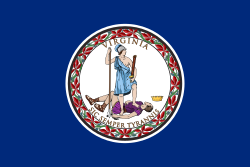
The seal of Virginia is the official symbolic representation of the Commonwealth of Virginia, a U.S. state. The state flag of Virginia consists of the obverse of the seal against a blue background. A state flag was first adopted at the beginning of the American Civil War in April 1861, readopted in 1912, and standardized by the General Assembly in February 1950. The standing allegorical female figure of virtue is shown having vanquished tyranny, symbolized by a fallen king at her feet. She has an exposed breast in the manner of classical depictions of Amazons. The motto shown on the seal, Sic semper tyrannis, means "Thus always to tyrants."
It is one of six U.S. state flags (along with Florida, New York, New Jersey, Wyoming, and Idaho) with a depiction of a woman, and the only state flag in the U.S. depicting nudity.
The flag may be decorated with a white fringe along the fly edge; this is usually done when the flag is displayed indoors.
</ref>
|Flag of Virginia (1931–1950).png|The Virginia flag from the 1930s before standardization of the seal; it depicts Virtus and tyranny on a grassy field. }}
The first state flag was made in 1833 during the Nullification Crisis. It was raised on February 22 by Governor John Floyd in Richmond, and later displayed at Bellona Arsenal and other public buildings. Floyd suggested that the flag should fly during special events instead of the U.S. flag. The flag and the idea of flying it in place of the U.S. flag caused great resentment among some members of the Virginia House of Delegates who threatened to tear the flag down. In defense of the flag, other house members proclaimed that they would die for the flag. Floyd would later raise the American flag alongside the state flag to appease both sides of the house. This flag was not officially adopted until April 30, 1861, nearly two weeks after the state seceded from the Union.
The current flag of Virginia was adopted on March 28, 1912. The current flag was designed to be similar to the Civil War state flag. When the state seal was standardized on February 1, 1950, the flag was also updated to reflect the standardization.
In 2001, the North American Vexillological Association surveyed its members on the designs of 72 U.S. state, U.S. territorial, Canadian provincial and Canadian territorial flags. The survey ranked the Virginia flag 54th out of 72.
Flag and seal of Virginia
The seal of Virginia is the official symbolic representation of the Commonwealth of Virginia, a U.S. state. The state flag of Virginia consists of the obverse of the seal against a blue background. A state flag was first adopted at the beginning of the American Civil War in April 1861, readopted in 1912, and standardized by the General Assembly in February 1950. The standing allegorical female figure of virtue is shown having vanquished tyranny, symbolized by a fallen king at her feet. She has an exposed breast in the manner of classical depictions of Amazons. The motto shown on the seal, Sic semper tyrannis, means "Thus always to tyrants."
It is one of six U.S. state flags (along with Florida, New York, New Jersey, Wyoming, and Idaho) with a depiction of a woman, and the only state flag in the U.S. depicting nudity.
The flag may be decorated with a white fringe along the fly edge; this is usually done when the flag is displayed indoors.
</ref>
|Flag of Virginia (1931–1950).png|The Virginia flag from the 1930s before standardization of the seal; it depicts Virtus and tyranny on a grassy field. }}
The first state flag was made in 1833 during the Nullification Crisis. It was raised on February 22 by Governor John Floyd in Richmond, and later displayed at Bellona Arsenal and other public buildings. Floyd suggested that the flag should fly during special events instead of the U.S. flag. The flag and the idea of flying it in place of the U.S. flag caused great resentment among some members of the Virginia House of Delegates who threatened to tear the flag down. In defense of the flag, other house members proclaimed that they would die for the flag. Floyd would later raise the American flag alongside the state flag to appease both sides of the house. This flag was not officially adopted until April 30, 1861, nearly two weeks after the state seceded from the Union.
The current flag of Virginia was adopted on March 28, 1912. The current flag was designed to be similar to the Civil War state flag. When the state seal was standardized on February 1, 1950, the flag was also updated to reflect the standardization.
In 2001, the North American Vexillological Association surveyed its members on the designs of 72 U.S. state, U.S. territorial, Canadian provincial and Canadian territorial flags. The survey ranked the Virginia flag 54th out of 72.
Recent media
Recent media