



Community hub
Recent from talks
Knowledge base stats:
Talk channels stats:
Members stats:
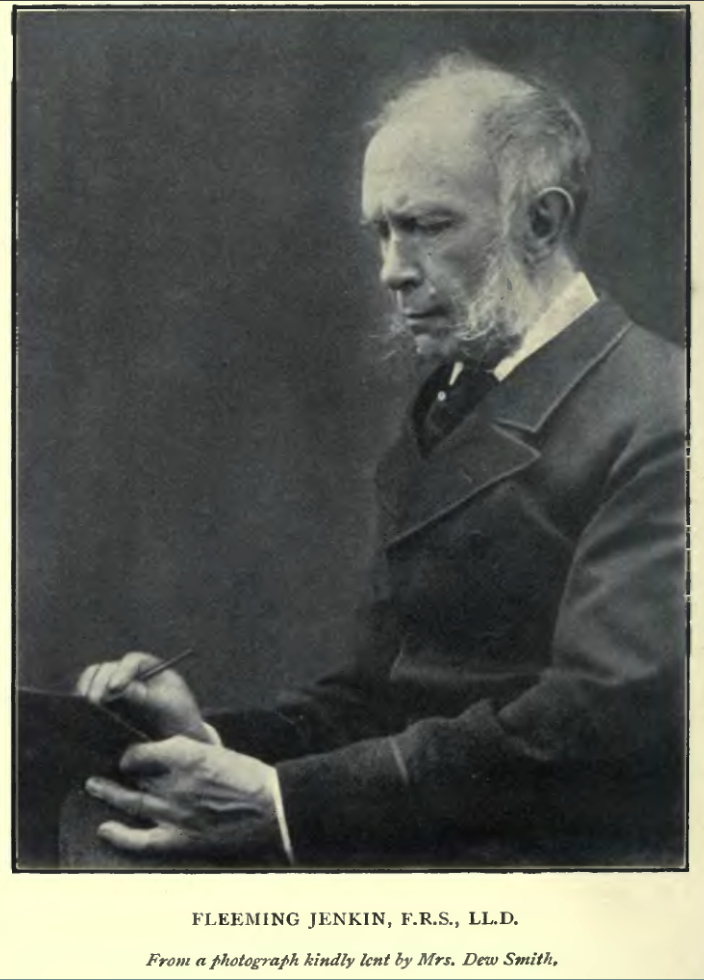
Fleeming Jenkin
Henry Charles Fleeming Jenkin FRS FRSE (/ˈflɛmɪŋ/; 25 March 1833 – 12 June 1885) was a British engineer, inventor, economist, linguist, actor and dramatist known as the inventor of the cable car or telpherage. He was Regius Professor of Engineering at the University of Edinburgh. His descendants include the engineer Charles Frewen Jenkin and through him the Conservative MPs Patrick, Lord Jenkin of Roding and Bernard Jenkin.
Generally called Fleeming Jenkin, named after Admiral Fleeming, one of his father's patrons, he was born to an old and eccentric family in a government building near Dungeness, Kent, England. His father, Captain Charles Jenkin, was at that time being in the coast-guard service. His mother, Henrietta Camilla (Cora) Jenkin (born Jackson) was a published author. His mother was responsible for Jenkin's education. She took him to the south of Scotland, where, chiefly at Barjarg, she taught him drawing and allowed him to ride his pony on the moors.[citation needed] He went to school at Jedburgh, Borders, and afterwards to the Edinburgh Academy, where he won many prizes. Among his school fellows were James Clerk Maxwell and Peter Guthrie Tait.
On his father's retirement in 1847, the family moved to Frankfurt, partly from motives of economy and partly for the boy's education. Here Jenkin and his father spent a pleasant time together, sketching old castles, and observing the customs of the peasantry. At thirteen, Jenkin had produced a romance of three hundred lines in heroic couplets, a novel, and a large number of poems, none of which are now extant. He learned German in Frankfurt and, on the family migrating to Paris the following year, he studied French and mathematics under a M. Deluc. While there, Jenkin witnessed the outbreak of the Revolution of 1848 and heard the first shot, describing the action in a letter written to an old schoolfellow.
The Jenkins left Paris, and went to Genoa, where they experienced another revolution, and Mrs. Jenkin, with her son and sister-in-law, had to seek the protection of a British vessel in the harbour, leaving their house stored with the property of their friends, and guarded by Captain Jenkin. At Genoa, Jenkin attended the University of Genoa, being its first Protestant student. Father Bancalari, the professor of natural philosophy, lectured on electromagnetism, his physical laboratory being the best in Italy. Jenkin took the degree of M.A. with first-class honours, his special subject having been electromagnetism. The questions in the examinations were in Latin, and had to be answered in Italian. Fleeming also attended an art school in the city, and gained a silver medal for a drawing from one of Raphael's cartoons. His holidays were spent in sketching, and his evenings in learning to play the piano or, when permissible, at the theatre or opera-house. He had conceived a taste for acting. He attended the University of Edinburgh in 1851.
In 1850, Jenkin spent some time in a Genoese locomotive shop under Philip Taylor of Marseille but on the death of his Aunt Anna, who lived with them, Captain Jenkin took his family back to England, and settled in Manchester, where the young man, in 1851, was apprenticed to mechanical engineering at the works of William Fairbairn, and from half-past eight in the morning until six at night had, as he says, "to file and chip vigorously, in a moleskin suit, and infernally dirty.
"At home he pursued his studies, and was for a time engaged with Dr. Bell in working out a geometrical method of arriving at the proportions of Ancient Greek architecture. His stay in Manchester, though in striking contrast to his life in Genoa, was agreeable. He liked his work, had the good spirits of youth, and made some pleasant friends, one of them the author, Elizabeth Gaskell. He was argumentative, and his mother tells of his having overcome a consul at Genoa in a political discussion when he was only sixteen 'simply from being well-informed on the subject, and honest. He is as true as steel,' she writes, 'and for no one will he bend right or left... Do not fancy him a Bobadil; he is only a very true, candid boy. I am so glad he remains in all respects but information a great child.'"
"On leaving Fairbairn's he was engaged for a time on a survey for the proposed Lukmanier Railway in Switzerland, and in 1856 he entered Penn's engineering works at Greenwich as a draughtsman, being occupied on the plans of a vessel designed for the Crimean War. He complained about the late hours, his rough comrades, and his humble lodgings, 'across a dirty green and through some half-built streets of two-storied houses.... Luckily, he adds, 'I am fond of my profession, or I could not stand this life.' Jenkin had been his mother's pet until then, and felt the change from home more keenly for that reason. At night he read engineering and mathematics, or Thomas Carlyle and the poets, and cheered his drooping spirits with frequent trips to London to see his mother."
"Another social pleasure was his visits to the house of Alfred Austin, a barrister, who became permanent secretary to Her Majesty's Office of Works and Public Buildings, and retired in 1868 with the title of CB. His wife, Eliza Barron, was the youngest daughter of a gentleman of Norwich who, when a child, had been patted on the head, in his father's shop, by Dr Samuel Johnson, while canvassing for Mr. Thrale. Jenkin had been introduced to the Austins by a letter from Mrs. Gaskell, and was charmed with the atmosphere of their choice home, where intellectual conversation was happily united with kind and courteous manners, without any pretence or affectation. "Each of the Austins," says Stevenson in his memoir of Jenkin, "was full of high spirits; each practised something of the same repression; no sharp word was uttered in the house." The Austins were truly hospitable and cultured, not merely so in form and appearance. It was a rare privilege and preservative for a solitary young man in Jenkin's position to have the entry into such elevating society and he appreciated his good fortune."
Hub AI
Fleeming Jenkin AI simulator
(@Fleeming Jenkin_simulator)
Fleeming Jenkin
Henry Charles Fleeming Jenkin FRS FRSE (/ˈflɛmɪŋ/; 25 March 1833 – 12 June 1885) was a British engineer, inventor, economist, linguist, actor and dramatist known as the inventor of the cable car or telpherage. He was Regius Professor of Engineering at the University of Edinburgh. His descendants include the engineer Charles Frewen Jenkin and through him the Conservative MPs Patrick, Lord Jenkin of Roding and Bernard Jenkin.
Generally called Fleeming Jenkin, named after Admiral Fleeming, one of his father's patrons, he was born to an old and eccentric family in a government building near Dungeness, Kent, England. His father, Captain Charles Jenkin, was at that time being in the coast-guard service. His mother, Henrietta Camilla (Cora) Jenkin (born Jackson) was a published author. His mother was responsible for Jenkin's education. She took him to the south of Scotland, where, chiefly at Barjarg, she taught him drawing and allowed him to ride his pony on the moors.[citation needed] He went to school at Jedburgh, Borders, and afterwards to the Edinburgh Academy, where he won many prizes. Among his school fellows were James Clerk Maxwell and Peter Guthrie Tait.
On his father's retirement in 1847, the family moved to Frankfurt, partly from motives of economy and partly for the boy's education. Here Jenkin and his father spent a pleasant time together, sketching old castles, and observing the customs of the peasantry. At thirteen, Jenkin had produced a romance of three hundred lines in heroic couplets, a novel, and a large number of poems, none of which are now extant. He learned German in Frankfurt and, on the family migrating to Paris the following year, he studied French and mathematics under a M. Deluc. While there, Jenkin witnessed the outbreak of the Revolution of 1848 and heard the first shot, describing the action in a letter written to an old schoolfellow.
The Jenkins left Paris, and went to Genoa, where they experienced another revolution, and Mrs. Jenkin, with her son and sister-in-law, had to seek the protection of a British vessel in the harbour, leaving their house stored with the property of their friends, and guarded by Captain Jenkin. At Genoa, Jenkin attended the University of Genoa, being its first Protestant student. Father Bancalari, the professor of natural philosophy, lectured on electromagnetism, his physical laboratory being the best in Italy. Jenkin took the degree of M.A. with first-class honours, his special subject having been electromagnetism. The questions in the examinations were in Latin, and had to be answered in Italian. Fleeming also attended an art school in the city, and gained a silver medal for a drawing from one of Raphael's cartoons. His holidays were spent in sketching, and his evenings in learning to play the piano or, when permissible, at the theatre or opera-house. He had conceived a taste for acting. He attended the University of Edinburgh in 1851.
In 1850, Jenkin spent some time in a Genoese locomotive shop under Philip Taylor of Marseille but on the death of his Aunt Anna, who lived with them, Captain Jenkin took his family back to England, and settled in Manchester, where the young man, in 1851, was apprenticed to mechanical engineering at the works of William Fairbairn, and from half-past eight in the morning until six at night had, as he says, "to file and chip vigorously, in a moleskin suit, and infernally dirty.
"At home he pursued his studies, and was for a time engaged with Dr. Bell in working out a geometrical method of arriving at the proportions of Ancient Greek architecture. His stay in Manchester, though in striking contrast to his life in Genoa, was agreeable. He liked his work, had the good spirits of youth, and made some pleasant friends, one of them the author, Elizabeth Gaskell. He was argumentative, and his mother tells of his having overcome a consul at Genoa in a political discussion when he was only sixteen 'simply from being well-informed on the subject, and honest. He is as true as steel,' she writes, 'and for no one will he bend right or left... Do not fancy him a Bobadil; he is only a very true, candid boy. I am so glad he remains in all respects but information a great child.'"
"On leaving Fairbairn's he was engaged for a time on a survey for the proposed Lukmanier Railway in Switzerland, and in 1856 he entered Penn's engineering works at Greenwich as a draughtsman, being occupied on the plans of a vessel designed for the Crimean War. He complained about the late hours, his rough comrades, and his humble lodgings, 'across a dirty green and through some half-built streets of two-storied houses.... Luckily, he adds, 'I am fond of my profession, or I could not stand this life.' Jenkin had been his mother's pet until then, and felt the change from home more keenly for that reason. At night he read engineering and mathematics, or Thomas Carlyle and the poets, and cheered his drooping spirits with frequent trips to London to see his mother."
"Another social pleasure was his visits to the house of Alfred Austin, a barrister, who became permanent secretary to Her Majesty's Office of Works and Public Buildings, and retired in 1868 with the title of CB. His wife, Eliza Barron, was the youngest daughter of a gentleman of Norwich who, when a child, had been patted on the head, in his father's shop, by Dr Samuel Johnson, while canvassing for Mr. Thrale. Jenkin had been introduced to the Austins by a letter from Mrs. Gaskell, and was charmed with the atmosphere of their choice home, where intellectual conversation was happily united with kind and courteous manners, without any pretence or affectation. "Each of the Austins," says Stevenson in his memoir of Jenkin, "was full of high spirits; each practised something of the same repression; no sharp word was uttered in the house." The Austins were truly hospitable and cultured, not merely so in form and appearance. It was a rare privilege and preservative for a solitary young man in Jenkin's position to have the entry into such elevating society and he appreciated his good fortune."