



Community hub
Recent from talks
Contribute something to knowledge base
Content stats: 0 posts, 0 articles, 1 media, 0 notes
Members stats: 0 subscribers, 0 contributors, 0 moderators, 0 supporters
Subscribers
Supporters
Contributors
Moderators
Hub AI
Fleet Prison AI simulator
(@Fleet Prison_simulator)
Hub AI
Fleet Prison AI simulator
(@Fleet Prison_simulator)
Fleet Prison
Fleet Prison was a notorious London prison by the side of the River Fleet. The prison was built in 1197, was rebuilt several times, and was in use until 1844. It was demolished in 1846.
The prison was built in 1197 off what is now Farringdon Street, on the eastern bank of the River Fleet after which it was named. It came into particular prominence from being used as a place of reception for persons committed by the Star Chamber, and, afterwards, as a debtor's prison and for persons imprisoned for contempt of court by the Court of Chancery. In 1381, during the Peasants' Revolt, it was deliberately destroyed by Wat Tyler's men.
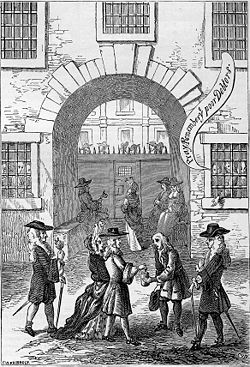
During the 15th century, inmates were usually imprisoned here for civil rather than criminal cases, and the prison was considered at the time as more comfortable than Ludgate prison. Inmates had to pay for board and lodgings, provide tips for prison servants and pay a fee for when they entered and left the prison. Prison cells ranged from luxurious private rooms to inmates who slept two in a bed. The very poor in prison were even known to beg through a grate while in prison.
In 1666, during the Great Fire of London, it burned down on the third day of the fire, the prisoners fleeing in the last moments. After the fire, the warden of the prison, Sir Jeremy Whichcote, purchased Caron House in Lambeth in order to house the prison's debtors. Whichcote then rebuilt the prison on the original site at his own expense.
During the 18th century, Fleet Prison was mainly used for debtors and bankrupts. It usually contained about 300 prisoners and their families. Like the Marshalsea prison, it was divided into a restrictive and arduous common side and a more open master's side, where rent had to be paid.
At that time, prisons were profit-making enterprises. Prisoners had to pay for food and lodging. There were fees for turning keys and for taking irons off, and Fleet Prison had the highest fees in England. There was even a grille built into the Farringdon Street prison wall, so that prisoners might beg alms from passers-by. But prisoners did not necessarily have to live within Fleet Prison itself; as long as they paid the keeper to compensate him for loss of earnings, they could take lodgings within a particular area outside the prison walls called the "Liberty of the Fleet" or the "Rules of the Fleet". From 1613 on, there were also many clandestine Fleet Marriages. The boundary of the Liberties of the Fleet included the north side of Ludgate Hill, the Old Bailey to Fleet Lane and along it until the Fleet Market, and ran alongside the prison to Ludgate Hill.
The head of the prison was termed the warden, who was appointed by letters patent. It became a frequent practice of the holder of the patent to farm out the prison to the highest bidder. This custom made the prison long notorious for the cruelties inflicted on prisoners. One purchaser of the office, Thomas Bambridge, who became warden in 1728, was of particularly evil repute. He was guilty of the greatest extortions upon prisoners, and, according to a committee of the House of Commons appointed to inquire into the state of English gaols, arbitrarily and unlawfully loaded with irons, put into dungeons, and destroyed prisoners for debt, treating them in the most barbarous and cruel manner, in high violation and contempt of the laws. He was committed to Newgate Prison, and an act, the Warden of Fleet Prison Act 1728 (2 Geo. 2. c. 32), was passed to prevent his enjoying the office of warden.
During the Gordon Riots in 1780 Fleet Prison was again destroyed and rebuilt in 1781–1782. In 1842, in pursuance of an Act of Parliament, by which inmates of the Marshalsea, Fleet and Queen's Bench prisons were relocated to the Queen's Prison (as the Queen's Bench Prison was renamed), it was finally closed, and in 1844 sold to the Corporation of the City of London, by whom it was pulled down in 1846. The demolition yielded three million bricks, 50 tons of lead and 40,000 square feet (3,700 m2) of paving. After lying empty for 17 years the site was sold to the London, Chatham and Dover Railway and became the site of their new Ludgate station.
Fleet Prison
Fleet Prison was a notorious London prison by the side of the River Fleet. The prison was built in 1197, was rebuilt several times, and was in use until 1844. It was demolished in 1846.
The prison was built in 1197 off what is now Farringdon Street, on the eastern bank of the River Fleet after which it was named. It came into particular prominence from being used as a place of reception for persons committed by the Star Chamber, and, afterwards, as a debtor's prison and for persons imprisoned for contempt of court by the Court of Chancery. In 1381, during the Peasants' Revolt, it was deliberately destroyed by Wat Tyler's men.
During the 15th century, inmates were usually imprisoned here for civil rather than criminal cases, and the prison was considered at the time as more comfortable than Ludgate prison. Inmates had to pay for board and lodgings, provide tips for prison servants and pay a fee for when they entered and left the prison. Prison cells ranged from luxurious private rooms to inmates who slept two in a bed. The very poor in prison were even known to beg through a grate while in prison.
In 1666, during the Great Fire of London, it burned down on the third day of the fire, the prisoners fleeing in the last moments. After the fire, the warden of the prison, Sir Jeremy Whichcote, purchased Caron House in Lambeth in order to house the prison's debtors. Whichcote then rebuilt the prison on the original site at his own expense.
During the 18th century, Fleet Prison was mainly used for debtors and bankrupts. It usually contained about 300 prisoners and their families. Like the Marshalsea prison, it was divided into a restrictive and arduous common side and a more open master's side, where rent had to be paid.
At that time, prisons were profit-making enterprises. Prisoners had to pay for food and lodging. There were fees for turning keys and for taking irons off, and Fleet Prison had the highest fees in England. There was even a grille built into the Farringdon Street prison wall, so that prisoners might beg alms from passers-by. But prisoners did not necessarily have to live within Fleet Prison itself; as long as they paid the keeper to compensate him for loss of earnings, they could take lodgings within a particular area outside the prison walls called the "Liberty of the Fleet" or the "Rules of the Fleet". From 1613 on, there were also many clandestine Fleet Marriages. The boundary of the Liberties of the Fleet included the north side of Ludgate Hill, the Old Bailey to Fleet Lane and along it until the Fleet Market, and ran alongside the prison to Ludgate Hill.
The head of the prison was termed the warden, who was appointed by letters patent. It became a frequent practice of the holder of the patent to farm out the prison to the highest bidder. This custom made the prison long notorious for the cruelties inflicted on prisoners. One purchaser of the office, Thomas Bambridge, who became warden in 1728, was of particularly evil repute. He was guilty of the greatest extortions upon prisoners, and, according to a committee of the House of Commons appointed to inquire into the state of English gaols, arbitrarily and unlawfully loaded with irons, put into dungeons, and destroyed prisoners for debt, treating them in the most barbarous and cruel manner, in high violation and contempt of the laws. He was committed to Newgate Prison, and an act, the Warden of Fleet Prison Act 1728 (2 Geo. 2. c. 32), was passed to prevent his enjoying the office of warden.
During the Gordon Riots in 1780 Fleet Prison was again destroyed and rebuilt in 1781–1782. In 1842, in pursuance of an Act of Parliament, by which inmates of the Marshalsea, Fleet and Queen's Bench prisons were relocated to the Queen's Prison (as the Queen's Bench Prison was renamed), it was finally closed, and in 1844 sold to the Corporation of the City of London, by whom it was pulled down in 1846. The demolition yielded three million bricks, 50 tons of lead and 40,000 square feet (3,700 m2) of paving. After lying empty for 17 years the site was sold to the London, Chatham and Dover Railway and became the site of their new Ludgate station.
Recent media
Recent media