
Recent from talks
Fluorophore
Knowledge base stats:
Talk channels stats:
Members stats:
Fluorophore
A fluorophore (or fluorochrome, similarly to a chromophore) is a fluorescent chemical compound that can re-emit light upon light excitation. Fluorophores typically contain several combined aromatic groups, or planar or cyclic molecules with several π bonds.
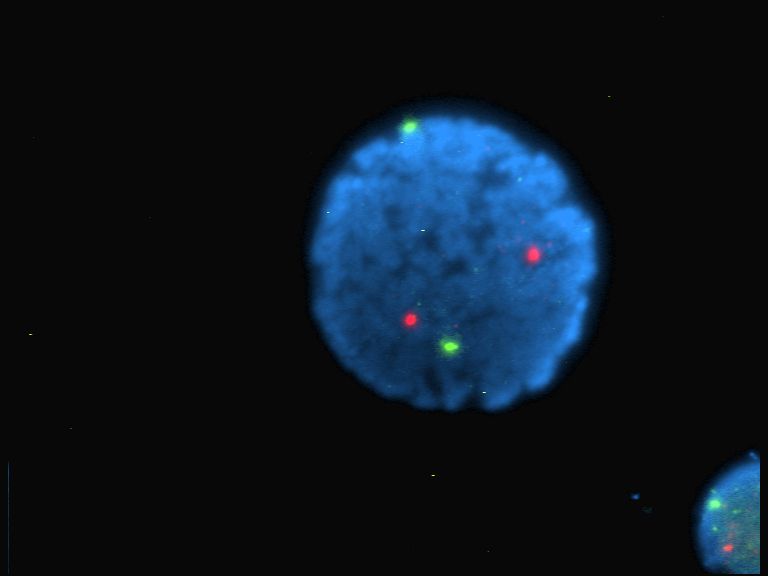
Fluorophores are sometimes used alone, as a tracer in fluids, as a dye for staining of certain structures, as a substrate of enzymes, or as a probe or indicator (when its fluorescence is affected by environmental aspects such as polarity or ions). More generally they are covalently bonded to macromolecules, serving as a markers (or dyes, or tags, or reporters) for affine or bioactive reagents (antibodies, peptides, nucleic acids). Fluorophores are notably used to stain tissues, cells, or materials in a variety of analytical methods, such as fluorescent imaging and spectroscopy.
Fluorescein, via its amine-reactive isothiocyanate derivative fluorescein isothiocyanate (FITC), has been one of the most popular fluorophores. From antibody labeling, the applications have spread to nucleic acids thanks to carboxyfluorescein. Other historically common fluorophores are derivatives of rhodamine (TRITC), coumarin, and cyanine. Newer generations of fluorophores, many of which are proprietary, often perform better, being more photostable, brighter, or less pH-sensitive than traditional dyes with comparable excitation and emission.
The fluorophore absorbs light energy of a specific wavelength and re-emits light at a longer wavelength. The absorbed wavelengths, energy transfer efficiency, and time before emission depend on both the fluorophore structure and its chemical environment, since the molecule in its excited state interacts with surrounding molecules. Wavelengths of maximum absorption (≈ excitation) and emission (for example, Absorption/Emission = 485 nm/517 nm) are the typical terms used to refer to a given fluorophore, but the whole spectrum may be important to consider. The excitation spectrum may be a very narrow or broader band, or it may be all beyond a cutoff level. The emission spectrum is usually sharper than the excitation spectrum, and it is of a longer wavelength and correspondingly lower energy. Excitation energies range from ultraviolet through the visible spectrum, and emission energies may continue from visible light into the near infrared region.
The main characteristics of fluorophores are:
These characteristics drive other properties, including photobleaching or photoresistance (loss of fluorescence upon continuous light excitation). Other parameters should be considered, as the polarity of the fluorophore molecule, the fluorophore size and shape (i.e. for polarization fluorescence pattern), and other factors can change the behavior of fluorophores.
Fluorophores can also be used to quench the fluorescence of other fluorescent dyes or to relay their fluorescence at even longer wavelengths.
Most fluorophores are organic small molecules of 20–100 atoms (200–1000 Dalton; the molecular weight may be higher depending on grafted modifications and conjugated molecules), but there are also much larger natural fluorophores that are proteins: green fluorescent protein (GFP) is 27 kDa, and several phycobiliproteins (PE, APC...) are ≈240kDa. As of 2020, the smallest known fluorophore was claimed to be 3-hydroxyisonicotinaldehyde, a compound of 14 atoms and only 123 Da.
Hub AI
Fluorophore AI simulator
(@Fluorophore_simulator)
Fluorophore
A fluorophore (or fluorochrome, similarly to a chromophore) is a fluorescent chemical compound that can re-emit light upon light excitation. Fluorophores typically contain several combined aromatic groups, or planar or cyclic molecules with several π bonds.
Fluorophores are sometimes used alone, as a tracer in fluids, as a dye for staining of certain structures, as a substrate of enzymes, or as a probe or indicator (when its fluorescence is affected by environmental aspects such as polarity or ions). More generally they are covalently bonded to macromolecules, serving as a markers (or dyes, or tags, or reporters) for affine or bioactive reagents (antibodies, peptides, nucleic acids). Fluorophores are notably used to stain tissues, cells, or materials in a variety of analytical methods, such as fluorescent imaging and spectroscopy.
Fluorescein, via its amine-reactive isothiocyanate derivative fluorescein isothiocyanate (FITC), has been one of the most popular fluorophores. From antibody labeling, the applications have spread to nucleic acids thanks to carboxyfluorescein. Other historically common fluorophores are derivatives of rhodamine (TRITC), coumarin, and cyanine. Newer generations of fluorophores, many of which are proprietary, often perform better, being more photostable, brighter, or less pH-sensitive than traditional dyes with comparable excitation and emission.
The fluorophore absorbs light energy of a specific wavelength and re-emits light at a longer wavelength. The absorbed wavelengths, energy transfer efficiency, and time before emission depend on both the fluorophore structure and its chemical environment, since the molecule in its excited state interacts with surrounding molecules. Wavelengths of maximum absorption (≈ excitation) and emission (for example, Absorption/Emission = 485 nm/517 nm) are the typical terms used to refer to a given fluorophore, but the whole spectrum may be important to consider. The excitation spectrum may be a very narrow or broader band, or it may be all beyond a cutoff level. The emission spectrum is usually sharper than the excitation spectrum, and it is of a longer wavelength and correspondingly lower energy. Excitation energies range from ultraviolet through the visible spectrum, and emission energies may continue from visible light into the near infrared region.
The main characteristics of fluorophores are:
These characteristics drive other properties, including photobleaching or photoresistance (loss of fluorescence upon continuous light excitation). Other parameters should be considered, as the polarity of the fluorophore molecule, the fluorophore size and shape (i.e. for polarization fluorescence pattern), and other factors can change the behavior of fluorophores.
Fluorophores can also be used to quench the fluorescence of other fluorescent dyes or to relay their fluorescence at even longer wavelengths.
Most fluorophores are organic small molecules of 20–100 atoms (200–1000 Dalton; the molecular weight may be higher depending on grafted modifications and conjugated molecules), but there are also much larger natural fluorophores that are proteins: green fluorescent protein (GFP) is 27 kDa, and several phycobiliproteins (PE, APC...) are ≈240kDa. As of 2020, the smallest known fluorophore was claimed to be 3-hydroxyisonicotinaldehyde, a compound of 14 atoms and only 123 Da.
Recent media