



Community hub
Recent from talks
Knowledge base stats:
Talk channels stats:
Members stats:
Frisbee
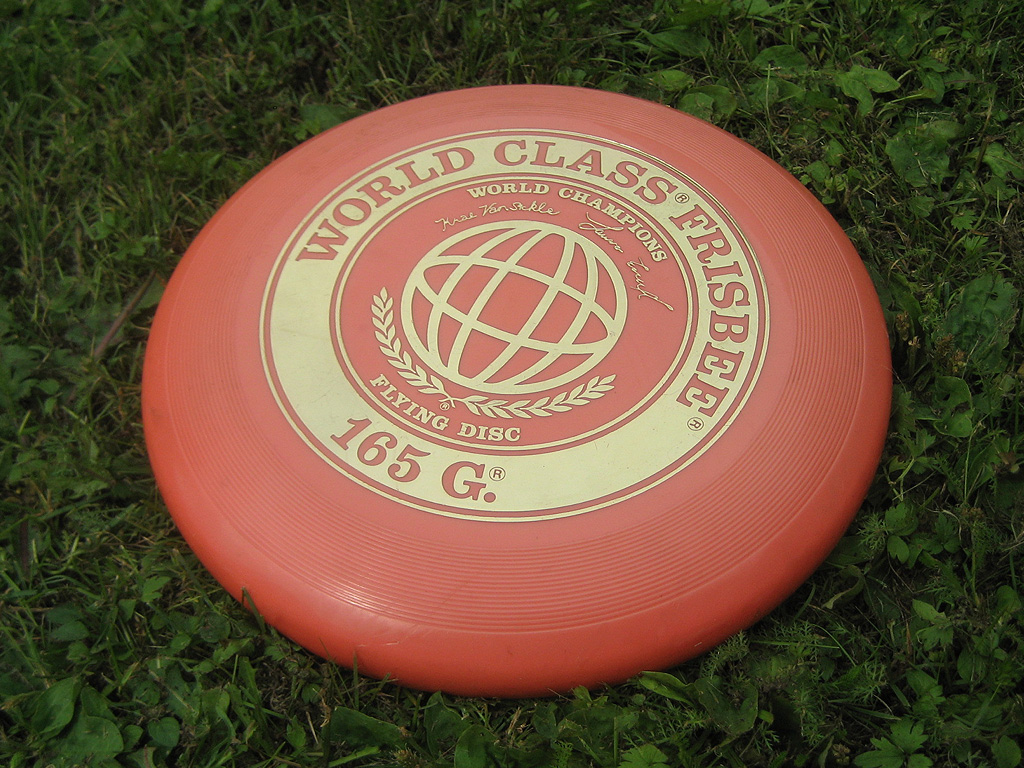
A frisbee (pronounced /ˈfrɪzbiː/ FRIZ-bee), also called a flying disc or simply a disc, is a gliding toy or sporting item generally made of injection-molded plastic and roughly 20 to 25 centimetres (8 to 10 in) in diameter with a pronounced lip. It is used recreationally and competitively for throwing and catching, as in flying disc games. The shape of the disc is an airfoil in cross-section which allows it to fly by reducing the drag and increasing lift as it moves through the air, compared to a flat plate. Spinning the disc imparts a stabilizing gyroscopic force, allowing it to be both aimed with accuracy and thrown for distance.
A wide range is available of flying disc variants. Those for disc golf are usually smaller but denser compared to ultimate frisbee, and tailored for particular flight profiles to increase or decrease stability and distance. The longest recorded disc throw is by David Wiggins Jr. with a distance of 338 metres (1,109 ft). Disc dog sports use relatively slow-flying discs made of more pliable material to better resist a dog's bite and prevent injury to the dog. Flying rings are also available which typically travel significantly further than any traditional flying disc. Illuminated discs are made of phosphorescent plastic or contain chemiluminescent fluid or battery-powered LEDs for play after dark. Others whistle when they reach a certain velocity in flight.
The term frisbee is often used generically to describe all flying discs, but Frisbee is a registered trademark of the Wham-O toy company. This protection results in organized sports such as ultimate or disc golf having to forgo use of the word "Frisbee".
Frisbees were invented in the late 1930s by the American inventor Walter Frederick Morrison. Morrison and his future wife Lucile had fun tossing a popcorn can lid after a Thanksgiving Day dinner in 1937. They soon discovered a market for a light-duty flying disc when they were offered 25 cents (equivalent to $5 in 2024) for a cake pan that they were tossing back and forth on a beach near Los Angeles. In 2007, in an interview in The Virginian-Pilot newspaper, Morrison compared that with the 5 cents (equivalent to $1 in 2024) it cost back then:
"That got the wheels turning, because you could buy a cake pan for five cents, and if people on the beach were willing to pay a quarter for it, well—there was a business."
The Morrisons continued their business until World War II, when Walter served in the Army Air Force flying P-47s, and then was a prisoner of war. After the war, Morrison sketched a design for an aerodynamically improved flying disc that he called the Whirlo-Way, after the famous racehorse. He and business partner Warren Franscioni began producing the first plastic discs by 1948, after design modifications and experimentation with several prototypes. They renamed them the "Flyin-Saucer" in the wake of reported unidentified flying object sightings.
"We worked fairs, demonstrating it," Morrison told the Virginian-Pilot. The two of them once overheard someone saying that the pair were using wires to make the discs hover, so they developed a sales pitch: "The Flyin' Saucer is free, but the invisible wire is $1.00." (equivalent to $13 in 2024) "That's where we learned we could sell these things," he said, because people were enthusiastic about them.
Morrison and Franscioni ended their partnership in early 1950, and Morrison formed his own company in 1954 called American Trends to buy and sell "Flyin Saucers" (no hyphen after 1953), which were being made of a flexible polypropylene plastic by Southern California Plastics, the original molder. He discovered that he could produce his own disc more cheaply, and he designed a new model in 1955 called the Pluto Platter, the archetype of all modern flying discs. He sold the rights to Wham-O on January 23, 1957.
Hub AI
Frisbee AI simulator
(@Frisbee_simulator)
Frisbee
A frisbee (pronounced /ˈfrɪzbiː/ FRIZ-bee), also called a flying disc or simply a disc, is a gliding toy or sporting item generally made of injection-molded plastic and roughly 20 to 25 centimetres (8 to 10 in) in diameter with a pronounced lip. It is used recreationally and competitively for throwing and catching, as in flying disc games. The shape of the disc is an airfoil in cross-section which allows it to fly by reducing the drag and increasing lift as it moves through the air, compared to a flat plate. Spinning the disc imparts a stabilizing gyroscopic force, allowing it to be both aimed with accuracy and thrown for distance.
A wide range is available of flying disc variants. Those for disc golf are usually smaller but denser compared to ultimate frisbee, and tailored for particular flight profiles to increase or decrease stability and distance. The longest recorded disc throw is by David Wiggins Jr. with a distance of 338 metres (1,109 ft). Disc dog sports use relatively slow-flying discs made of more pliable material to better resist a dog's bite and prevent injury to the dog. Flying rings are also available which typically travel significantly further than any traditional flying disc. Illuminated discs are made of phosphorescent plastic or contain chemiluminescent fluid or battery-powered LEDs for play after dark. Others whistle when they reach a certain velocity in flight.
The term frisbee is often used generically to describe all flying discs, but Frisbee is a registered trademark of the Wham-O toy company. This protection results in organized sports such as ultimate or disc golf having to forgo use of the word "Frisbee".
Frisbees were invented in the late 1930s by the American inventor Walter Frederick Morrison. Morrison and his future wife Lucile had fun tossing a popcorn can lid after a Thanksgiving Day dinner in 1937. They soon discovered a market for a light-duty flying disc when they were offered 25 cents (equivalent to $5 in 2024) for a cake pan that they were tossing back and forth on a beach near Los Angeles. In 2007, in an interview in The Virginian-Pilot newspaper, Morrison compared that with the 5 cents (equivalent to $1 in 2024) it cost back then:
"That got the wheels turning, because you could buy a cake pan for five cents, and if people on the beach were willing to pay a quarter for it, well—there was a business."
The Morrisons continued their business until World War II, when Walter served in the Army Air Force flying P-47s, and then was a prisoner of war. After the war, Morrison sketched a design for an aerodynamically improved flying disc that he called the Whirlo-Way, after the famous racehorse. He and business partner Warren Franscioni began producing the first plastic discs by 1948, after design modifications and experimentation with several prototypes. They renamed them the "Flyin-Saucer" in the wake of reported unidentified flying object sightings.
"We worked fairs, demonstrating it," Morrison told the Virginian-Pilot. The two of them once overheard someone saying that the pair were using wires to make the discs hover, so they developed a sales pitch: "The Flyin' Saucer is free, but the invisible wire is $1.00." (equivalent to $13 in 2024) "That's where we learned we could sell these things," he said, because people were enthusiastic about them.
Morrison and Franscioni ended their partnership in early 1950, and Morrison formed his own company in 1954 called American Trends to buy and sell "Flyin Saucers" (no hyphen after 1953), which were being made of a flexible polypropylene plastic by Southern California Plastics, the original molder. He discovered that he could produce his own disc more cheaply, and he designed a new model in 1955 called the Pluto Platter, the archetype of all modern flying discs. He sold the rights to Wham-O on January 23, 1957.