Hubbry Logo
FrisbeeFrisbeeMain
Open search
Frisbee
Community hub
Frisbee
logo
8 pages, 0 posts
0 subscribers
Be the first to start a discussion here.
Contribute something
Frisbee
Frisbee
from Wikipedia

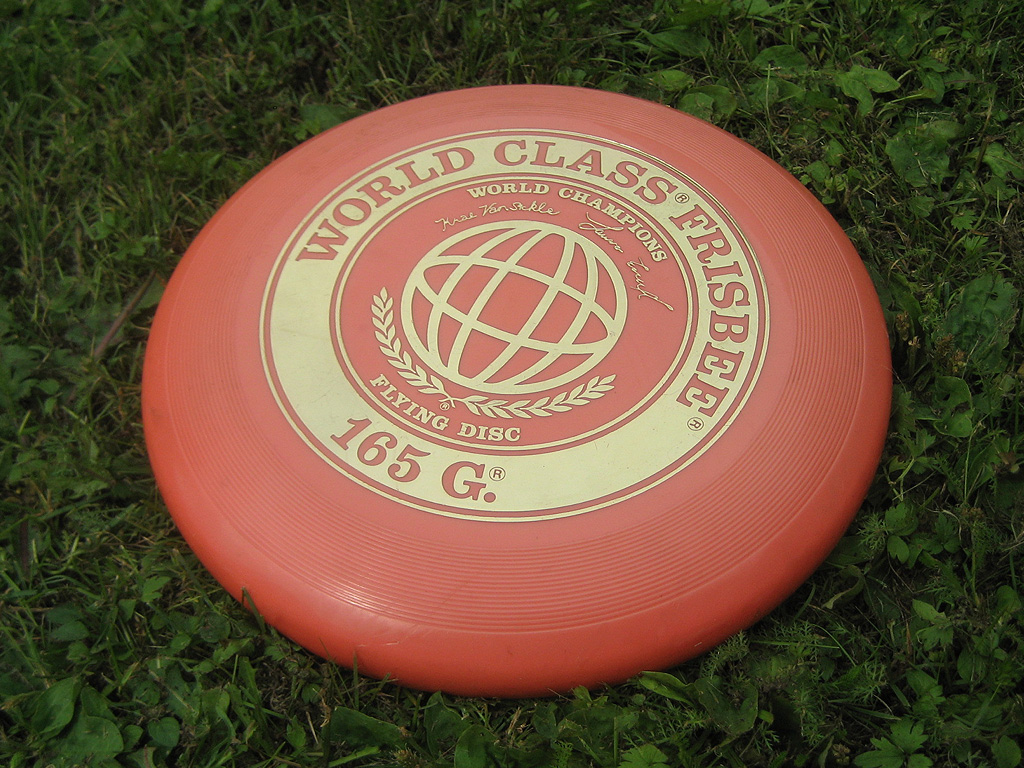
A flying disc with the Wham-O registered trademark "Frisbee"

A frisbee (pronounced /ˈfrɪzb/ FRIZ-bee), also called a flying disc or simply a disc, is a gliding toy or sporting item generally made of injection-molded plastic and roughly 20 to 25 centimetres (8 to 10 in) in diameter with a pronounced lip. It is used recreationally and competitively for throwing and catching, as in flying disc games. The shape of the disc is an airfoil in cross-section which allows it to fly by reducing the drag and increasing lift as it moves through the air, compared to a flat plate. Spinning the disc imparts a stabilizing gyroscopic force, allowing it to be both aimed with accuracy and thrown for distance.

A wide range is available of flying disc variants. Those for disc golf are usually smaller but denser compared to ultimate frisbee, and tailored for particular flight profiles to increase or decrease stability and distance. The longest recorded disc throw is by David Wiggins Jr. with a distance of 338 metres (1,109 ft).[1] Disc dog sports use relatively slow-flying discs made of more pliable material to better resist a dog's bite and prevent injury to the dog. Flying rings are also available which typically travel significantly further than any traditional flying disc. Illuminated discs are made of phosphorescent plastic or contain chemiluminescent fluid or battery-powered LEDs for play after dark. Others whistle when they reach a certain velocity in flight.

The term frisbee is often used generically to describe all flying discs, but Frisbee is a registered trademark of the Wham-O toy company.[2] This protection results in organized sports such as ultimate or disc golf having to forgo use of the word "Frisbee".[3][4]

History

[edit]
A flying disc in flight near the Mackinac Bridge
A flying disc being caught

Frisbees were invented in the late 1930s by the American inventor Walter Frederick Morrison. Morrison and his future wife Lucile had fun tossing a popcorn can lid after a Thanksgiving Day dinner in 1937. They soon discovered a market for a light-duty flying disc when they were offered 25 cents (equivalent to $5 in 2024) for a cake pan that they were tossing back and forth on a beach near Los Angeles.[5] In 2007, in an interview in The Virginian-Pilot newspaper, Morrison compared that with the 5 cents (equivalent to $1 in 2024) it cost back then:

"That got the wheels turning, because you could buy a cake pan for five cents, and if people on the beach were willing to pay a quarter for it, well—there was a business."[6]

The Morrisons continued their business until World War II, when Walter served in the Army Air Force flying P-47s, and then was a prisoner of war.[6] After the war, Morrison sketched a design for an aerodynamically improved flying disc that he called the Whirlo-Way,[5] after the famous racehorse. He and business partner Warren Franscioni began producing the first plastic discs by 1948, after design modifications and experimentation with several prototypes. They renamed them the "Flyin-Saucer" in the wake of reported unidentified flying object sightings.[6]

"We worked fairs, demonstrating it," Morrison told the Virginian-Pilot. The two of them once overheard someone saying that the pair were using wires to make the discs hover,[6] so they developed a sales pitch: "The Flyin' Saucer is free, but the invisible wire is $1.00." (equivalent to $13 in 2024)[7] "That's where we learned we could sell these things," he said, because people were enthusiastic about them.[6]

Morrison and Franscioni ended their partnership in early 1950,[6] and Morrison formed his own company in 1954 called American Trends to buy and sell "Flyin Saucers" (no hyphen after 1953), which were being made of a flexible polypropylene plastic by Southern California Plastics, the original molder.[5] He discovered that he could produce his own disc more cheaply, and he designed a new model in 1955 called the Pluto Platter, the archetype of all modern flying discs. He sold the rights to Wham-O on January 23, 1957.[5][a]

In June 1957, Wham-O co-founders Richard Knerr and Arthur "Spud" Melin gave the disc the brand name "Frisbee" after learning college students were calling the Pluto Platter by that term,[10] which was derived from the Connecticut-based pie manufacturer Frisbie Pie Company,[11] a supplier of pies to Yale University, where students had started a campus craze tossing empty pie tins stamped with the company's logo—the way Morrison and his wife had in 1937.[6]

The first Frisbee (Professional Model) to be produced as a sport disc with the first disc sport tournament identification, the 1972 Canadian Open Frisbee Championships in Toronto.

In November 1957, the Frisbee was featured in what may be the first rock musical ever performed, Anything & Everything, written by Ted Nelson. The game of Frisbee (spelled Frisby) is described in the song "Friz Me the Frisby," as a Frisbee was passed among stooges in the audience. The scene was expressly intended as a way to introduce the game to the audience.[12]

In 1964, Ed Headrick was hired as Wham-O's general manager and vice president of marketing. Headrick redesigned the Pluto Platter by reworking the mold, mainly to remove the names of the planets, but fortuitously increasing the rim thickness and mass in the process, creating a more controllable disc that could be thrown with higher accuracy.[13]

A memorial disc containing some of the ashes of Ed Headrick, on display at Ripley's Believe It or Not!, London.

Wham-O changed their marketing strategy to promote Frisbee use as a new sport, and sales increased. In 1964, the first professional model went on sale. Headrick patented its design; it featured raised ridges (the "Rings of Headrick") that were claimed to stabilize flight.[14]

Headrick became known as the father of Frisbee sports;[15] he founded the International Frisbee Association and appointed Dan Roddick as its head. Roddick began establishing North American Series (NAS) tournament standards for various Frisbee sports, such as Freestyle, Guts, Double Disc Court, and overall events.[16] Headrick later helped to develop the sport of disc golf, which was first played with Frisbees and later with more aerodynamic beveled-rim discs, by inventing standardized targets called "pole holes".[17][18] When Headrick died, he was cremated, and his ashes were molded into memorial discs and given to family and close friends[19] and sold to benefit The Ed Headrick Memorial Museum.[20]

In 1998, the Frisbee was inducted into the National Toy Hall of Fame.[21] In addition, many championships have sprung up around the world and the sport has become very popular, with nine-time champion Miguel Larrañaga from Spain being the leading exponent of frisbee throwing.

Variations of flying discs

[edit]

Flying discs, also known as "frisbees," have variations produced for different purposes to optimize alternatives between branches of disc sports. The three main categories are: ultimate disc, golf disc, and freestyle disc.[22]

Ultimate disc

[edit]
An ultimate frisbee.

Ultimate discs are designed to be used in the sport of Ultimate. Ultimate discs are made of durable plastic (often polyethylene) and are designed to be thrown for maximum distance and accuracy.[23]

Ultimate has a unique standard with a diameter of 27.3 centimetres (10.75 in) and a weight of 175 grams (6.2 oz).[24] For competitive uses, WFDF or other official organizations set disc standards to ensure quality.[25]

Disc golf

[edit]
Disc golf discs in a target.

Another type of flying disc is the disc golf disc, which is used in the sport of disc golf. Disc golf discs are similar in size and shape to ultimate discs, but have different weights and designs.[26] The material used to make golf discs is polypropylene.[27] There are three main types of golf discs: drivers, mid-range discs, and putters.[28]

Each type is designed for a specific purpose, with drivers being used for long-distance throws, mid-range discs for more controlled shots, and putters for short and accurate throws into the target.[29] The rim for golf discs are sharper than ultimate frisbee, to reduce wind drag.[30]

Each type of golf disc has hundreds of variations, subject to a uniform requirement in the size of discs: the minimum diameter of a golf disc is 21 cm (8.3 in).[31]

Freestyle disc

[edit]
Freestyle disc

Freestyle discs are another variation of flying discs that are used in freestyle Frisbee competitions. These discs are usually smaller and lighter than other types of flying discs. Most freestyle discs have a diameter of 25.5 centimetres (10.0 in) or less and a weight of around 160 grams (5.6 oz), but this is subject to change according to the performer's need.[32]

Disc sports

[edit]

The IFT guts competitions in Northern Michigan, the Canadian Open Frisbee Championships (1972), Toronto, Ontario, the Vancouver Open Frisbee Championships (1974), Vancouver, British Columbia, the Octad (1974), New Jersey, the American Flying Disc Open (1974), Rochester, New York, and the World Frisbee Championships (1974), Pasadena, California, are the earliest Frisbee competitions that presented the Frisbee as a new disc sport. Before these tournaments, the Frisbee was considered a toy and used for recreation.[33]

Double disc court was invented and introduced in 1974 by Jim Palmeri,[34] a sport played with two flying discs and two teams of two players. Each team defends its court and tries to land a flying disc in the opposing court.

Dogs and their human flying disc throwers compete in events such as distance catching and somewhat choreographed freestyle catching.[35]

This is a precision and accuracy sport where individual players throw a flying disc at a target pole hole. In 1926, In Bladworth, Saskatchewan, Canada, Ronald Gibson and a group of his Bladworth Elementary school friends played a game using metal lids, they called "Tin Lid Golf".[36] In 1976, the game of disc golf was standardized with targets called "pole holes" invented and developed by Wham-O's Ed Headrick.[37]

In 1974, freestyle competition was created and introduced by Ken Westerfield and Discraft's Jim Kenner. Teams of two or three players are judged as they perform a routine that consists of a series of creative throwing and catching techniques set to music.[38]

A half-court disc game derived from ultimate, similar to hot box. The object is to advance the disc on the field of play by passing, and score points by throwing the flying disc to a teammate in a small scoring area.[39]

The game of guts was invented by the Healy Brothers in the 1950s and developed at the International Frisbee Tournament (IFT) in Eagle Harbor, Michigan. Two teams of one to five team members stand in parallel lines facing each other across a court and throw flying discs at members of the opposing team.[40]

Man plays KanJam.

A patented game scoring points by throwing and deflecting the flying disc and hitting or entering the goal. The game ends when a team scores exactly 21 points or "chogs" the disc for an instant win.[41]

The most widely played disc game began in the late 1960s with Joel Silver and Jared Kass. In the 1970s, it developed as an organized sport with the creation of the Ultimate Players Association by Dan Roddick, Tom Kennedy, and Irv Kalb.[42]

The object of the game is to advance the disc and score points by eventually passing the disc to a team member in the opposing team's end zone. Players may not run while holding the disc.[43]

Disc-wing Aerodynamics

[edit]

Theory

[edit]

Frisbees are characterized aerodynamically as disc-wings. While their profile is generally an aerofoil like most wings, disc-wing flight is distinct from other wing arrangements because the center of pressure of a disk at a typical flight angle of attack (AOA) is ahead of the center of gravity for the disk. Therefore, without stabilizing gyroscopic effects from the disk’s spin, the frisbee has a tendency to roll about the direction of motion.[44]

The aerodynamic flight of a disc-wing consists of two main changing components, the coefficient of lift (CL), and the coefficient of drag (CD). They are governed by the following.

Where CL0 and CD0 are base lift and drag values of the airfoil itself, based on its geometry, as well as skin friction and pressure drag for CD0 [6]. The other two parameters, C and C, are the effects that on the lift and drag brought on by changes in the angle of attack (α).[45]

Overall lift and drag for a disc-wing can be calculated from the coefficients of lift and drag using the following equations.

Where ρ is the density of air, A is the surface area of the frisbee and v is the velocity of the frisbee. It is noted that in almost all calculations, the airfoil is approximated as a disc and as such A is calculated through the standard area of a circle formula.[45]

Another contributing factor to the aerodynamics is the pitching moment of the frisbee. This is caused due to an imbalance of the lift force between the front and back ends of the frisbee during the flight, and causes the AOA to change based on the moment it experiences. As such, lift, drag, AOA, velocity in x, y, and z as well as acceleration in x and z change throughout the duration of the flight.[46]

The changes in velocity and acceleration in the z direction are due to a force known as the Robins-Magnis force acting on the frisbee.[46] When a spin is applied, the frisbee experiences a force that causes it to travel in a curved path relative to the ground. As such, depending on the spin that the frisbee experiences, it could drift far to the left or to the right of the thrower, even if a thrown with no z direction velocity, due to the spin that is applied.[44][45][47]

Some spin is necessary for stable flight of the frisbee, as the angular momentum self stabilizes in the air and allows for a smooth flight. This is due to the spin causing the frisbee to act as a gyroscope in the air. The roll dynamics and moments that a frisbee experiences play an insignificant role in the flight dynamics of the frisbee.[46]

Research into disc-wing Aerodynamics

[edit]

The limited use of flying discs in mainstream aeronautical applications means that research and procedures for studying them are less available than for traditional wing shapes.

A common thread across existing research materials is that theoretical results for disc trajectories and performance are checked against data collected in the field. Professional Ultimate and disc golf players are preferred because they provide consistent release speeds and angles of attack.[48] For example, researchers developed a 2D flight dynamics approximation to find the theoretical maximum range an unpowered disk can travel given a set launch speed, and checked it against field tests.[49]

Sources agree that controlling the trajectory of a frisbee to make landing points repeatable relies on understanding spin rate’s effect on frisbee lift and curve. One study using smoke wire flow visualization and particle image velocimetry measurements determined that spin rate has a slight but noticeable effect on a disk’s aerodynamic drag. At a low AOA (under 5 degrees), the trailing edge vortex strength remained unchanged between spinning and non-spinning tests. However, greater angles of attack allowed rotation to generate a large vortex region that heightened drag.[50] In a similar experiment using a different frisbee design, spin assisted lift across the board but lift enhancement was inversely proportional to the angle of attack.[51]

See also

[edit]

Notes

[edit]

References

[edit]
[edit]
Revisions and contributorsEdit on WikipediaRead on Wikipedia
from Grokipedia
A Frisbee is a lightweight disc, typically 20 to 25 centimeters (8 to 10 inches) in diameter, designed to glide through the air when thrown with a spinning motion for recreational catching games or competitive sports. Invented by Walter Frederick "Fred" Morrison in the late 1940s as a molded alternative to thrown metal objects, it was initially marketed as the "Pluto Platter" before being renamed and trademarked by the Wham-O Manufacturing Company in 1958. The disc's aerodynamic shape, featuring a raised rim and concave surface, allows for stable flight over distances up to 100 meters or more when thrown by skilled players. The concept of throwing circular objects for sport predates the modern Frisbee, with roots in the 1930s when students at colleges like Yale and Middlebury tossed empty pie tins from the bakery in , inadvertently inspiring the product's name. Morrison, influenced by these early games and his own wartime experiments with cake pans, partnered with Warren Franscioni in 1948 to produce the first plastic version called the "Flyin-Saucer," which evolved into the patented Pluto Platter by 1955. Wham-O acquired the rights in 1957 after its founders, Knerr and "Spud" Melin, observed strong sales at fairs, leading to . Beyond casual play, the Frisbee revolutionized outdoor recreation by spawning organized sports, including ultimate frisbee—developed in 1968 as a non-contact team game emphasizing passing and scoring in an end zone—and disc golf, formalized in the 1970s with courses using baskets as targets. In 1964, Wham-O employee Ed Headrick introduced the "Professional Model" with raised ridges for better grip and flight control, further boosting its athletic applications. Today, governed by organizations like the World Flying Disc Federation (founded 1985), these sports attract millions worldwide, with the Frisbee's enduring appeal stemming from its simplicity, portability, and adaptability for freestyle tricks, dog play, and competitive events.

History

Early Origins and Inspiration

The roots of flying disc play emerged in the early from informal tosses of everyday metal objects, particularly the pie tins produced by the in . Founded in 1871 by William Russell Frisbie, the company baked fruit pies in lightweight steel tins stamped with the "Frisbie" name, which employees began flinging during breaks in the 1920s for amusement at the factory on Kossuth Street. These tins, weighing about three-quarters of a pound and roughly 10 inches in diameter, glided surprisingly well when thrown with a spin, inspiring recreational play beyond the workplace. Yale University students, frequent customers of the pies for late-night snacks, soon adopted the tins for their own games on the New Haven campus starting in the 1920s. After devouring the contents, they would hurl the empty tins across lawns and courtyards, calling out "Frisbie!" to alert passersby as the discs whirred through the air—a practice that gave the activity its earliest name, "Frisbie-ing." Testimonials from the era confirm this as one of the first widespread instances of organized casual tossing, with students competing informally in distance and accuracy during campus picnics and gatherings in Connecticut during the decade. By the 1930s and 1940s, the game had proliferated across other campuses, including Amherst, Dartmouth, and Princeton, where students replicated the Yale tradition with similar metal lids from bakeries. This period also saw regional variations in nicknames, with the tins sometimes dubbed "flying saucers" amid growing public intrigue with unidentified flying objects in the post-World War II years, reflecting the era's cultural fascination with aerial phenomena.

Invention and Commercialization

In the 1930s, Walter Frederick "Fred" Morrison began experimenting with makeshift flying objects, tossing tin cookie lids and metal saucers on beaches to create a more durable and aerodynamic toy. These early efforts were inspired by casual play but evolved into a commercial pursuit after , when Morrison partnered with Warren Franscioni to develop a molded version. In 1948, they produced the Flyin-Saucer, a 10-inch disc made from , which they marketed and sold at county fairs and beachside locations for about $1 each, capitalizing on the era's fascination with flying saucers. Despite initial interest, sales remained limited due to production challenges and the lack of widespread distribution. By 1955, Morrison refined the design into the Pluto Platter, featuring improved weight distribution and a more stable flight path, which he patented as a flying under U.S. D183,626, issued on September 30, 1958. On January 23, 1957, Manufacturing Company, a California-based producer known for slingshots and spears, acquired the manufacturing rights from Morrison for a modest upfront payment plus future royalties, initiating of the Pluto Platter that same day. Initial sales were modest, primarily through novelty stores and fairs, but 's aggressive marketing strategy—demonstrations at sporting goods shops and tie-ins with the craze—began to build momentum. In 1959, renamed the product "Frisbee," altering the spelling of the tins that had inspired early pie-tin tossing games in , and registered it as a (U.S. Trademark No. 679,186) for toy flying saucers on May 26, 1959. This rebranding propelled sales, reaching millions of units by the mid-1960s as the disc became a staple in retail outlets and . faced ongoing battles to defend the "Frisbee" brand against generic use and competitors, including legal actions in the 1960s and later decades to maintain exclusivity for flying discs. By then, the Frisbee had transitioned from a niche to a commercial phenomenon, with reporting over 100 million units sold by 1977.

Popularization and Modern Developments

The popularization of Frisbee accelerated in the 1960s through 's aggressive marketing efforts, which positioned the flying disc as both a and an emerging sport, leading to widespread adoption across the . By 1977, cumulative sales had exceeded 100 million units, reflecting the toy's transformation into a cultural staple. The formation of early organizations further institutionalized the activity. In 1967, established the International Frisbee Association (IFA) as a promotional arm of to foster communication among players and organize tournaments worldwide. During the 1970s, player-driven groups like the Ultimate Players Association (UPA), founded in 1979, emerged to govern and promote as a non-contact , electing Tom Kennedy as its first director. The 1970s and 1980s saw expanded competitive infrastructure, with sponsoring major events such as the 1975 World Frisbee Championships at the Rose Bowl in , which featured disciplines like , freestyle, and , attracting international participants. Professional tours, including the North American Series launched in 1976, qualified top players for these championships, professionalizing the sport and boosting visibility. In the modern era, the was founded in 1985 in , , to serve as the global governing body for flying disc sports, coordinating events and standards across member nations. Flying disc disciplines gained further recognition with their inclusion in The World Games starting in 2001; the 2025 edition in Chengdu, China, highlighted in mixed-gender formats and in mixed-team events, showcasing elite international competition. Recent developments underscore the sport's evolution toward greater accessibility. In January 2025, WFDF released updated rules for effective through 2028, developed through extensive consultation with the global community to improve flow, ensure fairer outcomes, and reinforce the Spirit of the Game, thereby emphasizing inclusivity for diverse participants. The sport has experienced robust growth, particularly in and , as evidenced by WFDF's expansion to 126 member associations representing athletes in over 122 countries by late 2025.

Design and Aerodynamics

Physical Characteristics and Materials

Flying discs, commonly known as Frisbees, typically feature a diameter ranging from 10 to 12 inches (25 to 30 cm), a weight between 3 and 6.2 ounces (85 to 175 g), and a rim height of 1 to 2 inches (2.5 to 5 cm) designed to facilitate a secure grip during throws. For ultimate frisbee, the official disc has a diameter of 27.4 cm (10.8 in), weight of 175 g (6.2 oz), and rim height of 3.2 cm (1.26 in). These dimensions provide a balance of portability and aerodynamic potential, with variations allowing for recreational use or competitive play. The primary manufacturing method involves injection molding, where thermoplastic polymers are heated to a fluid state, injected into a precisely engineered mold, cooled to solidify, and then trimmed to remove excess material. For more durable variants used in sports, may be employed, applying heat and pressure to form the disc in a closed mold, enhancing structural . High-density polyethylene (HDPE) serves as the main material for recreational Frisbees, valued for its flexibility, low cost, and ease of molding. In contrast, premium sports discs often utilize various durable thermoplastics, such as blends, which offer superior impact resistance and longevity. Quality tiers differentiate baseline models, made from basic for affordability but with reduced durability, from premium options using advanced blends that can maintain flight performance for up to 10 years under regular use. Surface treatments include textured rims to improve grip, especially in wet conditions, and the incorporation of UV stabilizers to prevent color fading from sun exposure. In the 2020s, manufacturers like introduced eco-friendly variants using recycled plastics, such as post-consumer , to reduce environmental impact while preserving performance. These material choices subtly influence aerodynamic behavior by affecting flexibility and during flight.

Aerodynamic Principles and Flight Dynamics

The flight of a Frisbee is governed by two primary aerodynamic forces: lift, which acts perpendicular to the flight path and is generated by the disc's airfoil-shaped profile and rotational spin, and drag, which opposes the direction of motion and is minimized through the use of smooth, low-friction surfaces. Lift arises primarily from the pressure difference created across the disc's upper and lower surfaces as air flows faster over the curved top due to the enhanced by spin, while drag includes both and skin friction components that increase with velocity squared. The magnitude of lift force LL is described by the equation L=12ρv2ACLL = \frac{1}{2} \rho v^2 A C_L where ρ\rho is air , vv is the disc's relative to the air, AA is the of the disc, and CLC_L is the lift , which typically peaks between 0.5 and 1.0 for Frisbees traveling at speeds of 10-15 m/s. This varies with the disc's and flow conditions, reaching higher values at moderate angles of attack before dropping due to . Spin plays a crucial role in stabilization through gyroscopic , where the disc's —often reaching up to 2000 RPM in skilled throws—generates that counters aerodynamic torques, allowing stable, straight-line flight distances of up to 100 meters. Without sufficient spin, the disc would tumble due to uneven lift distribution; the effect tilts the spin axis in response to perturbations, maintaining orientation relative to the velocity vector. The angle of attack, defined as the angle between the disc's plane and the oncoming , is optimal in the range of 5-15 degrees, where the achieves a maximum of around 10:1, balancing efficient glide with minimal loss. At angles exceeding 20 degrees, occurs as separates from the upper surface, causing a sharp drop in lift and increased drag, leading to rapid descent. Frisbee trajectories are influenced by initial throw (typically 10-20 m/s), launch (10-30 degrees relative to horizontal), and environmental factors such as wind, which can induce curved paths through the —the lateral force arising from asymmetric airflow due to spin, often resulting in characteristic S-turns during extended flights. Smooth material surfaces contribute to low drag coefficients, enhancing overall range and control in these dynamics.

Research and Modeling

Early scientific investigations into Frisbee flight began in the 1970s with experiments conducted at universities and institutions, focusing on measuring lift and drag coefficients across various speeds and angles of attack to understand basic aerodynamic performance. These tests, such as those by Stilley and Carstens, demonstrated low drag coefficients for the disc, with values around 0.1 observed at speeds of approximately 15 m/s, highlighting the Frisbee's as a spin-stabilized . Such empirical provided foundational validation for the disc's stability in flight, comparing controlled results to free-flight observations. In the 2000s, (CFD) emerged as a key tool for modeling Frisbee , with simulations employing k-ε models to predict complex flow phenomena like separation and along the disc's edges. These numerical approaches, building on early data, mapped six-degree-of-freedom motion by integrating aerodynamic forces with rotational dynamics, enabling more accurate predictions of under varying spin rates and environmental conditions. For instance, studies validated CFD results against experimental lift and drag polars, revealing how edge geometry influences turbulent wake formation. Biomechanics research in the 2010s advanced understanding of throw mechanics through systems, analyzing contributions from arm velocity and wrist snap to initial spin and launch conditions. These analyses quantified wrist snap speeds reaching up to 20 m/s in skilled throws, correlating rapid pronation with enhanced gyroscopic stability during flight. High-resolution tracking of angles and disc orientation during and techniques revealed kinematic patterns that optimize energy transfer, with skilled players exhibiting greater shoulder rotation and elbow extension for longer distances. Recent advancements in the 2020s have incorporated AI-driven simulations to explore disc rebound dynamics and sports-specific optimizations, such as touchdown impacts captured via high-speed cameras. A 2023 study utilized vector transformation models to simulate post-landing behavior, aiding designs for ultimate Frisbee and disc golf by predicting bounce trajectories under variable surface interactions. These tools extend traditional CFD by incorporating machine learning for parameter tuning, improving predictive accuracy for real-world variability like wind gusts. Seminal works include Hummel's 2003 master's thesis, which developed a comprehensive 3D flight integrating translational and rotational dynamics with empirical aerodynamic . Similarly, Potts and Crowther's 2002 paper provided an aerodynamic mapping through combined and numerical methods, establishing benchmarks for lift, drag, and moment coefficients across operational regimes.

Types of Flying Discs

Standard Recreational Discs

Standard recreational discs are designed for casual, non-competitive play, prioritizing ease of use, affordability, and predictable flight paths that make them accessible to beginners and families. These discs typically feature simple, rounded molds without specialized rims or weights, allowing for straightforward throwing and catching in open spaces. Their basic emphasize stable, gliding motion over high speed or precision, enabling enjoyable games without requiring advanced technique. The archetypal example is the classic Frisbee, which weighs approximately 140 grams and measures about 10 inches (25 cm) in diameter. Molded from (HDPE), it offers a flexible yet durable construction that produces gentle curves in flight, suitable for recreational throws covering 40 to 60 meters. This material's resilience supports repeated use in varied outdoor conditions, contributing to its longevity for casual wear. Variations on the standard design enhance versatility for different users and environments. Lightweight models, around 120 grams, cater to children by reducing the effort needed for effective throws and minimizing impact if mishandled. Glow-in-the-dark versions integrate phosphorescent additives that charge under light and emit a visible glow for nighttime play, extending usability into evenings without artificial illumination. Other market examples include the flying ring, a ring-shaped alternative to traditional discs that flies significantly farther—often 20 to 30 percent beyond comparable solid discs—thanks to its open center, which minimizes drag for smoother, longer glides. For confined spaces, mini Frisbees with diameters of 4 to 6 inches provide compact options ideal for indoor tossing or short-range games. These discs are staples for park tossing and beach activities, where simple back-and-forth play fosters relaxation and social interaction.

Specialized Discs for Sports and Activities

Specialized flying discs are engineered with specific modifications to optimize performance, safety, and handling in targeted sports and activities, distinguishing them from general recreational models through variations in weight, material composition, rim design, and flexibility. These adaptations enhance flight characteristics, reduce injury risk, or facilitate precise maneuvers, often adhering to governing body standards like those from the (PDGA) or (WFDF). In disc golf, drivers represent high-performance discs designed for maximum distance throws, typically weighing 150-175 grams with diameters ranging from 21.0 to 21.6 centimeters to comply with PDGA regulations. These discs feature wide rims (1.8-2.5 centimeters) and are constructed from durable, high-speed premium plastics such as Innova's blend, a grippy material that provides grip and resistance to wear during repeated high-velocity releases. This enables stable flight paths, including hyzer (right-curving for right-handed throws) and anhyzer (left-curving) trajectories, allowing skilled players to achieve distances exceeding 100 meters in competitive play. Ultimate discs adhere to strict WFDF and specifications, standardizing at 175 grams with a 27.3-centimeter to ensure consistent passing and catching in team play. The Discraft UltraStar, the official model, incorporates a flexible blend with softer (TPE)-like rims for better grip and reduced sting on impact, promoting accurate short- to medium-range throws up to 60 meters. Many tournament variants include vibrant, factory-dyed colors such as yellow or orange to enhance visibility against grass or sky, minimizing tracking errors during fast-paced games. Freestyle and dog discs prioritize safety and pliability, often using softer materials like or foam to cushion catches and prevent dental or hand injuries, with weights in the 100-120 gram range for easier manipulation. Freestyle models, such as the Discraft Sky-Styler at around 160 grams but with flexible variants down to 110 grams, employ matte, grippy surfaces for tricks like body rolls and delays, while their aerodynamic shapes briefly reference edge curvature for controlled spins. Dog discs, exemplified by the Dogobie at 93 grams and 20-centimeter diameter made of pliable , offer flexibility for fetching and tugging, floating well on water and bending without cracking under bites. Other specialized variants include guts discs, which are lighter at approximately 110 grams with thinner rims (around 1.5 centimeters) compared to ultimate models, enabling faster speeds up to 110 kilometers per hour (70 mph) for the high-intensity, dodgeball-style game using the mold. For discathon events, participants often select reinforced-edge distance discs like the Innova Zephyr, featuring durable, flat rims for reliable throws over obstacles in cross-country races spanning 200-1000 meters, where multiple discs are carried and alternated to maintain momentum.

Disc Sports

Team-Based Competitions

Team-based competitions in flying disc sports emphasize cooperative strategies, precise passing, and defensive positioning on defined fields or courts, distinguishing them from individual skill displays. These games typically involve fixed team sizes, non-contact play, and scoring through controlled disc advancement or direct hits, fostering teamwork and athleticism. , invented in 1968 by and classmates at Columbia High School in , is played by two teams of seven players each on a rectangular field measuring 70 yards long by 40 yards wide, with 25-yard-deep end zones at each end. The objective is to score by catching a pass in the opponent's end zone, with play advancing through passing only—no running with the disc is allowed, making it a non-contact . Self-officiating is central, guided by the Spirit of the Game (SOTG), a principle emphasizing fair play, respect, and mutual enjoyment over formal referees, which has been a core tenet since the sport's inception. After a score, the defending team initiates play with a "pull" throw to the opposing side, and turnovers result in immediate possession change without stops. Guts is a high-intensity played by two teams of up to five players each, who line up along parallel goal lines 14 meters apart, with no running permitted once the disc is in play. The throwing aims to hurl the disc directly at the opposing line at speeds often exceeding 60 mph and up to 80 mph, scoring a point for each clean hit below the on an opponent who fails to catch it with one hand. Hits above the do not score, and players must remain stationary in a shoulder-to-shoulder formation to defend, promoting rapid reactions and precise throws over sustained movement. Play continues with direct exchanges until a reaches 21 points. Double disc court (DDC) is a precision-based game resembling , played by two teams of two players each on a small divided by a net, using two flying discs thrown simultaneously. Teams volley the discs back and forth, scoring a point if an opponent's throw lands out of bounds, is dropped, or fails to clear the net properly; the serving team alternates after each point. The consists of two square areas each measuring 13 meters by 13 meters, separated by 17 meters. Games are typically played to 15 points, emphasizing strategy in disc placement over power. Goaltimate combines elements of and soccer, played by two teams of up to four players each (minimum three) on a field with pole goals positioned at each end, where scoring occurs by throwing the disc through the goal to a teammate catching it in the end zone behind. Like , players cannot run with the disc and must pass to advance, but the pole goals introduce a defensive focus on blocking throws through the hoop, with no goaltending allowed. A clear line behind the goal requires the disc to be advanced past it after turnovers or scores before attempting another , promoting continuous play and positioning. Stalls are counted to five seconds, and games often use a "make it, take it" scoring system for fluid transitions.

Individual and Skill-Based Games

Freestyle competitions highlight individual or paired athleticism through choreographed routines involving precise throws, catches, and manipulations of the flying disc using the body, such as rolls, spins, and aerial passes. These performances emphasize personal creativity and technical skill, often set to music in events lasting 3 to 5 minutes, depending on the round and division. The sport originated in the early among alternative disc athletes experimenting with trick catches, evolving into organized judging by 1974 with the inaugural Octad tournament in , organized by Dan Roddick and Flash Kingsley; this event featured the Eastern Trick Catch as a precursor to full routines. Judging in freestyle focuses on three core criteria: difficulty, assessing the complexity and risk of maneuvers like multi-disc catches or inverted throws; artistic impression, evaluating , variety, and flow; and execution, measuring precision and without drops or errors. Panels of three to five judges score each category out of 10 points, with total scores determining placements in solo, pairs, or mixed divisions. Disc dog sports pair handlers with canines in competitions that showcase fetching accuracy, speed, and synchronized tricks, fostering a bond through training focused on commands and aerial pursuits. Key formats include distance accuracy, where handlers throw one disc multiple times within 60 seconds, scoring based on catch zones—such as the 50-foot mini-distance for shorter throws—and total distance achieved; pairs variants alternate two handlers for one to maximize catches. Freestyle routines, lasting up to 90 seconds with at least 60 seconds of timed interaction, involve choreographed sequences of leaps, weaves, and multiple disc throws, judged on canine athleticism, handler , and overall success rate. The discipline traces to the 1970s, propelled by Ashley Whippet, a whippet who reached speeds of 35 mph and vertical jumps of 9 feet, performing at Dodger Stadium in 1974 and securing national exposure on shows like The Tonight Show. Ashley set pioneering records by winning the first three Ashley Whippet Invitationals from 1975 to 1977, establishing benchmarks for canine disc handling that influenced modern events. Disc golf challenges players to navigate wooded or open courses individually or in casual groups, throwing specialized discs toward targets in the fewest strokes, much like traditional golf but with flight dynamics dictating strategy. Standard courses feature 18 holes, each with a par rating (typically 3 for short holes, 4 for longer ones) based on distance and obstacles; total scores aim to match or beat the course par, often 54 for an 18-hole layout. Targets consist of elevated metal baskets with hanging chains designed to trap discs, where a throw completes the hole if the disc enters the basket or suspends in the chains without falling out. The sport was formalized in 1976 by Ed Headrick, known as the "Father of Disc Golf," who invented the Pole Hole basket prototype and co-founded the Disc Golf Association to promote standardized play. KanJam offers a fast-paced, accessible 2-on-2 format for backyard or beach play, using two foam-padded plastic cans as goals placed 50 feet apart and a soft flying disc for throws. Teams alternate turns, with the throwing partner aiming to hit the opponent's can (1 point), achieve a deflection by their partner into the can's upper slot (2 points), or sail the disc through the slot unassisted (3 points and potential instant win at 21 total points). Invented in the in , by Charles Sciandra and Paul Swisher—initially as a trash-can variant called "Garbage Can Frisbee"—it prioritizes quick reactions and casual skill over endurance.

Emerging and Casual Variants

Speed Frisbee, also known as Speed Throw, is an individual distance-throwing contest that emphasizes raw power and technique to achieve the maximum range with a single throw of a flying disc. Requiring only a disc and a measured open field, this variant appeals to throwers seeking personal bests without the need for teams or complex setups. The stands at 338 meters (1,108.92 feet), set by David Wiggins Jr. in 2016 using an Innova disc, highlighting the event's focus on aerodynamic optimization and athletic prowess. Discathon emerged in the as an endurance-based hybrid event that integrates with successive distance throws across a cross-country course featuring checkpoints. Competitors advance by throwing their disc to hit targets or markers at each station, combining cardiovascular stamina with precise disc control in a format akin to a marathon. The (WFDF) formalized Discathon within its overall competitions starting in 1982, with winners tracked across major events like the World Flying Disc Championships, underscoring its role in testing holistic flying disc skills. Beach Ultimate variants adapt traditional Ultimate rules for sandy coastal environments, typically employing a 5v5 player format on fields measuring 75 meters by 25 meters (with 15-meter end zones) to account for the challenging and reduced mobility. Governed by WFDF rules updated through 2028, these games prioritize quick passes and defensive , with sand-specific rules such as a "sand foul" for significantly interfering with play by throwing into an opponent's face, and a recommendation for play. Growing in popularity among coastal communities, Beach Ultimate fosters accessible, high-energy play influenced by standard , attracting recreational players to beaches in regions like and . Casual Frisbee games, lacking formal governing bodies, promote informal fun and skill-building through simple, unstructured play. Keepaway involves teams tossing the disc while evading interceptors in a bounded area, encouraging short passes, pivots, and spatial awareness without scoring goals. These variants thrive in parks or backyards, adapting core and catching for social gatherings without competitive pressure.

Culture and Legacy

Organizations and Global Events

The , established in 1985, serves as the international governing body for flying disc sports, overseeing more than 126 member associations across over 122 countries as of 2025. In the United States, , founded in 1979 as the Ultimate Players Association and rebranded in 2010, acts as the national governing body, managing competitive programs including club, college, beach, and international team selections. These organizations coordinate standards, athlete development, and global participation, fostering the sport's expansion beyond recreational play. Major international events include the World Ultimate and Guts Championships (WUGC), first held in 1983 in , , where U.S. teams won the open and women's divisions. Now organized quadrennially by WFDF, the WUGC features national teams in and Guts disciplines, promoting competitive excellence every four years. Flying disc events debuted at The World Games in 2001 in Akita, , and returned in 2025 in , , with mixed-team and mixed-pairs disc golf competitions held from August 7 to 17. Earlier in the sport's history, the Octad tournament in the 1970s, starting with its inaugural event in 1974 in , emerged as a pioneering U.S. multi-event competition encompassing freestyle, accuracy, and other disciplines. Global growth has seen WFDF membership expand to over 122 countries by 2025, reflecting widespread adoption across continents. Regional championships, such as the Pan American Ultimate Championships (PAUC), further this momentum; the 2025 edition is scheduled for December 1–6 in , , qualifying teams for world events. Beach Ultimate has experienced notable surges in countries like , where post-2023 World Beach Ultimate Championships hosting has led to new national cups and increased participation, and , which holds annual peak events like the 2025 Australian Beach Ultimate Championships on the Gold Coast. Professional leagues highlight the sport's professionalization, with the American Ultimate Disc League (AUDL), launched in 2012, operating 24 teams across four divisions in the 2025 season. The league's schedule includes 144 regular-season games from April to July, culminating in playoffs, all streamed live on WatchUFA.tv with dedicated "Game of the Week" and "Friday Night Frisbee" broadcasts. In Europe, the European Ultimate Federation (EUF) organizes key events like the European Ultimate Club Championships (EUCC) and European Ultimate Club Finals (EUCF), which in 2025 featured top club teams competing in open, women, and mixed divisions across multiple host cities.

Records, Milestones, and Cultural Impact

Frisbee sports have produced remarkable athletic achievements, with distance records pushing the limits of human power and . The farthest thrown flying disc by a male stands at 338 meters (1,109 feet), achieved by Wiggins Jr. of the on March 28, 2016, in , as recognized by and the (WFDF). This feat, performed with a 154-gram Innova R-Pro Boss disc in strong tailwinds, surpassed previous marks and highlighted advancements in disc design for maximum range. Endurance and skill-based milestones further showcase the sport's diversity. The longest time aloft for a thrown flying disc is 16.72 seconds, set by Don Cain of the on May 26, 1984, in , , under WFDF guidelines. In terms of rapid handling, pairs have achieved 110 flying disc passes in one minute, a World Record held by David Rush and Chris Knight of the in , on May 8, 2019. These records, often sanctioned by WFDF or , emphasize precision and timing over brute strength. Key milestones trace the professionalization of Frisbee. The 1975 World Frisbee Championships at the Rose Bowl in , sponsored by , marked the first major international professional-level event, drawing top competitors in disciplines like distance throwing and gut and featuring emerging sports such as . This tournament solidified Frisbee's transition from casual play to organized competition. A pinnacle of global recognition came with the inclusion of flying disc events at The 2025 in , , where the secured gold in the ultimate team mixed final on August 16, 2025, defeating international rivals in a high-stakes showcase. Frisbee's cultural impact extends beyond athletics, embedding it in popular media and societal values. In the 1970s, advertisements featuring dogs chasing discs, pioneered by figures like Ashley Whippet and his owner Alex Stein, popularized canine flying disc activities and portrayed Frisbee as a joyful, accessible pursuit for pets and owners alike. The Spirit of the Game (SOTG) philosophy, central to ultimate Frisbee, mandates self-officiating and mutual respect without referees, fostering ethical standards that have influenced fair play in other non-contact sports by prioritizing integrity over confrontation. Socially, Frisbee promotes broad inclusivity, welcoming participants of all ages, genders, and skill levels through flexible formats like mixed-gender teams that encourage co-ed . Environmental efforts include manufacturer programs producing discs from 100% recycled post-consumer plastic, such as those by Trash Panda Disc Golf, reducing waste and appealing to eco-conscious players. As a symbol of , Frisbee embodied free-spirited rebellion and communal play, aligning with ideals of alternative recreation and later permeating music, , and casual gatherings as an icon of laid-back innovation.

References

Add your contribution
Related Hubs
Contribute something
User Avatar
No comments yet.