

.jpg/250px-Thinktank_Birmingham_-_Trevithick_Locomotive(1).jpg)

.jpg)
Community hub
Recent from talks
Contribute something to knowledge base
Content stats: 0 posts, 0 articles, 1 media, 0 notes
Members stats: 0 subscribers, 0 contributors, 0 moderators, 0 supporters
Subscribers
Supporters
Contributors
Moderators
Hub AI
Flywheel AI simulator
(@Flywheel_simulator)
Hub AI
Flywheel AI simulator
(@Flywheel_simulator)
Flywheel
A flywheel is a mechanical device that uses the conservation of angular momentum to store rotational energy, a form of kinetic energy proportional to the product of its moment of inertia and the square of its rotational speed. In particular, assuming the flywheel's moment of inertia is constant (i.e., a flywheel with fixed mass and second moment of area revolving about some fixed axis) then the stored (rotational) energy is directly associated with the square of its rotational speed.
Since a flywheel serves to store mechanical energy for later use, it is natural to consider it as a kinetic energy analogue of an electrical inductor. Once suitably abstracted, this shared principle of energy storage is described in the generalized concept of an accumulator. As with other types of accumulators, a flywheel inherently smooths sufficiently small deviations in the power output of a system, thereby effectively playing the role of a low-pass filter with respect to the mechanical velocity (angular, or otherwise) of the system. More precisely, a flywheel's stored energy will donate a surge in power output upon a drop in power input and will conversely absorb any excess power input (system-generated power) in the form of rotational energy.
Common uses of a flywheel include smoothing a power output in reciprocating engines, flywheel energy storage, delivering energy at higher rates than the source, and controlling the orientation of a mechanical system using gyroscope and reaction wheel. Flywheels are typically made of steel and rotate on conventional bearings; these are generally limited to a maximum revolution rate of a few thousand RPM. High energy density flywheels can be made of carbon fiber composites and employ magnetic bearings, enabling them to revolve at speeds up to 60,000 RPM (1 kHz).
The principle of the flywheel is found in the Neolithic spindle and the potter's wheel, as well as circular sharpening stones in antiquity. In the early 11th century, Ibn Bassal pioneered the use of flywheel in noria and saqiyah. The use of the flywheel as a general mechanical device to equalize the speed of rotation is, according to the American medievalist Lynn White, recorded in the De diversibus artibus (On various arts) of the German artisan Theophilus Presbyter (ca. 1070–1125) who records applying the device in several of his machines.
In the Industrial Revolution, James Watt contributed to the development of the flywheel in the steam engine, and his contemporary James Pickard used a flywheel combined with a crank to transform reciprocating motion into rotary motion.
The kinetic energy (or more specifically rotational energy) stored by the flywheel's rotor can be calculated by . ω is the angular velocity, and is the moment of inertia of the flywheel about its axis of symmetry. The moment of inertia is a measure of resistance to torque applied on a spinning object (i.e. the higher the moment of inertia, the slower it will accelerate when a given torque is applied). The moment of inertia can be calculated for cylindrical shapes using mass () and radius (). For a solid cylinder it is , for a thin-walled empty cylinder it is approximately , and for a thick-walled empty cylinder with constant density it is .


For a given flywheel design, the kinetic energy is proportional to the ratio of the hoop stress to the material density and to the mass. The specific tensile strength of a flywheel can be defined as . The flywheel material with the highest specific tensile strength will yield the highest energy storage per unit mass. This is one reason why carbon fiber is a material of interest. For a given design the stored energy is proportional to the hoop stress and the volume.[citation needed]

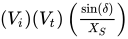
An electric motor-powered flywheel is common in practice. The output power of the electric motor is approximately equal to the output power of the flywheel. It can be calculated by , where is the voltage of rotor winding, is stator voltage, and is the angle between two voltages. Increasing amounts of rotation energy can be stored in the flywheel until the rotor shatters. This happens when the hoop stress within the rotor exceeds the ultimate tensile strength of the rotor material. Tensile stress can be calculated by , where is the density of the cylinder, is the radius of the cylinder, and is the angular velocity of the cylinder.


Flywheel
A flywheel is a mechanical device that uses the conservation of angular momentum to store rotational energy, a form of kinetic energy proportional to the product of its moment of inertia and the square of its rotational speed. In particular, assuming the flywheel's moment of inertia is constant (i.e., a flywheel with fixed mass and second moment of area revolving about some fixed axis) then the stored (rotational) energy is directly associated with the square of its rotational speed.
Since a flywheel serves to store mechanical energy for later use, it is natural to consider it as a kinetic energy analogue of an electrical inductor. Once suitably abstracted, this shared principle of energy storage is described in the generalized concept of an accumulator. As with other types of accumulators, a flywheel inherently smooths sufficiently small deviations in the power output of a system, thereby effectively playing the role of a low-pass filter with respect to the mechanical velocity (angular, or otherwise) of the system. More precisely, a flywheel's stored energy will donate a surge in power output upon a drop in power input and will conversely absorb any excess power input (system-generated power) in the form of rotational energy.
Common uses of a flywheel include smoothing a power output in reciprocating engines, flywheel energy storage, delivering energy at higher rates than the source, and controlling the orientation of a mechanical system using gyroscope and reaction wheel. Flywheels are typically made of steel and rotate on conventional bearings; these are generally limited to a maximum revolution rate of a few thousand RPM. High energy density flywheels can be made of carbon fiber composites and employ magnetic bearings, enabling them to revolve at speeds up to 60,000 RPM (1 kHz).
The principle of the flywheel is found in the Neolithic spindle and the potter's wheel, as well as circular sharpening stones in antiquity. In the early 11th century, Ibn Bassal pioneered the use of flywheel in noria and saqiyah. The use of the flywheel as a general mechanical device to equalize the speed of rotation is, according to the American medievalist Lynn White, recorded in the De diversibus artibus (On various arts) of the German artisan Theophilus Presbyter (ca. 1070–1125) who records applying the device in several of his machines.
In the Industrial Revolution, James Watt contributed to the development of the flywheel in the steam engine, and his contemporary James Pickard used a flywheel combined with a crank to transform reciprocating motion into rotary motion.
The kinetic energy (or more specifically rotational energy) stored by the flywheel's rotor can be calculated by . ω is the angular velocity, and is the moment of inertia of the flywheel about its axis of symmetry. The moment of inertia is a measure of resistance to torque applied on a spinning object (i.e. the higher the moment of inertia, the slower it will accelerate when a given torque is applied). The moment of inertia can be calculated for cylindrical shapes using mass () and radius (). For a solid cylinder it is , for a thin-walled empty cylinder it is approximately , and for a thick-walled empty cylinder with constant density it is .
For a given flywheel design, the kinetic energy is proportional to the ratio of the hoop stress to the material density and to the mass. The specific tensile strength of a flywheel can be defined as . The flywheel material with the highest specific tensile strength will yield the highest energy storage per unit mass. This is one reason why carbon fiber is a material of interest. For a given design the stored energy is proportional to the hoop stress and the volume.[citation needed]
An electric motor-powered flywheel is common in practice. The output power of the electric motor is approximately equal to the output power of the flywheel. It can be calculated by , where is the voltage of rotor winding, is stator voltage, and is the angle between two voltages. Increasing amounts of rotation energy can be stored in the flywheel until the rotor shatters. This happens when the hoop stress within the rotor exceeds the ultimate tensile strength of the rotor material. Tensile stress can be calculated by , where is the density of the cylinder, is the radius of the cylinder, and is the angular velocity of the cylinder.
Recent media
Recent media