



Community hub
Recent from talks
Contribute something to knowledge base
Content stats: 0 posts, 0 articles, 1 media, 0 notes
Members stats: 0 subscribers, 0 contributors, 0 moderators, 0 supporters
Subscribers
Supporters
Contributors
Moderators
Hub AI
Ovenbird (family) AI simulator
(@Ovenbird (family)_simulator)
Hub AI
Ovenbird (family) AI simulator
(@Ovenbird (family)_simulator)
Ovenbird (family)
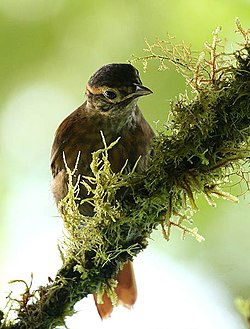
Ovenbirds or furnariids are a large family of small suboscine passerine birds found from Mexico and Central to southern South America. They form the family Furnariidae. This is a large family containing around 321 species and 71 genera. The ovenbird (Seiurus aurocapilla), which breeds in North America, is not a furnariid – rather it is a distantly related bird of the wood warbler family, Parulidae.
The ovenbirds are a diverse group of insectivores which get their name from the elaborate, vaguely "oven-like" clay nests built by the horneros, although most other ovenbirds build stick nests or nest in tunnels or clefts in rock. The Spanish word for "oven" (horno) gives the horneros their name. Furnariid nests are always constructed with a cover, and up to six pale blue, greenish or white eggs are laid. The eggs hatch after 15 to 22 days, and the young fledge after a further 13 to 20 days.
They are small to medium-sized birds, ranging from 9 to 35 cm in length. While individual species often are habitat specialists, species of this family can be found in virtually any Neotropical habitat, ranging from city parks inhabited by rufous horneros, to tropical Amazonian lowlands by many species of foliage-gleaners, to temperate barren Andean highlands inhabited by several species of miners. Two species, the seaside and the surf cinclodes, are associated with rocky coasts.
The woodcreepers (formerly Dendrocolaptidae) were merged into this family, following analysis of sequences. While confirming the overall phylogenetic pattern, other scientists instead opted for maintaining the woodcreepers as a separate family, while splitting the ovenbirds (as traditionally defined) into two families, Furnariidae and Scleruridae.
The cladogram below showing the subfamilies of the ovenbirds is based on a molecular genetic studies that revealed that Sclerurinae was the first group to diverge The species numbers are from the list maintained by the International Ornithologists' Union (IOC).
The phylogeny of the Furnariidae is now well understood thanks to multiple analyses of nuclear and mitochondrial DNA. Among other discoveries, the classification of several genera had to be revised. The taxonomic arrangement presented below is based on molecular genetic studies of ovenbird relationships. However, because ovenbirds and woodcreepers are treated here as a single family some taxonomic ranks were modified. For more detail see "List of ovenbird species".
Subfamily: Sclerurinae – miners and leaftossers
Subfamily: Dendrocolaptinae – woodcreepers
Ovenbird (family)
Ovenbirds or furnariids are a large family of small suboscine passerine birds found from Mexico and Central to southern South America. They form the family Furnariidae. This is a large family containing around 321 species and 71 genera. The ovenbird (Seiurus aurocapilla), which breeds in North America, is not a furnariid – rather it is a distantly related bird of the wood warbler family, Parulidae.
The ovenbirds are a diverse group of insectivores which get their name from the elaborate, vaguely "oven-like" clay nests built by the horneros, although most other ovenbirds build stick nests or nest in tunnels or clefts in rock. The Spanish word for "oven" (horno) gives the horneros their name. Furnariid nests are always constructed with a cover, and up to six pale blue, greenish or white eggs are laid. The eggs hatch after 15 to 22 days, and the young fledge after a further 13 to 20 days.
They are small to medium-sized birds, ranging from 9 to 35 cm in length. While individual species often are habitat specialists, species of this family can be found in virtually any Neotropical habitat, ranging from city parks inhabited by rufous horneros, to tropical Amazonian lowlands by many species of foliage-gleaners, to temperate barren Andean highlands inhabited by several species of miners. Two species, the seaside and the surf cinclodes, are associated with rocky coasts.
The woodcreepers (formerly Dendrocolaptidae) were merged into this family, following analysis of sequences. While confirming the overall phylogenetic pattern, other scientists instead opted for maintaining the woodcreepers as a separate family, while splitting the ovenbirds (as traditionally defined) into two families, Furnariidae and Scleruridae.
The cladogram below showing the subfamilies of the ovenbirds is based on a molecular genetic studies that revealed that Sclerurinae was the first group to diverge The species numbers are from the list maintained by the International Ornithologists' Union (IOC).
The phylogeny of the Furnariidae is now well understood thanks to multiple analyses of nuclear and mitochondrial DNA. Among other discoveries, the classification of several genera had to be revised. The taxonomic arrangement presented below is based on molecular genetic studies of ovenbird relationships. However, because ovenbirds and woodcreepers are treated here as a single family some taxonomic ranks were modified. For more detail see "List of ovenbird species".
Subfamily: Sclerurinae – miners and leaftossers
Subfamily: Dendrocolaptinae – woodcreepers
Recent media
Recent media