Hubbry Logo
FonniFonniMain
Open search
Fonni
Community hub
Fonni
logo
8 pages, 0 posts
0 subscribers
Be the first to start a discussion here.
Fonni
Fonni
from Wikipedia

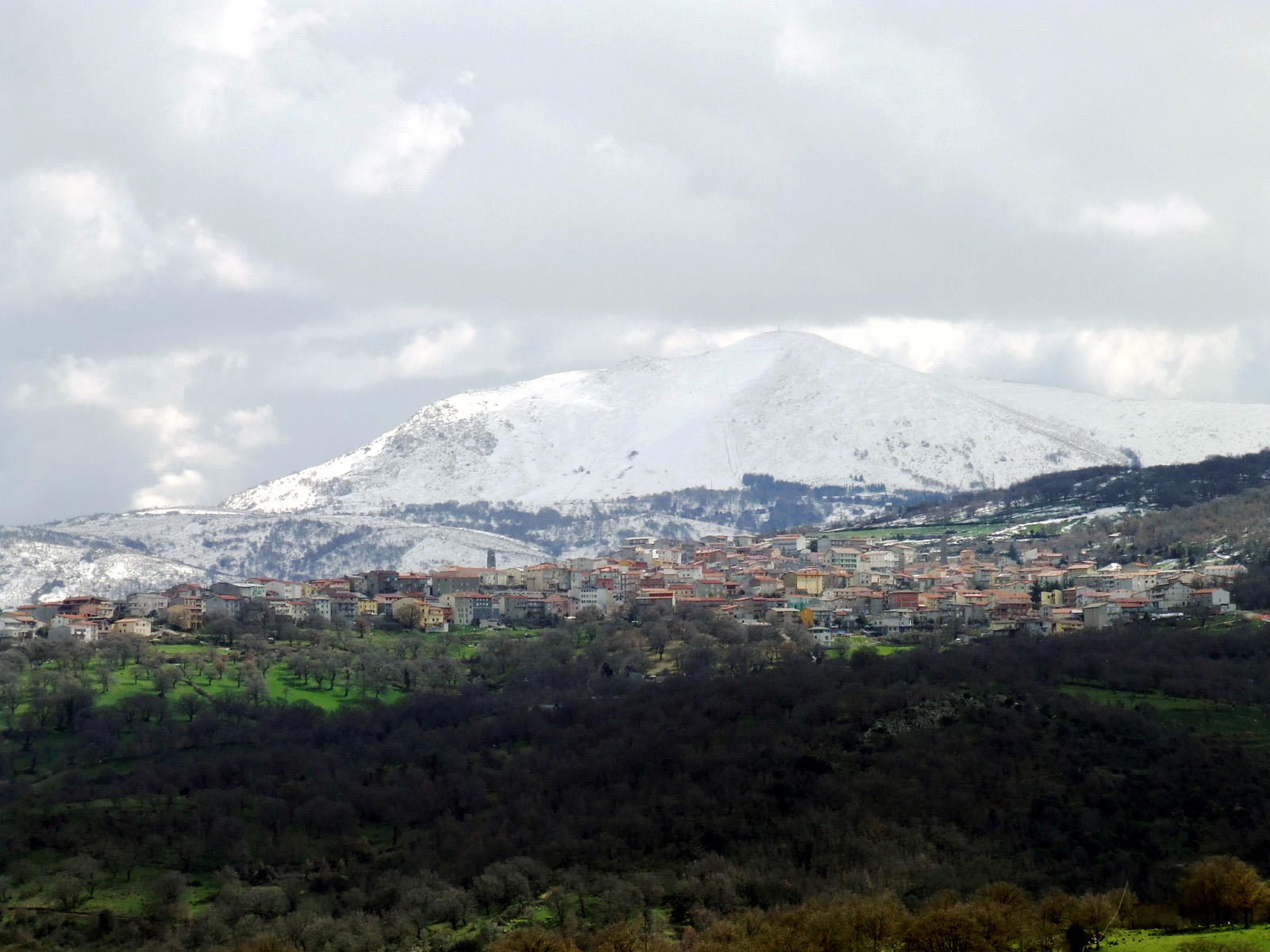
Fonni (Sardinian: Fonne) is a town and comune in Sardinia, in the province of Nuoro (Italy).

Key Information

It is the highest town in Sardinia, and situated among fine scenery with some chestnut woods.[3] Fonni is a winter sports centre with a ski lift to Monte Spada and Bruncu Spina.

Etymology

[edit]

The term "Fonni/-e" probably derives from the Latin fons, meaning "fountain" or "god of the sources". In fact the village contains numerous spring water fountains.

Climate

[edit]
Climate data for Fonni (1961–1990 normals)
Month Jan Feb Mar Apr May Jun Jul Aug Sep Oct Nov Dec Year
Mean daily maximum °C (°F) 6.6
(43.9)
6.9
(44.4)
8.9
(48.0)
11.5
(52.7)
16.3
(61.3)
21.2
(70.2)
25.8
(78.4)
25.5
(77.9)
21.7
(71.1)
16.4
(61.5)
10.9
(51.6)
8.1
(46.6)
15.0
(59.0)
Mean daily minimum °C (°F) 1.5
(34.7)
1.2
(34.2)
2.5
(36.5)
4.6
(40.3)
8.5
(47.3)
12.6
(54.7)
16.4
(61.5)
16.3
(61.3)
13.7
(56.7)
9.7
(49.5)
5.4
(41.7)
2.8
(37.0)
7.9
(46.2)
Average precipitation mm (inches) 101.6
(4.00)
93.2
(3.67)
76.9
(3.03)
81.1
(3.19)
60.7
(2.39)
31.4
(1.24)
13.2
(0.52)
15.6
(0.61)
48.8
(1.92)
81.1
(3.19)
97.0
(3.82)
100.1
(3.94)
800.7
(31.52)
Average precipitation days (≥ 1.0 mm) 9.9 10.0 9.4 10.5 7.4 4.2 1.6 2.4 4.8 8.8 9.7 9.9 88.6
Average relative humidity (%) 86 88 83 81 81 77 64 69 75 82 88 86 80
Source: NOAA[4]
San Giovanni Battista.

Culture

[edit]

The local costumes are extremely picturesque, and are well seen on the day of St John the Baptist, the patron saint. The men's costume is similar to that worn in the district generally; the linen trousers are long and black gaiters are worn. The women wear a white chemise; over that a very small corselet, and over that a red jacket with blue and black velvet facings. The skirt is brown above and red below, with a blue band between the two colours; it is accordion-pleated. Two identical skirts are often worn, one above the other. The unmarried girls wear white kerchiefs, the married women black.[3]

Neighborhoods

[edit]

Neighborhoods in Fonni are called "Rioni" of these the oldest is called su piggiu or the peak, probably derived by the fact this is the highest and first layer of the village. Others include puppuai and cresiedda to the south, and logotza to the east.

A traditional granite stone house in Fonni

Churches

[edit]

References

[edit]
Revisions and contributorsEdit on WikipediaRead on Wikipedia
from Grokipedia
Fonni is a (municipality) and town located in the , in the region of , , at an elevation of 1,000 meters (3,281 feet) above on the Massif, making it the highest municipality in Sardinia. Covering an area of 112.3 square kilometers (43.4 square miles), it features a of approximately 32 inhabitants per square kilometer. As of January 2025, Fonni has an estimated population of 3,579, reflecting a gradual decline from 4,002 in 2011 due to natural and migratory balances typical of rural Sardinian highland communities. The town is renowned for its deep-rooted agro-pastoral traditions, which have shaped its social and economic structure for centuries, with sheep herding and farming remaining central to local life. Its landscape includes archaeological treasures such as Nuragic sites from 1800–900 BCE and the Tombs of the Giants in the nearby Madau area, highlighting prehistoric human settlement in the region. Fonni's is marked by religious architecture, including the of Santa Maria dei Martiri, constructed between 1702 and 1706 by Milanese craftsmen, and the of Pastoral Culture, which preserves artifacts of traditional rural life. The town also features vibrant murals depicting daily pastoral scenes and hosts facilities on nearby Monte Spada, attracting visitors to its scenic, mountainous terrain. Historically, the area has been inhabited since pre-Nuragic times, enduring Roman influence and later integrating into medieval Sardinian judicates before feudal rule under the Kingdom of from 1720 onward.

Geography

Location and Topography

Fonni is located in the , in central , , at geographic coordinates 40°07′N 09°15′E. As Sardinia's highest , it sits at an elevation of approximately 1,000 meters above sea level on the slopes of the . The municipality spans 112 km², encompassing a varied with elevations ranging from 660 meters in lower valleys to peaks exceeding 1,600 meters. Positioned within the plateau, Fonni's landscape features rugged terrain shaped by limestone scarps overlying metamorphic rocks, contributing to prominent formations and steep gradients typical of the region. Sedimentary and volcanic influences from Sardinia's ancient geological further define the area's undulating plateaus and elevated basins. The surrounding environment includes dense woods and high-altitude pastures, supporting diverse flora adapted to the montane conditions. Prominent nearby mountains include Monte Spada and Bruncu Spina, the latter rising to 1,829 meters and forming part of the Gennargentu chain's dramatic skyline. This topography, with its mix of forested slopes and rocky summits, creates habitats suited to endemic species and influences local ecological patterns without delving into climatic variations.

Climate

Fonni exhibits a temperate climate influenced by both Mediterranean and alpine characteristics, owing to its inland, elevated position in the Barbagia region of Sardinia at around 1,000 meters above sea level. Historical records from the 1961–1990 period indicate an average annual high temperature of 15.0°C and an average annual low of 7.9°C, reflecting moderate overall warmth moderated by altitude. Annual in Fonni averages 800.7 mm, with the bulk occurring during autumn and winter months, fostering the area's verdant pastures and forests despite the relatively dry summers. This seasonal concentration of rainfall—peaking in and —results in about 60% of the yearly total falling between and , while summer sees minimal input, often below 25 mm per month. Summers remain cool by Mediterranean standards, with average highs reaching around 25°C in and , allowing comfortable daytime conditions but with cooler evenings. Winters are notably cold, featuring average lows dipping below 0°C from to , accompanied by snowfall that accumulates to support like in nearby areas, though it also exacerbates and occasional flooding from intense autumn downpours. The topographical plays a key role in these cooler temperatures, distinguishing Fonni's from warmer coastal zones.

History

Ancient and Medieval Periods

Human presence in the territory of Fonni dates back to the period, with archaeological evidence including small funerary structures at the Dronnoro site. Megalithic tombs at Madau, near Fonni, further attest to pre-Nuragic activity, featuring five structures oriented astronomically and arranged in an amphitheater-like formation associated with fertility rituals. The Nuragic period (circa 18th–2nd century BCE) saw significant settlements, including the Dronnoro —a complex tower structure expanded from an original single tower—and numerous villages and towers scattered across the landscape, indicating a dense network for controlling waterways and resources. The Sanctuary of Gremanu stands as a premier example, spanning over seven hectares with a single-tower , and apsidal temples, ritual basins, springs, wells, and a unique Nuragic aqueduct, alongside a of Giants' Tombs; artifacts such as bronze weapons and pins suggest its role in water cults and metallurgy from the Middle to Final (15th–9th century BCE). During the Roman era, Fonni's territory formed part of the central-southern region inhabited by the Ilienses, a Nuragic tribe known for fierce resistance against Roman expansion. Following Sardinia's annexation into the province of in 238 BCE, the area experienced ongoing rebellions, including major conflicts in 177–176 BCE where Roman forces under Tiberius Sempronius Gracchus subdued Ilienses strongholds in the interior mountains, resulting in heavy casualties. Archaeological remains at Sorabile-Fonni reveal a Roman fort from the 1st century BCE, featuring buildings, baths, mosaics, coins, a military diploma (214–217 CE), and a dedication to a procurator (mid-3rd century CE), underscoring efforts to and Romanize the highlands. Despite these measures, the region's rugged terrain fostered persistent local autonomy, with —termed Barbaria by Romans—symbolizing unyielding opposition to full conquest. In the medieval period, Fonni integrated into the Giudicato of Arborea around the , as the feudal kingdoms emerged across amid Byzantine and Pisan influences. Early Christian communities took root in during , facilitated by Roman trade routes and missionary efforts that evangelized pagan interior tribes, including the Barbagenses. The area's mountain strongholds enabled semi-autonomous status within the giudicato, preserving indigenous customs amid Vandal and Byzantine rule. Following the Aragonese conquest of northern in 1324 and the full island subjugation by 1478, Fonni's region resisted Spanish incursions, serving as a refuge for rebels during uprisings like the 14th-century Judicate of Arborea wars, where locals leveraged the terrain for guerrilla defense. Under Spanish Habsburg and later Bourbon administration until 1714, the zone maintained relative independence through feudal pacts, though subject to tribute and occasional military expeditions. In 1604, Fonni was incorporated into the Duchy of Mandas as a .

Modern Era

In 1720, following the Treaty of London, passed to the , forming the . Fonni remained a under this rule until the suppression of in 1839, which introduced administrative reforms and greater centralization while preserving much of the local pastoral economy. Following the in 1861, Fonni was incorporated into the new as part of the , retaining the administrative framework inherited from the , including centralized governance and the application of the as the constitutional basis until the establishment of the Italian Republic in 1946. This integration marked a shift from semi-autonomous regional structures to a unified national system, with Fonni's local administration adapting to Italian civil codes and fiscal policies that emphasized land taxation and pastoral regulation. In the , exerted indirect pressures on inland communities like Fonni through resource shortages and disrupted trade, as served as a strategic Axis , though the highland location spared it from major bombings. Post-war recovery was hampered by widespread from rural , with Fonni experiencing significant outflows starting in the 1950s and intensifying after 1963, as younger residents migrated to continental and in search of industrial jobs, leading to a marked and depopulation of pastoral areas. This exodus accelerated the transition away from traditional , which had long dominated Fonni's economy through sheep and goat herding, toward limited diversification into small-scale and services amid broader socio-economic modernization. By the , Fonni's population has continued to decline to approximately 3,579 residents as of January 2025, though rates have slowed with modest return migration supported by regional incentives. Recent revitalization efforts have included annual festivals and projects that depict local traditions and landscapes, transforming underused urban spaces into cultural attractions and boosting such as improved trails and visitor facilities in the surrounding massif. These initiatives, alongside archaeological preservation projects at sites like the Gremanu sanctuary, have fostered community-led efforts to safeguard pastoral heritage while adapting to contemporary economic challenges.

Demographics and Society

Population and Language

Fonni has experienced a steady decline in over recent decades, primarily due to . As of December 31, 2024 (provisional), the had 3,579 residents, down from 3,892 in 2017. With a surface area of 112.27 km², this yields a of approximately 31.9 inhabitants per km². The annual growth rate has slowed in recent years, from -2.39% in 2018 to -0.66% in 2023, and further to -1.13% in 2024, indicating a partial stabilization amid ongoing negative migratory balances, where out-migrations consistently exceed in-migrations. The demographic profile features a slight female majority, with 51.1% women and 48.9% men as of 2024. The is predominantly older, with 26.9% of residents aged 65 and above, compared to 17.0% under 20 years old. This aging structure reflects broader Sardinian trends influenced by low birth rates (around 8 per 1,000 inhabitants) and net , particularly among younger cohorts seeking opportunities elsewhere. Residents are bilingual, using Italian as the primary administrative and educational language alongside Sardinian, specifically the Logudorese dialect spoken in central-northern Sardinia. Fonni's variant of Logudorese exhibits unique phonetic traits, such as the preservation of Latin intervocalic /p, t, c/ as voiced stops (e.g., /b, d, g/), distinguishing it from other . Sardinian holds official minority language status in under Law 482/1999, supporting its use in regional contexts. Ethnically, the population is overwhelmingly of Sardinian heritage, with deep roots in the island's indigenous groups. Foreign residents constitute just 0.95% (34 individuals in 2024), mainly from , alongside minor presences from countries like and , reflecting limited external influences beyond historical ties to mainland .

Government and Administration

Fonni operates as a within the in the autonomous region of , , functioning as the basic unit of under Italian law. The is led by Daniela Falconi, who was reconfirmed in the local elections with 53.72% of the votes, securing her second term until the next elections in 2026. The city council, known as the Consiglio Comunale, consists of 12 elected members who deliberate on local policies and budgets, elected alongside the mayor through direct in municipal elections held every five years. With a population of approximately 3,579 residents as of 2024 (provisional), the administrative apparatus remains scaled to serve a small mountain community. The patron saint of Fonni is St. John the Baptist (San Giovanni Battista), whose feast day on shapes civic events, including processions and community gatherings that integrate religious traditions with local governance activities. As part of Sardinia's special autonomy status under the Italian Constitution, Fonni's administration integrates regional frameworks, managing essential services such as through local schools and healthcare via proximity to the Nuoro ASL district, while coordinating with provincial and regional bodies for broader infrastructure. Recent municipal policies emphasize and preservation, exemplified by the CEAS center established in 2009 for and sustainable practices, including initiatives like the 2024 "Wall of " project engaging in ecological . Additionally, Fonni collaborates on regional programs for the regeneration of small cultural sites, focusing on the conservation of religious and rural as part of the 2022 "Rigenerazione di piccoli siti culturali" initiative. These efforts align with Sardinia's broader goals for and cultural valorization in highland areas.

Economy

Agriculture and Local Industries

Fonni's economy is traditionally centered on pastoralism, with sheep and goat herding dominating due to the suitability of the mountainous terrain for grazing. These activities primarily support the production of pecorino cheese, facilitated by a local dairy that processes milk from over 100 agropastoral businesses in the area. Regional incentives have historically bolstered this sector, though it faces ongoing challenges from market pressures and a long-term crisis. Recent regional data indicate growth in Sardinian agriculture and livestock sectors, though highland communities like Fonni continue to face challenges (as of 2024). Agriculture in Fonni complements through cultivation in the lower, more accessible areas, focusing on chestnuts, grains, cereals, and olives. These crops are grown on marginal lands, but the high and rugged present significant challenges, with the percentage of families involved in declining from 40% in 1939 to 30% as of 2013, reflecting ongoing challenges. Horticultural production also plays a role, though it remains limited by climatic conditions and constraints. Local industries revolve around small-scale manufacturing and artisan crafts, including for traditional items such as , biscuits, pastries, and from dedicated facilities like a and four farms. Artisan activities feature for carpets and production of sweets, which have shown growth in local markets. is present through nearby falegnamerie, supporting traditional craftsmanship. Employment in Fonni's primary sector, encompassing and , engages a notable share of the , with as the economic mainstay amid diversification efforts. As of 2001, accounted for 12.12% of the active population in the broader locale including Fonni, though recent specific data for the area is limited. Over 100 agropastoral enterprises underscore this focus, though fewer workers are involved due to structural shifts.

Tourism and Recreation

Fonni serves as a gateway to Sardinia's mountainous interior, drawing visitors for its blend of seasonal outdoor pursuits and cultural immersion within the Gennargentu National Park. The town's elevation of approximately 1,000 meters provides access to diverse recreational opportunities, supported by local infrastructure that caters to both day-trippers and overnight stays. Tourism here emphasizes sustainable experiences that highlight the natural and artistic heritage of the region. Winter sports thrive in Fonni due to its subalpine , which delivers consistent snowfall from December to March, enabling reliable operations at nearby facilities. The Bruncu Spina ski area, Sardinia's largest winter resort, features three slopes ranging from beginner to intermediate levels, served by chairlifts and a total of 3.3 km of pistes reaching up to 1,824 meters. Monte Spada, another key site accessible from Fonni, offers basic lifts for beginners and some cross-country options. These facilities include on-site lodges and restaurants, making Fonni a hub for winter enthusiasts seeking uncrowded alternatives to mainland European resorts. In summer, the focus shifts to hiking and cultural exploration, with Fonni as an ideal base for treks in the Gennargentu National Park. Popular routes include the 13.6 km round-trip trail to Punta La Marmora, Sardinia's highest peak at 1,834 meters, starting from the nearby S'Arena plateau and offering panoramic views of the Supramonte massif. Cultural tours guide visitors through the town's vibrant street murals, over 20 large-scale artworks in the historic center depicting pastoral life, mountain traditions, and local folklore, often mapped out for self-guided walks. These attractions complement seasonal festivals, such as the August Palio horse race and the multi-month event series, which feature guided art tours and community performances to engage tourists. Tourism infrastructure in Fonni includes a range of accommodations like bed-and-breakfasts, such as La Dolce Sosta, and hotels like Parco Donnortei, with over 20 options providing easy access to trails and ski lifts. Well-marked hiking paths, including those in the adjacent Montes Forest with its ancient holm oaks and rocky spires, are maintained for eco-friendly exploration, while events like annual festivals invite artists to create new murals, fostering community involvement. These initiatives, including shuttle services to remote trailheads, enhance accessibility for families and solo adventurers. As a growing sector, in Fonni contributes to economic diversification, helping to offset rural emigration trends in by creating seasonal jobs in and guiding, with visitor peaks reaching several thousand during winter and summer months. Street art and cultural events have spurred rural revitalization, transforming the town from a declining inland village into a vibrant destination that retains young residents through tourism-related opportunities. Regional data indicates Sardinia's overall influx supports such local economies, with the island seeing nearly 19 million overnight stays in , a portion of which bolsters interior towns like Fonni.

Culture

Traditions and Festivals

Fonni's traditions and festivals are deeply rooted in its Barbagia heritage, blending Christian rites with pre-Christian pastoral customs that reinforce communal solidarity in this highland community. The Festa di San Giovanni Battista, held on June 24, honors the town's patron saint and protector of shepherds, featuring a solemn procession through flower-adorned streets where participants carry the saint's statue and the symbolic "Cohone e Vrores," a unique flower bread crafted by a single artisan preserving an ancient recipe. Approximately 150 knights on horseback and women in elaborate traditional attire accompany the procession, culminating in evening performances of folk dances by local groups and acrobatic displays by the knights at Viale del Lavoro, evoking the solstice's ancient pagan significance alongside Christian devotion. Traditional costumes play a central role in these events, symbolizing Fonni's enduring and often worn during processions and dances to connect participants with ancestral practices. Men don long trousers paired with black , a practical yet formal ensemble reflecting the shepherd's rugged lifestyle, while women layer white chemises under multi-tiered skirts (vardellinu) and vibrant jackets (cippone), topped with embroidered veils or scarves that highlight intricate handiwork passed down through generations. These garments, revived annually, underscore the community's commitment to sartorial heritage amid evolving daily attire. Carnival, known as Su Carrasecare Onnessu, exemplifies Fonni's ritualistic through its iconic masks—Urthos and Buttudos—which dramatize the primordial struggle between humanity and , fostering bonds through shared and . The Urthos, embodying wild animals or death's , appear in heavy black coverings and bells, lumbering through streets in chaotic parades that mimic untamed forces, while the Buttudos, representing domesticated men, clad in white orbace wool coats over velvet, leather leggings, and clanging cowbells, attempt to "tame" them in comedic chases and climbs up building facades. Accompanied by the feminine Sas Mascara Limpias in clean, colorful women's attire, these enactments in shepherd huts and public spaces emphasize collective and renewal, drawing entire families into the fray. Wedding traditions in Fonni further highlight social cohesion, with ceremonies spanning up to three days and rooted in customs that integrate and neighbors into elaborate rituals. The rite commences at the bride's , where she, flanked by close kin, leads a of guests to the church or , symbolizing communal endorsement of the union; this is followed by a lavish reception featuring farm-fresh feasts that bind attendees through shared abundance and . Such practices, evoking resilience, reinforce interpersonal ties in a town where marriages historically strengthened clan alliances. Shepherding folklore permeates these customs, as seen in the San Giovanni feast's dedication to the patron of herdsmen and Carnival's masks inspired by transhumant life, where Urthos and Buttudos rituals originate in traditional shepherd huts to invoke protection over flocks and land. This heritage, chronicled in local poetry that lauds the shepherd's sacrifices of isolation and toil, cultivates a collective ethos of endurance and mutual aid among Fonni's pastoral families. Preservation efforts in Fonni actively sustain these traditions against modernization's pressures, with annual festivals serving as vital platforms for intergenerational transmission and cultural assertion in . Community-led revivals, such as dedicated artisan roles for ritual breads and mask-making workshops, alongside events like Cortes Apertas that showcase open-door heritage demonstrations, ensure these practices remain living expressions of Sardinian identity rather than relics.

Arts, Cuisine, and Folklore

Fonni's artistic landscape is prominently shaped by its collection of murals, which adorn the town's narrow, winding streets and integrate seamlessly with the local architecture. These works, primarily created by artist Angelo Pilloni from San Sperate between 2001 and 2013, depict scenes of rural Sardinian life, including agricultural activities, artisan traditions such as wool spinning, and the strong connection to central to the area's equestrian heritage. The murals transform Fonni into an open-air gallery, inviting visitors to explore themes of everyday , treasures, and community celebrations, thereby preserving and highlighting the town's . The local cuisine of Fonni emphasizes hearty, ingredient-driven dishes rooted in the region's pastoral traditions, featuring high-quality meats, fresh , and dairy products. Signature preparations include su porcheddu, a slow-roasted cooked over aromatic woods to achieve crispy skin and tender meat, often served during communal gatherings. Complementing this are , ridged typically sauced with tomato-based incorporating local , , and grated cheese, reflecting the area's reliance on sheep . Desserts incorporate seasonal elements like chestnuts, prepared into simple sweets such as fritters or polenta-like cakes, alongside the use of wild herbs like myrtle and for flavoring cheeses and preserves, underscoring the cuisine's connection to the surrounding landscape. A notable local is Savoiardi di Fonni, soft biscuits made with , , and local non-pasteurized eggs, holding DE.CO status. Fonni's is deeply embedded in the oral traditions of , where legends of ancient warriors evoke the island's Nuragic past and tales of resilient defenders against invaders, passed down through generations as symbols of communal strength. These narratives intertwine with Sardinian , performed in the local by cantadores who improvise verses on themes of , labor, and during social occasions, maintaining linguistic and cultural continuity. Traditional music accompanies these expressions through the launeddas, a triple-reed producing polyphonic melodies that echo prehistoric roots and are played in central Sardinian contexts to evoke pastoral rhythms and spiritual resonance. In recent years, Fonni's arts, , and have been integrated into initiatives to promote authentic cultural experiences, with murals serving as key in guided walks and culinary tours highlighting traditional dishes to draw visitors to the inland region.

Landmarks

Religious and Historical Sites

Fonni, perched at over 1,000 meters in Sardinia's region, preserves a rich tapestry of religious and historical sites that reflect its layered past from the through medieval and modern eras. These landmarks, including ancient sanctuaries, parish churches, and pastoral structures, are integral to the town's identity, drawing visitors for their architectural significance and cultural continuity. The sites are accessible via local roads and trails, often integrated into the surrounding mountainous landscape. The primary religious structures center on the town's historic churches, with the Basilica of Santa Maria dei Martiri (also known as the Sanctuary of the Virgin of the Martyrs) standing as an early 18th-century masterpiece. Located at Fonni's highest point, this imposing complex includes a , the Church of the Santissima Trinità, and an oratory dedicated to San Michele, all built by Franciscan friars and featuring ornate interiors with 17th- and 18th-century paintings by local artists such as Antonio Todde. The basilica houses a revered statue of the , traditionally linked to the town's patronal devotion, and is surrounded by cumbessias—traditional pilgrim shelters that underscore its role in communal worship. Nearby, the of San Giovanni Battista, Fonni's patronal seat dating to the 16th century and known for its pink-hued facade, contains valuable silver relics; it was closed to the public from 2018 due to structural instability but has since reopened as of 2025. Rural chapels, such as those of Nostra Signora del Monte and San Cristoforo, serve remote communities and maintain active use, preserving elements of medieval devotional architecture amid the highlands. Archaeological remains dominate Fonni's prehistoric heritage, particularly the Nuragic complexes from the (circa 1800–900 BCE). The Sanctuary of Gremanu, one of Sardinia's most extensive Nuragic sites spanning over seven hectares near the Caravai Pass, functions as a sacred citadel with a rectangular housing a village of stone huts, temples, and upstream springs integrated into water features resembling sacred wells. These basalt-constructed elements, including altars and exedras, indicate a center for water worship and communal rites, accessible today via paths from Fonni. Other Nuragic sites include scattered nuraghes—tower-like fortifications—and the Madau , featuring four Giants' Tombs with a prominent 22-meter-long funerary chamber. Roman-era remnants are subtler, with evidence of a mansio (postal station) at Sorabile, approximately 15 km from town, marking imperial control over highland routes during the 1st–3rd centuries CE. Beyond monumental sites, Fonni's built heritage includes historic fountains tied to its etymology from the Latin fons (source or spring), with numerous natural and man-made water points that sustained ancient settlements and pastoral life. These fountains, often simple stone basins near trails, symbolize the town's hydrological importance in a rugged terrain. Shepherd huts known as pinnettas—circular dry-stone structures roofed with branches—dot the countryside as enduring cultural landmarks of transhumant herding traditions, echoing Nuragic hut designs and still used seasonally by locals. Preservation efforts in Fonni focus on structural safety and accessibility, with ongoing assessments for seismic vulnerabilities affecting sites like the San Giovanni Battista church, which was cordoned off from 2018 to prior to 2025 pending restoration funding from regional authorities. The Gremanu Sanctuary benefits from guided access and trail maintenance by local cooperatives, ensuring visitor safety while protecting its fragile basalt features from erosion. These initiatives, supported by Sardinia's cultural heritage bodies, emphasize to balance conservation with public engagement.

Neighborhoods and Urban Features

Fonni's urban layout is organized around historic , or neighborhoods, which form the core of its spatial and social structure. The oldest and highest rione, Su Piggiu, dates to the and features tightly clustered stone houses built on the town's elevated terrain, reflecting early medieval settlement patterns following the destruction of nearby Sorabile. Adjacent such as Pupuai and Logotza emerged in the 16th and 17th centuries, with Pupuai originating from a confined settlement during a plague outbreak in 1528, while Logotza developed around monastic influences with Spanish architectural elements. Ghinio, a later expansion from Su Piggiu and Logotza, incorporates more contemporary buildings from the . These core districts, along with minor ones like Cresiedda, maintain a compact, pedestrian-oriented design shaped by the town's mountainous . The are characterized by narrow cobblestone streets that wind through multi-story stone residences topped with wooden shingle roofs, known locally as scandulas, preserving a mountain aesthetic. Public squares, such as those serving as communal gathering points, facilitate daily interactions and host local markets, underscoring the neighborhoods' role in fostering community cohesion. Modern expansions, particularly in Logotza and Ghinio, have introduced broader avenues and residential zones to accommodate , with the town's layout evolving from isolated medieval clusters to integrated 20th-century developments that support increased . Recent urban enhancements include vibrant murals adorning walls throughout the historic , depicting local traditions and landscapes, which add a contemporary artistic layer to the traditional fabric. In daily life, the rioni delineate subtle social divisions rooted in their historical formation, with residents maintaining strong ties to their respective districts through shared origins and routines. Community interactions thrive in these spaces, from neighborhood gatherings in squares to collaborative events that bridge rioni, reinforcing collective identity amid the town's pastoral heritage. Sports facilities, including the nearby Bruncu Spina ski area and San Cristoforo racetrack, represent modern additions that extend urban functionality beyond residential cores, drawing visitors and integrating with the rioni's expansion to bolster recreational access. This blend of ancient clustering and adaptive growth highlights Fonni's transition into a balanced mountain community.

References

Add your contribution
Related Hubs
User Avatar
No comments yet.