


Community hub
Recent from talks
Contribute something to knowledge base
Content stats: 0 posts, 0 articles, 1 media, 0 notes
Members stats: 0 subscribers, 0 contributors, 0 moderators, 0 supporters
Subscribers
Supporters
Contributors
Moderators
Hub AI
Food pyramid (nutrition) AI simulator
(@Food pyramid (nutrition)_simulator)
Hub AI
Food pyramid (nutrition) AI simulator
(@Food pyramid (nutrition)_simulator)
Food pyramid (nutrition)
A food pyramid is a representation of the optimal number of servings to be eaten each day from each of the basic food groups. The first pyramid was published in Sweden in 1974. The 1992 pyramid introduced by the United States Department of Agriculture (USDA) was called the "Food Guide Pyramid" or "Eating Right Pyramid". It was updated in 2005 to "MyPyramid", and then it was replaced by "MyPlate" in 2011.
Amid high food prices in 1972, Sweden's National Board of Health and Welfare developed the idea of "basic foods" that were both cheap and nutritious, and "supplemental foods" that added nutrition missing from the basic foods. Anna-Britt Agnsäter, chief of the test kitchen for Kooperativa Förbundet (a cooperative Swedish retail chain), held a lecture the next year on how to illustrate these food groups. Attendee Fjalar Clemes suggested a triangle displaying basic foods at the base. Agnsäter developed the idea into the first food pyramid, which was introduced to the public in 1974 in KF's Vi magazine. The pyramid was divided into basic foods at the base, including milk, cheese, margarine, bread, cereals and potato; a large section of supplemental vegetables and fruit; and an apex of supplemental meat, fish and egg. The pyramid competed with the National Board's "dietary circle", which KF saw as problematic for resembling a cake divided into seven slices, and for not indicating how much of each food should be eaten. While the Board distanced itself from the pyramid, KF continued to promote it.
Food pyramids were developed in other Scandinavian countries, as well as West Germany, Japan and Sri Lanka. The United States later developed its first food pyramid in 1992.
The World Health Organization, in conjunction with the Food and Agriculture Organization, published guidelines that can be effectively represented in a food pyramid relating to objectives in order to prevent obesity, improper nutrition, chronic diseases and dental caries based on meta-analysis though they represent it as a table rather than as a "pyramid". The structure is similar in some respects to the USDA food pyramid, but there are clear distinctions between types of fats, and a more dramatic distinction where carbohydrates are categorized on the basis of free sugars versus sugars in their natural form. Some food substances are singled out due to the impact on the target issues that the "pyramid" is meant to address. In a later revision, however, some recommendations are omitted as they automatically follow other recommendations while other sub-categories are added. The reports quoted here explain that where there is no stated lower limit in the table below, there is no requirement for that nutrient in the diet.
All percentages are percentages of calories, not of weight or volume. To understand why, consider the determination of an amount of "10% free sugar" to include in a day's worth of calories. For the same amount of calories, free sugars take up less volume and weight, being refined and extracted from the competing carbohydrates in their natural form. In a similar manner, all the items are in competition for various categories of calories.
The representation as a pyramid is not precise, and involves variations due to the alternative percentages of different elements, but the main sections can be represented.
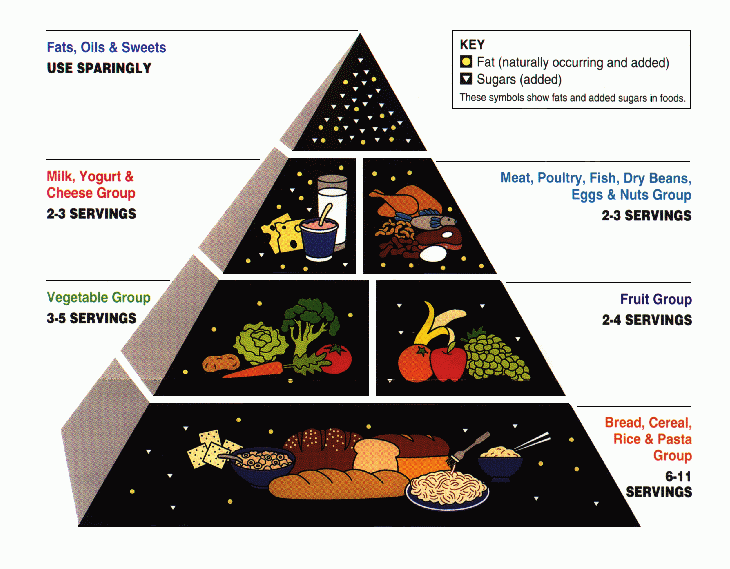
The USDA food pyramid was created in 1992 and divided into six horizontal sections containing depictions of foods from each section's food group. It was updated in 2005 with black and white vertical wedges replacing the horizontal sections and renamed MyPyramid. MyPyramid was often displayed with the food images absent, creating a more abstract design. In an effort to restructure food nutrition guidelines, the USDA rolled out its new MyPlate program in June 2011. My Plate is divided into four slightly different sized quadrants, with fruits and vegetables taking up half the space, and grains and protein making up the other half. The vegetables and grains portions are the largest of the four.
A modified food pyramid was proposed in 1999 for adults aged over 70.
Food pyramid (nutrition)
A food pyramid is a representation of the optimal number of servings to be eaten each day from each of the basic food groups. The first pyramid was published in Sweden in 1974. The 1992 pyramid introduced by the United States Department of Agriculture (USDA) was called the "Food Guide Pyramid" or "Eating Right Pyramid". It was updated in 2005 to "MyPyramid", and then it was replaced by "MyPlate" in 2011.
Amid high food prices in 1972, Sweden's National Board of Health and Welfare developed the idea of "basic foods" that were both cheap and nutritious, and "supplemental foods" that added nutrition missing from the basic foods. Anna-Britt Agnsäter, chief of the test kitchen for Kooperativa Förbundet (a cooperative Swedish retail chain), held a lecture the next year on how to illustrate these food groups. Attendee Fjalar Clemes suggested a triangle displaying basic foods at the base. Agnsäter developed the idea into the first food pyramid, which was introduced to the public in 1974 in KF's Vi magazine. The pyramid was divided into basic foods at the base, including milk, cheese, margarine, bread, cereals and potato; a large section of supplemental vegetables and fruit; and an apex of supplemental meat, fish and egg. The pyramid competed with the National Board's "dietary circle", which KF saw as problematic for resembling a cake divided into seven slices, and for not indicating how much of each food should be eaten. While the Board distanced itself from the pyramid, KF continued to promote it.
Food pyramids were developed in other Scandinavian countries, as well as West Germany, Japan and Sri Lanka. The United States later developed its first food pyramid in 1992.
The World Health Organization, in conjunction with the Food and Agriculture Organization, published guidelines that can be effectively represented in a food pyramid relating to objectives in order to prevent obesity, improper nutrition, chronic diseases and dental caries based on meta-analysis though they represent it as a table rather than as a "pyramid". The structure is similar in some respects to the USDA food pyramid, but there are clear distinctions between types of fats, and a more dramatic distinction where carbohydrates are categorized on the basis of free sugars versus sugars in their natural form. Some food substances are singled out due to the impact on the target issues that the "pyramid" is meant to address. In a later revision, however, some recommendations are omitted as they automatically follow other recommendations while other sub-categories are added. The reports quoted here explain that where there is no stated lower limit in the table below, there is no requirement for that nutrient in the diet.
All percentages are percentages of calories, not of weight or volume. To understand why, consider the determination of an amount of "10% free sugar" to include in a day's worth of calories. For the same amount of calories, free sugars take up less volume and weight, being refined and extracted from the competing carbohydrates in their natural form. In a similar manner, all the items are in competition for various categories of calories.
The representation as a pyramid is not precise, and involves variations due to the alternative percentages of different elements, but the main sections can be represented.
The USDA food pyramid was created in 1992 and divided into six horizontal sections containing depictions of foods from each section's food group. It was updated in 2005 with black and white vertical wedges replacing the horizontal sections and renamed MyPyramid. MyPyramid was often displayed with the food images absent, creating a more abstract design. In an effort to restructure food nutrition guidelines, the USDA rolled out its new MyPlate program in June 2011. My Plate is divided into four slightly different sized quadrants, with fruits and vegetables taking up half the space, and grains and protein making up the other half. The vegetables and grains portions are the largest of the four.
A modified food pyramid was proposed in 1999 for adults aged over 70.
Recent media
Recent media