Hubbry Logo
Ford B seriesFord B seriesMain
Open search
Ford B series
Community hub
Ford B series
logo
8 pages, 0 posts
0 subscribers
Be the first to start a discussion here.
Ford B series
Ford B series
from Wikipedia
Ford B series
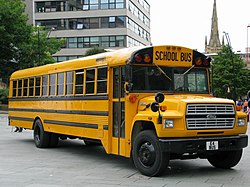
Sixth-generation Ford B-series (1985–1994 Ford B700 with Thomas Saf-T-Liner conventional body)
Overview
ManufacturerFord
Also calledMercury MB series (1948–1968; Canada)
Production1948–1998
Body and chassis
ClassClass 6 (medium duty)
LayoutCowled chassis 4x2
Body styles
PlatformFord F-Series (medium duty)
Chronology
Predecessor1941 Ford truck chassis
SuccessorFreightliner FS-65 (indirect)
Blue Bird Vision (indirect)

The Ford B series is a bus chassis that was manufactured by Ford Motor Company from 1948 to 1998. A variant of the medium-duty Ford F-Series, the B-series was developed for bus use. Alongside its sales in the United States and Canada, the chassis was exported worldwide for various manufacturers.

In contrast to the F-Series chassis-cab truck, the B-Series was a cowled-chassis vehicle: a bare chassis aft of the firewall, with all other bodywork supplied from a second-stage manufacturer. While primarily adopted for yellow school bus applications, the B series also saw various specialty uses.

Coinciding with the late 1996 sale of the Louisville/AeroMax heavy-truck line to Freightliner (which led to the introduction of Sterling Trucks), Ford ended cowled-chassis vehicle production after 1998. Though Ford has remained in the medium-duty segment (introducing the F-650/F-750 Super Duty for 2000), the company has not since developed a cowled-chassis derivative of the model line, instead concentrating on cutaway chassis vehicles. The role and market share of the B-series in the cowled-chassis segment was largely superseded by the Freightliner FS-65 and the Blue Bird Vision (a proprietary chassis paired with a body from its manufacturer).

Overview

[edit]

For 1948, Ford released the F-series truck line, moving all truck production to a dedicated model family. The B series (B= Bus) was introduced as a cowled-chassis variant of the medium-duty F-5 and F-6 (1 ½ and 2-ton), slotted between pickup trucks and "Big Job" heavy conventionals.

For 1953, the second generation F-Series shifted to a three-digit model nomenclature (which remains in use by Ford today), with the B-series following suit. In 1968, Ford introduced diesel-fuel engines as an option, denoting such vehicles with a four-digit model number (this nomenclature ended for 1991).

Prior to 1969, Ford of Canada marketed the B-Series through both Ford and its Lincoln-Mercury dealer networks, with the latter selling it as part of the Mercury M-series truck line. At the time, rural Canadian communities had access to either a Ford or a Lincoln-Mercury dealership, but not both concurrently.

For its entire 50-year production run, the B-series paralleled the medium-duty F series in its development. Until 1966, medium-duty F-Series trucks differed from their lighter-duty counterparts primarily in their frame and front suspension design, retaining front bodywork commonality. For 1967, Ford medium-duty trucks were given wider front axles and their own front bodywork, with the B-Series using this design entirely. For 1980, a final generation was produced (undergoing a model revision in 1995).

First generation (1948–1952)

[edit]
1948–1951 B series located in Israel

For 1948, as Ford introduced the Ford F-series as its first dedicated truck platform, the B-series made its debut. Based on the medium-duty F-5 and F-6 (1½ and 2-ton), the B series was slotted between the pickup trucks and the "Big Job" conventionals. In 1951, the grille trim was redesigned, with the horizontal grille bars replaced by wider-spread vertical ones.

Sharing the engines with the F-5 and F6, a 95 hp 226 inline 6 was standard, with a 100 hp Flathead V8 and a 110 hp 254 inline-six as options.

Engine name Configuration Production Fuel Transmission
Rouge I6 226 cu in (3.7 L) OHV I6 1948–1953 gasoline 3-speed manual

4-speed manual

254 cu in (4.2 L) OHV I6
Flathead V8 239 cu in (3.9 L) side-valve V8

Second generation (1953–1956)

[edit]

In 1953, Ford celebrated their 50th anniversary and the B series saw a redesign with new B-"00" designations added to the name. The redesign implemented a set back front axle that made the front look nose heavy, but allowed for a tighter turning radius. The hood was also longer and flowed into the fenders. The grille was still horizontal, but was two bars as opposed to the one large one in the previous model. 1954 buses received a refreshed grille and a new OHV V8 engine option to replace the old 239 Flathead V8. The 1956 buses got a new wraparound windshield and restyled dashboards as well as a new grille that was similar to the 1953 model year.

Engines
  • 215 cu in (3.5 L) OHV I6 (1953)
  • 239 cu in (3.9 L) Flathead V8 (1953)
  • 223 cu in (3.7 L) OHV "Mileage Maker" I6 (1954–1956)
  • 239 cu in (3.9 L) Ford Y-Block OHV V8 (1954–1955)
  • 272 cu in (4.5 L) Ford Y-Block OHV V8 (1956)

Third generation (1957–1960)

[edit]
1958–1960 Ford-chassis school bus in California

In 1957 the B series got a redesigned front end and a new dash area. The front hood was now flush with the fenders creating a more boxy look. The 1958 models saw a new grille and quad headlamps along with new circular gages.

Engines
  • 223 cu in (3.7 L) Ford "Mileage Maker" I6 (1958–1960)
  • 272 cu in (4.5 L) Ford Y-Block V8 (1957)
  • 292 cu in (4.8 L) Ford Y-Block V8 (1958–1960)
  • 302 cu in (4.9 L) Lincoln Y-block V8[1]

Fourth generation (1961–1966)

[edit]
1961 Ford B Series with new designed front grill

The B series was redesigned for 1961 offering a new horizontal grille and fenders that were flared just above the front wheel to allow for larger wheels. The new chassis and front fascia made the truck look lower and wider than previous years. The quad head lamps were replaced with single lights integrated into the grille. The frame and suspension were also redesigned to be tougher than before. This generation of B series would be the last to utilize the same front fascia as light duty Ford trucks. Both the B series and medium duty F series were to gain their own look.

Engines
  • 262 cu in (4.3 L) Ford I6 (1961–1964)
  • 292 cu in (4.8 L) Ford Y-Block V8 (1961–1963)
  • 330 cu in (5.4 L) Ford FT V8 (1964–1966)
  • 361 cu in (5.9 L) Ford FT V8 (1964–1966)
  • 391 cu in (6.4 L) Ford FT V8 (1964–1966)
  • 240 cu in (3.9 L) Ford 240 I6 (1965–1966)
  • 300 cu in (4.9 L) Ford 300 I6 (1965–1966)

Fifth generation (1967–1979)

[edit]
Early 1970s Ford B series located in Hong Kong

Ford completely redesigned both the B series and medium-duty F series and departed from using the same grilles as the lighter duty F-series trucks. The new buses were taller and wider with a large grille utilizing much of the space of the front fascia. The new grille was rectangular with the single headlights being placed very near the far ends of the grille. The fenders were even more flared than before to allow for a wider track and larger wheels and tires needed to make the necessary gain in GVW to remain competitive. This generation was also the first to receive the option of a diesel engine in place of the strictly gasoline lineup in the past. An extra "0" was added to the series notation on diesel models. After 1968, the Mercury-branded version of the B series was discontinued in the Canadian market. For 1973, the grille was updated with longer teardrops around the headlights and F O R D block lettering appeared on the front of the hood just above the grille.

Engines
Gasoline
  • 330 cu in (5.4 L) Ford FT V8 (1967–1977)
  • 361 cu in (5.9 L) Ford FT V8 (1967–1977)
  • 391 cu in (6.4 L) Ford FT V8 (1967–1977)
  • 370 cu in (6.1 L) Ford 385/Lima V8 (1978–1979)
Diesel
  • Caterpillar 1140 V8 (1968–1974) B-6000 Only
  • Caterpillar 1145 V8 (1968–1974) B-6000 and B-7000
  • Caterpillar 3208 V8 (1975–1978) B-7000 Only

Sixth generation (1980–1998)

[edit]

For 1980, the B-Series was redesigned for the first time since 1967 production. Again sharing model commonality with the medium-duty F-Series, the model line saw significant external design changes; in place of the long-running full-width hood, Ford shifted to a narrower hoodline combined with separate fenders. In another change, the grille shifted its design influence from F-Series light trucks to the L-Series "Louisville" heavy trucks.

In production across 19 model years, this is the longest-produced version of the B-Series; for 1995, the model line received a redesign of the hood.

1980–1994

[edit]
1980–1994 B-series Diesel located in the UK

For 1980, the sixth-generation B-Series was derived from the F-700, F-800, and F-8000 (diesel). As a cowled chassis (produced without a cab) with no interior, the B-Series was produced with a revised dashboard from the previous generation. For 1984, the medium-duty F-Series and B-Series adopted the Ford Blue Oval emblem, replacing the "FORD" lettering in the center of the grille; other revisions were made to cowl badging. As an option, a tilt-forward hood was introduced alongside the standard rear-hinged hood; on the B-series, the tilting hood would become standard by the end of the 1980s.

Engines

For its 1980 launch, the sixth-generation was offered with three engines. Alongside the 6.1L (370) gasoline V8 and the Caterpillar 3208 V8 diesel (Ford B-8000), a Detroit Diesel four-stroke 8.2L V8 was introduced as an option. For 1982, Ford introduced a 7.0L gasoline engine as an option.

During the 1980s and early 1990s, the engine offerings would undergo several revisions. For 1985, as part of a joint venture with New Holland, Ford introduced a 6.6L and 7.8L inline-6 diesel sourced from Brazil. For 1991, the Caterpillar 3208 and Detroit Diesel V8s were withdrawn (following the discontinuation of the latter); it would also serve as the final year for the 6.1L gasoline V8. For 1992, Ford introduced Cummins 6BT and C8.3 diesels; for 1993, they would replace the Ford-New Holland diesels entirely.

Gasoline
  • 370 cu in (6.1 L) Ford 385/Lima V8 (1980–1991)
  • 429 cu in (7.0 L) Ford 385/Lima V8 (1982–1994)
Diesel
  • 8.2 L Detroit Diesel "Fuel Pincher" V8 (1980–1990)
  • 6.6 L and 7.8 L Ford-New Holland I6 (1985–1992)
  • 5.9 L Cummins 5.9 6BT I6 (1992–1998)
  • 10.4 L Caterpillar "3208" V8 (1983–1990)
  • 8.3 L Cummins "C8.3" I6 diesel (1992–1994)

1995–1998

[edit]
1997 Ford B series located in Alabama, USA.

For 1995, the medium-duty F-Series underwent a model revision, improving the aerodynamics of the hood design, with the B-series following suit. With few changes made to the chassis, the B-series retained the same steering column and instrument panel used since 1980. For the first time, a tilt-steering column was offered as an option (distinguished by Ford-badged steering wheels sourced from International).

The badging of the B-Series underwent a revision, ending the use of external B-700/B-800 designation; all cowl badges used "B-Series" badging.

After a 50-year production run, the final B-series cowled bus chassis was produced as the sixth-generation medium-duty Ford F-Series ended its model cycle after the 1998 model year.

Engines

While the 7.0L gasoline engine remained standard on the medium-duty F-Series, the 1995 B-series shifted entirely to diesel-fuel engines, using Cummins-sourced 5.9L and 8.3L inline-6 engines.

  • 5.9 L Cummins 5.9 6BT I6 diesel (1992–1998)
  • 8.3 L Cummins 8.3 I6 diesel (1994–1998)

Discontinuation

[edit]

While the medium-duty F-Series was redesigned for a seventh generation for the 1999 model year (topping the Super Duty line), the model line no longer included a B-Series cowled bus chassis. Several factors would contribute to the discontinuation of the model line, related both to Ford and to bus manufacturers.

From 1980 to 1998, the number of major school bus manufacturers using cowled bus chassis had been reduced from six to four (three, after 2001). In an effort to secure their future, body manufacturers began a series of business agreements with chassis suppliers (with some becoming subsidiaries of the latter). As the 1990s progressed, Ford was faced with the potential withdrawal of the B-series or entering into a supply agreement with a body manufacturer to guarantee a source of demand.[citation needed] Following the 10-year agreement between General Motors and Blue Bird Corporation to standardize its B7 chassis (making Ford an extra-cost option); a potential arrangement proved increasingly difficult as AmTran and Thomas Built Buses were purchased outright in 1995 and 1998 by truck manufacturers Navistar and Freightliner, respectively.

At the end of 1996, Ford sold the rights to its heavy-truck lines to Freightliner subsidiary of Daimler-Benz. Redesigned less than a year before, the Louisville/Aeromax heavy trucks were reintroduced as the Sterling brand of trucks. While the sale did not include the F-Series medium-duty trucks, a condition of the sale included a 10-year non-compete agreement, stipulating that the two companies would not introduce products in direct competition with one another.[citation needed] Introduced in 1997, the Freightliner FS-65 (developed from its medium-duty FL-Series before the sale) would inherit much of the cowled-chassis market share vacated by the B series. While Ford was able to continue the medium-duty F-Series (entering into the Blue Diamond joint venture with Navistar to produce the model line), the overlap that a bus chassis derived from it represented was a potential breakage of the non-compete agreement.

In response to the conclusion of the Blue Bird/GM agreement, in 2002, Ford sought its own supply agreement with the company. A few prototype vehicles were developed from F-650/F-750 Super Duty trucks (converted to cowled-chassis vehicles); the design did not lead to an agreement between the two companies. Elements of its design were developed further, becoming the Blue Bird Vision; in place of a commercially sourced chassis, the Vision uses a proprietary chassis.

As of current production, Ford no longer produces a cowled-chassis bus in North America. Shifting its production exclusively to cutaway vehicles, Ford produces vehicles derived from the Transit (350/350HD), E-Series (E-350/E-450), Super Duty (F-550), and medium-duty F-Series (F-650/F-750). The vehicles are produced for multiple applications; along with school buses, the chassis are also used for shuttle buses, paratransit, and multiple commercial uses.

Body manufacturers

[edit]

The B series was widely available and was used by many manufacturers throughout its production run.

Body Manufacturer Model Name Years Available Notes
American Transportation Corporation Volunteer (1992–1996)
CS (1997–1998)
1992–1998 Ford was the only non-International chassis to be bodied by AmTran
Blue Bird Corporation Blue Bird/Ford B-Series to 1998 After 1998 the B-Series body was sold with a Blue Bird Body. Sold alongside Blue Bird Vision after 2003.
Carpenter
Crown By Carpenter
Classic to 1998 From 1996 to 1999, Carpenter used the Crown by Carpenter brand name on their buses.
Les Enterprises Michel Corbeil 1990–1998 Sold only in Canada.
Superior Coach Company Pioneer to 1982
Perley A. Thomas Car Works
Thomas Built Buses, Inc.
Saf-T-Liner Conventional 1972–1998 replaced by Freightliner-based buses (FS-65)
Ward Body Works Master Deluxe
Volunteer
to 1992
Wayne Corporation
Wayne Wheeled Vehicles
Lifeguard 1973–1995

References

[edit]

See also

[edit]
Revisions and contributorsEdit on WikipediaRead on Wikipedia
from Grokipedia
The Ford B-Series was a medium-duty bus chassis manufactured by the from 1948 to 1998, designed primarily for applications in . Introduced as part of Ford's postwar truck lineup alongside the F-Series, it featured a conventional cab-forward configuration and was sold mainly as a "cowled " to third-party body builders such as Blue Bird, , and Carpenter for final assembly into Type C (conventional-style) es. Key to its longevity was the sharing of mechanical components with Ford's F-Series medium- and heavy-duty trucks, including engines, transmissions, and axles, which contributed to its reputation for and serviceability in demanding fleet operations. Model designations like B-500, B-600, B-700, and B-800 denoted variations in gross vehicle weight rating (GVWR), ranging from approximately 10,000 to 33,000 pounds, allowing customization for different passenger capacities and regional requirements. Over its 50-year production run, the B-Series became one of the most widely used chassis in the United States, with assembly primarily at Ford's . By the mid-1990s, market shifts and Ford's cost-cutting initiatives prompted the company to consolidate its medium-duty offerings, leading to the discontinuation of B-Series production by the end of 1997. The chassis was succeeded by updated F-Series Super Duty variants, marking the end of an era for dedicated bus platforms in Ford's portfolio.

Overview

History and Development

The Ford B-Series was introduced in as a cowled-chassis variant derived from the medium-duty F-5 and F-6 trucks within Ford's newly redesigned F-Series lineup, representing the company's first dedicated post-World War II truck platform separate from its designs. This launch aligned with Ford's broader effort to modernize its offerings after wartime production restrictions, emphasizing durability and versatility for heavy-duty tasks. The development of the B-Series addressed the surging postwar demand for specialized and commercial chassis, fueled by rapid suburban expansion, population growth, and the expansion of public school transportation systems across the and . Ford positioned the B-Series as a shared platform with its medium-duty F-Series trucks, adapting the conventional cab-forward configuration for bus body mounting to meet these needs efficiently. Initial production integrated into Ford's existing truck assembly lines, with later manufacturing at the in Louisville following its opening in 1969. Marketed exclusively for bus applications, the B-Series became a staple in North American school and transit fleets, with Canadian sales under Mercury MB-Series branding from 1948 to 1968 to align with Ford of Canada's dual-brand strategy. Spanning six generations over 50 years until 1998, the lineup solidified Ford's role in the medium-duty bus chassis market.

Design Characteristics

The Ford B-Series was characterized by its cowled-chassis design, a forward-control layout where the engine was positioned ahead of the to maximize interior space for bus body mounting. This configuration utilized a ladder-frame construction made from high-strength , paired with leaf-spring suspension on both axles to support heavy payloads in commercial applications. From its inception, the B-Series featured a basic cab with flat fenders, which evolved over time with set-back front axles introduced in 1953 and wider and taller cabs by 1967 to improve specifically for bus configurations. These changes allowed for better maneuverability and load balance without altering the core forward-control philosophy. Safety and durability were prioritized through reinforced ladder frames capable of handling gross vehicle weight ratings (GVWR) from approximately 10,000 to 33,000 pounds, with optional air brakes for enhanced and dual rear wheels for stability under load. Later iterations introduced tilt-forward hoods for improved access. Wheelbases ranging from 138 to 206 inches were suited for bus body lengths, unlike the shorter wheelbases of F-Series pickups, along with modular mounting points that facilitated integration of third-party bus bodies from manufacturers like Blue Bird and . The initial 1948 design shared underpinnings with the F-Series for shared components and .

Market Role and Applications

The Ford B-Series chassis established itself as a cornerstone of the U.S. school bus industry from the through the , serving as the primary platform for Type C conventional buses in both urban and rural districts across the country. Its design emphasized durability and adaptability, making it the go-to choice for transporting students over long distances on varied terrain, and it became synonymous with the yellow iconography in American education. Beyond education, the B-Series found widespread commercial applications, including as a base for transit buses, airport shuttles, and utility vehicles operated by various fleet providers. In the , production reached its height, reflecting strong demand in these sectors amid and expansion. In the Canadian market, the B-Series was rebadged as the Mercury MB-Series and sold through Lincoln-Mercury dealerships until 1968, achieving notable adoption for school transportation in provinces such as where local regulations favored robust chassis designs. Economically, the B-Series contributed to the standardization of school bus safety through its low-cost, reliable engineering, which incorporated features like reinforced frames and compliance with national standards for compartmentalization and high seating positions to protect occupants in crashes. This platform enabled body manufacturers to efficiently assemble complete vehicles, supporting cost-effective fleet operations for districts and operators.

Generations

First Generation (1948–1952)

The first generation of the Ford B-Series, spanning 1948 to 1952, marked the introduction of a dedicated Type C conventional bus derived from the medium-duty F-5 and F-6 variants of Ford's newly launched F-Series truck line. Introduced in January 1948 alongside the F-Series, it was designed primarily for applications, providing a bare and to third-party body manufacturers for adding the bus body. The platform emphasized post-war innovations in truck engineering, including a robust ladder-frame shared with the F-Series to handle medium-duty loads while allowing customization for passenger transport. Styling cues from the F-Series were prominent, featuring a flat, single-piece for improved visibility, rounded fenders with integrated headlights, and a horizontal bar grille that contributed to a modern, streamlined appearance for the era. The cab-forward configuration maximized interior space for bus bodies, with wheelbases of 135 inches, 159 inches, and 194-195 inches available to accommodate larger passenger capacities of 30 to 48 students. Gross ratings (GVWR) ranged from approximately 12,000 pounds for shorter-wheelbase models to 15,500 pounds for heavier-duty setups, enabling reliable performance in routes and other commercial uses. Production occurred at Ford's truck assembly facilities in the United States, supporting medium-duty vehicle output during the post-war boom. Body builders such as Blue Bird quickly adopted the chassis for school buses, leveraging its durability and compatibility with steel bodies to meet growing demand for safe, efficient pupil transport. Powertrain options included the 226 cubic-inch inline-six engine, the 254 cubic-inch inline-six, and the 239 cubic-inch flathead V8, with the V8 providing 100 horsepower for demanding applications. Despite its innovations, the generation faced challenges with the flathead V8's reliability under heavy-duty bus operations, including overheating and durability concerns in prolonged use, which prompted Ford to refine engine designs ahead of the 1953 redesign. These issues highlighted the transition from wartime production to civilian commercial vehicles, but the B-Series established Ford's foothold in the school bus market through its versatile platform.

Second Generation (1953–1956)

The second generation of the Ford B-series, spanning the 1953 to 1956 model years, represented a mid-1950s redesign that emphasized enhanced handling through modifications and expanded choices for medium-duty applications, particularly in bus and truck configurations. A key change was the set-back front placement, which positioned the further rearward under the to improve maneuverability with short-turn handling ease and promote stability via wide treads and deep construction. This adjustment contributed to better overall compared to the first generation's flat fenders, aiding load balance in demanding service. The lineup included the B-500 to B-600 series models, with available wheelbases ranging from 138 to 159 inches to accommodate various body styles, including and delivery configurations. The cab itself adopted updated styling cues shared with Ford's light-duty lines, such as increased glass area for improved , while two-tone schemes became available for aesthetic appeal in commercial fleets. Production during this period emphasized durability for vocational uses, with the B-series gaining popularity as a for Type C buses built by third-party body manufacturers like Blue Bird and Superior Coach. Units were also exported to international markets, including , where local assembly of bus bodies on B-series supported regional needs. While exact figures vary by source, output reflected strong demand in North American and commercial sectors. Among the innovations, 1954 marked the introduction of the Y-block family to the B-series options, replacing the prior Flathead V8 and providing higher output for challenging conditions like hilly terrains; initial variants included the 239 cu in displacement rated at approximately 130 hp, with larger 272 cu in and 312 cu in versions following by 1956 for heavy-duty models up to 172 hp. Complementing this, the inline-6 engine evolved to a 223 cu in overhead-valve design by mid-decade, delivering around 137 hp for balanced economy in lighter applications, all while meeting standards for safety and reliability.

Third Generation (1957–1960)

The third generation of the Ford B-Series, spanning 1957 to 1960, introduced a refreshed styling that aligned with contemporary , featuring a boxy front end, quad rectangular headlamps, a prominent chrome grille, and wider fenders to enhance its modern profile. This design carried over the cab structure from the F-Series medium-duty lineup, providing a robust yet updated appearance suitable for bus applications. Chassis refinements included gross vehicle weight ratings (GVWR) up to 20,000 pounds for medium-duty configurations, supporting heavier payloads in use, along with optional for improved maneuverability and 4-speed manual transmissions for versatile operation. These updates built on the second generation's set-back front design, maintaining forward visibility while accommodating the evolving demands of medium-duty service. Production during this era emphasized reliability for commercial fleets, with strong sales directed toward body builders like , which mounted conventional bodies on these for school transportation. A minor facelift in 1959 added wraparound rear windows to the cab, improving driver visibility without altering core dimensions. Engine offerings focused on balancing power and efficiency, with the standard 272 cubic-inch Y-Block V8 delivering 173 horsepower for robust performance in demanding applications. An optional 223 cubic-inch "Mileage Maker" inline-six provided economical operation at around 138 horsepower, appealing to fleet operators prioritizing fuel savings over peak output. By 1958, the lineup expanded to include a 292 cubic-inch Y-Block V8 option for enhanced torque in heavier loads.

Fourth Generation (1961–1966)

The fourth generation of the Ford B-Series marked a significant expansion in cab dimensions and chassis capabilities, building on the quad headlamp design of the previous generation with early models retaining similar lighting arrangements. The cab was widened to 96 inches, providing greater interior space for driver and passengers while maintaining a lower roofline for improved visibility. Styling featured a single rectangular grille flanked by the headlights, a V-shaped hood that integrated smoothly with the fenders, and optional wraparound windshields for enhanced panoramic views. The model range spanned from the B-600 to the B-900, accommodating gross ratings (GVWR) up to 27,000 pounds to support a variety of commercial applications. Tandem-axle configurations were introduced for the first time, enabling heavier payloads particularly for bus bodies in urban and transit roles. This generation emphasized durability with a redesigned frame and suspension system to handle increased loads without compromising maneuverability. Production was notable, with exports to European markets for urban transit operations, reflecting Ford's growing international presence in medium-duty vehicles. A mid-cycle facelift in 1965 updated the front end with stacked headlamps for a more modern appearance, alongside minor refinements to the grille and fenders. Key features included factory air-conditioning options becoming available for the first time, enhancing cab comfort in hot climates and setting a new standard for operator amenities in medium-duty trucks.

Fifth Generation (1967–1979)

The fifth generation of the Ford B-Series represented a significant redesign for the medium-duty bus , introducing a taller and wider cab measuring 108 inches in overall width to accommodate federal safety standards, including improved crash protection and visibility features. The sloped hood and rectangular headlamps marked a departure from previous rounded designs, enhancing and aligning with broader Ford truck styling trends while maintaining compatibility with the carryover from the fourth generation. This generation prioritized durability for and commercial applications, with the cab derived from the medium-duty F-Series platform to share production efficiencies. Engines were tuned to meet initial 1972 EPA emissions standards. Models ranged from the B-600 to the B-880, offering gross vehicle weight ratings (GVWR) up to 33,000 pounds to support heavy-duty bodies and vocational uses. The lineup retained the conventional Type C configuration, with wheelbases from 138 to 216 inches to fit various body lengths. In response to the , Ford implemented fuel-efficient gearing options, such as taller rear axle ratios in the 4.10 to 5.83 range, to improve highway economy without sacrificing low-end for urban routes. Gasoline power came from the FE-series V8 engines (361, 390, and 427 cubic inches), tuned to meet early Environmental Protection Agency (EPA) emissions requirements introduced in 1972, with outputs around 200-250 horsepower. Production was strong during this era, driven by demand for school buses amid and fleet modernization. Facelifts occurred in with larger energy-absorbing bumpers to comply with new federal impact standards, and in 1977 with updated emissions controls and minor grille revisions to address stricter EPA rules for hydrocarbons and . These changes helped sustain the B-Series' dominance in the North American market. A key innovation was the introduction of diesel powertrains starting in 1968, with Caterpillar 3160 and later 3208 V8 engines rated at 210-250 horsepower, offering superior torque (up to 600 lb-ft) and fuel efficiency over gasoline counterparts for long-haul routes. The Caterpillar partnership, established in the 1960s for mid-range truck engines, provided the 10.4-liter 3160 V8 initially, transitioning to the more refined 3208 by the late 1970s. These diesels were paired with Ford's heavy-duty 5- or 6-speed manual transmissions and met evolving EPA standards through improved injection systems.

Sixth Generation (1980–1998)

The sixth generation of the Ford B-series represented a significant redesign introduced for the 1980 , marking the first major update since and sharing design elements with the redesigned medium-duty F-series trucks. The cab adopted a more aerodynamic profile with an integrated grille and fenders for improved and visibility, while the featured high-tensile steel frame rails capable of supporting extended wheelbases. Standard features included a split system with power booster and integral allowing up to 45 degrees of front wheel articulation, enhancing maneuverability for bus applications. Initial models included the B-600 with a gross rating (GVWR) of 24,500 pounds for 36- to 60-passenger configurations and the B-700 rated at 27,500 pounds for 60- to 72-passenger setups, both primarily serving as cowled for Type C school buses. Wheelbases ranged from 151 inches to 275 inches to accommodate various body lengths up to 444 inches overall. Powertrains initially emphasized V8 engines, such as the 6.1-liter (370 ) and 7.0-liter (429 ) options paired with 4- or 5-speed manual transmissions or a 4-speed automatic, though diesel availability expanded later in the decade to meet efficiency demands. By the mid-1980s, updates included electronic ignition in 1986 for better reliability and 1991 exhaust modifications to comply with evolving emissions standards. The generation's longevity spanned 18 years, produced at the , with sales challenged in the 1980s by increased competition from manufacturers like but stabilizing in the through diesel adoption. A 1995 refresh consolidated the lineup into the B-800 model, featuring a larger grille, optional (ABS), and a shift to exclusive diesel engines, such as the 5.9-liter 6BT inline-six for enhanced torque and fuel economy in heavy-duty applications. Production concluded in 1998, with the final B-700 and B-800 units built primarily for bus bodies, ending the B-series after over 50 years as Ford transitioned to the F-650/F-750 Super Duty replacements.

Powertrains

Gasoline Engines

The Ford B series medium-duty and bus primarily utilized inline-six and V8 engines derived from Ford's broader truck lineup, offering a balance of durability and power for commercial applications from to 1994. These engines were selected for their reliability in heavy-duty service, with displacements ranging from 226 cubic inches to 429 cubic inches, and power outputs evolving from around 95 horsepower in early models to over 200 horsepower in later variants. Early first-generation (1948–1952) models featured the flathead inline-six as standard, a 226-cubic-inch (3.7 L) unit producing 95–101 horsepower at 3,400 rpm, known for its simplicity and torque in low-speed hauling. An optional 254-cubic-inch (4.2 L) flathead I6 delivered 110 horsepower. An optional 239-cubic-inch (3.9 L) flathead V8 delivered 100 horsepower at 3,400 rpm, providing improved performance for heavier loads while maintaining the era's side-valve design for ease of maintenance. These engines were paired with three-speed manual transmissions, emphasizing ruggedness over refinement in bus and chassis configurations. From (1953–1956), Ford transitioned to overhead-valve designs for better efficiency and power. The inline-six lineup included the 215-cubic-inch (3.5 L) OHV unit in 1953, soon replaced by the 223-cubic-inch (3.7 L) "Mileage Maker" I6 producing up to 114 horsepower by 1954–1956. V8 options shifted to the Y-block family, starting with a carryover 239-cubic-inch flathead in 1953 before the 239-cubic-inch Y-block OHV V8 became available, rated at approximately 130 horsepower. By the third generation (1957–1960), Y-block V8s expanded to 272-cubic-inch (4.5 L) and 292-cubic-inch (4.8 L) displacements, delivering 140–170 horsepower depending on configuration, while the inline-six remained the 223-cubic-inch variant at 114 horsepower. These were mated to three- or four-speed manual transmissions, with torque outputs supporting GVWRs up to 18,000 pounds. The fourth generation (1961–1966) saw a mix of engines before standardization. For 1961–1964, options included the 262-cubic-inch (4.3 L) I6, 292-cubic-inch Y-block V8, and FT-series V8s (330 cu in / 5.4 L, 361 cu in / 5.9 L, 391 cu in / 6.4 L) producing 150–200 horsepower. From 1965, inline-six options standardized on the 240-cubic-inch (3.9 L) OHV engine producing 127–150 horsepower, followed by the 300-cubic-inch (4.9 L) variant from 1965–1979, rated at 170 horsepower at 3,600 rpm with 283 lb-ft of . V8 engines adopted the FE series starting in 1965, including 360-cubic-inch (5.9 L) and 390-cubic-inch (6.4 L) units generating 200–225 horsepower, followed by the 429-cubic-inch (7.0 L) from the 385 series in 1968–1979, offering up to 250 horsepower and 350 lb-ft of for demanding bus operations. Transmissions included four- or five-speed manuals, alongside the Ford C6 four-speed automatic or later Automatic Overdrive five-speed units, optimized for ratings up to 350 lb-ft. In bus applications, these engines typically achieved fuel economy of 6–10 mpg under load, reflecting the for power in medium-duty service.
Engine FamilyDisplacement (cu in / L)Horsepower RangeYears in B SeriesNotes
Flathead I6226 / 3.795–1011948–1953Standard early inline-six; side-valve design
Flathead I6254 / 4.21101948–1953Optional larger inline-six
Flathead V8239 / 3.91001948–1953Optional early V8; phased out post-1953
Y-Block V8239–312 / 3.9–5.1130–1851954–1966OHV improvement; 272/292/312 variants
OHV I6223–300 / 3.7–4.9114–1701953–1979Mileage Maker to 300 cu in; durable workhorse
FT V8330–391 / 5.4–6.4150–2001961–1964Medium-duty truck V8s; pre-FE
FE/385 V8360–429 / 5.9–7.0200–2501965–1994Big-block power; 390/429 for heavy duty; continued as 370/429 in sixth gen to 1994
Gasoline engines in the sixth generation (1980–1994) continued with the 370-cubic-inch (6.1 L) and 429-cubic-inch 385-series V8s, rated up to 213 horsepower in some configurations, often with LP-gas adaptations for use. After 1994, options were phased out entirely in favor of diesel powertrains, as emissions regulations and demands favored compression-ignition engines for medium-duty applications.

Diesel Engines

The introduction of diesel engines to the Ford B series occurred during the fifth generation (1967–1979), beginning in 1968 with the Caterpillar 1140 (V150) and 1145 (V175) V8 diesels, transitioning to the 3208 V8 by 1975 for enhanced performance in medium-duty applications. The 3208, a 10.4 L (636 cu in) V8 diesel, delivered 210–250 hp and 600–800 lb-ft of , providing robust low-end power for heavy-hauling tasks while meeting early emissions standards through naturally aspirated or turbocharged configurations. These engines were paired primarily with manual transmissions but offered improved durability over gasoline counterparts for vocational uses like school buses and delivery vehicles. The sixth generation (1980–1998) featured a variety of diesel powertrains. Initial options included the 8.2 L (500 cu in) V8 from 1980–1990, rated at 200–250 hp and 425–525 lb-ft. The 3208 V8 continued availability from 1983–1990 at similar specs to prior generations. From 1985–1992, Ford-New Holland inline-6 diesels (6.6 L / 400 cu in and 7.8 L / 475 cu in) were offered, producing 175–210 hp and 350–460 lb-ft. Starting in 1992, diesel powertrains expanded options, including the 5.9 L (359 cu in) 6BT inline-6 rated at 160–210 hp with torque outputs around 400–500 lb-ft, emphasizing reliability and serviceability in its cast-iron block design. Also from 1992–1994, the larger 8.3 L (504 cu in) C8.3 inline-6 became available, offering 230–300 hp and up to 600 lb-ft of , incorporating electronic fuel controls for better efficiency and compliance with tightening emissions regulations. From 1995 onward, the B-series was diesel-only, with the 6BT and ISL (8.3 L) series as standard. Diesel engines in the B series provided key advantages, including 20–30% superior fuel economy over V8s, typically achieving 8–12 mpg in SAE Type II tests for configurations, which reduced operating costs for fleet operators handling heavy loads. Their high at low rpm suited demanding applications like and frequent stops, while post-1985 models could pair with optional Allison automatic transmissions for smoother shifting and reduced driver fatigue in urban routes. By 1995, diesel powertrains had become the sole offering across the B series lineup, comprising 100% of production from 1995–1998 due to their superior emissions performance, longevity (often exceeding 500,000 miles with proper maintenance), and alignment with regulatory demands for cleaner operation in commercial fleets. This dominance reflected broader industry trends toward diesel for medium-duty , phasing out options entirely after 1994.
Engine FamilyDisplacement (L / cu in)Horsepower RangeTorque Range (lb-ft)Years in B SeriesNotes
Caterpillar 1140/1145 V87.0 / 427150–175350–4251968–1974Early diesel options; V150/V175 designations
Caterpillar 3208 V810.4 / 636210–250600–8001975–1990Naturally aspirated or turbocharged
Detroit Diesel 8.2L V88.2 / 500200–250425–5251980–1990"Jimmy" series; common in medium-duty
New Holland I66.6–7.8 / 400–475175–210350–4601985–1992Ford-sourced diesels
Cummins 6BT I65.9 / 359160–210400–5001992–1998Inline-6; turbocharged
Cummins C8.3 / ISL I68.3 / 504230–300500–6001992–1998Electronic controls; for heavier GVWR

Production and Variants

North American Production

The Ford B series bus chassis were assembled primarily at the in , beginning in 1969 and continuing through the final production year of 1998. This facility, which opened specifically for heavy-duty and medium-duty truck production including the B series, handled chassis assembly for school bus and commercial applications, supporting the line's evolution across its later generations. Earlier production from 1948 to 1969 occurred at various Ford truck assembly sites in the , aligned with the medium-duty F series platforms upon which the B series was based, though detailed plant-specific records for those initial years are sparse in public documentation. In , the B-series was rebadged and sold as a Mercury until 1968 to meet local market preferences and regulatory differences, with chassis likely imported from the . North American output focused on cowled chassis configurations for Type C conventional es, reflecting the series' dominance in that segment. The chassis complied with key U.S. regulations, including Federal Motor Vehicle Safety Standard (FMVSS) 220 for school bus rollover protection, implemented in 1977 to enhance occupant safety in crashes. Production adaptations in the included labor adjustments under (UAW) contracts, shifting work patterns to improve efficiency amid rising competition in the medium-duty sector. U.S. and Canadian variants featured standard cowled designs for Type C and Type D buses, with subtle differences such as badging and minor specification tweaks for bilingual labeling or metric compliance in , ensuring broad compatibility with body manufacturers like and Corbeil.

International Markets and Variants

The Ford B-series chassis found limited application outside , primarily through exports to Latin American markets where it was adapted for local needs such as school and transport buses. In and other Latin American countries, the chassis supported various body configurations, including buses used for community and educational transport, reflecting its versatility in regions with rugged terrain and growing infrastructure demands. In Argentina, the B-series inspired unique adaptations during the 1970s, including three-door "Suburban"-style conversions and panel vans based on F-series platforms with shared components. These often featured handmade bodywork with added side and rear windows, powered by engines such as the 221 cubic-inch inline-six, 292 cubic-inch V8, or a 3.3 L Perkins diesel for enhanced durability in local conditions. Produced by Argentine firms like Igarreta on imported or locally assembled chassis, these variants addressed demand for affordable crew-cab and utility vehicles, though high tariffs on imported components limited overall production scale.

Body Configurations

Chassis Types

The Ford B series adopted a cowled configuration as its primary design, integrating a conventional cab with an engine-forward placement ahead of the front to optimize and for bus operations. This setup left the frame rails aft of the firewall bare, providing a robust platform for mounting custom bodies while adhering to Type C standards. Rear axle variants ranged from single to tandem arrangements to handle diverse payload demands, with heavier-duty models incorporating and 70 series units for superior strength and load-bearing capacity. Wheelbases varied from 138 to 270 inches to accommodate different body lengths. These supported GVWR ratings across classes 3 through 7, from 10,000 to 33,000 pounds, enabling applications from light commercial use to full-size buses. Suspension featured multi-leaf springs on both front and rear axles, delivering progressive support for heavy loads and uneven common in bus service. Braking evolved from hydraulic and vacuum-assisted systems in early generations to optional air brakes starting in the , improving safety and control under loaded conditions. A tilt-forward hood option, introduced in later generations, allowed improved bay access during routine . Customization provisions on the chassis frame included reinforced mounting points for bus roofs, supporting high-pitch rooflines for passenger comfort and accessibility.

Major Body Manufacturers

emerged as the dominant third-party body manufacturer for Ford B-Series chassis, producing school bus bodies from the through on models such as the B-600 and B-700. Their Conventional series was particularly prominent, featuring all-steel construction adapted for the Ford chassis to accommodate 50 to 84 passengers in Type C configurations. Over its history, built more than 550,000 es overall, many utilizing Ford B-Series platforms during this period, contributing significantly to the standardization of yellow-painted school buses with integrated stop arms for pupil transport. Thomas Built Buses began mounting bodies on Ford B-Series in the 1960s, continuing through 1998 with the Saf-T-Liner series, which emphasized enhanced safety features like improved visibility and structural reinforcements. The Saf-T-Liner Conventional, a Type C design, was customized for and commercial applications on the B-600 and B-700 , often incorporating padded seating and exits tailored to regulatory standards. In 1998, was acquired by Freightliner LLC, marking the end of its direct reliance on Ford as production shifted toward integrated systems. AmTran, evolving from Ward Body Works in the 1980s, integrated Ford B-Series into its designs through the 1990s, though increasingly favoring platforms for Type C buses. Their RE and Conventional models were built on B-700 for transport, featuring modular bodies that allowed for local customizations like additional storage for rural routes. By the late 1990s, AmTran discontinued Ford options, focusing exclusively on Navistar suppliers following its acquisition. Carpenter Body Works produced bodies for Ford B-Series from 1948 into the , with the model serving as a key Type C offering on B-600 and B-700 for and shuttle services. Known for durable steel framing and capacities up to 72 passengers, these buses included features like high-back seats and roof hatches customized for educational fleets. Carpenter ranked among the top U.S. body builders post-World War II, supplying Ford kits to regional assemblers until production wound down in the late . Ward Body Works mounted bodies on Ford B-Series from the 1950s to the 1980s, specializing in Conventional Type C designs for applications with options for commercial conversions. Their bodies, often on B-700 , pioneered innovations like rollover-tested structures, influencing safety standards, and were equipped with yellow exteriors, mechanical stop arms, and eight-way warning lights. As a precursor to , Ward facilitated Ford-supplied kits for smaller builders, enabling widespread adoption in North American markets. Wayne Corporation also produced significant numbers of Type C school bus bodies on Ford B-Series chassis from the 1950s through the 1990s, including models like , which were widely used for pupil transportation and contributed to the chassis's popularity. Ford collaborated with these manufacturers by providing incomplete B-Series kits, allowing body builders to add specialized features for es, such as reinforced flooring and accessibility ramps, while distinguishing Type C conventional layouts from emerging Type D transit styles in the . This partnership enabled customization for pupil transport—emphasizing elements like compartmentalization and flashing lights—and commercial sectors, including shuttles and tour vehicles, fostering a diverse ecosystem until the B-Series discontinuation in 1998.

Discontinuation and Legacy

Reasons for End of Production

The discontinuation of the Ford B-Series bus chassis in 1998 stemmed primarily from Ford Motor Company's strategic shift away from medium- and heavy-duty truck production to focus on more profitable light-duty vehicles. In July 1996, Ford announced it would cease production of its medium-duty F-Series trucks (F-700, F-800, and FT-900) and the B-Series chassis by the end of 1997, citing the need to streamline operations amid declining market share in those segments. This decision aligned with broader corporate restructuring, as the medium-duty lines, including the B-Series, were deemed less competitive compared to Ford's core automotive and light-truck businesses. Compounding this was the 1997 sale of Ford's heavy-duty truck division to Freightliner Corporation (a Daimler-Benz subsidiary), which included the Kentucky Truck Plant in Louisville where B-Series chassis were assembled. The transaction, valued at an undisclosed amount but involving technology, tooling, and the facility, allowed Ford to exit a persistently money-losing operation while Freightliner continued some heavy-truck production under the Ford name for a transition period. The plant's retooling for light-truck output effectively ended B-Series manufacturing, with all "1998" models completed in late 1997. Market dynamics in the school bus sector further eroded demand for the B-Series. The witnessed extensive consolidation among body manufacturers, reducing the pool of independent builders that relied on Ford chassis. Navistar International acquired full ownership of (a major B-Series body supplier) in 1995, integrating it vertically with its own International chassis lines. Similarly, Freightliner's 1998 purchase of tied another key player to non-Ford platforms. These mergers favored chassis from the acquiring firms, sidelining the B-Series. Additionally, the growing popularity of cost-effective cutaway chassis, such as the Ford E-Series-derived Type A buses, captured demand for smaller pupil capacities, diminishing the need for traditional cowled designs like the B-Series. Intensifying competition from rivals like Navistar's International 3700 and 3800 series—bolstered by exclusive supply agreements with body builders such as Blue Bird—further pressured Ford's market position. Blue Bird, a dominant school bus body producer, primarily utilized International chassis throughout the , limiting B-Series adoption. Production volumes reflected this decline, falling significantly in the . The last B-800 variant offered engine options including the 8.3L inline-six diesel, but impending EPA emissions standards for heavy-duty engines (effective 2004) posed compliance challenges for aging designs like the B-Series, contributing to the decision not to invest in updates.

Successors and Lasting Impact

Following the discontinuation of the Ford B-Series in 1998, Ford re-entered the medium-duty truck market with the F-650 and F-750 Super Duty models, which have been produced continuously since their introduction and are widely used for cutaway bus configurations in commercial and shuttle applications. These chassis provide similar payload capacities and engine options, such as the 6.7L Power Stroke diesel, but shifted away from the dedicated cowled design that defined the B-Series for Type C school buses. In parallel, Ford's former heavy-duty truck operations, acquired by Freightliner in 1997 and rebranded as , offered the A-Line series (including the A9500) from 1999 to 2010 as a transitional option for vocational uses, including limited bus chassis adaptations with set-back axles for improved maneuverability. Contemporary equivalents in the school bus sector include the , a Class 6-7 chassis from Navistar that supports both cutaway and flat-nose body mounts for modern Type C and Type A buses. The B-Series left a lasting legacy in standardizing the cowled chassis for Type C school buses, a design that dominated North American production for decades and contributed to the evolution of safety features now codified in (FMVSS) Nos. 220 and 221 for school bus rollover protection and roof crush resistance. Its robust ladder-frame construction and engine-forward layout set benchmarks for durability in high-volume fleet service, influencing subsequent chassis like the , which captured much of the B-Series' upon its 1997 debut. Among enthusiasts, restored examples from the to eras command growing interest, often converted into skoolies or preserved for historical displays due to their mechanical simplicity and availability of period-correct components. Culturally, the B-Series became synonymous with American education, powering the iconic yellow school buses that transported generations of students and inspiring the "short bus" stereotype—a colloquial term often used derogatorily to reference special education routes. Internationally, echoes persist in Latin America, where the B-100 variant— a three-door SUV derived from the B-Series platform—remains a cultural icon in Mexico and Argentina, with ongoing restorations highlighting its rugged appeal for off-road and family use. As of 2025, Ford has no plans to revive the B-Series, but parts remain accessible through specialized aftermarket suppliers for and restoration projects. Additionally, aging B-Series are increasingly targeted for environmental retrofits, including electric repowers in pilot programs aimed at reducing emissions in legacy fleets, as demonstrated by broader initiatives converting diesel school buses to battery-electric systems.

References

Add your contribution
Related Hubs
User Avatar
No comments yet.