


Community hub
Recent from talks
Contribute something to knowledge base
Content stats: 0 posts, 0 articles, 1 media, 0 notes
Members stats: 0 subscribers, 0 contributors, 0 moderators, 0 supporters
Subscribers
Supporters
Contributors
Moderators
Ford Taurus (third generation)
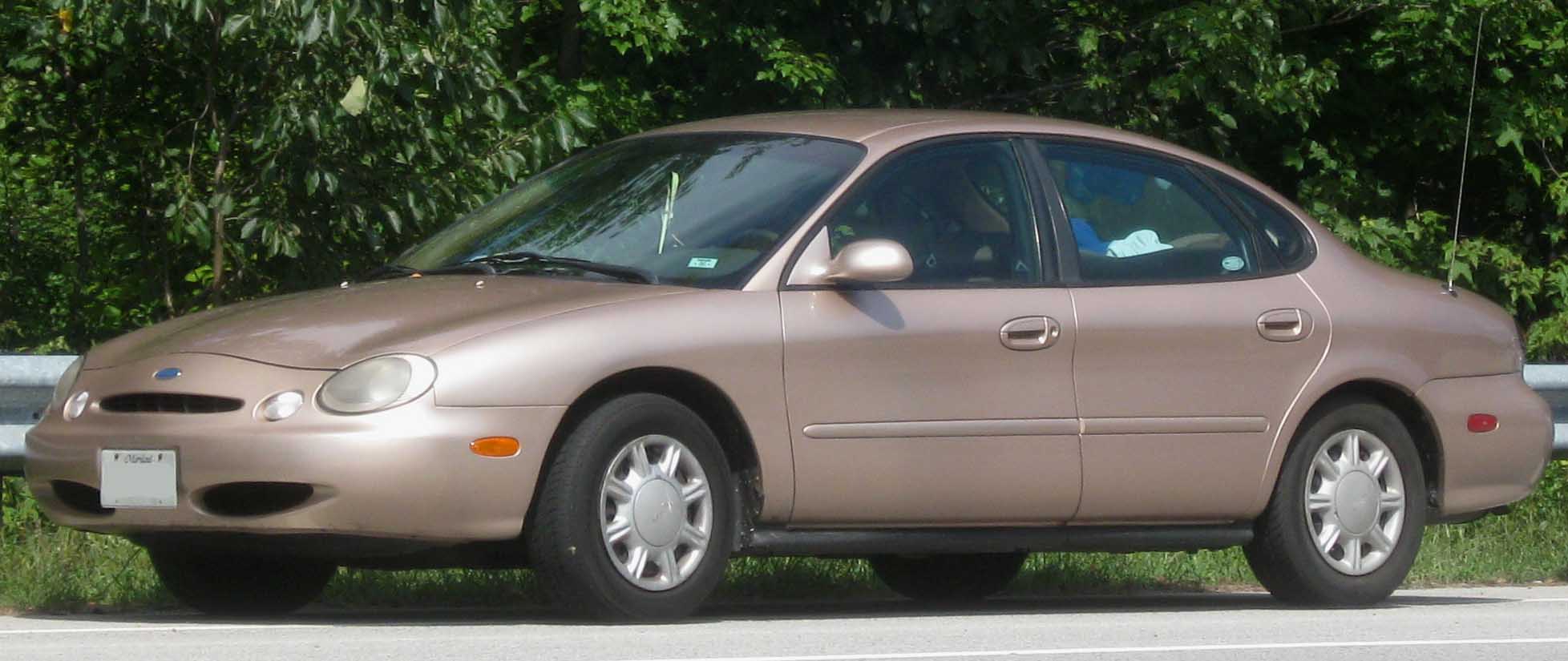
The third-generation Ford Taurus is an automobile that was marketed by Ford for the 1996 to 1999 model years, having entered production in June 1995. While the chassis underpinnings were largely carried over, the redesign gave the Taurus its first complete exterior redesign since its 1986 introduction. As a mid-size car it slotted between the compact Ford Contour and full-size Ford Crown Victoria in Ford's North American model range. The third-generation Taurus was again offered as a four-door sedan and as a five-door station wagon, marketed alongside the Mercury Sable.
In contrast to the evolutionary 1992 update of the second generation, the third generation sought to recreate the class-leading design introduced by the 1986 Taurus, also in response to the 1992 introduction of the Chrysler LH cars. Following the 1986 introduction of the Taurus, the model line had gained two significant competitors — the Toyota Camry and Honda Accord (the latter of which, the Taurus had overtaken as best-selling car in the United States) alongside traditional GM and Chrysler-brand competition. The first Ford to combine round headlights with composite-style housings, the third-generation Taurus adopted oval shapes for multiple design elements of the exterior and interior, including the grille openings, taillamps, the rear window (for the Taurus sedan and Taurus/Sable station wagons), and side window openings for the Taurus/Sable.
The model line was released for sale in late 1995; in contrast to the near-universal acceptance of the first-generation Taurus, the third-generation Taurus received mixed reactions from consumers. For the 1996 model year, the Taurus remained the best-selling car in the United States; however, only 49% of the model line were sold to retail customers, with the rest nearly entirely supported through fleet sales. For 1997, the more conservatively redesigned Toyota Camry overtook the Taurus as the best-selling car in the United States (a position it has held ever since).
The third-generation Taurus was assembled by Ford at its Atlanta Assembly (Hapeville, Georgia) and Chicago Assembly (Chicago, Illinois) facilities.
Development for the third-generation Taurus began in 1991, and its designers and engineers believed that they were faced with a daunting task; they compared completely redesigning the Taurus to repainting the Mona Lisa. Like the first-generation Taurus, the new Taurus was developed by a team effort, in which the exterior and interior designers, engineers, and marketing staff had input on the new car.
Many designs were considered during the development process, from designs that resembled the second generation cars, to more radically styled cars. They eventually decided on a radical new styling scheme based upon oval derived design elements in April 1992 (final approval), which would prove to be the car's Achilles heel in the marketplace. Chief designer Jack Telnack, who oversaw the development of the first and second generation Taurus, said that his Taurus was designed the way it was to stand out in the marketplace, and that the use of the oval was becoming the new global design theme for Ford.
Breaking down and testing competing cars, as well as listening to customer input played a large part in the development of the third-generation Taurus, just like it did during the development of the first generation. Many competing cars were broken down and extensively tested in order for the Taurus to be designed to be superior to them in terms of comfort, performance, and refinement. Most notably, the Toyota Camry and Honda Accord were extensively tested, and the Taurus' suspension was designed to emulate these cars' ride and handling techniques. Customer input played a large part into the design of the third generation Taurus' interior.
The dashboard's design originated from a large number of complaints from customers that the previous Taurus' radio and climate control modules were cluttered with many small and similar feeling buttons, as well as small graphics, which caused the driver to have to look away from the road to be able to operate them properly. As a result, a large portion of the third generation's dash was devoted to the radio and climate control, with each button on these modules containing a unique design, making it easier for the driver to operate the radio and climate control without taking their eyes off the road. This would eventually lead to the creation of the Integrated Control Panel.
Ford Taurus (third generation)
The third-generation Ford Taurus is an automobile that was marketed by Ford for the 1996 to 1999 model years, having entered production in June 1995. While the chassis underpinnings were largely carried over, the redesign gave the Taurus its first complete exterior redesign since its 1986 introduction. As a mid-size car it slotted between the compact Ford Contour and full-size Ford Crown Victoria in Ford's North American model range. The third-generation Taurus was again offered as a four-door sedan and as a five-door station wagon, marketed alongside the Mercury Sable.
In contrast to the evolutionary 1992 update of the second generation, the third generation sought to recreate the class-leading design introduced by the 1986 Taurus, also in response to the 1992 introduction of the Chrysler LH cars. Following the 1986 introduction of the Taurus, the model line had gained two significant competitors — the Toyota Camry and Honda Accord (the latter of which, the Taurus had overtaken as best-selling car in the United States) alongside traditional GM and Chrysler-brand competition. The first Ford to combine round headlights with composite-style housings, the third-generation Taurus adopted oval shapes for multiple design elements of the exterior and interior, including the grille openings, taillamps, the rear window (for the Taurus sedan and Taurus/Sable station wagons), and side window openings for the Taurus/Sable.
The model line was released for sale in late 1995; in contrast to the near-universal acceptance of the first-generation Taurus, the third-generation Taurus received mixed reactions from consumers. For the 1996 model year, the Taurus remained the best-selling car in the United States; however, only 49% of the model line were sold to retail customers, with the rest nearly entirely supported through fleet sales. For 1997, the more conservatively redesigned Toyota Camry overtook the Taurus as the best-selling car in the United States (a position it has held ever since).
The third-generation Taurus was assembled by Ford at its Atlanta Assembly (Hapeville, Georgia) and Chicago Assembly (Chicago, Illinois) facilities.
Development for the third-generation Taurus began in 1991, and its designers and engineers believed that they were faced with a daunting task; they compared completely redesigning the Taurus to repainting the Mona Lisa. Like the first-generation Taurus, the new Taurus was developed by a team effort, in which the exterior and interior designers, engineers, and marketing staff had input on the new car.
Many designs were considered during the development process, from designs that resembled the second generation cars, to more radically styled cars. They eventually decided on a radical new styling scheme based upon oval derived design elements in April 1992 (final approval), which would prove to be the car's Achilles heel in the marketplace. Chief designer Jack Telnack, who oversaw the development of the first and second generation Taurus, said that his Taurus was designed the way it was to stand out in the marketplace, and that the use of the oval was becoming the new global design theme for Ford.
Breaking down and testing competing cars, as well as listening to customer input played a large part in the development of the third-generation Taurus, just like it did during the development of the first generation. Many competing cars were broken down and extensively tested in order for the Taurus to be designed to be superior to them in terms of comfort, performance, and refinement. Most notably, the Toyota Camry and Honda Accord were extensively tested, and the Taurus' suspension was designed to emulate these cars' ride and handling techniques. Customer input played a large part into the design of the third generation Taurus' interior.
The dashboard's design originated from a large number of complaints from customers that the previous Taurus' radio and climate control modules were cluttered with many small and similar feeling buttons, as well as small graphics, which caused the driver to have to look away from the road to be able to operate them properly. As a result, a large portion of the third generation's dash was devoted to the radio and climate control, with each button on these modules containing a unique design, making it easier for the driver to operate the radio and climate control without taking their eyes off the road. This would eventually lead to the creation of the Integrated Control Panel.
Recent media
Recent media