



Community hub
Recent from talks
Contribute something to knowledge base
Content stats: 0 posts, 0 articles, 1 media, 0 notes
Members stats: 0 subscribers, 0 contributors, 0 moderators, 0 supporters
Subscribers
Supporters
Contributors
Moderators
Hub AI
Ford Transit AI simulator
(@Ford Transit_simulator)
Hub AI
Ford Transit AI simulator
(@Ford Transit_simulator)
Ford Transit
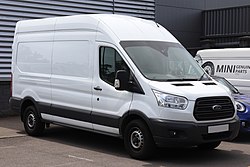
The Ford Transit is a family of light commercial vehicles manufactured by the Ford Motor Company since 1965, primarily as a cargo van, but also available in other configurations including a large passenger van (marketed as the Ford Tourneo in some markets since 1995), cutaway van chassis, and a pickup truck. The vehicle is also known as the Ford T-Series (T-150, T-250, T-350), a nomenclature shared with Ford's other light commercial vehicles, the Ford F-Series trucks, and the Ford E-Series chassis. As of 2015[update], 8 million Transit vans have been sold, making it the third best-selling van of all time and has been produced across four basic platform generations (debuting in 1965, 1986, 2000, and 2013 respectively), with various "facelift" versions of each.
The first product of the merged Ford of Europe, the Transit was originally marketed in Western Europe and Australia. By the end of the twentieth century, it was marketed nearly globally with the exception of North America until 2015 when it replaced the Ford E-Series van. Upon its introduction in North America, the Transit quickly became the best-selling van of any type in the United States, minivan sales included.
That mirrors the success the Transit has achieved in Europe, where it has been the best-selling light commercial vehicle for forty years, and in some countries the term "Transit" has passed into common usage as a generic trademark applying to any light commercial van in the Transit's size bracket.
Predecessor of the British and German-built Transit, the first production Ford to wear the "Transit" badge was a van built in Ford's Cologne plant in Germany. It was introduced in 1953 as FK 1000 (carrying 1,000 kg) with the 1.2-litre Ford sidevalve engine from the contemporary Taunus. In 1955 the engine capacity was enlarged to 1.5 litres. From 1961, this vehicle was called the Ford Taunus Transit. Production of this model ceased in 1965.
On May 9, 1945, the day after the unconditional surrender of the German Wehrmacht in the Second World War, production at Ford Germany in Cologne resumed. Because the production of civilian cars in the British occupied zone was restricted, Ford-Werke AG was limited to the production of trucks until 1948. Those trucks based on the slightly modified war models V 3000 S, B 3000 S and V 3000 A as they were already produced before and during the Second World War in the Ford production facilities in the Third Reich. Those trucks were now called "Rhein" (V8-engined) and "Ruhr" (four-cylinder).
At that time neither Ford of Britain nor Ford Werke AG were 100% subsidiaries of Ford Motor Company in Detroit; before the Second World War each company had its own more or less protected market. After the war, several economical boundaries were abolished and local markets did not exist anymore in the same way that they existed before. With this, Ford of Britain and Ford-Werke AG suddenly became more competitive on the whole European Continent than local market subsidiaries of their parent company in Detroit.
Production of light commercial vehicles began in late 1948, when 148 half-ton delivery vehicles were built. In 1951 Ford Werke AG launched the commercial vehicle series FK, standing for Ford Köln, with different-sized vehicles (FK2000 with 2 tons payload, FK3000 with 3 tons payload, FK3500 with 3.5 tons payload, etc.). The FK series was successor of the "Rhein" and "Ruhr" trucks. In 1953, the FK series were rounded off with the light delivery van FK1000/FK1250 (1ton/1.25tons payload), in competition to the Volkswagen Type 2 VW Bus, the DKW Type F89L Schnellaster or the Tempo Matador.
As usual in the Anglo-Saxon countries in those days, Ford's marketing experts attached more importance to the model/series designation than to the "Ford" label as a brand.[citation needed] Most British Ford products carried no Ford emblem. The commercial vehicles produced at Ford-Werke AG were marketed with the FK logo, while the passenger cars produced from 1948 onwards were offered under the name Taunus referring to the re-produced pre-war model Ford Taunus G93A.
Ford Transit
The Ford Transit is a family of light commercial vehicles manufactured by the Ford Motor Company since 1965, primarily as a cargo van, but also available in other configurations including a large passenger van (marketed as the Ford Tourneo in some markets since 1995), cutaway van chassis, and a pickup truck. The vehicle is also known as the Ford T-Series (T-150, T-250, T-350), a nomenclature shared with Ford's other light commercial vehicles, the Ford F-Series trucks, and the Ford E-Series chassis. As of 2015[update], 8 million Transit vans have been sold, making it the third best-selling van of all time and has been produced across four basic platform generations (debuting in 1965, 1986, 2000, and 2013 respectively), with various "facelift" versions of each.
The first product of the merged Ford of Europe, the Transit was originally marketed in Western Europe and Australia. By the end of the twentieth century, it was marketed nearly globally with the exception of North America until 2015 when it replaced the Ford E-Series van. Upon its introduction in North America, the Transit quickly became the best-selling van of any type in the United States, minivan sales included.
That mirrors the success the Transit has achieved in Europe, where it has been the best-selling light commercial vehicle for forty years, and in some countries the term "Transit" has passed into common usage as a generic trademark applying to any light commercial van in the Transit's size bracket.
Predecessor of the British and German-built Transit, the first production Ford to wear the "Transit" badge was a van built in Ford's Cologne plant in Germany. It was introduced in 1953 as FK 1000 (carrying 1,000 kg) with the 1.2-litre Ford sidevalve engine from the contemporary Taunus. In 1955 the engine capacity was enlarged to 1.5 litres. From 1961, this vehicle was called the Ford Taunus Transit. Production of this model ceased in 1965.
On May 9, 1945, the day after the unconditional surrender of the German Wehrmacht in the Second World War, production at Ford Germany in Cologne resumed. Because the production of civilian cars in the British occupied zone was restricted, Ford-Werke AG was limited to the production of trucks until 1948. Those trucks based on the slightly modified war models V 3000 S, B 3000 S and V 3000 A as they were already produced before and during the Second World War in the Ford production facilities in the Third Reich. Those trucks were now called "Rhein" (V8-engined) and "Ruhr" (four-cylinder).
At that time neither Ford of Britain nor Ford Werke AG were 100% subsidiaries of Ford Motor Company in Detroit; before the Second World War each company had its own more or less protected market. After the war, several economical boundaries were abolished and local markets did not exist anymore in the same way that they existed before. With this, Ford of Britain and Ford-Werke AG suddenly became more competitive on the whole European Continent than local market subsidiaries of their parent company in Detroit.
Production of light commercial vehicles began in late 1948, when 148 half-ton delivery vehicles were built. In 1951 Ford Werke AG launched the commercial vehicle series FK, standing for Ford Köln, with different-sized vehicles (FK2000 with 2 tons payload, FK3000 with 3 tons payload, FK3500 with 3.5 tons payload, etc.). The FK series was successor of the "Rhein" and "Ruhr" trucks. In 1953, the FK series were rounded off with the light delivery van FK1000/FK1250 (1ton/1.25tons payload), in competition to the Volkswagen Type 2 VW Bus, the DKW Type F89L Schnellaster or the Tempo Matador.
As usual in the Anglo-Saxon countries in those days, Ford's marketing experts attached more importance to the model/series designation than to the "Ford" label as a brand.[citation needed] Most British Ford products carried no Ford emblem. The commercial vehicles produced at Ford-Werke AG were marketed with the FK logo, while the passenger cars produced from 1948 onwards were offered under the name Taunus referring to the re-produced pre-war model Ford Taunus G93A.
Recent media
Recent media