


Community hub
Recent from talks
Contribute something to knowledge base
Content stats: 0 posts, 0 articles, 1 media, 0 notes
Members stats: 0 subscribers, 0 contributors, 0 moderators, 0 supporters
Subscribers
Supporters
Contributors
Moderators
Hub AI
Fordyce spots AI simulator
(@Fordyce spots_simulator)
Hub AI
Fordyce spots AI simulator
(@Fordyce spots_simulator)
Fordyce spots
Fordyce spots (also termed Fordyce granules) are harmless and painless visible sebaceous glands typically appearing as white/yellow small bumps or spots on the inside of lips or cheeks, gums, or genitalia. They are common, and are present in around 80% of adults. Treatment is generally not required and attempts to remove them typically result in pain and scarring.
Their cause is unclear, and they are not associated with hair follicles. Diagnosis is done by visualisation. They may appear similar to genital warts or molluscum. They were first described in 1896 by American dermatologist John Addison Fordyce.
Fordyce spots are named after the American dermatologist John Addison Fordyce, who first described them in 1896.
Sebaceous glands are normal structures of the skin but may also be found ectopically in the mouth, where they are referred to as oral Fordyce granules or ectopic sebaceous glands. On the foreskin, they are called Tyson's glands, but should not be confused with hirsuties coronae glandis.
When they appear on the penis, they are called penile sebaceous glands.
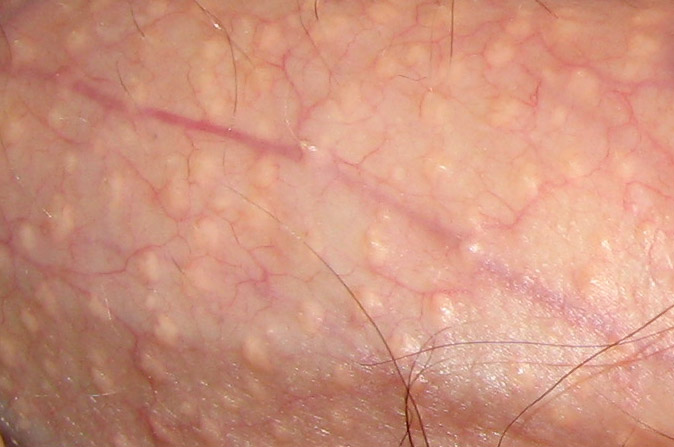
They appear as small, painless, raised, pale, red or white spots or bumps 1 to 3 mm in diameter that may appear on the scrotum, shaft of the penis, or on the labia, as well as the inner surface (retromolar mucosa) and vermilion border of the lips of the face. They are not associated with any disease or illness, nor are they infectious but rather they represent a natural occurrence on the body. Therefore, no treatment is required. People with this condition sometimes consult a dermatologist because they are worried they may have a sexually transmitted infection (especially genital warts) or some form of cancer.
On the shaft of the penis, Fordyce spots are more visible when the skin is stretched, and may only be noticeable during an erection. The spots can also appear on the skin of the scrotum.
Oral Fordyce granules appear as rice-like granules, white or yellow-white in color. They are painless papules (small bumps), about 1–3 mm in greatest dimension. The most common site is along the line between the vermilion border and the oral mucosa of the upper lip, or on the buccal mucosa (inside the cheeks) in the commissural region, often bilaterally. They may also occur on the mandibular retromolar pad and tonsillar areas, but any oral surface may be involved. There is no surrounding mucosal change. Some patients will have hundreds of granules while most have only one or two.[citation needed]
Fordyce spots
Fordyce spots (also termed Fordyce granules) are harmless and painless visible sebaceous glands typically appearing as white/yellow small bumps or spots on the inside of lips or cheeks, gums, or genitalia. They are common, and are present in around 80% of adults. Treatment is generally not required and attempts to remove them typically result in pain and scarring.
Their cause is unclear, and they are not associated with hair follicles. Diagnosis is done by visualisation. They may appear similar to genital warts or molluscum. They were first described in 1896 by American dermatologist John Addison Fordyce.
Fordyce spots are named after the American dermatologist John Addison Fordyce, who first described them in 1896.
Sebaceous glands are normal structures of the skin but may also be found ectopically in the mouth, where they are referred to as oral Fordyce granules or ectopic sebaceous glands. On the foreskin, they are called Tyson's glands, but should not be confused with hirsuties coronae glandis.
When they appear on the penis, they are called penile sebaceous glands.
They appear as small, painless, raised, pale, red or white spots or bumps 1 to 3 mm in diameter that may appear on the scrotum, shaft of the penis, or on the labia, as well as the inner surface (retromolar mucosa) and vermilion border of the lips of the face. They are not associated with any disease or illness, nor are they infectious but rather they represent a natural occurrence on the body. Therefore, no treatment is required. People with this condition sometimes consult a dermatologist because they are worried they may have a sexually transmitted infection (especially genital warts) or some form of cancer.
On the shaft of the penis, Fordyce spots are more visible when the skin is stretched, and may only be noticeable during an erection. The spots can also appear on the skin of the scrotum.
Oral Fordyce granules appear as rice-like granules, white or yellow-white in color. They are painless papules (small bumps), about 1–3 mm in greatest dimension. The most common site is along the line between the vermilion border and the oral mucosa of the upper lip, or on the buccal mucosa (inside the cheeks) in the commissural region, often bilaterally. They may also occur on the mandibular retromolar pad and tonsillar areas, but any oral surface may be involved. There is no surrounding mucosal change. Some patients will have hundreds of granules while most have only one or two.[citation needed]
Recent media
Recent media