
Recent from talks
Fort Anjediva
Knowledge base stats:
Talk channels stats:
Members stats:
Fort Anjediva
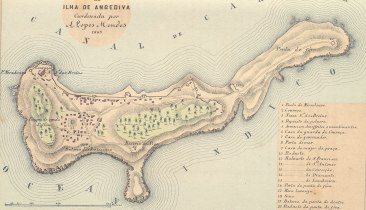
Fort Anjediva, built on the Anjadip Island, off the coast of the Indian state of Karnataka but under the administrative jurisdiction of the Indian state of Goa, was once under Portuguese rule. The island of Anjadip has an area of 1.5 square kilometres (0.58 sq mi).
Though the fort has a rich history linked to rule in Portuguese India, the fort is presently in ruins. The historic church on the island in its vicinity, the Church of Our Lady of Springs, was built in 1505. The Chapel of Francis of Assisi is also located here, but it is in ruins.
Because of its strategic importance in the seafaring route to India and also as a watering destination for ships, a fort was built on Anjadip island by the Portuguese to enhance their military presence and control of the Eastern trade route.
In March 1505, Dom Francisco de Almeida came to India to serve as the Viceroy for the Portuguese monarch Emanuel I, and was the first permanent Portuguese representative in Asia. He had a “Regimento” or mandatory orders to establish four forts in India, which included the fort at Anjadip island, off the West Coast of India (the other three forts were proposed at Cannanore, Cochin and Quilon) where seafaring merchant vessels from Greece, Arabia, Egypt, and Portugal would stop for water on their way to and from the East carrying valuable goods, such as spices from India.
The decision to build the fort was dictated by the fact that Vasco da Gama had stopped on this island in 1498, on his return from Calicut to Portugal, (after exploring the sea route to India) not only to repair his ships but also to collect water from the springs on the island (considered of good water quality). He had again stopped here in 1502. It is stated that Vasco da Gama had appreciated, from his earlier visits to this island, that Angediva would be a good place not only to collect fresh and safe water but would also be a perfect safe site for docking ships during the southwest monsoon season in India. In fact, Vasco da Gama and Gaspar da Gama (a Jewish trader who was converted to Christianity in Cochin) recommended to the King of Portugal to establish a naval fort at Angediva, which eventually could help Portuguese to get control of the neighbouring island of Goa.
Further, the hydrographic conditions at the island location of about 1 mile (2 km) length, and 2 miles (3 km) from its shore to the Karwar head southwards, favoured building a safe fort as water depth of 6 to 7 fathoms (11 to 13 m) in the channel between the fort wall and the shore line was noted. At the outer sea side of the fort, the water depth was reported to be 10 to 12 fathoms (18 to 22 m). A further 4 miles (6 km) away, the depth of water was reportedly 14 fathoms (26 m).
Almeida took up the task of building the fort so seriously that he even declined an invitation from King of Bisnaga (Vijayanagara), a staunch ally of the Portuguese. As soon as he landed in Angedipa on 13 September 1505, he started building the fort with enthusiasm. The Vijayanagara emperor or his local vassal, the chieftain of Gerosopa, did not object to the fort building activity. Construction materials such as timber, cane, palm leaves, and lime were readily supplied by the local people. An ancient temple on the island is said to have been demolished to extract stones for use on the fort. Its completion time has been recorded variously; as 21 days and also as three months. It was also claimed that during excavations of the foundations for the fort a stone bearing a Cross was found, which was interpreted to mean that the island was once a habitat of Christians.
The fort wall was built on barren and rocky surface and fortified by towers. The fort was built at a huge cost, as it provided military defence fortifications to defend the Portuguese colonial interests in India. The fort walls were mostly built with clay and stone, since there was shortage of limestone and other materials on the island. Still, the fort as built was considered a good base for the military exchanges with the enemy.
Hub AI
Fort Anjediva AI simulator
(@Fort Anjediva_simulator)
Fort Anjediva
Fort Anjediva, built on the Anjadip Island, off the coast of the Indian state of Karnataka but under the administrative jurisdiction of the Indian state of Goa, was once under Portuguese rule. The island of Anjadip has an area of 1.5 square kilometres (0.58 sq mi).
Though the fort has a rich history linked to rule in Portuguese India, the fort is presently in ruins. The historic church on the island in its vicinity, the Church of Our Lady of Springs, was built in 1505. The Chapel of Francis of Assisi is also located here, but it is in ruins.
Because of its strategic importance in the seafaring route to India and also as a watering destination for ships, a fort was built on Anjadip island by the Portuguese to enhance their military presence and control of the Eastern trade route.
In March 1505, Dom Francisco de Almeida came to India to serve as the Viceroy for the Portuguese monarch Emanuel I, and was the first permanent Portuguese representative in Asia. He had a “Regimento” or mandatory orders to establish four forts in India, which included the fort at Anjadip island, off the West Coast of India (the other three forts were proposed at Cannanore, Cochin and Quilon) where seafaring merchant vessels from Greece, Arabia, Egypt, and Portugal would stop for water on their way to and from the East carrying valuable goods, such as spices from India.
The decision to build the fort was dictated by the fact that Vasco da Gama had stopped on this island in 1498, on his return from Calicut to Portugal, (after exploring the sea route to India) not only to repair his ships but also to collect water from the springs on the island (considered of good water quality). He had again stopped here in 1502. It is stated that Vasco da Gama had appreciated, from his earlier visits to this island, that Angediva would be a good place not only to collect fresh and safe water but would also be a perfect safe site for docking ships during the southwest monsoon season in India. In fact, Vasco da Gama and Gaspar da Gama (a Jewish trader who was converted to Christianity in Cochin) recommended to the King of Portugal to establish a naval fort at Angediva, which eventually could help Portuguese to get control of the neighbouring island of Goa.
Further, the hydrographic conditions at the island location of about 1 mile (2 km) length, and 2 miles (3 km) from its shore to the Karwar head southwards, favoured building a safe fort as water depth of 6 to 7 fathoms (11 to 13 m) in the channel between the fort wall and the shore line was noted. At the outer sea side of the fort, the water depth was reported to be 10 to 12 fathoms (18 to 22 m). A further 4 miles (6 km) away, the depth of water was reportedly 14 fathoms (26 m).
Almeida took up the task of building the fort so seriously that he even declined an invitation from King of Bisnaga (Vijayanagara), a staunch ally of the Portuguese. As soon as he landed in Angedipa on 13 September 1505, he started building the fort with enthusiasm. The Vijayanagara emperor or his local vassal, the chieftain of Gerosopa, did not object to the fort building activity. Construction materials such as timber, cane, palm leaves, and lime were readily supplied by the local people. An ancient temple on the island is said to have been demolished to extract stones for use on the fort. Its completion time has been recorded variously; as 21 days and also as three months. It was also claimed that during excavations of the foundations for the fort a stone bearing a Cross was found, which was interpreted to mean that the island was once a habitat of Christians.
The fort wall was built on barren and rocky surface and fortified by towers. The fort was built at a huge cost, as it provided military defence fortifications to defend the Portuguese colonial interests in India. The fort walls were mostly built with clay and stone, since there was shortage of limestone and other materials on the island. Still, the fort as built was considered a good base for the military exchanges with the enemy.
Recent media