Hubbry Logo
Fort DenisonFort DenisonMain
Open search
Fort Denison
Community hub
Fort Denison
logo
8 pages, 0 posts
0 subscribers
Be the first to start a discussion here.
Fort Denison
Fort Denison
from Wikipedia

Fort Denison, part of the Sydney Harbour National Park, is a heritage-listed former penal site and defensive facility occupying a small island located north-east of the Royal Botanic Garden and approximately 1 kilometre (0.62 mi) east of the Opera House in Sydney Harbour, New South Wales, Australia. The island is also known as Mattewanye or Muddawahnyuh in the Eora language, and as Pinchgut Island.

Key Information

The site contains time gun, navigational aids and tide gauge facilities. Correctional and military facilities were designed by George Barney and built from 1840 to 1862 by William Randle. The property is owned by the Office of Environment & Heritage, an agency of the Government of New South Wales. It was added to the New South Wales State Heritage Register on 2 April 1999.[2] In 1978 the former fortress was listed on the (now defunct) Register of the National Estate,[1] and is currently used as a national park, nature reserve, tourist facility, and as a function space.

History

[edit]

Prior to European settlement, the island had the Eora name Mattewanye (sometimes Mallee’wonya).[citation needed]

Prison

[edit]
Pinchgut
Map
LocationSydney Harbour, New South Wales, Australia
StatusClosed
Security classMaximum; isolation
Opened1788
Former nameRock Island
Managed byNew South Wales Colonial Government

After the First Fleet arrived in 1788, Governor Phillip and his advocate-general used the name "Rock Island". In 1788, a convict named Thomas Hill was sentenced to a week on bread and water in irons there. The island came to be known as "Pinchgut".[3] Once a 15-metre (49 ft) high or higher sandstone islet, the rock was levelled by convicts under the command of Captain George Barney, the civil engineer for the colony, who quarried it for sandstone to construct nearby Circular Quay.

In late 1796 the Governor had installed a gibbet on Pinchgut. A convict to be hanged and then gibbeted there was Francis Morgan. In 1793, the British transported him to New South Wales for life as punishment for a murder. The authorities in NSW executed Morgan for bashing Simon Raven to death in Sydney on 18 October 1796.[4] On 30 November 1796, Morgan was hanged; following his execution, his body was hung in chains (gibbeting) on Pinchgut. His skeleton was still hanging there four years after his execution. He said to the hangman that the only thing worth mentioning was the superb view of the harbour from his high elevation, and that he was sure there were no waters the world over to compare with it for beauty.

Military fortress

[edit]

In 1839, two American warships entered the harbour at night and circled Pinchgut Island. Concern with the threat of foreign attack caused the government to review the harbour's inner defences. Barney, who had earlier reported that Sydney's defences were inadequate, recommended that the government establish a fort on Pinchgut Island to help protect Sydney Harbour from attack by foreign vessels. Fortification of the island began in 1841 but was not completed. Construction resumed in 1855 because of fear of a Russian naval attack during the Crimean War, and was completed on 14 November 1857. The newly built fort then took its current name from Sir William Thomas Denison, the Governor of New South Wales from 1855 to 1861.

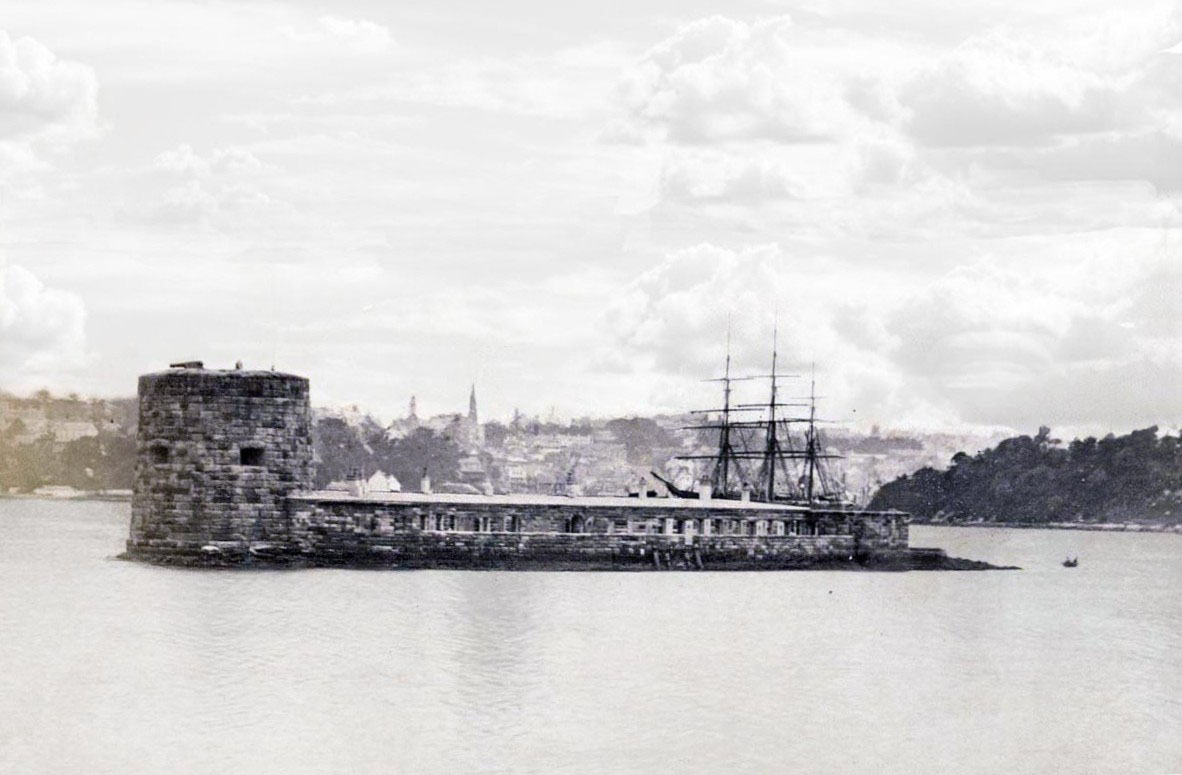
The fortress features a distinctive Martello tower, the only one ever built in Australia and the last one ever constructed in the British Empire. It was constructed using 8,000 tonnes (7,900 long tons) of sandstone from nearby Kurraba Point, Neutral Bay. The tower's walls are between 3.3–6.7 metres (11–22 ft) thick at the base and 2.7 metres (8 ft 10 in) thick at the top. However, developments in artillery rendered the fort largely obsolete by the time it was completed. The tower itself had quarters for a garrison of 24 soldiers and one officer. Fort Denison's armament included three 8-inch (200 mm) muzzle loaders in the tower, two 10-inch (250 mm) guns, one on a 360-degree traverse on the top of the tower and one in a bastion at the other end of the island, and twelve 32-pound (15 kg) cannons in a battery between the base of the tower and the flanking bastion.

Eventually all the guns were removed, except for the three 8-inch (200 mm) muzzle-loading cannons in the gun room in the tower, which were installed before construction was complete. The passages within the tower are too narrow to permit these to be removed. However, from the beginning the three cannons were of limited utility. The embrasures for the cannons were too small to use the guns effectively and by the time a cannon was loaded the ship it was to fire on would have sailed past. Lastly, the guns' recoil was too powerful for the small room.[citation needed]

In 1906, a saluting gun (pictured below) was transferred from Dawes Point to Fort Denison.

In 1913 a lighthouse beacon built in Birmingham, England, and shipped to Sydney, replaced the 10-inch (250 mm) gun on the roof of the tower. The light is called Fort Denison Light, which is still in use.

Fort Denison circa 1930

In May 1942, three Japanese two-man midget-submarines attacked Sydney Harbour. When the US Navy cruiser USS Chicago fired on the Japanese, some of its 5-inch (130 mm) shells hit Fort Denison, causing the tower minor damage which remains visible.

Explosive prank

[edit]

In October 1900, as the Boer war raged in Africa, the White Star Line ship SS Medic sailed into Sydney Harbour and dropped anchor in Neutral Bay. One night, the fourth officer, Charles Lightoller and two shipmates rowed to Fort Denison and climbed the tower with a plan to fool locals into believing a Boer raiding party was attacking Sydney. They hoisted a makeshift Boer flag on the lightning conductor and fired a harmless wad of cotton waste from one of the 8-inch cannons.[5][6] The blast shattered a few of the fort's windows but caused no other damage. Lightoller was never apprehended but confessed to his company's superiors and related the whole story in an autobiography.[7] He was transferred to the Atlantic route and went on to be the second officer of the RMS Titanic and the most senior officer to survive the 1912 sinking of the ship. He was a key witness at both the British and American inquiries into the disaster.

Current use

[edit]

Recent restorative works

[edit]

Since 1992, the NSW National Parks & Wildlife Service, which manages the site, has spent around A$2m conserving and upgrading the facilities. EnergyAustralia also made a significant contribution for the work via the Foundation for National Parks and Wildlife.[8]

Following publication of a conservation plan, further renovation commenced in 1999 and was completed in 2001. The conservation and adaptive re-use of the island was awarded the NSW Royal Australian Institute of Architects (RAIA) Conservation Award; a Commendation in the National RAIA Awards; and a National Trust Heritage Award in 2001.

Increased harbour traffic has already destroyed the slipway. Furthermore, the porous sandstone drinks in the salt right down to the fort's foundations. In 2007 the government announced a $1.5 million rescue package. Fort Denison is now home to more than 100 birds.

Viewing west from the southern bastion

Fort Denison – Muddawahnyuh remains closed to visitors for service upgrades and conservation works until mid-2025. Fort Denison is a museum, tourist attraction, restaurant, and popular location for wedding receptions and corporate events. The tourist facility contains an exhibition of the island's history from Aboriginal times. Access to Fort Denison is via a ferry that departs Wharf 6 at Circular Quay every 45 minutes, 7 days a week. The price of the ferry ticket includes the landing fee. Guided tours of the island, including the Martello tower are at an additional cost. NSW National Parks & Wildlife Services conducts the tours.

In 2004 the NSW National Parks & Wildlife Service restored the lighthouse beacon, which is still in use and supports operation of a Harbour Navigational Facility, with tide gauge, navigation channel markers, foghorn and beacon, established in the mid-19th century. The Bureau of Meteorology operates a weather facility from the island and publishes observations at half-hourly intervals on its website.[9]

The custom of firing a gun daily at 1pm began in 1906 to enable sailors to set their ship's chronometers correctly. The daily gun continued until World War II when the authorities stopped it for fear of alarming residents. The practice recommenced in 1986.[10]

Restaurant on the Island

[edit]

The Fort Denison Restaurant was opened on the island in 2006, although the restaurant lease expired in June 2017 and is yet to be renewed. Throughout the years since it has been voted in the top five waterfront restaurants worldwide by The Sydney Morning Herald, and was open for lunch seven days a week year round, dinners on a Sunday, and for special events and occasions which can be found on their website.[11] Bookings for major occasions, such as New Year's Eve, were coveted.

[edit]

Fort Denison was the location of the 1959 film The Siege of Pinchgut, released in the United States as Four Desperate Men. Directed by Harry Watt, written by Jon Cleary and starring Aldo Ray, the production was the final Australian film of the British-based Ealing Studios. The island also featured as the base of operations for Neville Savage in the sixth episode of the Australian children's television show Mission Top Secret. Fort Denison was often seen in the television series Water Rats. One episode in season two of the show, End of the Line, featured a party on the island.

Description

[edit]

Fort Denison on Sydney Harbour is within the visual catchment of the Sydney Opera House, the Sydney Harbour Bridge, the Royal Botanic Garden and the Sydney Harbour Naval Precinct.[12][2] Fort Denison is the only Sydney Harbour island which is no longer described as an island. Even Garden Island, now visually part of the mainland (and anything but a garden) is still known as an island. The island known as Mattewanye (small rocky island) to Aborigines and Rock Island to the first settlers, is now popularly known as Fort Denison and viewed as a built artefact rather than an island.[2]

From a distance no evidence of its original island character is apparent, except perhaps scattered rocks at low tide. However, on close inspection the sandstone bedrock visible below the south west battery reveals part of the rock of the island, particularly when combined with the pictorial evidence provided by drawings such as that by Barrington in 1802.[2]

The Fort
The visual impact of the fort is a combination of the strong vertical mass of the Martello tower and the equally strong horizontal lines of the low barrack and battery buildings. The two distinct building forms reflects the history of the staged Fort construction; which progressed from the original horizontal form of the battery, and later construction of the barracks and Martello tower. The tower, which only lost its dominant role in marking the water entrance to the city with the construction of the Sydney Opera House, was built with an open gun platform (terreplein) which surmounted two internal levels. A section through the tower, shows the navigational light which replaced the upper cannon in 1913. The lower internal level contained rooms for the storage of gunpowder and provisions and the middle level still houses the three original cannons. Internal tower circulation is via a spiralling staircase that connects the three tower levels. External access to the tower is through a single external door from the upper terrace level battery and bastion.[2]
Three major elements comprise the strong horizontal section of the fort; the battery and bastion, the barracks and terrace.[2]
Gun Battery and Bastion
The outward facing defensive side of the fort known as the gun battery and bastion confronted incoming ships. It is constructed out of the island's sandstone bedrock. The battery consists of an open working area which services a series of nine gun placements and corresponding slanted firing openings which are equally positioned along the raised parapet wall of the battery. An underground water tank has been cut into the bedrock of the battery. The bastion located at the southern end of the battery was constructed to house a single cannon set behind a raised stone parapet. The cannon was located on a raised circular revolving mount to maximise the cannon's aim of fire.[2]
Wet Ditch and Breakwater
A wet ditch and breakwater formed by sandstone blocks separates the fort from the open harbour channel. Beyond this is a breakwater which surrounds the whole island which moderates the wave action against the stone fabric of the fort.[2]
Barrack
The main single storey building is the barrack, its eight chimneys indicate its original accommodation purpose. The barracks are built into cut back bedrock and contain a row of single rooms used for military bunk-style accommodation for the lower ranks as well as accommodation for two separate officers' quarters. A central breezeway and vault covered staircase allows access from the barracks and lower terraces to the upper terrace battery, bastion and Martello tower. The two end rooms adjoining the barracks, known as the Tide Gauge Room to the north and the West Room to the south, were constructed soon after the completion of the barracks. The loopholes, or angled openings, were designed to enable the defensive fire whilst defending against enemy attack.[2]
Terrace
The lower north west facing terrace is constructed on the same level as the barracks. It was probably built on rubble fill which is contained by a low stone wall.[2]
The terrace is open and not defensive in nature, as it faces away from the open sea and potential attack. It currently has a bitumen surface and several small planted garden beds. Garden beds were constructed on this terrace during the 20th century as part of the domestication of the fort by the Sydney Harbour Trust and later Maritime Services Board caretakers. Two sewerage treatment units which service the toilets are concealed in the garden beds at either end of the barracks.[2][13]
Plantings
A Canary Island date palm (Phoenix canariensis) planted in one raised garden bed on the terrace's western side and a fruiting fig tree (Ficus carica cv.) at the south-west base of the Martello Tower are the only trees on Fort Denison.[14][2]
An external cannon is on the Eastern Terrace. A tall flag pole with side spars runs three permanently flown flags on this terrace.[12][2]

Condition

[edit]

As at 26 May 2014, the physical condition is excellent. Archaeological potential is high.[2] Published material on such towers in the English speaking world suggests that this may well be the most intact tower.[15][2]

Modifications and dates

[edit]

The following modifications have been made to Fort Denison:[2]

  • 1840–1842 – construction of battery
  • 1856–1858 – construction of battery, barrack and tower and bastion
  • 1858–1862 – construction of terrace, west room and tide gauge room
  • 1917 – construction of slipway

Heritage listing

[edit]

Fort Denison was listed on the New South Wales State Heritage Register on 2 April 1999 .[2]

Tide gauge

[edit]

Tides have been measured at Fort Denison since 1857 on completion of the fort, initially using a bench mark cut into the stonework of the Martello Tower. From 1867 successive instruments were used as tide measuring technology developed.[16] (The measurements since 1914 are graphed by Bureau of Meteorology).[17]

The Fort Denison photographs below show float activated tide gauge instruments in a cabinet and the system's stilling well.[18] A wire connected to the upper drum mechanism passes out through the bottom right of the cabinet and runs over a pulley to drop down to the float system in the large pipe in the well. This system is now obsolete at Fort Denison but maintained as a museum exhibit. To the right of the large pipe in the well is an enclosed pipe which rises to the active modern system.

Tide heights and times at Fort Denison are the primary base referent for published tide information for other places in the state of New South Wales.

[edit]

See also

[edit]

References

[edit]

Further reading

[edit]
[edit]
Revisions and contributorsEdit on WikipediaRead on Wikipedia
from Grokipedia
Fort Denison is a heritage-listed fortification and former defensive facility situated on a small rocky island in the central area of Sydney Harbour, , . Originally known to the people as Muddawahnyuh, meaning "rocky island," the site was renamed Pinchgut Island in the early colonial period and used as a place of punishment for convicts, including public executions. Construction of the fort began in 1840 under the design of colonial architect George Barney and was substantially completed between 1855 and 1857 using over 8,000 tonnes of local sandstone quarried from , with the structure built by convict laborer William Randle. It was renamed Fort Denison in 1857 after Sir William Thomas Denison, the Governor of from 1855 to 1861, and equipped with three 8-inch muzzle-loading cannons to defend against feared Russian naval incursions during the (1853–1856). The fort represents one of the last and most intact Martello towers constructed worldwide, a circular defensive structure typical of 19th-century coastal fortifications, though it was never used in active combat for its intended purpose and was largely abandoned by the 1870s as more advanced defenses rendered it obsolete. During , on 31 May 1942, it sustained minor damage from when the cruiser USS Chicago mistakenly shelled the island amid the chaos of a Japanese midget submarine attack in the harbour, with the scars still visible today. Since the early , the site has served non-military roles, including as a tide-recording station since 1857 and firing a time gun daily at 1:00 p.m. since 1906 to synchronize ship chronometers. Today, Fort Denison is managed by the National Parks and Wildlife Service as part of Harbour National Park and holds national and international heritage significance for its rare, well-preserved 19th-century and role in early colonial defense strategies. It attracts visitors via ferry for guided tours highlighting its history, though access has been temporarily closed since early 2025 for essential conservation and wharf upgrade works to preserve the structure against , with reopening expected in early 2026 and plans for a new restaurant. The island also continues to support meteorological observations and is recognized as a key landmark visible from iconic sites like the and Harbour Bridge.

History

Indigenous and early colonial period

Prior to European colonization, the small island now known as Fort Denison held cultural significance for the Nation, whose territory encompassed Harbour and surrounding areas. Referred to as Mattewanye or Muddawahnyuh in the Eora language, the name translates to "small rocky island" or "rocky island," reflecting its physical characteristics as a natural used as a gathering and resort place by local Aboriginal peoples. The arrival of the in 1788 marked a profound disruption for the , Guringai, and Darug peoples, whose traditional lands around Harbour were rapidly appropriated for settlement, leading to displacement, violent conflicts, and the breakdown of ecological and social systems essential to their way of life. European settlers soon repurposed the island, renaming it Pinchgut Island—a term derived from the severe punishment of confining recalcitrant convicts there on meager rations of bread and water alone, beginning in the 1790s as a remote outpost for short-term isolation. This penal role was underscored by public executions, including the 1796 hanging and gibbeting of Irish Francis Morgan for , whose body was displayed in chains on the island's gibbet as a deterrent to incoming ships; the remains reportedly lingered as a grim spectacle into 1803, drawing early colonial onlookers and cementing Pinchgut's reputation as a site of harsh punishment. Throughout the early , the island saw sporadic utilization for convict confinement, storage of provisions, and occasional isolation measures, prior to the initiation of formal fortification plans in the amid growing concerns over harbor defense.

Construction and naming

The fortification of the small rocky island known as Pinchgut began in 1840 under the direction of Colonial Architect Captain George Barney, who oversaw the initial leveling of the 25-meter-high outcrop to create a platform for a gun battery, utilizing convict labor from the iron gang. Work stalled after this preliminary phase but resumed vigorously in 1855, driven by anxieties over a potential Russian naval assault on Harbour during the , prompting Governor Sir William Thomas Denison to prioritize harbor defenses. Construction accelerated under Barney's design, now as Lieutenant Colonel, with masonry contractor William Randle leading the build of the and associated barracks using approximately 8,000 tons of local quarried from sites like Kurraba Point in . The tower, completed on 14 November 1857, featured walls 3.3 to 6.7 meters thick at the base tapering to 2.7 meters at the top, forming Australia's sole and the last such structure erected in the . Modeled on the circular developed for British coastal defenses in the early —such as those in and —this design was uniquely adapted with an open gun battery platform below the tower to mount directly overlooking the harbor entrance. Upon completion, the fort was officially named Fort Denison on 14 1857 to honor William Thomas Denison (1855–1861), whose advocacy had secured funding and expedited the project; it had previously been referred to as Fort Pinchgut, echoing the island's earlier use as a site for short-term penal confinement in the colonial era. Initial armaments included three 8-inch muzzle-loading guns, two 10-inch guns, and twelve 32-pounder cannons, positioning the fort as a key element in Harbour's integrated defense network alongside structures like Fort Macquarie and the battery at Bradley's Head.

Military service and incidents

Fort Denison was activated in 1857 as a vital element of Sydney Harbour's fixed defenses, constructed in response to fears of Russian naval incursions during the . The fort served to protect the harbor entrance alongside other fortifications, with its providing a strategic vantage for artillery. It was initially manned by gunners from the colonial military, including detachments of the Royal Artillery, who operated the installation until the in 1901, when responsibility transferred to the newly formed Commonwealth forces under the Sydney Harbour Fortifications command. Throughout the late 19th century, the fort's armaments underwent upgrades to enhance its defensive capabilities against evolving naval threats, incorporating 8-inch and 10-inch muzzle-loading mounted in the tower and bastions for long-range fire. These improvements included two 10-inch shell guns and an 8-inch shell gun, supplementing earlier 32-pounder cannons, and were intended to deter ironclad warships approaching the harbor. The upgrades reflected broader advancements in artillery technology during the period, though the fort's fixed position limited its tactical flexibility. A memorable incident highlighting the fort's symbolic role occurred in October 1900, during heightened tensions from the Second Boer War. Crew members from the RMS Medic, including Fourth Officer —who would later serve as Second Officer on the Titanic—rowed to the island under cover of night, climbed the tower, hoisted a Boer flag, and fired a using a wad of waste. The gunshot sparked widespread alarm in , shattering windows but causing only superficial damage. The prank led to a reprimand for the perpetrators but underscored public anxieties about harbor security. Fort Denison played a limited role during , with its guns largely inactive due to the shift toward mobile defenses. However, on the night of 31 May 1942, during the Japanese midget submarine raid on Sydney Harbour, the tower sustained shrapnel damage from anti-submarine gunfire, including rounds from the USS Chicago targeting the intruders. The scars from this remain visible on the structure today, marking the fort's final brush with active conflict. By the 1930s, rapid advancements in —such as long-range , , and mobile —had rendered static coastal forts like Denison obsolete for frontline defense. The installation was formally decommissioned around this time, though a small remained for occasional training exercises until its complete retirement from military use shortly thereafter.

Architecture and features

Design and structure

Fort Denison occupies a small island in the middle of Harbour, originally a rocky outcrop leveled to create a platform for its fortifications. The core structure is a , the only one constructed in and the last in the , accompanied by a barrack block and gun battery. The island's defenses were arranged to provide comprehensive coverage of the harbor approaches, with the tower serving as the central element for elevated firepower. The tower included a middle-level gun room and quarters for a of 24 soldiers and one officer. The features robust masonry walls measuring 3.3 to 6.7 meters thick at the base, tapering to 2.7 meters at the top, designed to withstand prolonged bombardment. Constructed from approximately 8,000 tonnes of blocks quarried at Kurraba Point in , the tower rises on the leveled 25-meter-high rock platform, enabling 360-degree visibility and enfilading across the harbor. The surrounding battery, positioned between the tower base and a flanking , incorporated earthen elements integrated into the excavated rock for additional gun emplacements, supporting a self-contained defensive system capable of sustaining a . Access to the island was facilitated by a landing wharf, allowing supply by vessel while limiting landward approaches.

Armaments and modifications

Upon its completion in 1857, Fort Denison was equipped with an 8-inch shell gun on a traversing carriage atop the roof, three 32-pounder shot guns in the tower on carriages, and additional guns including nine 32-pounders in the terreplein battery, one 12-pounder in the tower, and two 10-inch shell guns in battery positions. These shell guns were capable of firing 100-pound projectiles at ranges of up to 3 kilometers, providing defensive coverage across Harbour. In the late 19th century, the fort's armaments underwent upgrades to address evolving naval threats, including the installation of searchlights to enhance nighttime surveillance capabilities. By 1900, however, many emplacements were removed as advancements in rifled rendered the older guns obsolete. The 20th century brought further adaptations, with the tower roof converted in 1913 to serve as a by replacing the gun with a acetylene lantern, marking the shift toward navigational functions. During , from 1941 to 1943, the site saw temporary reinforcements including a QF 3-inch 20 cwt anti-aircraft gun mounted on a concrete pad in the for harbor defense, which was subsequently dismantled after the war. Among the surviving artifacts are three original 32-pounder guns, which remain mounted in the tower's gun room and have been restored for preservation. The underground magazines, designed to store ammunition securely, are intact and feature preserved elements including simulated original powder barrels to illustrate historical storage practices. Following the removal of most heavy ordnance between 1899 and 1900, the site was repurposed in the early for light signals and tide gauges to support maritime operations.

Preservation and current roles

Heritage status and restoration efforts

Fort Denison holds multiple heritage listings that underscore its national and state-level significance as a 19th-century defensive structure. It was added to the Register of the National Estate on 21 March 1978 (place ID 1856), a now-defunct that recognized its historical value prior to the establishment of the current National Heritage List. On 2 April 1999, it was inscribed on the State Heritage Register (item #5045472), affirming its exceptional integrity as an intact example of colonial military architecture. Since 1995, the site has been managed as part of Harbour by the NSW National Parks and Wildlife Service, integrating it into a broader protected landscape that preserves harbor foreshores and islands. Conservation efforts at Fort Denison are guided by the Fort Denison Conservation Management Plan, first developed in the 1990s and updated in January 2019, which adheres to the Australia ICOMOS Burra Charter principles for places. The plan prioritizes the retention of original fabric, including visible World War II-era shell damage on the from a 1942 incident involving Japanese midget submarines and USS Chicago gunfire, as this evidence contributes to the site's interpretive value as a defensive outpost. Policies emphasize minimal intervention, in-situ preservation of archaeological elements, and that does not compromise structural authenticity. Major restorative works, which commenced in 2017, are ongoing, with the site closed to public access until early 2026 for upgrades focused on long-term durability and safety. These include extensive repairs to combat on the tower and , seismic strengthening to enhance resilience against potential earthquakes in the , and accessibility improvements such as wharf reconstruction for safer vessel docking and pathways compliant with disability standards. The project, funded primarily by the NSW Government through the and the National Parks and Wildlife Service, addresses cumulative deterioration from over a century of exposure. Key conservation challenges include tidal erosion from harbor waves and ferry wash, which undermine the sandstone base and cause salt ingress leading to spalling; these forces have historically necessitated periodic breakwater maintenance since the 1910s. Graffiti removal is conducted regularly using non-abrasive methods to avoid further surface damage to the porous stone, while vegetation control targets invasive species like ivy that could exacerbate cracking in walls and foundations. Sea level rise projections, informed by on-site tide gauge data, further inform adaptive strategies like elevated infrastructure to mitigate future inundation risks. Ongoing management is coordinated by the NSW National Parks and Wildlife Service, which conducts annual structural inspections and cyclical maintenance as outlined in the 2019 Conservation Management Plan, including of mortar joints and monitoring for in iron fittings. Recent initiatives include the installation of interpretive signage to educate visitors on the fort's and conservation efforts, enhancing public understanding without altering the site's fabric. Community consultation and collaboration with heritage experts ensure that preservation aligns with broader Harbour environmental goals.

Tourism and facilities

Fort Denison is accessible exclusively by , departing from Wharf 6 at in , with the journey taking approximately 15 minutes across the harbor. Private boats are also permitted, but all visitors must pay a landing fee of $7 per person upon arrival, managed by NSW National Parks and Wildlife Service. As of November 2025, the island remains closed to public access until early 2026 for ongoing conservation works, though guided tours are planned to resume following the upgrades, with capacities limited to around 40-45 passengers per trip for safety and preservation reasons. The island features an on-site housed in the historic , showcasing colonial-era artifacts related to its penal and military past, including exhibits on the 1900 prank involving Titanic officer , who hoisted a Boer flag and fired the fort's gun as a jest while serving on the SS Medic. Restored areas serve as venues for weddings and corporate functions, offering panoramic harbor views and accommodating events in spaces like the gun batteries and tower interiors. Entry fees from tours and events directly support site maintenance and heritage preservation efforts. A new was awarded to The Point Group in 2021 for up to 25 years, following the expiration of the previous operator's agreement in 2017, with dining planned to reopen in late 2025 featuring harbor-view seating and historical theming integrated into the fort's architecture. Visitor experiences include self-guided audio tours of the Martello tower and batteries, providing narrated insights into the site's history, available for free when the island is open. Annual heritage events, such as open days hosted by NSW National Parks, allow limited public access for educational programs, with adult tour tickets priced at around $32, inclusive of ferry and national park fees. In , Fort Denison has appeared as a scenic backdrop in Sydney-set films and television productions, emphasizing its iconic harbor silhouette. It also features in and historical accounts tied to the Titanic through the Lightoller prank story, which highlights the officer's early adventurous spirit before his role as second officer on the ill-fated liner. Following its decommissioning as a military facility in , Fort Denison transitioned to supporting maritime safety and scientific monitoring within Harbour. This shift emphasized navigational aids and environmental data collection, leveraging the island's central position to enhance harbor operations and long-term observations. The at Fort Denison, installed in 1857, provides one of Australia's oldest continuous sea-level records, with reliable data spanning from onward. Maintained by the of NSW, the current automated acoustic system records water levels every 15 minutes, supplying essential data to the for flood warnings, tidal predictions, and updates. This installation has earned centennial status from the , underscoring its role in precise harbor navigation. From 1906 until recent suspensions for maintenance, Fort Denison hosted the daily time gun firing at 1:00 p.m., relocated from Dawes Point to assist ships in synchronizing chronometers with the Sydney Observatory's time ball. The tradition, using an original saluting cannon, was suspended during World War II but reinstated in 1986 with electronic ignition for reliable operation; it has been suspended again during the current conservation works as of 2025. Additional navigational aids include the Fort Denison Light, established in 1913 with a lantern manufactured in Birmingham, , mounted atop the Martello tower to replace a former gun emplacement. The light features a group flashing white characteristic with a 15-second period and a range of 5 nautical miles, guiding vessels through the harbor entrance. A functioning foghorn provides audible warnings during low visibility, complemented by channel markers that delineate safe passage for traffic. The site also operates a weather station, delivering real-time wind speed, direction, and visibility data to support safe maritime activities. These functions contribute significantly to scientific research, particularly long-term studies on sea-level rise, with Fort Denison's gauge data informing analyses of regional trends at approximately 0.8 mm per year since 1886. The gauge room is accessible via guided tours, offering educational insights into tidal dynamics and climate monitoring.

References

Add your contribution
Related Hubs
User Avatar
No comments yet.