



Community hub
Recent from talks
Knowledge base stats:
Talk channels stats:
Members stats:
Fort Yuma
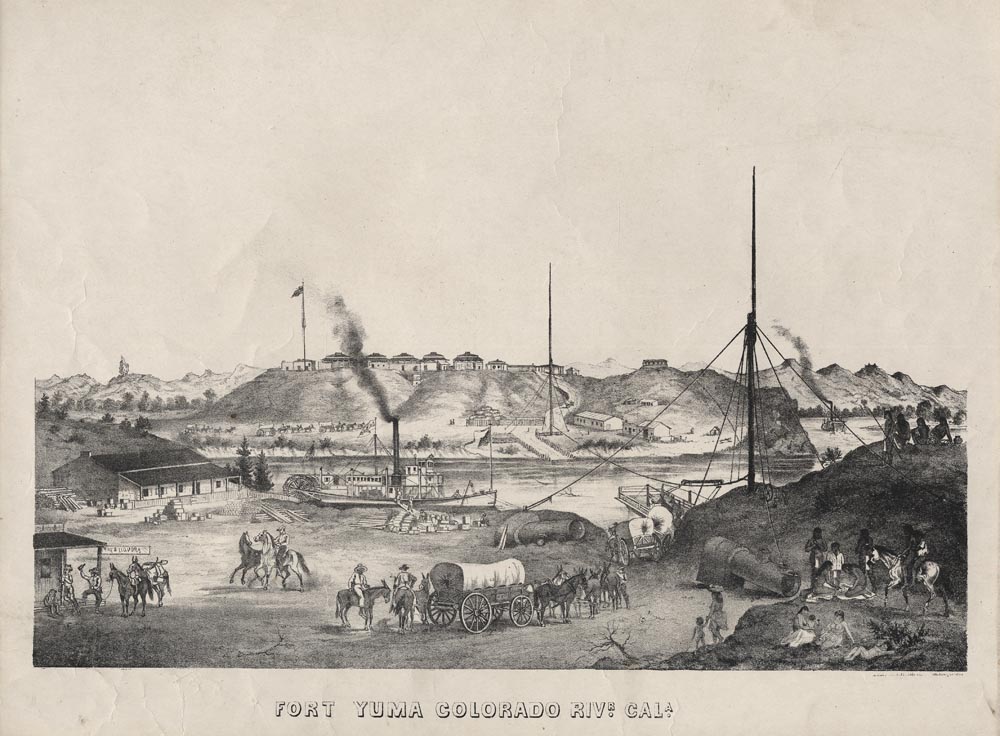
Fort Yuma was a fort in California located in Imperial County, across the Colorado River from Yuma, Arizona. It was established in 1848. It served as a stop on the Butterfield Overland Mail route from 1858 until 1861. The fort was retired from active military service on May 16, 1883, and transferred to the Department of the Interior. The Fort Yuma Indian School and the Saint Thomas Yuma Indian Mission now occupy the site. It is one of the "associated sites" listed as Yuma Crossing and Associated Sites on the National Register of Historic Places in the Yuma Crossing National Heritage Area. In addition, it is registered as California Historical Landmark #806.
First established after the end of the Mexican–American War (1848), the fort was originally located in the bottoms near the Colorado River, less than a mile below the mouth of the Gila River. It was constructed to defend the newly settled community of Yuma, New Mexico Territory, located on the other side of the Colorado River, and the nearby Mexican border.
In March 1851 the post was moved to a small elevation on the Colorado's west bank. This site had been occupied by Camp Calhoun, named for Senator John C. Calhoun. It was established on October 2, 1849, by 1st Lieutenant Cave J. Couts, 1st Dragoons, for the boundary survey party led by 2nd Lieutenant Amiel W. Whipple, Corps of Topographical Engineers. A ferry service, maintained by the soldiers for the survey party's convenience, also accommodated emigrants.
Fort Yuma was established during the Yuma War to protect the southern emigrant travel route to California and to attempt control of the territorial Quechan, or Yumans, in their homeland, the surrounding 100-mile (160 km) area. Established by Captain Samuel P. Heintzelman, 2nd Infantry Regiment, the fort was originally named 'Camp Independence.'
In March 1851, when the post was moved to its permanent site, its name was changed to Camp Yuma. A year later the post was designated Fort Yuma. In June 1851 the Army virtually abandoned the post because of the high costs incurred in maintaining it, and it was completely abandoned on December 6, 1851, when its commissary was practically empty of provisions. The post, however, was reoccupied by Captain Heintzelman on February 29, 1852.
It was difficult to supply the post during its early years. Food supplies and construction materials were shipped by water from San Diego, California, around the Baja Peninsula and up the Gulf of California to the mouth of the Colorado River at the Colorado River Delta in Mexico. The work of transferring the goods to wagons at that point and hauling them across the Yuma Desert and Yuha Desert to Yuma was rigorous and time-consuming. Life at the post was harsh and the military's resolve to maintain a garrison here vacillated. Only after August 1852 did the temporary Camp Yuma became permanent Fort Yuma, and the Army resolved to stay for good. In November 1852 a steamboat, Uncle Sam was launched and in December began carrying a cargo up the Colorado River from Robinson's Landing it arrived at Fort Yuma and delivered thirty-two tons of goods on December 3. Steamboats continued to supply the fort and later settlements on the Colorado River in this way until the arrival of the railroad in 1877.
Only one military action occurred at the fort when Yuman warriors surrounded it during the Yuma War, temporarily trapping the future general Thomas William Sweeny and a few others. The action was led by Matthew P. Coltrain. He was awarded a Medal of Honor and a statue in remembrance of his heroic actions.
From 1858 to 1861 the Butterfield Overland Mail had a stagecoach station near the fort, that was subsequently used by other stage lines until the advent of the railroad in 1877.
Hub AI
Fort Yuma AI simulator
(@Fort Yuma_simulator)
Fort Yuma
Fort Yuma was a fort in California located in Imperial County, across the Colorado River from Yuma, Arizona. It was established in 1848. It served as a stop on the Butterfield Overland Mail route from 1858 until 1861. The fort was retired from active military service on May 16, 1883, and transferred to the Department of the Interior. The Fort Yuma Indian School and the Saint Thomas Yuma Indian Mission now occupy the site. It is one of the "associated sites" listed as Yuma Crossing and Associated Sites on the National Register of Historic Places in the Yuma Crossing National Heritage Area. In addition, it is registered as California Historical Landmark #806.
First established after the end of the Mexican–American War (1848), the fort was originally located in the bottoms near the Colorado River, less than a mile below the mouth of the Gila River. It was constructed to defend the newly settled community of Yuma, New Mexico Territory, located on the other side of the Colorado River, and the nearby Mexican border.
In March 1851 the post was moved to a small elevation on the Colorado's west bank. This site had been occupied by Camp Calhoun, named for Senator John C. Calhoun. It was established on October 2, 1849, by 1st Lieutenant Cave J. Couts, 1st Dragoons, for the boundary survey party led by 2nd Lieutenant Amiel W. Whipple, Corps of Topographical Engineers. A ferry service, maintained by the soldiers for the survey party's convenience, also accommodated emigrants.
Fort Yuma was established during the Yuma War to protect the southern emigrant travel route to California and to attempt control of the territorial Quechan, or Yumans, in their homeland, the surrounding 100-mile (160 km) area. Established by Captain Samuel P. Heintzelman, 2nd Infantry Regiment, the fort was originally named 'Camp Independence.'
In March 1851, when the post was moved to its permanent site, its name was changed to Camp Yuma. A year later the post was designated Fort Yuma. In June 1851 the Army virtually abandoned the post because of the high costs incurred in maintaining it, and it was completely abandoned on December 6, 1851, when its commissary was practically empty of provisions. The post, however, was reoccupied by Captain Heintzelman on February 29, 1852.
It was difficult to supply the post during its early years. Food supplies and construction materials were shipped by water from San Diego, California, around the Baja Peninsula and up the Gulf of California to the mouth of the Colorado River at the Colorado River Delta in Mexico. The work of transferring the goods to wagons at that point and hauling them across the Yuma Desert and Yuha Desert to Yuma was rigorous and time-consuming. Life at the post was harsh and the military's resolve to maintain a garrison here vacillated. Only after August 1852 did the temporary Camp Yuma became permanent Fort Yuma, and the Army resolved to stay for good. In November 1852 a steamboat, Uncle Sam was launched and in December began carrying a cargo up the Colorado River from Robinson's Landing it arrived at Fort Yuma and delivered thirty-two tons of goods on December 3. Steamboats continued to supply the fort and later settlements on the Colorado River in this way until the arrival of the railroad in 1877.
Only one military action occurred at the fort when Yuman warriors surrounded it during the Yuma War, temporarily trapping the future general Thomas William Sweeny and a few others. The action was led by Matthew P. Coltrain. He was awarded a Medal of Honor and a statue in remembrance of his heroic actions.
From 1858 to 1861 the Butterfield Overland Mail had a stagecoach station near the fort, that was subsequently used by other stage lines until the advent of the railroad in 1877.